
94 Results for "

threshold

" in MedChemExpress (MCE) Product Catalog:
Products (94)

94 Results for "threshold" in MCE Product Catalog:

Cat. No.: HY-111189
CAS No.: 896117-64-9
Target:  

GlyT

Research Areas:  

Neurological Disease

GSK931145 is a glycine transporter 1 (GlyT1) inhibitor with anti-epileptic activity. GSK931145 exhibits a low minimum effective dose in the maximum electrical stimulation threshold test, indicating that it has a significant anti-epileptic effect. GSK931145 is also suitable as a positron emission tomography (PET) radioligand for quantifying the availability of glycine transporters in the living brain .
loading...
    loading...
Cat. No.: HY-14218R
CAS No.: 97-39-2
Synonyms: 1,3-Di-o-tolylguanidine (Standard); DTG (Standard)
Research Areas:  

Neurological Disease

Ditolylguanidine (Standard) is the analytical standard of Ditolylguanidine. This product is intended for research and analytical applications. Ditolylguanidine (1,3-Di-o-tolylguanidine) is an agonist of sigma receptor (σ1/σ2 receptor) with Ki values of 69 and 21 nM for σ1 and σ2 receptors, respectively. Ditolylguanidine effectively inhibits the growth of small cell lung cancer cells. Ditolylguanidine can be used for the research of lung cancer .
loading...
    loading...
Cat. No.: HY-105500
CAS No.: 144425-86-5
Target:  

Sodium Channel

Research Areas:  

Neurological Disease

BW-1003C87 Ethylsulfate is a glutamate release inhibitor. BW-1003C87 Ethylsulfate exhibit neuroprotective effect. BW-1003C87 Ethylsulfate can elevate seizure threshold. BW-1003C87 Ethylsulfate can be used for the research of neurological disease, such as ischemic and seizure .
loading...
    loading...
Cat. No.: HY-P1319A
Target:  

Opioid Receptor

Research Areas:  

Inflammation/Immunology

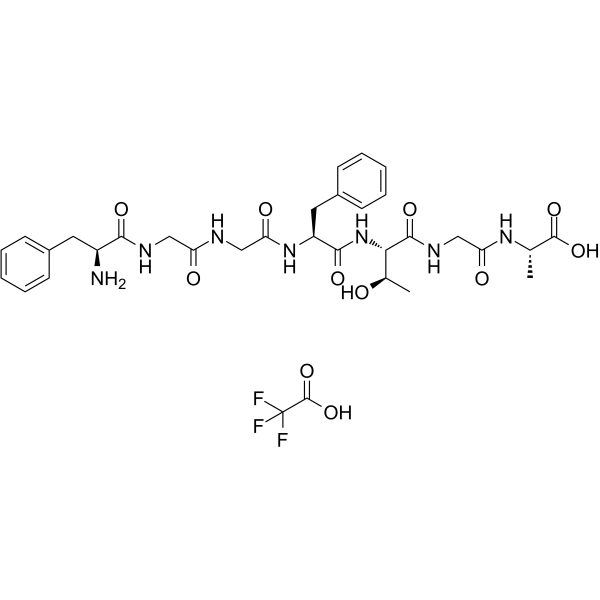
Nociceptin (1-7) TFA is the N-terminal bioactive fragment of nociceptin (HY-P0183). Nociceptin (1-7) TFA is a potent ORL1 (NOP) receptor agonist with antinociceptive activity. Nociceptin (1-7) TFA combines with nociceptin reduces hyperalgesia in vivo .
loading...
    loading...
Cat. No.: HY-P5869
Research Areas:  

Neurological Disease

Kurtoxin is a selective Cav3 (T-type) voltage-gated Ca 2+ channel gating inhibitor with a Kd of 15 nM for Cav3.1 (α1G T-type) Ca 2+ channel. Kurtoxin can interact with high affinity with native neuronal high-threshold L-type, N-type, and P-type Ca 2+ channels in central and peripheral neurons. Kurtoxin also shows cross-reactivity with voltage-gated Na + channel .
loading...
    loading...
Cat. No.: HY-W017785
CAS No.: 504-20-1
Synonyms: Diisopropylidene acetone
Phorone (Diisopropylidene acetone) is a glutathione (GSH) depletor. Phorone specifically and reversibly depletes free GSH through enzymatic binding (Glutathione S-transferase) (Km = 0.9 mM). Phorone reversibly reduces the binding and nuclear uptake of glucocorticoid receptors in rat liver, and this effect is related to the temporal changes in GSH levels. Phorone can be used for studying liver toxicity.
loading...
    loading...
Cat. No.: HY-135556A
CAS No.: 107674-50-0
Norfluoxetine oxalate is the active metabolite of the antidepressant Fluoxetine (HY-B0102); it is also a TREK-2 K2P potassium channel inhibitor. Norfluoxetine oxalate exhibits neuroimmunological activity, induces apoptosis in primary microglial cells, and inhibits the release of pro-inflammatory factors. Norfluoxetine oxalate inhibits high-threshold voltage-gated Ca 2+ currents in neurons with an EC50 of 20.4 μM. Norfluoxetine oxalate can be used in research related to depression, ischemic stroke, and epilepsy .
loading...
    loading...
Cat. No.: HY-111011
CAS No.: 958873-83-1
Synonyms: JNJ 38488502 acetate; FE 200665 acetate
Target:  

Opioid Receptor

Research Areas:  

Neurological Disease

CR 665 (JNJ 38488502) acetate is a kappa-opioid agonist that may effectively treat visceral pain by activating receptors on afferent nerves within the gut. CR 665 acetate exhibits peripheral selectivity, differentiating its pharmacokinetic profile from that of non-selective opioids like oxycodone. CR 665 acetate has demonstrated a beneficial effect on visceral pain tolerance thresholds without the delayed analgesic response characteristic of opioids that penetrate the brain. CR 665 acetate is proposed for use in managing postoperative pain due to its pain-relieving properties.
loading...
    loading...
Cat. No.: HY-161784
CAS No.: 3021554-08-2
Target:  

GABA Receptor

Research Areas:  

Neurological Disease

GABAA receptor modulator-5 (Compound S28) is a modulator for (γ-aminobutyric acid)A receptor (GABAA receptor), with EC50 of 56 nM and 10 nM, for α1β2γ2 and α4β3δ subtype. GABAA receptor modulator-5 exhibits good pharmacokinetic characteristics in rats. GABAA receptor modulator-5 is slightly toxic toxicity in rats with a loss of rollover reflex (LORR) threshold dose of 23.3 μmol/kg, and exhibits potential ameliorating the postpartum depression .
loading...
    loading...
Cat. No.: HY-108998
CAS No.: 96480-44-3
Research Areas:  

Cardiovascular Disease

Bisaramil hydrochloride is an antiarrhythmic compound with activity in inhibiting free radical generation. Bisaramil hydrochloride directly blocks sodium currents and exhibits enhanced sodium channel blocking ability. Bisaramil hydrochloride inhibits isoproterenol-induced slow calcium action potentials in cardiomyocytes. Bisaramil hydrochloride reduces heart rate and prolongs the PR, QRS, and QT intervals in the electrocardiogram, showing blocking effects on sodium and potassium channels. Bisaramil hydrochloride reduces cardiac conduction velocity, increases the threshold current for capture and atrial fibrillation, and prolongs the effective refractory period. Bisaramil hydrochloride reduces ventricular arrhythmias and eliminates mortality caused by ventricular fibrillation in ischemic rat hearts .
loading...
    loading...
Cat. No.: HY-W011235R
CAS No.: 57226-68-3
Norfluoxetine hydrochloride (Standard) is the analytical standard of Norfluoxetine hydrochloride (HY-W011235). This product is intended for research and analytical applications. Norfluoxetine hydrochloride is the active metabolite of the antidepressant Fluoxetine (HY-B0102); it is also a TREK-2 K2P potassium channel inhibitor. Norfluoxetine hydrochloride exhibits neuroimmunological activity, induces apoptosis in primary microglial cells, and inhibits the release of pro-inflammatory factors. Norfluoxetine hydrochloride inhibits high-threshold voltage-gated Ca 2+ currents in neurons with an EC50 of 20.4 μM. Norfluoxetine hydrochloride can be used in research related to depression, ischemic stroke, and epilepsy .
loading...
    loading...
Cat. No.: HY-15074
CAS No.: 245063-59-6
Synonyms: NS-1209
Target:  

iGluR

Research Areas:  

Neurological Disease

SPD-502 is a novel glutamate antagonist with potential neuroprotective properties, particularly in brain ischemia. It selectively targets the AMPA receptor, showing high affinity (IC50 = 0.043 μM) and competitive inhibition of AMPA-induced effects in rat cortical membranes and cultured mouse cortical neurons. In vivo, SPD-502 effectively blocks AMPA-evoked spike activity in the hippocampus after intravenous administration, significantly increasing the seizure threshold in mice and demonstrating robust protection against ischemia-induced damage to hippocampal neurons in gerbils. These findings suggest SPD-502 may be promising for studying neurodegenerative conditions associated with glutamate excitotoxicity .
loading...
    loading...
Cat. No.: HY-15076
CAS No.: 205645-02-9
Synonyms: NS-1209 sodium
Target:  

iGluR

Research Areas:  

Neurological Disease

SPD-502 sodium is a novel glutamate antagonist with potential neuroprotective properties, particularly in brain ischemia. It selectively targets the AMPA receptor, showing high affinity (IC50 = 0.043 μM) and competitive inhibition of AMPA-induced effects in rat cortical membranes and cultured mouse cortical neurons. In vivo, SPD-502 sodium effectively blocks AMPA-evoked spike activity in the hippocampus after intravenous administration, significantly increasing the seizure threshold in mice and demonstrating robust protection against ischemia-induced damage to hippocampal neurons in gerbils. These findings suggest SPD-502 sodium may be promising for studying neurodegenerative conditions associated with glutamate excitotoxicity .
loading...
    loading...
Cat. No.: HY-B1751S1
Quinidine- 13C, d2 hydrochloride is the 13C, d2 labeled Quinidine hydrochloride (HY-W115674). Quinidine hydrochloride is an orally active antiarrhythmic agent. Quinidine hydrochloride reduces the expression level of P-gp, inhibits P-gp-mediated efflux, increases the intracellular accumulation of P-gp substrates, induces PARP cleavage and Caspase-3 activation, and elevates the proportion of Apoptotic cells at the sub-G1 phase. Quinidine hydrochloride exerts sustained block and open-channel block effects on IK(f). Quinidine hydrochloride alters the urinary metabolic ratio of Amphetamine, modulates the Pentylenetetrazol-induced seizure threshold, and regulates the anticonvulsant effect of Dextromethorphan. Quinidine hydrochloride can be used in studies related to uterine sarcoma and seizures .
loading...
    loading...
Cat. No.: HY-P1336A
CAS No.: 2952824-50-7
Synonyms: Deltorphin 1 TFA; Deltorphin C TFA; [D-Ala2] Deltorphin I TFA
Target:  

Opioid Receptor

Research Areas:  

Neurological Disease

Deltorphin I TFA (Deltorphin 1 TFA; Deltorphin C TFA; [D-Ala2] Deltorphin I TFA) is a high-affinity, selective δ-opioid receptor agonist that targets the δ1 and δ2 opioid receptor subtypes. Deltorphin I TFA produces analgesic effects in the rat spinal cord. Deltorphin I TFA increases the pain threshold in rats. Deltorphin I TFA can be used in studies related to nociception (acute pain) .
loading...
    loading...
Cat. No.: HY-W142457
CAS No.: 18479-58-8
Dihydromyrcenol is an orally active flavor ingredient and Antifungal agent. Dihydromyrcenol acts as a toxicant. Dihydromyrcenol induces phototoxicity-related growth inhibition in Bakers' Yeast. In pregnant rats, Dihydromyrcenol causes threshold maternal toxicity by reducing feed consumption and body weight gain, and also induces threshold developmental toxicity by decreasing fetal body weight, inhibiting ossification of metatarsal bones in the hind paws, increasing the number of extra thoracic vertebrae ribs, and altering vertebral counts .
loading...
    loading...
Cat. No.: HY-119512
CAS No.: 3570-46-5
Synonyms: Ethomoxane
Target:  

Adrenergic Receptor

Research Areas:  

Cardiovascular Disease

Ethoxomane (Ethomoxane) is an α-adrenergic receptor blocker. Ethoxomane elevates the hissing threshold induced by perifornical hypothalamic stimulation in cats. Ethoxomane exhibits antihypertensive effects. Ethoxomane can be used in the research of cardiovascular and cerebrovascular diseases .
loading...
    loading...
Cat. No.: HY-105454R
CAS No.: 74738-24-2
Synonyms: Wy-42362 (Standard)
Recainam (Standard) is the analytical standard of Recainam. This product is intended for research and analytical applications. Recainam is a potent orally active antiarrhythmic agent and a sodium channel inhibitor. Recainam elevates ventricular fibrillation threshold, suppresses induced cardiac dysrhythmias, and may accentuate cardiac tissue refractoriness heterogeneity. Recainam can be used for the research of arrhythmias .
loading...
    loading...
Cat. No.: HY-105439A
CAS No.: 68379-03-3
Synonyms: LY 150378
Target:  

Drug Derivative

Research Areas:  

Cardiovascular Disease

Clofilium phosphate (LY 150378) is an antiarrhythmic/antifibrillatory agent. Clofilium phosphate significantly prolongs the action potential duration and effective refractory period of canine cardiac Purkinje fibers, increases the ventricular fibrillation threshold, reduces the risk of reentrant arrhythmias, and enables spontaneous conversion of some ventricular fibrillation episodes to sinus rhythm. Clofilium phosphate is applicable to research related to ventricular fibrillation, arrhythmias, and ventricular tachyarrhythmias .
loading...
    loading...
Cat. No.: HY-Y1002
CAS No.: 505-10-2
Synonyms: 3-Hydroxypropyl methyl sulfide; 3-Methylmercapto-1-propanol; 4-Thiapentan-1-ol; gamma-Hydroxypropyl methyl sulfide
Research Areas:  

Infection

Methionol is a sulfur-containing flavor compound and also a component of aggregation pheromones produced by males. Methionol exists in fermented coconut milk and wine. Methionol has an odor similar to boiled cabbage, and imparts cauliflower-like off-flavors to wine when its content exceeds the perception threshold. Methionol attracts both male and female adults of Knulliana cincta cincta, and mainly attracts female adults of Elaphidion mucronatum .
loading...
    loading...

