879 Results for "

binding affinity

" in MedChemExpress (MCE) Product Catalog:
Products (879)

879 Results for "binding affinity" in MCE Product Catalog:

Cat. No.: HY-P2996B
CAS No.: 9029-27-0
Target:  

Others

Research Areas:  

Others

Nitrate Reductase (NAD[P]H), Pichia pastoris (recombinant) is a simplified version of nitrate reductase S-NaR1 expressed and purified by Pichia pastoris. Nitrate Reductase (NAD[P]H), Pichia Pastoris (recombinant) contains sites binding molybdenum-molybdenopyridine (Mo-MPT) and nitrate reduction active sites and only contains two domains instead of the five domains of the complete NaR. This simplified form of nitrate reductase was expressed in high density in P. pastoris and purified to homogeneity in one step by fixed metal affinity chromatography (IMAC). Nitrate Reductase (NAD[P]H), Pichia Pastoris (recombinant) can be used in the development of biosensors and environmental monitoring .
loading...
    loading...
Cat. No.: HY-W007223
CAS No.: 4350-07-6
Synonyms: D-5-HTP; 5-Hydroxy-D-tryptophan
Target:  

5-HT Receptor

Research Areas:  

Neurological Disease

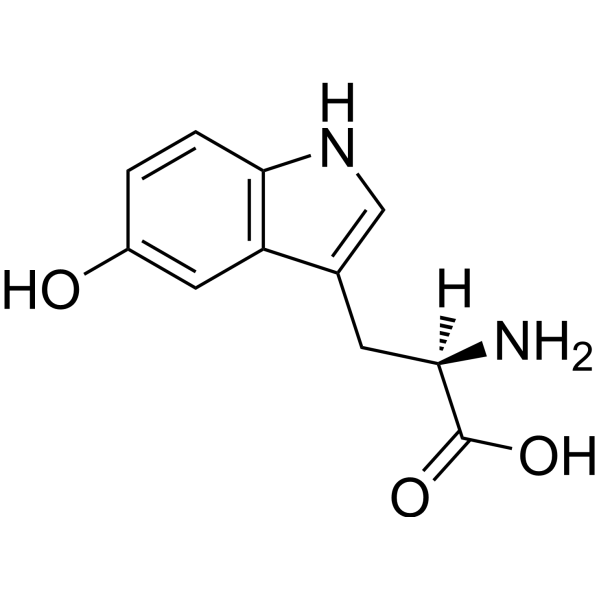
D-5-Hydroxytryptophan (D-5-HTP) is the D-isomer of 5-HTP and can be isolated from DL-5-hydroxytryptophan by continuous separation. Compared with intraperitoneal administration of L-5-Hydroxytryptophan, which can induce dose-dependent backward walking behavior in mice, D-5-Hydroxytryptophan has no significant effect on mouse behavior and is a negative control. D-5-Hydroxytryptophan is also a 5-HT ligand, capable of binding to the 5-HT site with affinity in the micromolar range .
loading...
    loading...
Cat. No.: HY-Y1840R
CAS No.: 150-19-6
3-Methoxyphenol (Standard) is the analytical standard of 3-Methoxyphenol (HY-Y1840). This product is intended for research and analytical applications. 3-Methoxyphenol is an environmental pollutant. 3-Methoxyphenol occurs in the aroma components of dried bonito. 3-Methoxyphenol potentially enhances GABA-evoked responses of α1β1 GABAA receptors by increasing the affinity of GABA binding sites. 3-Methoxyphenol is used as a flavoring substance in food and animal feed. 3-Methoxyphenol prolongs pentobarbital-induced sleeping time and reduces elevated plus maze behavior .
loading...
    loading...
Cat. No.: HY-Y1840S
CAS No.: 104714-88-7
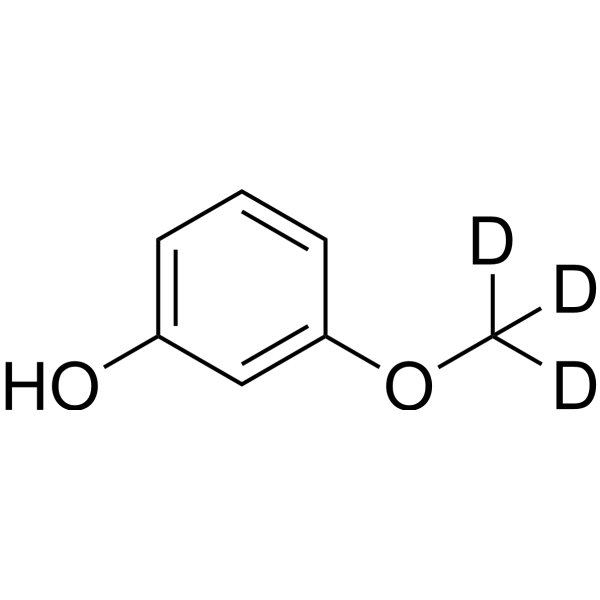
3-Methoxyphenol-d3 is the d3-labeled 3-Methoxyphenol (HY-Y1840). 3-Methoxyphenol is an environmental pollutant. 3-Methoxyphenol occurs in the aroma components of dried bonito. 3-Methoxyphenol potentially enhances GABA-evoked responses of α1β1 GABAA receptors by increasing the affinity of GABA binding sites. 3-Methoxyphenol is used as a flavoring substance in food and animal feed. 3-Methoxyphenol prolongs pentobarbital-induced sleeping time and reduces elevated plus maze behavior .
loading...
    loading...
Cat. No.: HY-Z12208
CAS No.: 1305124-48-4
N1-Phenylsuberamide is an organic amide compound, and its structure can be regarded as a simplified analogue of Vorinostat (HY-10221). N1-Phenylsuberamide exhibits moderate anti-proliferative activity against MDA-MB-231 and MCF-7 cells. N1-Phenylsuberamide does not show significant HDAC inhibitory activity and can only weakly induce the expression of the p21 gene. N1-Phenylsuberamide has extremely low relative binding affinity of estrogen receptor. N1-Phenylsuberamide can be used as a control compound .
loading...
    loading...
Cat. No.: HY-P991745

Target:  

CCR

Research Areas:  

Cancer

Anti-Mouse CCR2 Antibody (C2Mab-6) is a monoclonal antibody targeting mouse CC chemokine receptor type 2 (mCCR2), with a KD value of 0.18-1.6 nM. Anti-Mouse CCR2 Antibody (C2Mab-6) exhibits high binding affinity to cells expressing mCCR2 and shows no reactivity to parental CHO-K1 cells. Anti-Mouse CCR2 Antibody (C2Mab-6) recognizes the amino acid region spanning positions 1-19 of mCCR2, and its key binding epitope includes Asp3, Asn4, Met6, Pro8, Gln9 and Phe10. Anti-Mouse CCR2 Antibody (C2Mab-6) can be used in leukemia-related research .
loading...
    loading...
Cat. No.: HY-W043748
CAS No.: 38862-24-7
Synonyms: N-Succinimidyl acrylate
Research Areas:  

Others

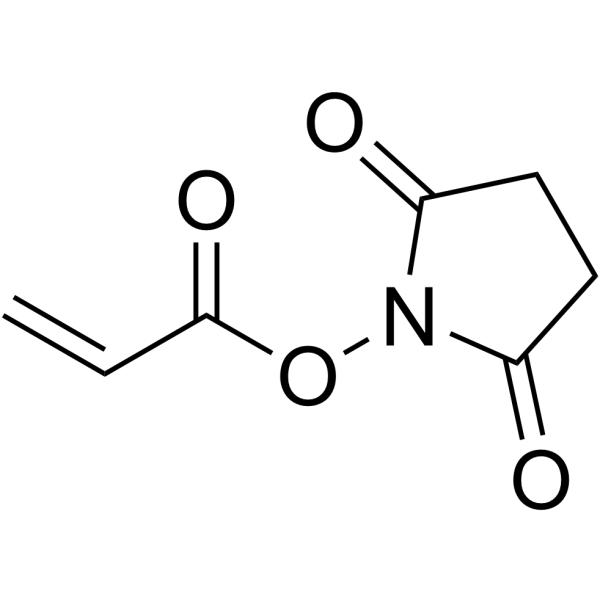
2,5-Dioxopyrrolidin-1-yl acrylate (N-Succinimidyl acrylate) is a lysine residue modifier and coupling monomer. 2,5-Dioxopyrrolidin-1-yl acrylate covalently modifies the primary amines of lysine residues on monoclonal anti-horseradish peroxidase IgG antibodies, neutralizes positive charges and replaces them with low-affinity acrylate groups. 2,5-Dioxopyrrolidin-1-yl acrylate inhibits the formation of rapid hard coronas on citrate-coated gold nanoparticles, induces antibody unfolding and loss of antigen-binding function, but does not affect the antigen-binding function of antibodies in free solution. 2,5-Dioxopyrrolidin-1-yl acrylate reacts with the ε-amino groups on lysine residues of L-asparaginase, introduces vinyl groups and generates N-hydroxysuccinimide. 2,5-Dioxopyrrolidin-1-yl acrylate regulates the activity of L-asparaginase .
loading...
    loading...
Cat. No.: HY-P72748
Purity:  ≥ 95%, as determined by reducing SDS-PAGE.
Synonyms: FCER2; Immunoglobulin E-binding Factor; Prev. CD23A; Lymphocyte IgE Receptor; Prev. FCE2; Fc-Epsilon-RII; CLEC4J; BLAST-2; FcepsilonRII; IGEBF; CD23 Antigen; Fc Fragment Of IgE, Low affinity II, Receptor For (CD23A); FCErII; C-Type Lectin Domain Family 4,
Species:  
Human
Source:  
HEK293
loading...
    loading...
Cat. No.: HY-P74320
Purity:  ≥ 95%, as determined by reducing SDS-PAGE.
Synonyms: FCER2; Immunoglobulin E-binding Factor; Prev. CD23A; Lymphocyte IgE Receptor; Prev. FCE2; Fc-Epsilon-RII; CLEC4J; BLAST-2; FcepsilonRII; IGEBF; CD23 Antigen; Fc Fragment Of IgE, Low affinity II, Receptor For (CD23A); FCErII; C-Type Lectin Domain Family 4,
Species:  
Rat
Source:  
HEK293
loading...
    loading...
Cat. No.: HY-P74321
Purity:  ≥ 95%, as determined by reducing SDS-PAGE.
Synonyms: FCER2; Immunoglobulin E-binding Factor; Prev. CD23A; Lymphocyte IgE Receptor; Prev. FCE2; Fc-Epsilon-RII; CLEC4J; BLAST-2; FcepsilonRII; IGEBF; CD23 Antigen; Fc Fragment Of IgE, Low affinity II, Receptor For (CD23A); FCErII; C-Type Lectin Domain Family 4,
Species:  
Mouse
Source:  
HEK293
loading...
    loading...
Cat. No.: HY-10211S
Synonyms: 17-AAG-d5; NSC 330507-d5; CP 127374-d5
Tanespimycin-d5 (17-AAG-d5; NSC 330507-d5; CP 127374-d5) is the deuterium labeled Tanespimycin (HY-10211). Tanespimycin (17-AAG) is a potent HSP90 inhibitor with an IC50 of 5 nM, having a 100-fold higher binding affinity for tumour cell derived HSP90 than normal cell derived HSP90 . Tanespimycin depletes cellular STK38/NDR1 and reduces STK38 kinase activity. Tanespimycin also downregulates the stk38 gene expression .
loading...
    loading...
Cat. No.: HY-14541S
CAS No.: 786686-79-1
Purity:  99.09%
Synonyms: LY170053-d3
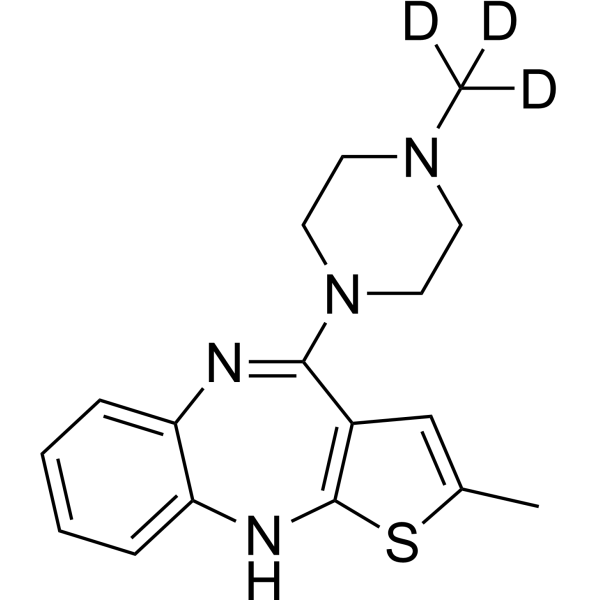
Olanzapine-d3 (LY170053-d3) is the deuterium labeled Olanzapine. Olanzapine is a selective, orally active monoaminergic antagonist with high affinity binding to serotonin H1, 5HT2A/2C, 5HT3, 5HT6 (Ki=7, 4, 11, 57, and 5 nM, respectively), dopamine D1-4 (Ki=11 to 31 nM), muscarinic M1-5 (Ki=1.9-25 nM), and adrenergic α1 receptors (Ki=19 nM). Olanzapine is an atypical antipsychotic .
loading...
    loading...
Cat. No.: HY-14993R
CAS No.: 245520-69-8
SCH79797 (Standard) is the analytical standard of SCH79797. This product is intended for research and analytical applications. SCH79797 is a highly potent, selective nonpeptide protease activated receptor 1 (PAR1) antagonist. SCH79797 inhibits binding of a high-affinity thrombin receptor-activating peptide to PAR1 with an IC50 of 70 nM and a Ki of 35 nM. SCH79797 inhibits thrombin-induced platelet aggregation with an IC50 of 3 μM. SCH79797 has antiproliferative and pro-apoptotic effects, and limits myocardial ischemia/reperfusion injury in rat hearts. SCH79797 also potently prevents PAR1 activation in vascular smooth muscle cells, endothelial cells, and astrocytes .
loading...
    loading...
Cat. No.: HY-14994R
CAS No.: 1216720-69-2
SCH79797 (dihydrochloride) (Standard) is the analytical standard of SCH79797 (dihydrochloride). This product is intended for research and analytical applications. SCH79797 dihydrochloride is a highly potent, selective nonpeptide protease activated receptor 1 (PAR1) antagonist. SCH79797 dihydrochloride inhibits binding of a high-affinity thrombin receptor-activating peptide to PAR1 with an IC50 of 70 nM and a Ki of 35 nM. SCH79797 dihydrochloride inhibits thrombin-induced platelet aggregation with an IC50 of 3 μM. SCH79797 dihydrochloride has antiproliferative and pro-apoptotic effects, and limits myocardial ischemia/reperfusion injury in rat hearts. SCH79797 dihydrochloride also potently prevents PAR1 activation in vascular smooth muscle cells, endothelial cells, and astrocytes .
loading...
    loading...
Cat. No.: HY-150579
CAS No.: 2456294-92-9
Purity:  96.77%
Target:  

Keap1-Nrf2

Research Areas:  

Inflammation/Immunology Cancer

Keap1-Nrf2-IN-13 is a Keap1-Nrf2 protein–protein interaction (PPI) inhibitor with an IC50 value of 0.15 μM. Keap1-Nrf2-IN-13 has strong binding affinities to the Keap1 protein by forming hydrogen bond with the key polar residues (Asn414, Arg415, Arg483, Gln530). Keap1-Nrf2-IN-13 can be used in the research of oxidative stress-related and inflammatory diseases, including pulmonary fibrosis, chronic obstructive pulmonary disorder (COPD) and cancers .
loading...
    loading...
Cat. No.: HY-165399
CAS No.: 145253-48-1
Research Areas:  

Others

RB104 is a highly selective neutral endopeptidase (NEP) inhibitor that exhibits extremely high affinity for Aplysia californica apNEP (Kd=0.16-0.26 pM) and rat NEP (Kd=7.0-26.8 pM). RB104 effectively blocks apNEP-mediated cleavage of Leu-enkephalin and shows minimal cross-reactivity with other zinc peptidases. Furthermore, RB104 can be iodinated or radiolabeled with 125I to serve as a probe, and is widely used in inhibitor gel electrophoresis, binding assays, Western blotting, and autoradiographic tissue localization, enabling sensitive detection of nanogram-level NEP in crude extracts and tissue sections .
loading...
    loading...
Cat. No.: HY-176501
CAS No.: 3036243-81-6
Target:  

FKBP

Research Areas:  

Cancer

FKBP12 ligand-2 (compound d) is a high affinity ligand targeting FKBP12. FKBP12 ligand-2 can be used to selectively enhance the binding of heterobifunctional molecules to BRD4, enriching the drug intracellularly through the "CellTrap" effect to form a ternary complex of FKBP12-ligand-BRD4. This ternary complex has inhibitory activity against BRD4, thereby inhibiting the expression of BRD4 target genes (such as MYC) and inducing tumor cell death. FKBP12 ligand-2 can be used for selective cancer research based on differences in intracellular presenter protein levels .
loading...
    loading...
Cat. No.: HY-176502
CAS No.: 3036374-26-9
Target:  

FKBP

Research Areas:  

Cancer

FKBP12 ligand-3 (compound dj) is a high-affinity ligand targeting FKBP12. FKBP12 ligand-3 can be used to selectively enhance the binding of heterobifunctional molecules to BRD4, enriching the drug intracellularly through the "CellTrap" effect to form a ternary complex of FKBP12-ligand-BRD4. This ternary complex has inhibitory activity against BRD4, thereby inhibiting the expression of BRD4 target genes (such as MYC) and inducing tumor cell death. FKBP12 ligand-3 can be used for selective cancer research based on differences in intracellular presenter protein levels .
loading...
    loading...
Cat. No.: HY-176546
Target:  

Neurokinin Receptor

Research Areas:  

Endocrinology

NK3R-IN-2 is an orally active NK3R inhibitor with an IC50 of 330.50 nM for human NK3R. NK3R-IN-2 can pass through the blood-brain barrier. NK3R-IN-2 has excellent NK3R binding affinity (IC50 = 87.31 nM) in CHO-K1 cells. NK3R-IN-2 effectively inhibits the level of luteinizing hormone (LH). NK3R-IN-2 can be used for research on hormone related conditions .
loading...
    loading...
Cat. No.: HY-180526
CAS No.: 2055901-03-4
Research Areas:  

Neurological Disease

PDE2A-IN-2 is a selective and brain-penetrant PDE2A inhibitor (Ki = 5.49 nM and 100 > fold selectivity over other PDE isoforms). The 11C-labeled PDE2A-IN-2 serves as a positron emission tomography (PET) tracer for brain imaging in patients with neurodegenerative diseases. PDE2A-IN-2 educes the radiotracer signal in PDE2A-rich regions in vitro. PDE2A-IN-2 exhibits low binding affinity in vivo. PDE2A-IN-2 can be used for neurodegenerative diseases .
loading...
    loading...