119 Results for "

Competitive interactions

" in MedChemExpress (MCE) Product Catalog:
Products (119)

119 Results for "Competitive interactions" in MCE Product Catalog:

Cat. No.: HY-N6678A
CAS No.: 42011-78-9
Research Areas:  

Cancer

(Rac)-Zearalanone is an ATP-competitive HSP90 inhibitor with an EC50 of 2.3 μM. (Rac)-Zearalanone interferes with the binding of ATP to HSP90, impairs the chaperone function of HSP90, and promotes the degradation of client proteins. (Rac)-Zearalanone reduces intracellular accumulation of Raf-1, induces cleavage of caspase-3, and promotes Her2 degradation in a dose-dependent manner by disrupting the Her2-HSP90 interaction. (Rac)-Zearalanone can be used in the research of small cell lung cancer and breast cancer .
loading...
    loading...
Cat. No.: HY-17504AR
CAS No.: 287714-41-4
Synonyms: ZD 4522 (Standard)
Rosuvastatin (Standard) is the analytical standard of Rosuvastatin (HY-17504A). This product is intended for research and analytical applications. Rosuvastatin (ZD 4522) is a competitive HMG-CoA reductase inhibitor with an IC50 of 11 nM. Rosuvastatin potently blocks hERG current with an IC50 of 195 nM, delayed cardiac repolarization, and thereby prolonged action potential durations (APDs) and corrected QT interval (QTc) intervals. Rosuvastatin reduces the expression of the mature hERG and the interaction of heat shock protein 70 (Hsp70) with the hERG protein. Rosuvastatin effectively lowers low-density lipoprotein (LDL) cholesterol, triglycerides, and C-reactive protein levels .
loading...
    loading...
Cat. No.: HY-181759
CAS No.: 3086024-48-5
CBP/p300/BRD4 ligand-1 is a small-molecule inhibitor targeting CBP, p300, and BRD4. CBP/p300/BRD4 ligand-1 competitively binds to the functional domains of target proteins without disrupting key interactions. CBP/p300/BRD4 ligand-1 can be used for the construction of dual-target PROTAC degraders (HY-181758) in studies related to prostate cancer and other cancers .
loading...
    loading...
Cat. No.: HY-187616
CAS No.: 163435-77-6
R-95845 is a non-nucleoside HIV-1 reverse transcriptase (RT) inhibitor. R-95845 is specific to HIV-1 RT and acts as a functionally non-competitive inhibitor with respect to nucleotide incorporation. R-95845 binds to the non-nucleoside inhibitor binding pocket of HIV-1 RT in a butterfly-like conformation, forms hydrogen bonds with Tyr 188 and Val 189, and engages in hydrophobic interactions with surrounding residues. R-95845 can be used in studies related to HIV-1 infection and acquired immunodeficiency syndrome .
loading...
    loading...
Cat. No.: HY-189006
CAS No.: 3066273-36-4
Research Areas:  

Infection

MBL-IN-7 is a potent metallo-β-lactamase (MBLs) inhibitor. The IC50 values of MBL-IN-7 against NDM-1, IMP-1, VIM-1, VIM-2, and L1 are 11 nM, 69 nM, 29 nM, 12 nM, and 85 μM, respectively. MBL-IN-7 is an antibiotic adjuvant. MBL-IN-7 competitively inhibits enzyme activity primarily by coordinating with zinc ions in the active site of MBLs and forming hydrogen bonds and π interactions, thereby protecting carbapenem antibiotics from hydrolysis. MBL-IN-7 is applicable to research related to carbapenem-resistant Gram-negative bacterial infections .
loading...
    loading...
Cat. No.: HY-100034R
CAS No.: 383907-43-5
Synonyms: DA-3003-1 (Standard)
NSC 663284 (Standard) is the analytical standard of NSC 663284 (HY-100034). This product is intended for research and analytical applications. NSC 663284 (DA-3003-1) is a potent, cell-permeable, and irreversible Cdc25 dual specificity phosphatase inhibitor, has an IC50 for Cdc25B2 of 0.21 μM. NSC 663284 exhibits mixed competitive kinetics against Cdc25A, Cdc25B(2), and Cdc25C with Ki values of 29, 95, and 89 nM, respectively . NSC 663284 inhibits NSD2 (IC50 of 170 nM) through a direct interaction with the catalytic SET domain (Kd of 370 nM) .
loading...
    loading...
Cat. No.: HY-100903R
CAS No.: 113158-34-2
Synonyms: nor-Binaltorphimine dihydrochloride (Standard); nor-BNI dihydrochloride (Standard)
Research Areas:  

Neurological Disease

Norbinaltorphimine dihydrochloride (Standard) is the analytical standard of Norbinaltorphimine dihydrochloride (HY-100903). This product is intended for research and analytical applications. Norbinaltorphimine dihydrochloride (nor-Binaltorphimine dihydrochloride; nor-BNI dihydrochloride) is a selective, long-acting competitive antagonist of the κ-opioid receptor. Norbinaltorphimine dihydrochloride blocks κ-opioid receptor-mediated analgesic effects, and inhibits butorphanol-induced changes in κ-opioid receptor binding kinetics, desensitization and down-regulation. Norbinaltorphimine dihydrochloride suppresses specific opioid withdrawal symptoms, precipitates withdrawal behaviors in butorphanol-dependent rats, and serves as a molecular probe for studying κ-opioid receptor-agonist interactions. Norbinaltorphimine dihydrochloride is applicable to research related to neurological disorders such as pain .
loading...
    loading...
Cat. No.: HY-180197
PICK1 PDZ-IN-1 (Compound 6b) is a selective and brain-penetrant protein interacting with C kinase 1 (PICK1) PDZ domain inhibitor with a Ki of 27.73 μM. PICK1 PDZ-IN-1 can competitively inhibit the interaction between PICK1 and the GluA2 subunit of AMPA receptors. PICK1 PDZ-IN-1 can increase the survival rate of HT22 cells and primary cortical neuron cells induced by glutamate and inhibit ROS production. PICK1 PDZ-IN-1 exhibits neuroprotective effect and reduces the area of cerebral infarction. PICK1 PDZ-IN-1 can be used for the research of ischemic stroke .
loading...
    loading...
Cat. No.: HY-184244
CAS No.: 3094094-17-1
Synonyms: CAS-13312-010
Target:  

Deubiquitinase

Research Areas:  

Cancer

CAS-010 (CAS-13312-010) is a potent and selective USP28 inhibitor with an IC50 of 2.2 nM against full-length USP28. CAS-010 acts as a ubiquitin-competitive inhibitor and shows higher selectivity over USP25 (IC50 = 51 nM) and other USP family members, disrupting the 53BP1-USP28 interaction and suppressing p53-dependent transcription of CDKN1A (p21), MDM2, and BAX. CAS-010 can be used for studying USP28-mediated DNA damage response and p53 signaling in cancer-related research .
loading...
    loading...
Cat. No.: HY-N6678S
CAS No.: 1795020-90-4
(Rac)-Zearalanone-d6 is the d6-labeled (Rac)-Zearalanone (HY-N6678A). (Rac)-Zearalanone is an ATP-competitive HSP90 inhibitor with an EC50 of 2.3 μM. (Rac)-Zearalanone interferes with the binding of ATP to HSP90, impairs the chaperone function of HSP90, and promotes the degradation of client proteins. (Rac)-Zearalanone reduces intracellular accumulation of Raf-1, induces cleavage of caspase-3, and promotes Her2 degradation in a dose-dependent manner by disrupting the Her2-HSP90 interaction. (Rac)-Zearalanone can be used in the research of small cell lung cancer and breast cancer .
loading...
    loading...
Cat. No.: HY-P11905
CAS No.: 874909-17-8
Research Areas:  

Others

FcIII peptide is a 13-amino-acid peptide that competitively binds the hinge region of IgG Fc fragment with high affinity. FcIII peptide has an inhibition constant Ki of 25 nM when competing with Protein A for binding sites. FcIII peptide displays high selectivity toward human IgG subtypes yet weak binding affinity for murine IgG1. FcIII peptide anchors IgG Fc through hydrophobic interactions formed by tryptophan and valine residues, alongside multiple hydrogen bonds and salt bridges. FcIII peptide alters the local microenvironment of conjugated fluorescein after binding IgG Fc, which triggers enhanced fluorescent signals. FcIII peptide can be applied to researches related to monoclonal antibody production. .
loading...
    loading...
Cat. No.: HY-171216
CAS No.: 278598-52-0
Target:  

Integrin

Research Areas:  

Neurological Disease

GW559090 is a selective, competitive, and high-affinity α4 integrin antagonist with a Kd of 0.19 nM for α4β1. GW559090 can effectively block the binding of α4β1 to vascular cell adhesion molecule 1 (VCAM-1) and fibronectin with IC50 values of 7.72 and 8.04 nM. GW559090 also inhibits the interaction between α4β7 and mucosal addressin cell adhesion molecule 1 (MAdCAM-1) (IC50 = 23 nM). GW559090 can inhibit inflammatory infiltration in the eyes, repair the corneal barrier and restore the function of goblet cells. GW559090 can be used for research of Sjögren's syndrome associated dry eye .
loading...
    loading...
Cat. No.: HY-117738
CAS No.: 143651-45-0
Purity:  95.79%
Benarthin is an orally active Pyroglutamyl peptidase inhibitor, THY1 inhibitor (with a Kd value of 5.13e-08 M) and competitive PGP-1 inhibitor (Ki = 1.2 µM). Benarthin is isolated from the culture broth of Streptomyces xanthophaeus MJ244-SF1. Benarthin disrupts the THY1-SFRP1 interaction, inhibits the activation of the GSK3α/β-β-catenin pathway, and reduces the upregulation of FASLG. Benarthin attenuates urothelial anoikis and reduces cell Apoptosis. Benarthin possesses iron-chelating activity. Benarthin maintains urothelial barrier integrity and blocks the pathological cascade of renal interstitial fibroblasts induced by HAP stimulation. Benarthin can be used in studies related to kidney stones .
loading...
    loading...
Cat. No.: HY-101140A
CAS No.: 1799974-69-8
Purity:  99.32%
Target:  

Drug Isomer

Research Areas:  

Inflammation/Immunology

KI696 isomer is an isomer of KI696 (HY-101140). KI696 is a selective KEAP1/NRF2 protein-protein interaction inhibitor with a human Kd value of 1.3 nM. KI696 acts by competitively occupying the NRF2-binding pocket of the KEAP1 Kelch domain. KI696 blocks KEAP1-mediated ubiquitination and degradation of NRF2, promotes the translocation of NRF2 to the nucleus, activates the expression of downstream antioxidant genes, increases intracellular glutathione levels, and alleviates oxidative stress-induced cell damage and inflammatory cell infiltration in the lungs. KI696 reduces ozone-induced pulmonary oxidative damage and inflammatory cell accumulation in rats, and upregulates pulmonary antioxidant genes. KI696 can be used in research related to chronic obstructive pulmonary disease, oxidative stress and inflammation .
loading...
    loading...
Cat. No.: HY-117855
CAS No.: 1427304-84-4
Target:  

HIV

Research Areas:  

Infection

NBD-11021 is a HIV-1 entry antagonist and CD4 antagonist. NBD-11021 binds to the Phe43 cavity of HIV-1 gp120 and competitively blocks the gp120-CD4 interaction . NBD-11021 exhibits broad-spectrum inhibitory activity against 56 HIV-1 Env pseudoviruses of different subtypes, with an IC50 of 0.6-5.3 μM. NBD-11021 inhibits CCR5- and CXCR4-tropic HIV-1, primary HIV-1, drug-resistant HIV-1, HIV-1 Env-mediated cell fusion and intercellular viral transmission. NBD-11021 can be used in studies related to HIV-1 gp120, viral entry and HIV infection .
loading...
    loading...
Cat. No.: HY-184339
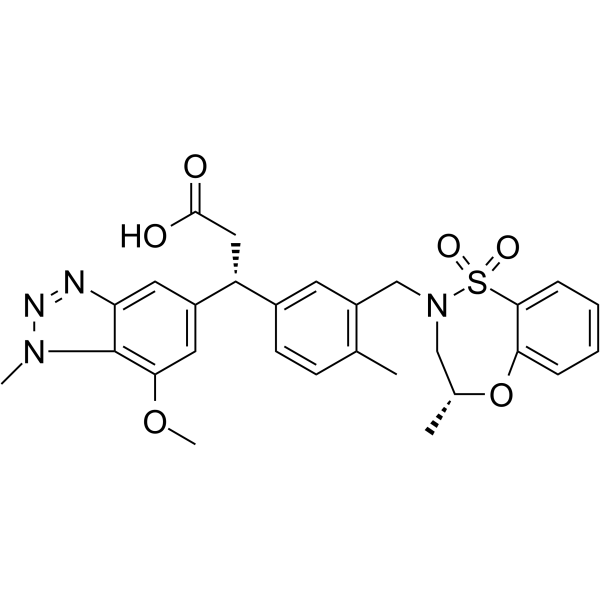
BRD4-IN-42 is a BRD4 BD1 inhibitor with an IC50 of 108.50 nM. BRD4-IN-42 can be used for the synthesis of PROTACs and serves as the target protein moiety of PROTAC BET Degrader-18 (HY-184335). BRD4-IN-42 inhibits the proliferation of wild-type and SHP099-resistant acute myeloid leukemia cells. BRD4-IN-42 is applicable to research related to acute myeloid leukemia .
loading...
    loading...
Cat. No.: HY-101140R
CAS No.: 1799974-70-1
KI696 (Standard) is the analytical standard of KI696 (HY-101140). This product is intended for research and analytical applications. KI696 is a selective KEAP1/NRF2 protein-protein interaction inhibitor with a human Kd value of 1.3 nM. KI696 acts by competitively occupying the NRF2-binding pocket of the KEAP1 Kelch domain. KI696 blocks KEAP1-mediated ubiquitination and degradation of NRF2, promotes the translocation of NRF2 to the nucleus, activates the expression of downstream antioxidant genes, increases intracellular glutathione levels, and alleviates oxidative stress-induced cell damage and inflammatory cell infiltration in the lungs. KI696 reduces ozone-induced pulmonary oxidative damage and inflammatory cell accumulation in rats, and upregulates pulmonary antioxidant genes. KI696 can be used in research related to chronic obstructive pulmonary disease, oxidative stress and inflammation .
loading...
    loading...
Cat. No.: HY-N0481R
CAS No.: 6812-81-3
Roburic acid (Standard) is the analytical standard of Roburic acid. This product is intended for research and analytical applications. Roburic acid acts as an anti-inflammatory, anti-tumor and osteoclastogenesis inhibitor, with a Ki of 7.066 μM against human TNF, an IC50 of 9 μM against human COX-2, and an IC50 of 5 μM against ovine COX-1. Roburic acid reduces the production of inflammatory mediators such as NO and IL-6 in macrophages by inhibiting the NF-κB and MAPK (p38/JNK) pathways. By competitively inhibiting the TNF-TNF-R1 interaction, Roburic acid blocks the downstream NF-κB signaling pathway, thereby inducing cell cycle arrest and apoptosis in cancer cells. Roburic acid specifically inhibits osteoclastogenesis and bone resorption by suppressing the RANKL/TRAF6/NF-κB/NFATc1 axis. Roburic acid can be used in research related to osteolytic diseases such as osteoporosis, colorectal cancer and inflammatory diseases.
loading...
    loading...
Cat. No.: HY-101140AR
CAS No.: 1799974-69-8
Research Areas:  

Inflammation/Immunology

KI696 isomer (Standard) is the analytical standard of KI696 isomer (HY-101140A). This product is intended for research and analytical applications. KI696 isomer is an isomer of KI696 (HY-101140). KI696 is a selective KEAP1/NRF2 protein-protein interaction inhibitor with a human Kd value of 1.3 nM. KI696 acts by competitively occupying the NRF2-binding pocket of the KEAP1 Kelch domain. KI696 blocks KEAP1-mediated ubiquitination and degradation of NRF2, promotes the translocation of NRF2 to the nucleus, activates the expression of downstream antioxidant genes, increases intracellular glutathione levels, and alleviates oxidative stress-induced cell damage and inflammatory cell infiltration in the lungs. KI696 reduces ozone-induced pulmonary oxidative damage and inflammatory cell accumulation in rats, and upregulates pulmonary antioxidant genes. KI696 can be used in research related to chronic obstructive pulmonary disease, oxidative stress and inflammation .
loading...
    loading...

