143 Results for "

Switch 2 closure

" in MedChemExpress (MCE) Product Catalog:
Products (143)

143 Results for "Switch 2 closure" in MCE Product Catalog:

Cat. No.: HY-N1033
CAS No.: 140631-27-2
Research Areas:  

Infection

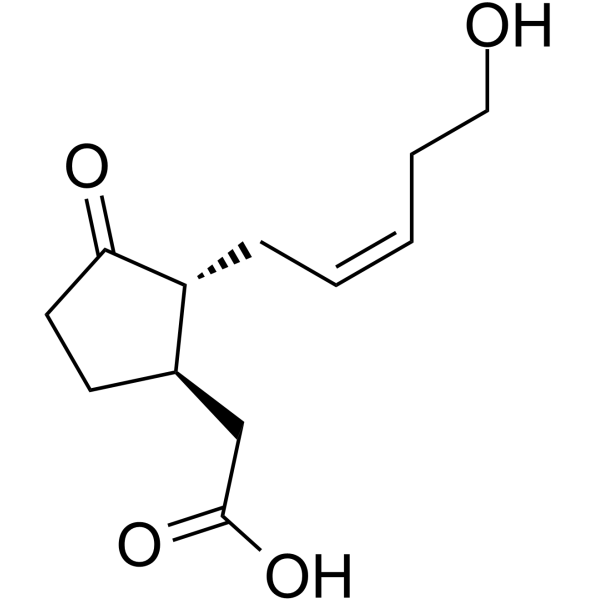
12-Hydroxyjasmonic acid is a metabolite of Jasmonic acid (HY-122464A) and an inducer of defense responses. 12-Hydroxyjasmonic acid can be isolated from potato leaflets. During the response of sugar beet plants to Cercospora beticola infection, 12-Hydroxyjasmonic acid is released through deglycosylation of its glucoside form and participates in the Jasmonic acid-mediated defense signaling pathway. 12-Hydroxyjasmonic acid mediates changes in source-sink relationships during pathogen infection, prioritizing the activation of defense processes over growth processes. 12-Hydroxyjasmonic acid serves as a substrate for salicylic acid Glycosyltransferases in tobacco and rice. 12-Hydroxyjasmonic acid can induce leaflet closure in Samanea saman. 12-Hydroxyjasmonic acid acts as a potato tuber-inducing substance. 12-Hydroxyjasmonic acid does not induce protoplast shrinkage in extensor motor cells of Samanea saman. 12-Hydroxyjasmonic acid can be used in studies related to brown spot disease [2] .
loading...
    loading...
Cat. No.: HY-112411
CAS No.: 216163-53-0
Purity:  98.35%
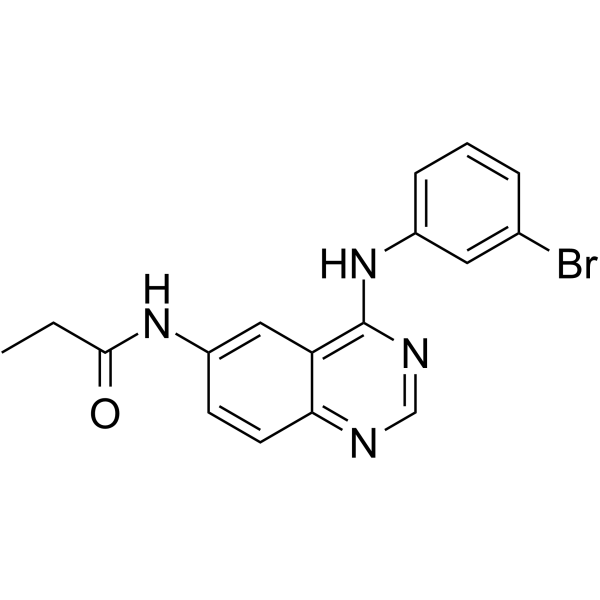
PD 174265 is a highly selective, reversible EGFR/ErbB2 tyrosine kinase inhibitor (IC50=0.45 nM) and cell differentiation inducer. By blocking receptor autophosphorylation and the downstream ERK signaling pathway (with an IC50 of 0.45 μM for full-length ERK), PD 174265 effectively inhibits tumor growth and exhibits antitumor activity without obvious toxicity in in vivo models. PD 174265 drives oligodendrocyte precursor cells to switch from a proliferative state to a differentiated state, significantly upregulates the expression of myelin proteins such as CNP, PLP and MBP, and induces neurite branching. PD 174265 shows no inhibitory effect on other kinases including insulin, PDGF and basic FGF receptors, and serves as a crucial tool molecule for investigating the treatment of human epidermoid carcinoma and the mechanism of myelin repair in multiple sclerosis [2] .
loading...
    loading...
Cat. No.: HY-161577
CAS No.: 701231-39-2
Target:  

Bcl-2 Family

Research Areas:  

Cancer

BFC1103 is a small-molecule compound whose primary mechanism of action involves interaction with a specific domain of Bcl-2, particularly its loop domain. This interaction induces a conformational change in Bcl-2, exposing its BH3 (Bcl-2 homology 3) domain, thereby switching Bcl-2's function from anti-apoptotic to pro-apoptotic. The cell death induced by BFC1103 is dependent on the presence of Bax or Bak, both of which are key proteins involved in the intrinsic apoptotic pathway mediated by mitochondria. BFC1103 has successfully inhibited lung metastasis of triple-negative breast cancer in mouse models. It can be utilized in studying the roles of Bcl-2 family proteins in cancer development and how they impact the survival and proliferation of cancer cells .
loading...
    loading...
Cat. No.: HY-165459
CAS No.: 401907-57-1
Synonyms: MK-056
Target:  

TRP Channel

Research Areas:  

Infection Inflammation/Immunology

KJM429 (MK-056) is a high-affinity ligand for the rat vanilloid receptor rTRPV1 (Ki=30-63 nM) with a unique dual regulatory function. KJM429 acts as a competitive antagonist to inhibit TRPV1 receptor activation induced by Capsaicin (HY-10448), resiniferatoxin, thermal stimulation and weak acid (pH 6.0), and switches to a TRPV1 agonist under strong acid conditions (pH<5.5). KJM429 effectively blocks calcium influx induced by Capsaicin and partial thermal stimulation, and triggers calcium uptake under low pH conditions, with minimal effects on non-TRPV1-mediated calcium signaling. KJM429 can be used for research on the mechanisms of pain-related diseases such as postherpetic neuralgia, diabetic neuropathy, cluster headache, osteoarthritis and pruritus .
loading...
    loading...
Cat. No.: HY-151738
CAS No.: 1935981-35-3
Target:  

ADC Linkers

Research Areas:  

Others

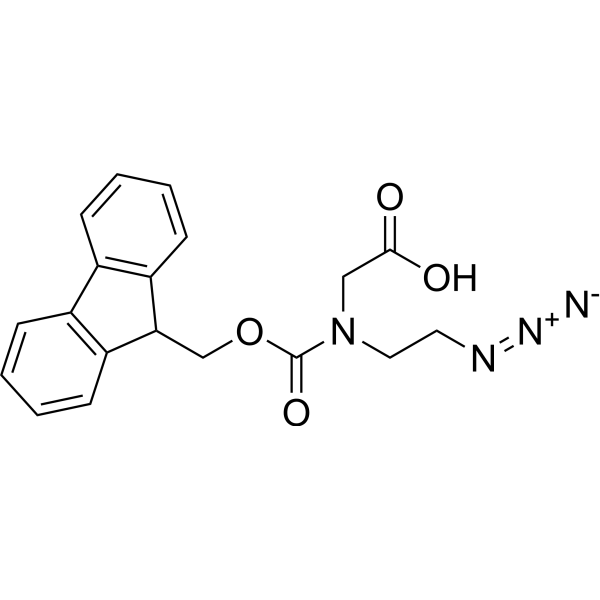
Fmoc-Aeg(N3)-OH is a click chemistry reagent containing an Azide. Alkylating the Nitrogen of an amide bond results in peptoid structures, which leads to conformational restrains, like N-methylation and allows backbone derivatisation. Altering cytotoxicity, bacterial cell selectivity and receptor pharmacology through formation of peptoid derivatives have been published for Cilengitide, Piscidin 1, and MC3, MC4 and MC5 receptor agonist. This building block enables design of macrocycles through intermolecular crosslinking or backbone stabilization through intermolecular ring-closure. This compound is a potential building block for the construction of (customized) peptide nucleic acids (PNAs) and for peptoid synthesis . Fmoc-Aeg(N3)-OH is a click chemistry reagent, it contains an Azide group and can undergo copper-catalyzed azide-alkyne cycloaddition reaction (CuAAc) with molecules containing Alkyne groups. It can also undergo strain-promoted alkyne-azide cycloaddition (SPAAC) reactions with molecules containing DBCO or BCN groups.
loading...
    loading...
Cat. No.: HY-P706013
Purity:  ≥ 85%, as determined by reducing SDS-PAGE.
Synonyms: FOSB; G0/G1 Switch Regulatory Protein 3; FosB Proto-Oncogene, AP-1 Transcription Factor Subunit; Activator Protein 1; G0S3; DKFZp686C0818; GOSB; Protein FosB; GOS3; MGC42291; AP-1; FosB Proto-Oncogene, AP-1 Trancription Factor Subunit; FBJ Murine Osteosar
Species:  
Mouse
Source:  
E. coli
loading...
    loading...
Cat. No.: HY-P7S2617
Purity:  ≥ 90%, as determined by reducing SDS-PAGE.
Synonyms: FOSB; G0/G1 Switch Regulatory Protein 3; FosB Proto-Oncogene, AP-1 Transcription Factor Subunit; Activator Protein 1; G0S3; DKFZp686C0818; GOSB; Protein FosB; GOS3; MGC42291; AP-1; FosB Proto-Oncogene, AP-1 Trancription Factor Subunit; FBJ Murine Osteosar
Species:  
Human
Source:  
E. coli
loading...
    loading...
Cat. No.: HY-181420A
CAS No.: 3029443-36-2
Research Areas:  

Cancer

BBO-11818 is an orally active, highly selective (relative to NRAS and HRAS), non-covalent pan-KRAS inhibitor (IC50=28-120 nM). BBO-11818 specifically binds to the Switch-II/Helix 3 pocket, disrupts the KRAS:RAF1 interaction by inducing conformational changes, and blocks the MAPK signaling pathway. BBO-11818 exhibits significant anti-tumor activity, which not only inhibits cell proliferation and induces apoptosis, but also drives tumor regression in xenograft models. BBO-11818 produces synergistic effects when combined with Cetuximab (HY-P9905), anti-PD-1 antibody or PI3Kα inhibitor. BBO-11818 is used in the research of KRAS mutation-related malignancies such as pancreatic cancer, non-small cell lung cancer and colorectal cancer [2].
loading...
    loading...
Cat. No.: HY-189129
Target:  

Ras

Research Areas:  

Cancer

RAS GTPase-IN-3 is a RAS GTPase inhibitor that targets multiple KRAS-Q61 mutant variants. RAS GTPase-IN-3 binds to the switch II pocket of GTP-bound KRAS-Q61R, positions its side-chain imidazole group near the GTP γ-phosphate, and accelerates GTP hydrolysis of KRAS-Q61. RAS GTPase-IN-3 inhibits Sos-catalyzed nucleotide exchange on GTP-bound KRAS. RAS GTPase-IN-3 only activates GTP hydrolysis of HRAS-Q61R/Q95H and NRAS-Q61R/L95H mutant proteins. RAS GTPase-IN-3 can be applied in research related to cancers driven by KRAS-Q61 mutations .
loading...
    loading...
Cat. No.: HY-P11892
c10c-G1V3 is a BRAG2 binder with a Kd value of 7.37 μM. c10c-G1V3 binds to BRAG2, thereby disrupting its interaction with GluA2 and blocking GluA2 endocytosis and AMPAR subunit switching. c10c-G1V3 reduces glutamate-induced intracellular reactive oxygen species (ROS) accumulation and cell apoptosis (apoptosis). c10c-G1V3 decreases infarct volume in the transient middle cerebral artery occlusion model. c10c-G1V3 can be used in studies related to ischemic stroke .
loading...
    loading...
Cat. No.: HY-134813R
CAS No.: 2621928-55-8
Target:  

Reference Standards Ras

Research Areas:  

Cancer

MRTX1133 (Standard) is the analytical standard of MRTX1133 (HY-134813). This product is intended for research and analytical applications. MRTX1133 is a noncovalent, potent, and selective alkyne-based KRAS G12D inhibitor. MRTX1133 optimally fills the switch II pocket and extends three substituents to favorably interact with the protein, resulting in an estimated KD against KRAS G12D of 0.2 pM. MRTX1133 prevents SOS1-catalyzed nucleotide exchange and/or formation of the KRAS G12D/GTP/RAF1 complex, thereby inhibiting mutant KRAS-dependent signal transduction. MRTX1133 selectively inhibits KRAS G12D mutant, but not KRAS wild-type, tumor cells. MRTX1133 has single digit nanomolar activity in cellular assays and marked in vivo efficacy in tumor models harboring KRAS G12D mutations [2].
loading...
    loading...
Cat. No.: HY-P86801
Synonyms: C C motif chemokine 3 antibody; CCL 3 antibody; CCL3 antibody; CCL3_HUMAN antibody; Chemokine (C C motif) ligand 3 antibody; Chemokine C C motif ligand 3 antibody; Chemokine ligand 3 antibody; G0/G1 Switch regulatory protein 19 1 antibody; G0/G1 Switch regulatory protein 19-1 antibody; G0S19 1 antibody; C C motif chemokine 3 antibody; CCL 3 antibody; CCL3 antibody; CCL3_HUMAN antibody; Chemokine (C C motif) ligand 3 antibody; Chemokine C C motif ligand 3 antibody; Chemokine ligand 3 antibody; G0/G1 Switch regulatory protein 19 1 antibody; G0/G1 Switch regulatory protein 19-1 antibody; G0S19 1 antibody; G0S19 1 protein antibody; Heparin binding chemotaxis protein antibody; L2G25B antibody; LD78 alpha antibody; LD78-alpha(4-69) antibody; LD78alpha antibody; Macrophage inflammatory protein 1 alpha antibody; Macrophage inflammatory protein 1-alpha antibody; macrophage inflammatory protein 1a antibody; M; IP : 1 alpha antibody; M; IP : 1A antibody; MIP-1-alpha antibody; MIP-1-alpha(4-69) antibody; MIP1 alpha antibody; MIP1A antibody; PAT 464.1 antibody; SCYA 3 antibody; SCYA3 antibody; SIS alpha antibody; SIS beta antibody; SIS-beta antibody; Small inducible cytokine A3 antibody; small inducible cytokine A3 (homologous to mouse Mip-1a) antibody; Small-inducible cytokine A3 antibody; Tonsillar lymphocyte LD78 alpha protein antibody;

Host:  

Rabbit

Application:  

WB, ICC/IF, IHC-P

Reactivity:  

Human, Mouse

loading...
    loading...
Cat. No.: HY-160062
Target:  

Mucin

Research Areas:  

Cancer

S2.2 aptamer sodium is a nucleic acid-based MUC1-binding aptamer with high affinity and low toxicity. Upon binding to its target, S2.2 aptamer sodium undergoes a conformational switch and restores fluorescence signal, serving as a targeted imaging agent for MUC1-positive cancer cells. S2.2 aptamer sodium enables targeted delivery to breast cancer cells with overexpressed MUC1. When formulated as the S2.2-PEG-MZF molecular probe, S2.2 aptamer sodium possesses the functions of T2 signal inhibition, magnetic field-induced hyperthermia and targeted magnetic resonance molecular imaging. In the S2.2-PEG-MZF/DOX nanoliposome, S2.2 aptamer sodium supports targeted thermochemotherapy, effectively inhibiting cancer cell proliferation and invasion as well as inducing apoptosis, and is widely used in studies related to breast cancer [2] .
loading...
    loading...
Cat. No.: HY-181420
CAS No.: 3029184-80-0
Research Areas:  

Cancer

(S,R,S)-BBO-11818 is an orally active, highly selective (relative to NRAS and HRAS), non-covalent pan-KRAS inhibitor (IC50=28-120 nM). (S,R,S)-BBO-11818 specifically binds to the Switch-II/Helix 3 pocket, disrupts the KRAS:RAF1 interaction by inducing conformational changes, and blocks the MAPK signaling pathway. (S,R,S)-BBO-11818 exhibits significant anti-tumor activity, which not only inhibits cell proliferation and induces apoptosis, but also drives tumor regression in xenograft models. (S,R,S)-BBO-11818 produces synergistic effects when combined with Cetuximab (HY-P9905), anti-PD-1 antibody or PI3Kα inhibitor. (S,R,S)-BBO-11818 is used in the research of KRAS mutation-related malignancies such as pancreatic cancer, non-small cell lung cancer and colorectal cancer [2].
loading...
    loading...
Cat. No.: HY-L260
82 compounds

KRAS (Kirsten Rat Sarcoma Viral Oncogene Homolog) is one of the most important oncogenic driver genes in oncology, with high mutation frequencies in pancreatic cancer, non‑small cell lung cancer, and colorectal cancer. For a long time, KRAS was considered "undruggable" due to the lack of suitable small‑molecule binding pockets on its protein surface. In recent years, with the discovery of the switch‑II pocket and the successful approval of KRAS G12C inhibitors, KRAS‑targeted research has achieved groundbreaking progress, which has also spurred a wave of development targeting non‑G12C mutants such as G12D and G12V, as well as upstream and downstream regulatory factors including SOS1 and SHP2.

MCE KRAS Targeted Compound Library contains 82 small‑molecule compounds targeting the KRAS, serving as high‑quality research tools for mechanistic studies of KRAS‑mutant tumors, combination therapy development, resistance mechanism exploration, and high‑throughput drug screening, thereby providing robust support for KRAS‑targeted drug discovery.

Cat. No.: HY-P990304A

Target:  

TNF Receptor

Anti-Mouse 4-1BBL/CD137L Antibody (TKS-1-Mouse IgG2a) is a mouse-derived IgG2a κ antibody inhibitor that targets mouse 4-1BBL/CD137L. Anti-Mouse 4-1BBL/CD137L Antibody (TKS-1-Mouse IgG2a) is a chimeric version of the original TKS-1 antibody (HY-P990304). The variable domain sequences are identical to the original TKS-1 but the constant region sequences have been switched from rat IgG2a to mouse IgG2a. Anti-Mouse 4-1BBL/CD137L Antibody (TKS-1-Mouse IgG2a) reacts with mouse 4-1BB ligand (4-1BBL). Anti-Mouse 4-1BBL/CD137L Antibody (TKS-1-Mouse IgG2a) can be used for the researches of cancer, infection, inflammation and immunology.
loading...
    loading...
Cat. No.: HY-P990269

Target:  

TNF Receptor

Research Areas:  

Inflammation/Immunology Cancer

Anti-Mouse CD40L/CD154 (LALA-PG) Antibody (MR-1) is a mouse-derived IgG2a κ type antibody inhibitor, targeting to mouse CD40L/CD154. Anti-Mouse CD40L/CD154 (LALA-PG) Antibody (MR-1) is a chimeric version of the original MR-1 antibody (HY-P990134). The variable domain sequences are identical to the original MR-1 but the constant region sequences have been switched from Armenian hamster IgG to mouse IgG2a. Anti-Mouse CD40L/CD154 (LALA-PG) Antibody (MR-1) contains a LALA-PG mutation in the Fc fragment rendering it unable to bind to endogenous Fcγ receptors. Anti-Mouse CD40L/CD154 (LALA-PG) Antibody (MR-1) blocks CD40/CD40L signaling. Anti-Mouse CD40L/CD154 (LALA-PG) Antibody (MR-1) can be used for researches of cancer, inflammation and immunology.
loading...
    loading...
Cat. No.: HY-P990270

Target:  

TNF Receptor

Research Areas:  

Inflammation/Immunology Cancer

Anti-Mouse CD40L/CD154 (D265A) Antibody (MR-1) is a mouse-derived IgG1 κ type antibody inhibitor, targeting to mouse CD40L/CD154. Anti-Mouse CD40L/CD154 (D265A) Antibody (MR-1) is a chimeric version of the original MR-1 antibody (HY-P990134). The variable domain sequences are identical to the original MR-1 but the constant region sequences have been switched from Armenian hamster IgG to mouse IgG1. Anti-Mouse CD40L/CD154 (D265A) Antibody (MR-1) contains a D265A mutation in the Fc fragment rendering it unable to bind to endogenous Fcγ receptors. Anti-Mouse CD40L/CD154 (D265A) Antibody (MR-1) blocks CD40/CD40L signaling. Anti-Mouse CD40L/CD154 (D265A) Antibody (MR-1) can be used for researches of cancer, inflammation and immunology.
loading...
    loading...
Cat. No.: HY-P990304B

Target:  

TNF Receptor

Anti-Mouse 4-1BBL/CD137L (D265A) Antibody (TKS-1) is a mouse-derived IgG1 κ antibody inhibitor that targets mouse 4-1BBL/CD137L. Anti-Mouse 4-1BBL/CD137L (D265A) Antibody (TKS-1) is a chimeric version of the original TKS-1 antibody (HY-P990304). The variable domain sequences are identical to the original TKS-1 but the constant region sequences have been switched from rat IgG2a to mouse IgG1. Anti-Mouse 4-1BBL/CD137L (D265A) Antibody (TKS-1) contains a D265A mutation in the Fc fragment rendering it unable to bind to endogenous Fcγ receptors. Anti-Mouse 4-1BBL/CD137L (D265A) Antibody (TKS-1) reacts with mouse 4-1BB ligand (4-1BBL). Anti-Mouse 4-1BBL/CD137L (D265A) Antibody (TKS-1) can be used for the researches of cancer, infection, inflammation and immunology.
loading...
    loading...
Cat. No.: HY-P990304C

Target:  

TNF Receptor

Anti-Mouse 4-1BBL/CD137L (LALA-PG) Antibody (TKS-1) is a mouse-derived IgG2a κ antibody inhibitor that targets mouse 4-1BBL/CD137L.Anti-Mouse 4-1BBL/CD137L (LALA-PG) Antibody (TKS-1) is a chimeric version of the original TKS-1 antibody (HY-P990304). The variable domain sequences are identical to the original TKS-1 but the constant region sequences have been switched from rat IgG2a to mouse IgG2a. Anti-Mouse 4-1BBL/CD137L (LALA-PG) Antibody (TKS-1) contains a LALA-PG mutation in the Fc fragment rendering it unable to bind to endogenous Fcγ receptors. Anti-Mouse 4-1BBL/CD137L (LALA-PG) Antibody (TKS-1) reacts with mouse 4-1BB ligand (4-1BBL). Anti-Mouse 4-1BBL/CD137L (LALA-PG) Antibody (TKS-1) can be used for the researches of cancer, infection, inflammation and immunology.
loading...
    loading...

