

185 Results for "

dimerization

" in MedChemExpress (MCE) Product Catalog:
Products (185)

185 Results for "dimerization" in MCE Product Catalog:

Cat. No.: HY-P99391
CAS No.: 1781223-80-0
Synonyms: ABT-700; ABBV-400 Antibody

Target:  

c-Met/HGFR Apoptosis

Research Areas:  

Cancer

Telisotuzumab (ABT-700) is a bivalent humanized IgG1 anti-c-Met monoclonal antibody. Telisotuzumab binds cellular c-Met and disrupts its productive dimerization and activation induced by HGF or by the high density of c-Met on the cell surface independent of ligand. Telisotuzumab induces apoptosis. Telisotuzumab can be used for the study of cancers harboring amplified MET, such as gastric and lung cancers .
loading...
    loading...
Cat. No.: HY-E70700
Target:  

EGFR

Research Areas:  

Cancer

EGFR is a driver of tumorigenesis. EGFR is mainly found in an auto-inhibited, dimerization-incompetent, state at the plasma membrane (PM). Ligand binding promotes receptor dimerization, which determines a series of structural rearrangements that are conveyed to the cytoplasmic domain allowing the formation of asymmetric dimers between the two juxtaposed catalytic domains. EGFR has multiple mutants. EGFR d746-750/T790M/C797S/L858R Recombinant Human Active Protein Kinase is a recombinant EGFR d746-750/T790M/C797S/L858R protein that can be used to study EGFR d746-750/T790M/C797S/L858R-related functions .
loading...
    loading...
Cat. No.: HY-131570
CAS No.: 1997359-63-3
Target:  

Glycosidase

Research Areas:  

Neurological Disease

JZ-4109 is a β-Glucocerebrosidase (GCase) modulator with an IC50 of 8 nM for wild-type recombinant GCase. JZ-4109 binds to an allosteric site at the GCase dimer interface, stabilizes wild-type and GCase N370S mutant GCase, induces GCase dimerization. JZ-4109 increases GCase protein abundance. JZ-4109 can be used for the research of Parkinson's diseas .
loading...
    loading...
Cat. No.: HY-146812
CAS No.: 2675490-72-7
Target:  

G-quadruplex

Research Areas:  

Cancer

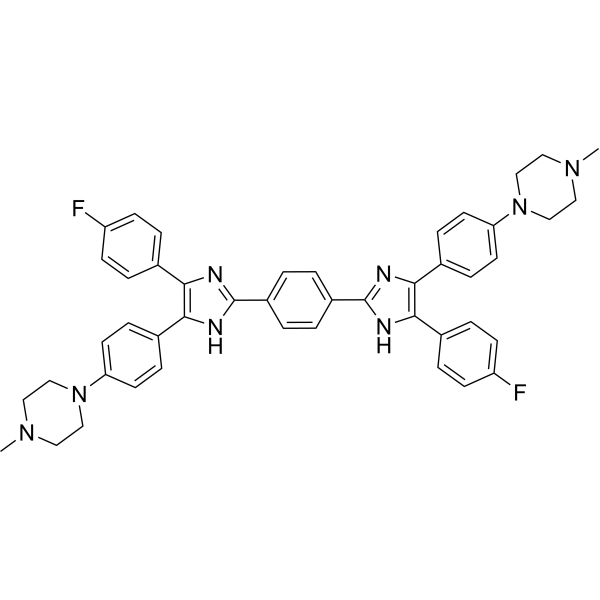
DIZ-3 is a selective multimeric G4 ligand based on a G4-ligand-dimerizing strategy. DIZ-3 intercalates into the G4-G4 interface, stabilizing the higher-order structure. DIZ-3 induces cell cycle arrest and apoptosis, and thus inhibits cell proliferation in alternative lengthening of telomere (ALT) cancer cells .
loading...
    loading...
Cat. No.: HY-P99245
CAS No.: 1448221-67-7
Synonyms: RG 7155; RO 5509554

Target:  

c-Fms

Research Areas:  

Cancer

Emactuzumab(RG 7155) is a specific monoclonal antibody that inhibits colonystimulating factor 1 receptor (CSF1R) activation. Emactuzumab has high affinity for CSF-1R with Ki value of 0.2 nM to blocks CSF-1R dimerization. Emactuzumab can be used for the research of several diseases, such as diffuse-type tenosynovial giant cell tumour (dt-GCT) .
loading...
    loading...
Cat. No.: HY-174568
Target:  

mRNA

Research Areas:  

Inflammation/Immunology

Human NFKB2 mRNA encodes the human nuclear factor kappa B subunit 2 (NFKB2) protein, a subunit of the transcription factor complex nuclear factor-kappa-B (NFkB). The NFkB complex is expressed in numerous cell types and functions as a central activator of genes involved in inflammation and immune function. NFKB2 can function as either a transcriptional activator or repressor depending on its dimerization partner.
loading...
    loading...
Cat. No.: HY-P99391A
CAS No.: 1781223-80-0
Synonyms: ABT-700 (powder)

Target:  

c-Met/HGFR Apoptosis

Research Areas:  

Cancer

Telisotuzumab (ABT-700) (powder) is a bivalent humanized IgG1 anti-c-Met monoclonal antibody. Telisotuzumab (powder) binds cellular c-Met and disrupts its productive dimerization and activation induced by HGF or by the high density of c-Met on the cell surface independent of ligand. Telisotuzumab (powder) induces apoptosis. Telisotuzumab (powder) can be used for the study of cancers harboring amplified MET, such as gastric and lung cancers .
loading...
    loading...
Cat. No.: HY-15148R
CAS No.: 174484-41-4
Synonyms: PNU-140690 (Standard)
Research Areas:  

Infection

Tipranavir (Standard) is the analytical standard of Tipranavir. This product is intended for research and analytical applications. Tipranavir (PNU-140690) inhibits the enzymatic activity and dimerization of HIV-1 protease, exerts potent activity against multi-protease inhibitor (PI)-resistant HIV-1 isolates with IC50s of 66-410 nM . Tipranavir inhibits SARS-CoV-2 3CL pro activity .
loading...
    loading...
Cat. No.: HY-15148S1
Synonyms: PNU-140690-d7
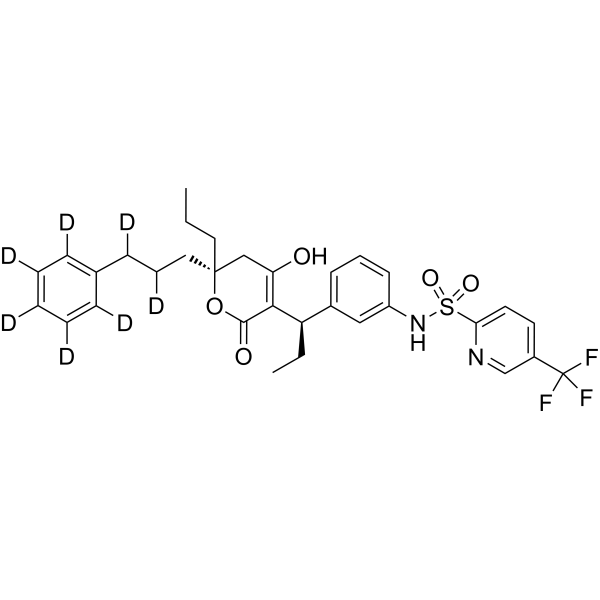
Tipranavir-d7 is deuterated labeled Tipranavir (HY-15148). Tipranavir (PNU-140690) inhibits the enzymatic activity and dimerization of HIV-1 protease, exerts potent activity against multi-protease inhibitor (PI)-resistant HIV-1 isolates with IC50s of 66-410 nM . Tipranavir inhibits SARS-CoV-2 3CL pro activity .
loading...
    loading...
Cat. No.: HY-182034
GAP214 is a monosaccharide lipid A analogue and TLR4/MD-2 complex modulator.GAP214 binds to the TLR4/MD-2 complex via hydrophobic interactions, salt bridges, and hydrogen bonds, induces dimerization of the complex to initiate intracellular signaling cascades.GAP214 functions as an immunostimulant and vaccine adjuvant, enhances antigen-specific IgG antibody production in a mouse model .
loading...
    loading...
Cat. No.: HY-E70762
Target:  

PDGFR

Research Areas:  

Cancer

PDGFRalpha is a receptor tyrosine kinases that stimulate cell survival, proliferation and motility. Upon PDGF binding, the receptor dimerizes and undergoes a conformational change, which activates the kinase domain. PDGFRalpha D842V is a mutant of PDGFRalpha. PDGFRalpha D842V Recombinant Human Active Protein Kinase is a recombinant PDGFRalpha D842V protein that can be used to study PDGFRalpha D842V-related functions .
loading...
    loading...
Cat. No.: HY-E70763
Target:  

PDGFR

Research Areas:  

Cancer

PDGFRalpha is a receptor tyrosine kinases that stimulate cell survival, proliferation and motility. Upon PDGF binding, the receptor dimerizes and undergoes a conformational change, which activates the kinase domain. PDGFRalpha T674I is a mutant of PDGFRalpha. PDGFRalpha T674I Recombinant Human Active Protein Kinase is a recombinant PDGFRalpha T674I protein that can be used to study PDGFRalpha T674I-related functions .
loading...
    loading...
Cat. No.: HY-E70764
Target:  

PDGFR

Research Areas:  

Cancer

PDGFRalpha is a receptor tyrosine kinases that stimulate cell survival, proliferation and motility. Upon PDGF binding, the receptor dimerizes and undergoes a conformational change, which activates the kinase domain. PDGFRalpha V561D is a mutant of PDGFRalpha. PDGFRalpha V561D Recombinant Human Active Protein Kinase is a recombinant PDGFRalpha V561D protein that can be used to study PDGFRalpha V561D-related functions .
loading...
    loading...
Cat. No.: HY-P10793
CAS No.: 535959-77-4
Target:  

EGFR Apoptosis

Research Areas:  

Cancer

Cyclic(YCDGFYACYMDV) is a HER2 signaling pathway inhibitor with anti-cancer activity. This compound self-assembles into nanoparticles in aqueous solution and transforms into nanofibers upon specific binding to HER2 on cancer cells. This transformation disrupts HER2 dimerization and subsequent downstream signaling events, leading to cancer cell apoptosis (Apoptosis). The inhibitory effects on HER2 positive breast cancer have been demonstrated to be effective in a murine xenograft model .
loading...
    loading...
Cat. No.: HY-W014223
CAS No.: 131-56-6
Synonyms: Ultraviolet absorber UV-0
2,4′-Dihydroxybenzophenone (Ultraviolet absorber UV-0) occupies the hydrophobic pocket of MD2 and blocks the dimerization of TLR4. 2,4′-Dihydroxybenzophenone inhibits the LPS induced mtROS production, and LPS induced inflammatory response by downregulating pro-inflammatory mediators and decreasing the expression of MyD88, p-IRAK4, and NF-κB. 2,4′-Dihydroxybenzophenone is also a UV absorber .
loading...
    loading...
Cat. No.: HY-144258
CAS No.: 2499965-12-5
Purity:  99.85%
Target:  

PD-1/PD-L1

Research Areas:  

Inflammation/Immunology Cancer

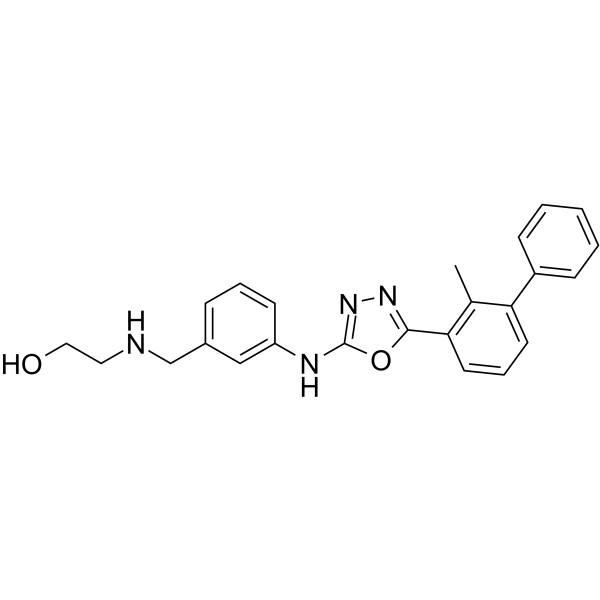
PD-1/PD-L1-IN-14 (compound 17) is a bifunctional inhibitor of PD-1/PD-L1 interactions, with an IC50 of 27.8 nM. PD-1/PD-L1-IN-14 (compound 17) inhibits PD-1/PD-L1 interactions and promotes dimerization, internalization, and degradation of PD-L1 .
loading...
    loading...
Cat. No.: HY-153225
CAS No.: 2560576-15-8
Purity:  99.32%
Research Areas:  

Infection

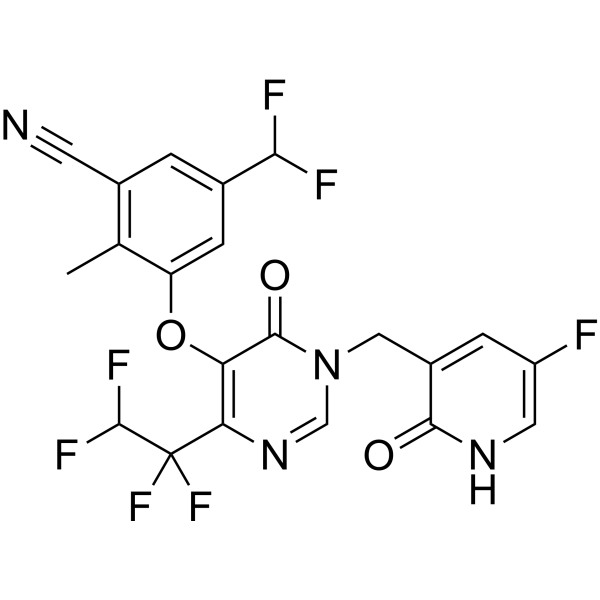
PYR01 is a non-nucleoside reverse transcriptase inhibitor and a killing activator targeting HIV infected cells. PYR01 has cytokilling and antiviral properties of HIV-1 infection with the IC50 values of 27.5nM and 39.7nM, respectively. PYR01 leads to selective cytotoxicity by promoting HIV-1 Gag-Pol dimerization and HIV-1 protease intracellular activation. PYR01 can be used in the study of HIV .
loading...
    loading...
Cat. No.: HY-184924
CAS No.: 3102264-65-0
Research Areas:  

Infection

HIV-IN-15 is a HIV-infected cell killer, with an EC50 of 20 nM in the HIV-TACK assay. HIV-IN-15 binds to the reverse transcriptase p66 domain of monomeric GAG-POL, accelerates the dimerization process, and selectively kills HIV-infected cells expressing GAG-POL, with no cytotoxicity against HIV-uninfected cells. HIV-IN-15 can be used for research on HIV infection, acquired immunodeficiency syndrome (AIDS), or AIDS-related complex (ARC) .
loading...
    loading...
Cat. No.: HY-P10426
CAS No.: 1446322-73-1
Research Areas:  

Cancer

cyclo(CLLFVY) is an inhibitor for hypoxia inducible factor-1 (HIF-1), with IC50 of 19 μM (in U2OS) and 16 μM (in MCF-7). cyclo(CLLFVY) binds to the PAS-B domain of HIF-1α, inhibits HIF-1 dimerization and transcriptional activity. cyclo(CLLFVY) downregulates the expression of hypoxia response genes, such as VEGF and CAIX, exhibits antitumor against the HIF-1 associated cancers .
loading...
    loading...
Cat. No.: HY-P11497
Research Areas:  

Infection

Cyclomarin monomer-1 (Compound 5), a cyclomarin monomer, is a pre-dimerization precursor that can form Homo-BacPROTACs targeting the degradation of ClpC1. Cyclomarin monomer-1 binds to the Mtb ClpC1 protein with a KD of 3.5 nM. The MIC of Cyclomarin monomer-1 against the Mtb H37Rv standard strain is 1.6 μM. Cyclomarin monomer-1 can be used as a key intermediate in the development of Homo-BacPROTACs .
loading...
    loading...

