179 Results for "

progenitor

" in MedChemExpress (MCE) Product Catalog:
Products (179)

179 Results for "progenitor" in MCE Product Catalog:

Cat. No.: HY-108476R
CAS No.: 1169755-45-6
Research Areas:  

Cancer

INDY (Standard) is the analytical standard of INDY (HY-108476). This product is intended for research and analytical applications. INDY is a potent and ATP-competitive Dyrk1A and Dyrk1B inhibitor with IC50s of 0.24 μM and 0.23 μM, respectively. INDY binds in the ATP pocket of the enzyme and has a Ki value of 0.18 μM for Dyrk1A. INDY sharply reduces the self-renewal capacity of normal and tumorigenic cells in primary Glioblastoma (GBM) cell lines and neural progenitor cells .
loading...
    loading...
Cat. No.: HY-E70742
Target:  

c-Kit

Research Areas:  

Cancer

KIT (CD117) is an important cell surface marker used to identify certain types of hematopoietic(blood) progenitors in the bone marrow. KIT is a cytokine receptor expressed on the surface of hematopoietic stem cells as well as other cell types. Altered forms of this receptor may be associated with some types of cancer. KIT V654A is a mutant of KIT. KIT V654A Recombinant Human Active Protein Kinase is a recombinant KIT V654A protein that can be used to study KIT V654A-related functions .
loading...
    loading...
Cat. No.: HY-P10953
CAS No.: 2868985-56-0
Synonyms: PSP 29-mer, anti-inflammatory peptide
Target:  

ERK STAT

Research Areas:  

Inflammation/Immunology

Fulipiftide (PSP 29-mer) is a short peptide derived from pigment epithelium-derived factor (PEDF). Fulipiftide induces the phosphorylation of ERK2 and STAT3, enriches tendon stem/progenitor cell markers, maintains cell stemness, promotes colony formation and niche expansion, and drives cell infiltration into injured tendons. Fulipiftide promotes the oriented formation of collagen fibers, regulates collagen deposition, and reduces inflammatory cell infiltration and neovascularization. Fulipiftide can be used in studies related to acute tendon injury .
loading...
    loading...
Cat. No.: HY-107589R
CAS No.: 327613-57-0
Research Areas:  

Inflammation/Immunology

BIO5192 (Standard) is the analytical standard of BIO5192 (HY-107589). This product is intended for research and analytical applications. BIO5192 is a selective and potent integrin α4β1 (VLA-4) inhibitor (Kd<10 pM). BIO5192 selectively binds to α4β1 (IC50=1.8 nM) over a range of other integrins. BIO5192 results in a 30-fold increase in mobilization of murine hematopoietic stem and progenitors (HSPCs) over basal levels .
loading...
    loading...
Cat. No.: HY-110093
CAS No.: 1255517-77-1
UNC0638 hydrate selectively inhibits G9a and GLP histone methyltransferases with IC50 of 15 nM and 19 nM, respectively. UNC0638 hydrate inhibits TNBC cell invasion and migration in vitro. UNC0638 hydrate is also an inhibitor of EHMT1/2 and induces fetal hemoglobin (HbF) expression in human erythroid progenitor cell culture. In addition, UNC0638 hydrate has anti-FMDV (foot-and-mouth disease virus) and anti-VSV (vesicular stomatitis virus) activities, with excellent potency and selectivity against multiple epigenetic and non-epigenetic targets .
loading...
    loading...
Cat. No.: HY-117285
CAS No.: 60227-09-0
Synonyms: Lactoquinomycin A; LQM-A
Lactoquinomycin A is a quinone antibiotic. Lactoquinomycin A has the activity of anti-Gram-positive bacteria and some Gram-negative bacteria, but the effect of anti-Gram-negative bacteria is weak and has no effect on fungi. Lactoquinomycin A inhibits a variety of cell lines including lymphoma L5178Y progenitor, Adriamycin resistant, Bleomycin-resistant, human leukemia K562, mouse leukemia L-1210 and mouse leukemia P 388 with ID50 (μg/mL) of 0.02, 0.006, 0.008, 0.033, 0.013 and 0.03, respectively .
loading...
    loading...
Cat. No.: HY-129453
CAS No.: 1947348-42-6
Purity:  99.11%
Target:  

Integrin

Research Areas:  

Inflammation/Immunology

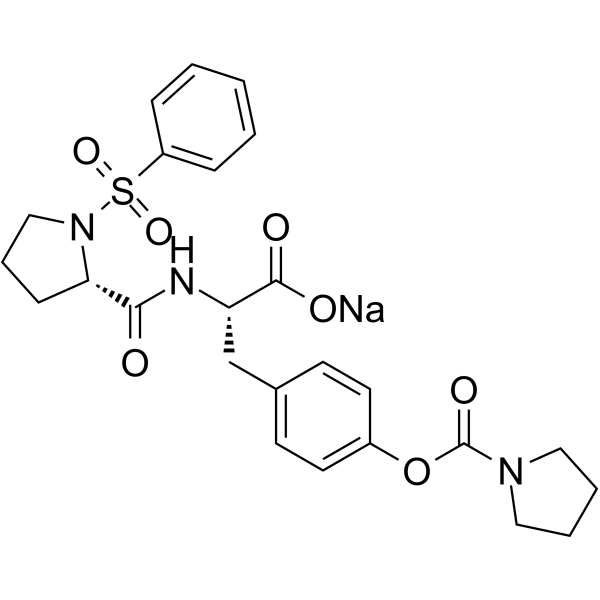
BOP sodium is a potent and selective dual α9β1/α4β1 integrin inhibitor with Kd values in the picomolar range. BOP sodium shows the rapid and preferential mobilization of hematopoietic stem cell (HSC) and progenitors. BOP sodium has little inhibitory activity on α4β7, α1β1, α2β1, and α5β1, αIIBβ3 integrins .
loading...
    loading...
Cat. No.: HY-146231
CAS No.: 2636072-62-1
Target:  

PROTACs MAP4K

Research Areas:  

Inflammation/Immunology Cancer

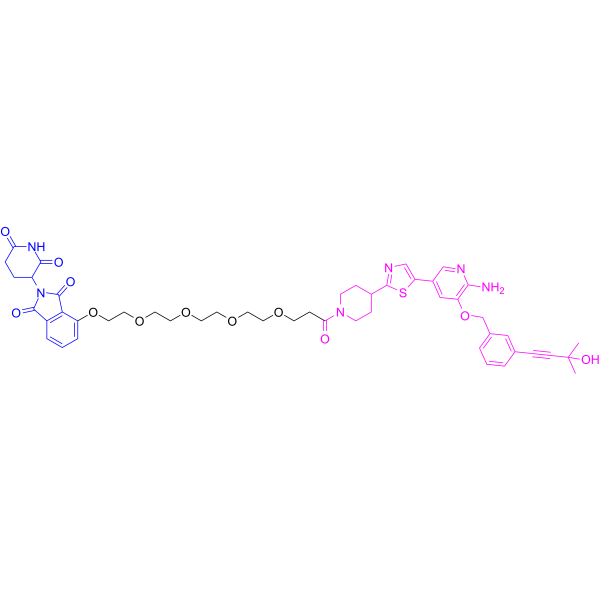
SS47 is a hematopoietic progenitor kinase HPK1 PROTAC-class degrader and immune activator. SS47 promotes the proliferation of CD4+ and CD8+ T cells as well as IFN-γ secretion, and enhances the anti-tumor cytotoxicity and in vivo efficacy of BCMA CAR-T cells. SS47 also inhibits tumor growth in mouse models, and when combined with anti-PD-1 therapy, it improves the immune response of 4T1 tumor-bearing mice. SS47 can be used in breast cancer-related research .
loading...
    loading...
Cat. No.: HY-147617
CAS No.: 2361378-89-2
Target:  

c-Fms

Research Areas:  

Cancer

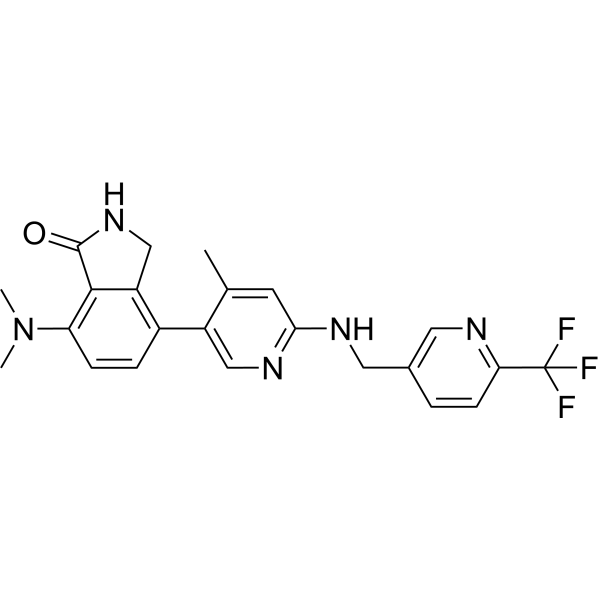
CSF1R-IN-14 is an isoindolinone derivative compound. CSF1R-IN-14 is a potent inhibitor of CSF1R. Colony stimulating factor 1 (CSF-1, also known as macrophage colony stimulating factor, M-CSF) is an important growth factor that controls bone marrow progenitor cells, monocytes, macrophages, and giants. CSF1R-IN-14 has the potential for the research of cancer diseases (extracted from patent WO2019134662A1, compound 1) .
loading...
    loading...
Cat. No.: HY-182569
CAS No.: 132340-44-4
Target:  

VEGFR

FR 111142 is an angiogenesis inhibitor (IC50 = 18.4 μM) and has anti-inflammatory activity (IC50 = 20.6 μM). FR 111142 inhibits capillary-like tube formation as well as nitric oxide production in LPS (HY-D1056)-activated murine macrophages. FR 111142 enhances catabolism of low-density lipoprotein (LDL). FR 111142 does not induce significant cytotoxicity in human endothelial progenitor cells, nor affect cell viability of murine macrophages. FR 111142 can be used for the research of cancer, inflammatory diseases .
loading...
    loading...
Cat. No.: HY-19867
CAS No.: 1191448-17-5
Synonyms: TG-0054
Target:  

CXCR

Research Areas:  

Cancer

Burixafor (TG-0054) is a potent CXCR4 antagonist with a pIC50 of 7.4. Burixafor inhibits the binding of CXCL12 to CXCR4, antagonizes CXCL12-induced recruitment of Gαᵢ and β-arrestin2, and blocks the downstream Gαᵢ-mediated inhibitory effect on cAMP signal transduction. Burixafor mobilizes CD34 + hematopoietic stem/progenitor cells (HSPC) from the bone marrow to the peripheral blood. Burixafor can be used for research on autologous hematopoietic stem cell transplantation (ASCT) .
loading...
    loading...
Cat. No.: HY-B1719AR
CAS No.: 50-10-2
Oxyphenonium bromide Standard is the analytical standard of Oxyphenonium bromide (HY-B1719A). This product is intended for research and analytical applications. Oxyphenonium bromide is an orally effective competitive muscarinic acetylcholine receptor (mAChR) antagonist. Oxyphenonium bromide competitively binds to and blocks mAChR, thereby inhibiting the parasympathetic pathway. By inhibiting CHRM4, Oxyphenonium bromide increases cAMP levels and activates the CREB transcriptional program, thereby promoting erythroid progenitor cell expansion. Oxyphenonium bromide can be used in research on asthma, anemia, and gastric ulcers .
loading...
    loading...
Cat. No.: HY-E70734
Target:  

c-Kit

Research Areas:  

Cancer

KIT (CD117) is an important cell surface marker used to identify certain types of hematopoietic(blood) progenitors in the bone marrow. KIT is a cytokine receptor expressed on the surface of hematopoietic stem cells as well as other cell types. Altered forms of this receptor may be associated with some types of cancer. KIT A829P is a mutant of KIT. KIT A829P Recombinant Human Active Protein Kinase is a recombinant KIT A829P protein that can be used to study KIT A829P-related functions .
loading...
    loading...
Cat. No.: HY-E70735
Target:  

c-Kit

Research Areas:  

Cancer

KIT (CD117) is an important cell surface marker used to identify certain types of hematopoietic(blood) progenitors in the bone marrow. KIT is a cytokine receptor expressed on the surface of hematopoietic stem cells as well as other cell types. Altered forms of this receptor may be associated with some types of cancer. KIT D816H is a mutant of KIT. KIT D816H Recombinant Human Active Protein Kinase is a recombinant KIT D816H protein that can be used to study KIT D816H-related functions .
loading...
    loading...
Cat. No.: HY-E70736
Target:  

c-Kit

Research Areas:  

Cancer

KIT (CD117) is an important cell surface marker used to identify certain types of hematopoietic(blood) progenitors in the bone marrow. KIT is a cytokine receptor expressed on the surface of hematopoietic stem cells as well as other cell types. Altered forms of this receptor may be associated with some types of cancer. KIT D816V is a mutant of KIT. KIT D816V Recombinant Human Active Protein Kinase is a recombinant KIT D816V protein that can be used to study KIT D816V-related functions .
loading...
    loading...
Cat. No.: HY-E70737
Target:  

c-Kit

Research Areas:  

Cancer

KIT (CD117) is an important cell surface marker used to identify certain types of hematopoietic(blood) progenitors in the bone marrow. KIT is a cytokine receptor expressed on the surface of hematopoietic stem cells as well as other cell types. Altered forms of this receptor may be associated with some types of cancer. KIT T670I is a mutant of KIT. KIT T670I Recombinant Human Active Protein Kinase is a recombinant KIT T670I protein that can be used to study KIT T670I-related functions .
loading...
    loading...
Cat. No.: HY-E70738
Target:  

c-Kit

Research Areas:  

Cancer

KIT (CD117) is an important cell surface marker used to identify certain types of hematopoietic(blood) progenitors in the bone marrow. KIT is a cytokine receptor expressed on the surface of hematopoietic stem cells as well as other cell types. Altered forms of this receptor may be associated with some types of cancer. KIT V559D is a mutant of KIT. KIT V559D Recombinant Human Active Protein Kinase is a recombinant KIT V559D protein that can be used to study KIT V559D-related functions .
loading...
    loading...
Cat. No.: HY-E70741
Target:  

c-Kit

Research Areas:  

Cancer

KIT (CD117) is an important cell surface marker used to identify certain types of hematopoietic(blood) progenitors in the bone marrow. KIT is a cytokine receptor expressed on the surface of hematopoietic stem cells as well as other cell types. Altered forms of this receptor may be associated with some types of cancer. KIT V560G is a mutant of KIT. KIT V560G Recombinant Human Active Protein Kinase is a recombinant KIT V560G protein that can be used to study KIT V560G-related functions .
loading...
    loading...
Cat. No.: HY-N14774
CAS No.: 101342-94-3
Lactoquinomycin B is a quinone antibiotic. Lactoquinomycin B has the activity of anti-Gram-positive bacteria and some Gram-negative bacteria, but the effect of anti-Gram-negative bacteria is weak and has no effect on fungi. Lactoquinomycin B inhibits a variety of cell lines including lymphoma L5178Y progenitor, Adriamycin resistant, Bleomycin-resistant, human leukemia K562, mouse leukemia L-1210 and mouse leukemia P 388 with ID50 (μg/mL) of 0.43, 0.21, 0.19, 0.16, 0.2 and 0.12, respectively .
loading...
    loading...
Cat. No.: HY-P11728
CAS No.: 1643580-44-2
Target:  

CXCR Apoptosis Caspase Akt ERK

Research Areas:  

Cancer

Peptide E5 is an antagonist targeting the CXCR4/CXCL12 axis. Peptide E5 blocks the CXCR4/CXCL12 axis, downregulates CXCR4 expression, and inhibits the phosphorylation of downstream Akt and Erk. Peptide E5 induces apoptosis, suppresses migration and adhesion of breast cancer cells. Peptide E5 inhibits CXCL12-mediated endothelial progenitor cell recruitment, thereby suppressing tumor angiogenesis. Peptide E5 is applicable to relevant research on breast cancer .
loading...
    loading...

