1. Search Result
Search Result
Results for "

AML-12

" in MedChemExpress (MCE) Product Catalog:

11

Inhibitors & Agonists

2

Natural
Products

Cat. No. Product Name Target Research Areas Chemical Structure
  • HY-N2392
    Kukoamine A
    1 Publications Verification

    Parasite Lipoxygenase Opioid Receptor Apoptosis Autophagy Reactive Oxygen Species (ROS) Interleukin Related TNF Receptor PGE synthase COX Infection Neurological Disease Metabolic Disease Inflammation/Immunology Cancer
    Kukoamine A, a spermine alkaloid, is an orally active and brain-penetrant component found in the root barks of Lycium chinense (L. chinense) Miller. Kukoamine A inhibits purified Crithidia fasciculata trypanothione reductase and soybean lipoxygenase, activates μ-opioid receptor. Kukoamine A can inhibt cancer cell proliferation, migration and invasion, cause G0/G1 phase cell cycle arrest and induce apoptosis. Kukoamine A exerts neuroprotective effect and can induce autophagy . Kukoamine A inhibits LPS (HY-D1056)-induced NO, ROS, PGE2, TNF-α, IL-1β, IL-6 production and COX-2 activity. Kukoamine A reverses palmitic acid-induced insulin resistance, lipid accumulation, and oxidative stress via downregulation of Srebp-1c. Kukoamine A can be used for the research of cancer, infection, inflammation, metabolic and neurological disease, such as glioblastoma and Parkinson's disease .
    Kukoamine A
  • HY-111179

    Drug Derivative Inflammation/Immunology
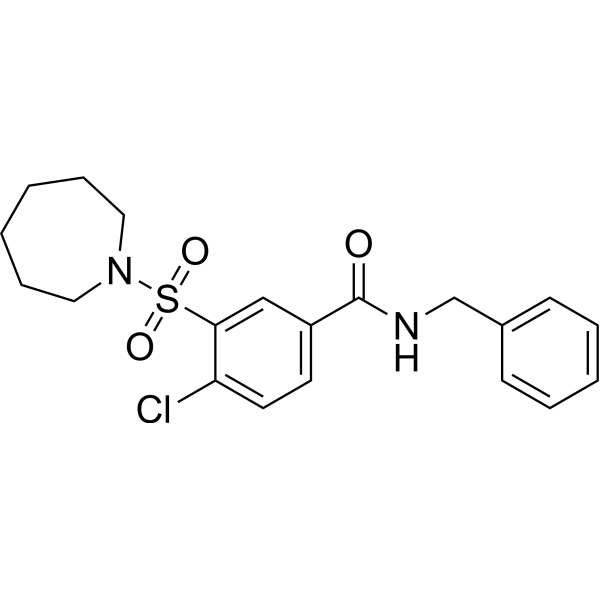
    ML261 is a hepatic lipid droplets formation inhibitor with an IC50 value of 69.7 nM. ML261 can be used for the research of non-alcoholic fatty liver disease (NAFLD) and inflammation .
    ML261
  • HY-157088

    Caspase Apoptosis Cyclophilin Others
    C105SR is a cyclophilin D (CypD) inhibitor targeting to peptidyl-prolylcis-trans isomerase (PPIase). C105SR inhibits mitochondrial permeability transition opening (mPTP) with an IC 50 of 5 nM. C105SR inhibits hypoxia and reoxygenation inudced hepatocyte apoptosis and increases the level of calcium retention capacity (CRC). C105SR exhibits hepaprotective effect in ischaemia-reperfusion injury (IRI) mouse model .
    C105SR
  • HY-N5073

    4''-O-Glucosylvitexin

    JNK p38 MAPK Interleukin Related TNF Receptor Caspase Lactate Dehydrogenase Apoptosis Cardiovascular Disease Metabolic Disease
    Vitexin-4''-O-glucoside (4''-O-Glucosylvitexin) is an orally active natural flavonoid component with multiple pharmacological effects including antioxidation, anti-inflammation, cytoprotection and anti-apoptosis. Vitexin-4''-O-glucoside regulates the MAPK signaling pathway by downregulating the phosphorylation levels of JNK and p38, thereby blocking endoplasmic reticulum stress responses. Vitexin-4''-O-glucoside alleviates oxidative stress by reducing MDA content and upregulating the activities of SOD and CAT, attenuates inflammation by downregulating the expressions of inflammatory factors TNF-α, IL-1β and IL-6, and also reduces LDH release and inhibits caspase-3 activation. Vitexin-4''-O-glucoside effectively improves drug-induced acute liver injury and exerts significant protective effects against myocardial hypoxia/reoxygenation injury. Vitexin-4''-O-glucoside can be used in studies on acute liver injury, cardiovascular diseases and myocardial hypoxia-reoxygenation injury .
    Vitexin-4''-O-glucoside
  • HY-175303

    Xanthine Oxidase Metabolic Disease
    Xanthine oxidase-IN-17 is a potent xanthine oxidase (XOD) inhibitor with an IC50 of 298 nM and a Ki of 167 nM. Xanthine oxidase-IN-17 decreases the formation of O radical by inhibiting the catalytic activity of XOD to diminish the production of uric acid. Xanthine oxidase-IN-17 shows no cytotoxicity in AML-12 hepatocytes, while suppressing uric acid production. Xanthine oxidase-IN-17 can be used for the studies of hyperuricemia and subsequently to gout .
    Xanthine oxidase-IN-17
  • HY-175815

    Apoptosis Bcl-2 Family Caspase MMP Cadherin Cancer
    Apoptosis inducer 44 is an apoptosis inducer. Apoptosis inducer 44 triggers apoptosis in MDA-MB-231 cells by increasing the levels of Bax and Cyt C, reducing Bcl-2, and initiating caspase-3 cleavage. Apoptosis inducer 44 suppresses the invasion and migration of MDA-MB-231 cells by down-regulating MMP-2 and MMP-9 expression and up-regulating E-cadherin protein levels. Apoptosis inducer 44 can be used for the study of breast cancer .
    Apoptosis inducer 44
  • HY-111180

    Endogenous Metabolite Metabolic Disease
    ML-262 is an inhibitor of hepatic lipid droplet formation (IC50=6.4 nM in murine AML-12 cells), which is associated with non-alcoholic fatty liver disease.1 ML-262 does not induce cytotoxicity (up to 33 μM) or inhibit fatty acid uptake (up to 50 μM).
    ML262
  • HY-158160

    Sodium Channel Metabolic Disease
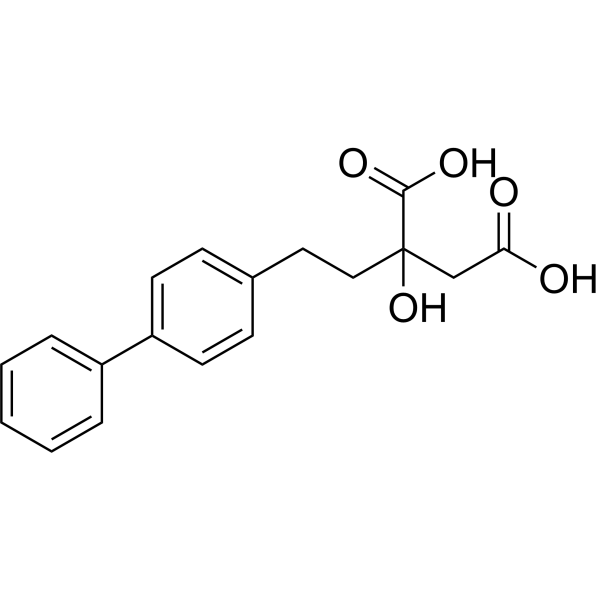
    LBA-3 is a selective, orally active inhibitor for sodium-coupled citrate transporter SLC13A5, with an IC50 of 67 nM. LBA-3 decreases levels of triglyceride and total cholesterol in oleic and palmitic acid (OPA)-stimulated AML12 cells, PCN-stimulated primary mouse hepatocytes and in mouse models, without detectable toxicity. LBA-3 is blood-brain barrier permeable .
    LBA-3
  • HY-122209

    HBV Infection
    DVR-01 is a HBV inhibitor with EC50 values of 1.7 and 1.6 μM in AML12HBV10 and HepDES19 cells, respectively. DVR-01 shows antiviral activity against drug-resistant HBV mutants with EC50s of 2.403-3.273 μM. DVR-01 can be used for the research of HBV infection and related diseases .
    DVR-01
  • HY-181765

    Toll-like Receptor (TLR) NF-κB Keap1-Nrf2 Reactive Oxygen Species (ROS) Neurological Disease Inflammation/Immunology
    TLR4/NF-κB-IN-2 is an orally active TLR4/NF-κB inhibitor and Nrf2/HO-1 activator. TLR4/NF-κB-IN-2 combats oxidative stress and exerts anti-inflammatory effects by regulating the Nrf2/HO-1 and TLR4/NF-κB pathways. TLR4/NF-κB-IN-2 reduces aggregation and protects neurons. TLR4/NF-κB-IN-2 can be used in the research of Alzheimer's disease .
    TLR4/NF-κB-IN-2
  • HY-183296

    NOD-like Receptor (NLR) Interleukin Related Caspase Inflammation/Immunology
    NLRP3-IN-91 is a potent NLRP3 inflammasome inhibitor with a Kd of 558.4 nM. NLRP3-IN-91 directly targets the NLRP3 NACHT domain, blocks inflammasome assembly and activation, and exerts anti-inflammatory effects. NLRP3-IN-91 increases survival time in a murine model of LPS (HY-D1056)-induced sepsis. NLRP3-IN-91 can be used for the research of sepsis .
    NLRP3-IN-91

Inquiry Online

Your information is safe with us. * Required Fields.

Salutation


Country or Region *

Applicant Name *


Organization Name *

Department *


Email Address *


Product Name *

Cat. No.


Requested quantity *

Phone Number *


Remarks

Inquiry Online

Inquiry Information

Product Name:
Cat. No.:
Quantity:
MCE Japan Authorized Agent:

