1. Search Result
Search Result
Results for "

AlphaScreen assay

" in MedChemExpress (MCE) Product Catalog:
Targets Recommended:
Cat. No. Product Name Target Research Areas Chemical Structure
  • HY-103663
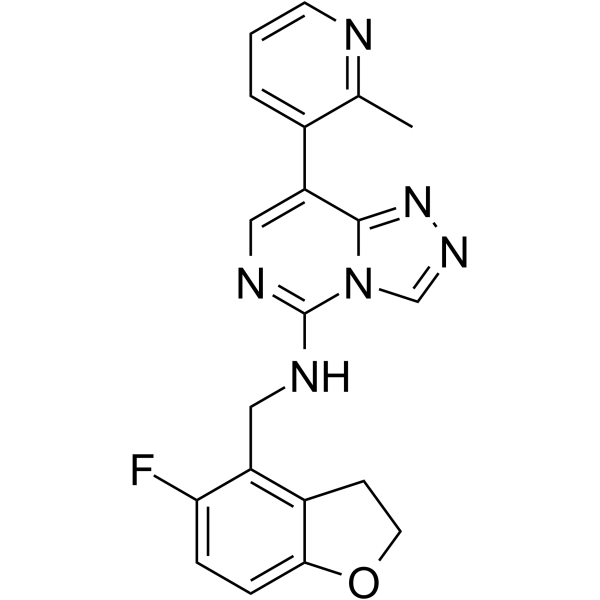
    MAK683
    4 Publications Verification

    Histone Methyltransferase Cancer
    MAK683 is an embryonic ectoderm development (EED) inhibitor extracted from patent US20160176882 A1, compound example 2. MAK683 exhibits IC50s of 59, 89, 26 nM in EED Alphascreen binding, LC-MS and ELISA assay .
    MAK683
  • HY-117233
    UU-T02
    1 Publications Verification

    β-catenin Wnt Metabolic Disease Cancer
    UU-T02 is a novel potent, selective small-molecule inhibitor of β-Catenin/T-cell factor protein-protein interaction (β-catenin/Tcf PPI) with a Ki of 1.36 μM . UU-T02 inhibits canonical Wnt signaling and the growth of colorectal cancer cells .
    UU-T02
  • HY-103663A

    Histone Methyltransferase Cancer
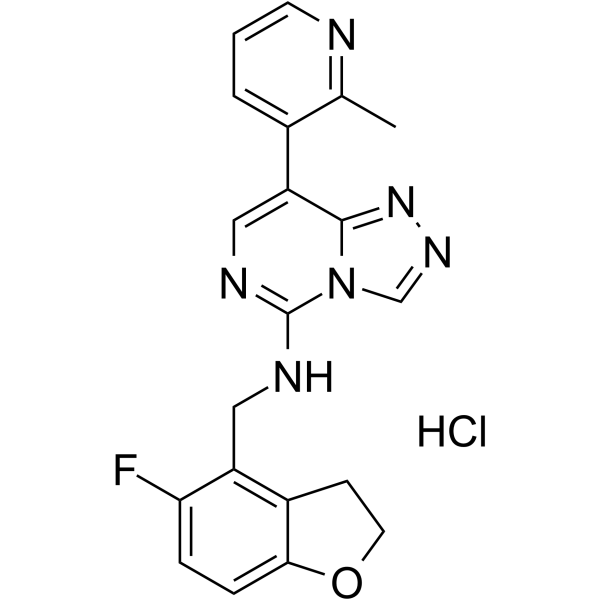
    MAK683 hydrochloride is an embryonic ectoderm development (EED) inhibitor extracted from patent US20160176882 A1, compound example 2. MAK683 exhibits IC50s of 59, 89, 26 nM in EED Alphascreen binding, LC-MS and ELISA assay .
    MAK683 hydrochloride
  • HY-142743

    Epigenetic Reader Domain Cancer
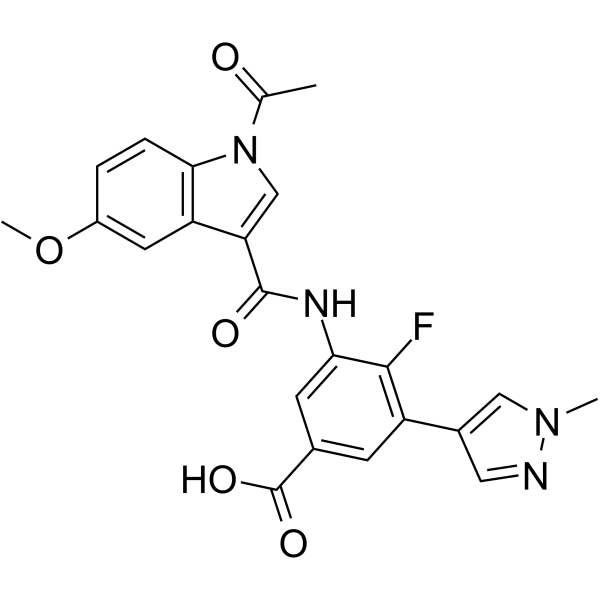
    Y08175 is a potent CBP bromodomain inhibitor. Y08175 exhibits considerable inhibitory effect with IC50s of 37 and 178.15 nM against CBP bromodomain in AlphaScreen assay and HTRF assay, respectively. Y08175 can be used for the research of prostate cancer .
    Y08175
  • HY-103663R

    Reference Standards Histone Methyltransferase Cancer
    MAK683 (Standard) is the analytical standard of MAK683 (HY-103663). This product is intended for research and analytical applications. MAK683 is an embryonic ectoderm development (EED) inhibitor extracted from patent US20160176882 A1, compound example 2. MAK683 exhibits IC50s of 59, 89, 26 nM in EED Alphascreen binding, LC-MS and ELISA assay .
    MAK683 (Standard)
  • HY-183248

    Epigenetic Reader Domain Cancer
    BRDT-IN-2 is a BRDT-BD1-preferring inhibitor (Ki=10 μM) with higher affinity for BRDT-BD1 than BRD4-BD1. BRDT-IN-2 preferentially binds BRDT-BD1 without direct interaction with BRDT-BD1’s Arg54 residue. BRDT-IN-2 binds BRD4-BD1 with lower affinity via structured water molecule displacement in its binding pocket. BRDT-IN-2 can be used for the research of multiple myeloma .
    BRDT-IN-2

Inquiry Online

Your information is safe with us. * Required Fields.

Salutation


Country or Region *

Applicant Name *


Organization Name *

Department *


Email Address *


Product Name *

Cat. No.


Requested quantity *

Phone Number *


Remarks

Inquiry Online

Inquiry Information

Product Name:
Cat. No.:
Quantity:
MCE Japan Authorized Agent:

