1. Search Result
Search Result
Results for "

BT549

" in MedChemExpress (MCE) Product Catalog:

32

Inhibitors & Agonists

1

Natural
Products

1

Isotope-Labeled Compounds

Cat. No. Product Name Target Research Areas Chemical Structure
  • HY-114169
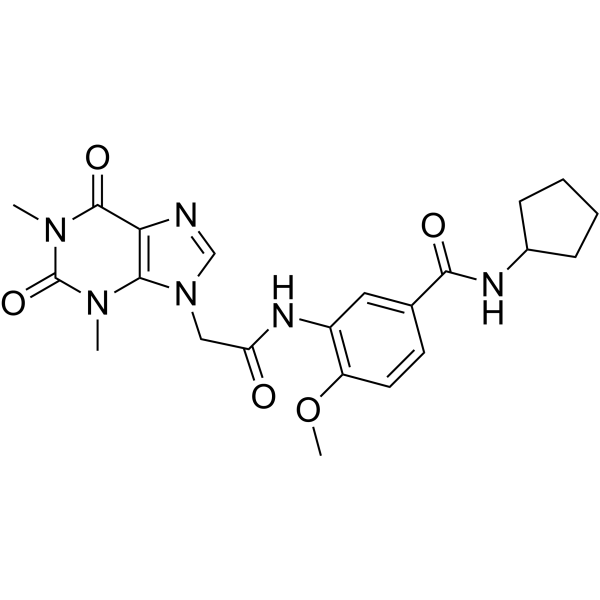
    WRG-28
    2 Publications Verification

    Discoidin Domain Receptor Inflammation/Immunology Cancer
    WRG-28 is a selective, extracellularly acting DDR2 allosteric inhibitor, with an IC50 of 230 nM. WRG-28 inhibits tumor invasion, migration and tumor-supporting effects of cancer-associated fibroblasts (CAFs). WRG-28 inhibits metastatic breast tumor cell colonization in the lungs. WRG-28 also shows good activity of relieving rheumatoid arthritis in CAIA model of mice .
    WRG-28
  • HY-162250

    PROTACs Histone Methyltransferase Cancer
    MS8847 is a PROTAC degrader and antiproliferative agent targeting EZH2 (DC50=34.4 nM in EOL-1 MLL-rAML cells). MS8847 recruits the E3 ligase von Hippel-Lindau (VHL) to mediate the degradation of EZH2 via the ubiquitin-proteasome system. MS8847 induces antiproliferative effects in MLL-rearranged acute myeloid leukemia cells and inhibits the growth of triple-negative breast cancer cell lines or 3D triple-negative breast cancer models. MS8847 is applicable to research related to MLL-rearranged acute myeloid leukemia and triple-negative breast cancer .
    MS8847
  • HY-137552
    MKI-1
    1 Publications Verification

    MASTL Kinase Inhibitor-1

    MASTL Cancer
    MKI-1, an inhibitor of MASTL (microtubule-associated serine/threonine kinase-like) with an IC50 of 9.9 μM, exerts antitumor and radiosensitizer activities through PP2A activation in breast cancer .
    MKI-1
  • HY-U00447

    MDM-2/p53 DNA Alkylator/Crosslinker Cancer
    PK11000 is an alkylating agent, and stabilizes the DNA-binding domain of both WT and mutant p53 proteins by covalent cysteine modification without compromising DNA binding. PK11000 has anti-tumor activities .
    PK11000
  • HY-124632
    WJ460
    3 Publications Verification

    Ferroptosis Autophagy Cancer
    WJ460 is a potent inhibitor of myoferlin (MYOF) that interacts directly with MYOF. WJ460 inhibits the migration and growth, induces cell cycle arrest, mitochondrial autophagy, lipid peroxidation and ferroptosis in tumor cells. WJ460 has anti-tumor activity .
    WJ460
  • HY-149894

    c-Myc Cadherin Cancer
    MC-1-F2 is a FOXC2 inhibitor. MC-1-F2 shows a binding affinity (Kd) of 26 μM for full-length FOXC2. MC-1-F2 reduces epithelial-mesenchymal transition (EMT) markers in breast cancer cells, suppresses cancer stem cell (CSC) properties and reduces invasiveness in castration-resistant prostate cancer (CRPC) cells. MC-1-F2 can be used for the study of CRPC and breast cancer .
    MC-1-F2
  • HY-159990

    Glutathione Peroxidase Cancer
    GPX4-IN-15 (Compound C1) is an inhibitor for GPX4, that inhibits 19.8% GPX4 at 1 μM. GPX4-IN-15 inhibits the proliferation of cancer cell MDA-MB-468, BT-549 and MDA-MB-231 with IC50 of 0.86, 0.96 and 0.48 μM .
    GPX4-IN-15
  • HY-175846

    Drug Derivative Apoptosis Cancer
    TQFL13 is derivative of Thymoquinone (TQ) (HY-D0803) with potent anti-breast cancer activity. TQFL13 exhibits higher cytotoxicity against breast cancer cells (BT549, MDA-MB-231, 4T1). TQFL13 increases apoptosis and blocks the cell cycle at S and G2/G1 phases in breast cancer cells. TQFL13 shows dose-dependent anti-tumor efficacy in mouse breast cancer allograft model. TQFL13 can be used for the study of breast cancer .
    TQFL13
  • HY-161378

    Deubiquitinase Cancer
    UCHL1-IN-1 (Compound 46) is an inhibitor for Ubiquitin C-terminal Hydrolase L1 (UCHL1), with an IC50 of 5.1 μM. UCHL1-IN-1 can be used for cancer research .
    UCHL1-IN-1
  • HY-118961

    Kinesin Cancer
    SR31527 chloride is a potent KIFC1 inhibitor with an IC50 value of 6.6 µM. SR31527 chloride decreases cell viability and colony formation .
    SR31527 chloride
  • HY-163108

    Epigenetic Reader Domain Apoptosis c-Myc Cancer
    ATAD2-IN-1 (compound 19f) is a potent ATAD2 inhibitor (IC50: 0.27 μM) and can induce apoptosis. ATAD2-IN-1 also inhibits c-Myc activation and BT-549 cell migration .
    ATAD2-IN-1
  • HY-N3222

    HIV Infection Cancer
    Myriceric acid B is a potent HIV-1 entry inhibitor targeting gp41. Myriceric acid B is an antitumor agent .
    Myriceric acid B
  • HY-136121

    Microtubule/Tubulin Cancer
    Tubulin inhibitor 6 (Compound 14b) is a tubulin inhibitor and a potent inhibitor of multiple cancer cell lines. Tubulin inhibitor 6 inhibits tubulin polymerization with an IC50 of 0.87 μM. Tubulin inhibitor 6 inhibits K562 cell growth with an IC50 of 840 nM .
    Tubulin inhibitor 6
  • HY-15113A

    Prolyl Endopeptidase (PREP) Neurological Disease Cancer
    Y-29794 tosylate is a selective, orally active inhibitor for non-peptide prolyl endopeptidase (PREP), with an IC50 of 3 nM and a Ki of 0.95 nM. Y-29794 tosylate enhances the effect of thyrotropin-releasing hormone (TRH) on the release of ACh in the rat hippocampus, exhibits potential neuroprotective efficacy. Y-29794 tosylate exhibits anticancer activity through inhibition of the IRS1-AKT-mTORC1 pathway. Y-29794 tosylate penetrates the brain-blood barrier (BBB) .
    Y-29794 tosylate
  • HY-169962

    Carbonic Anhydrase Cholinesterase (ChE) Neurological Disease Cancer
    hCA I-IN-4 (Compound 14) is the inhibitor for carbonic anhydrase and cholinesterase, that inhibits hCA I, hCA II, AChE, and BChE with Ki of 29.94 nM, 17.72 nM, 21.21 nM, and 7.65 nMrespectively. hCA I-IN-4 exhibits cytotoxicity in BT-549 with IC50 of 16.59 μM .
    hCA I-IN-4
  • HY-119694

    Fungal Cancer
    Rotenolone is an antiproliferative agent. Rotenolone shows antiproliferative activity against the ovarian cancer A2780, breast cancer BT-549, prostate cancer DU 145, NSCLC NCI-H460, and colon cancer HCC-2998 cell lines, with IC50s of 0.95, 1.6, 2.7, 2.0, and 2.9 μM, respectively .
    Rotenolone
  • HY-172092

    Apoptosis Ferroptosis Cancer
    BG11 induces the accumulation of Fe 2+ and intracellular lipid peroxides, induces ferroptosis. BG11 regulates the expression of Bax and Bcl-2 proteins, and induces apoptosis in MDA-MB-231 cell. BG11 arrests the cell cycle at G0/G1 and S phase, inhibits the proliferation of TNBC cancer cell (IC50 for MDA-MB-231 and BT549 is 0.49 μM and 0.52 μM), and inhibits the cell migration and invasion. BG11 exhibits antitumor efficacy in mouse models .
    BG11
  • HY-175544

    Drug Derivative Cancer
    anti-TNBC agent-10 is an anti-TNBC agent. anti-TNBC agent-10 shows potent anti-TNBC activity against BT549 cells (IC50 = 0.018 μM) and maintains activity against MDA-MB-231 cells (IC50 = 4.16 μM). anti-TNBC agent-10 9 demonstrates significant anti-tumor efficacy in mice bearing subcutaneous MDA-MB-231 TNBC xenografts. anti-TNBC agent-10 can be used for the study of triple-negative breast cancer (TNBC) .
    anti-TNBC agent-10
  • HY-134997

    4-oxo DHA

    PPAR Cancer
    4-oxo Docosahexaenoic acid (4-oxo DHA) is a putative metabolite of Docosahexaenoic acid (HY-B2167) with antiproliferative and PPARγ agonist activity. It inhibits the growth of several triple negative breast cancer cell lines (MCF-10F, trMCF, bsMCF, MDA-MB-231, and BT549) at 50-100 μM, however it increased proliferation of MCF-7 cells. 4-oxo DHA binds covalently to PPARγ and activates gene transcription in luciferase reporter assays and in dendritic cells with EC50 values of approximately 8-16 μM.
    4-Oxo Docosahexaenoic Acid
  • HY-126914

    Parasite Infection
    Diacetylcercosporin is a perylenequinone produced by Cercospora and Septoria that has diverse biological activities. Diacetylcercosporin inhibits the growth of P. falciparum strains that are sensitive and resistant to chloroquine (IC50s=2.75 and 1.94 μM for D6 and W2 clones, respectively) and L. donovani parasites (IC50=3.1 μM) in vitro. Diacetylcercosporin exhibits cytotoxicity against SK-MEL, KB, BT549, and SKOV3 human cancer cell lines (IC50s=4.8-8.7 μM). Diacetylcercosporin is also a phytotoxin that inhibits the growth of lettuce and bentgrass at a concentration of 1.62 mM.
    Diacetylcercosporin
  • HY-173016

    Opioid Receptor Neurological Disease
    HINT1-IN-1 (Compound 8) is the inhibitor for histidine triad nucleotide-binding protein 1 (HINT1) with a Ki of 1.14 μM. HINT1-IN-1 affects the cross-regulation between μ-opioid receptor (MOR) and NMDA receptor (NMDAR). HINT1-IN-1 enhances the analgesic effect of morphine without causing opioid tolerance and has independent analgesic effects in mouse model .
    HINT1-IN-1
  • HY-155490

    Nuclear Hormone Receptor 4A/NR4A Apoptosis Cancer
    Nur77 antagonist 1(Compound ja) is a selective Nur77 antagonist(KD SPRNur77 = 91 nM). Nur77 antagonist 1 induces cancer cell apoptosis. ja displays excellent antitumor against triple-negative breast cancer (TNBC) cells .
    Nur77 antagonist 1
  • HY-169994

    CDK Epigenetic Reader Domain Apoptosis DNA/RNA Synthesis Reactive Oxygen Species (ROS) Cancer
    BC13 is a CDK6/BRD4 inhibitor with the IC50 values of 234 nM and 36 nM for CDK6 and BRD4, respectively. BC13 shows antiproliferative activity and induces cell apoptosis and DNA damage. BC13 increases in ROS levels .
    BC13
  • HY-136123

    Microtubule/Tubulin Cancer
    Tubulin inhibitor 8 (Compound 33b) is a tubulin inhibitor and a potent inhibitor of multiple cancer cell lines. Tubulin inhibitor 8 inhibits tubulin polymerization with an IC50 of 0.73 μM. Tubulin inhibitor 8 inhibits K562 cell growth with an IC50 of 14 nM .
    Tubulin inhibitor 8
  • HY-136122

    Microtubule/Tubulin Cancer
    Tubulin inhibitor 7 (Compound 33c) is a tubulin inhibitor and a potent inhibitor of multiple cancer cell lines. Tubulin inhibitor 7 inhibits tubulin polymerization with an IC50 of 0.52 μM. Tubulin inhibitor 7 inhibits K562 cell growth with an IC50 of 11 nM .
    Tubulin inhibitor 7
  • HY-177869

    Drug Derivative Apoptosis Caspase PARP Cancer
    CHNQD-00824 is a Terphenyllin (HY-119821) derivative with potent anticancer effect. CHNQD-00824 inhibits the proliferation and migration of cancer cells via DNA damage. CHNQD-00824 triggers apoptosis and inhibits Doxycin Hydrochloride (DOX)-induced liver-specific enlargement in zebrafish embryos. CHNQD-00824 can be used for cancer research, such as liver and breast cancer .
    CHNQD-00824
  • HY-114169S

    Isotope-Labeled Compounds Cancer
    WRG-28-d5 is the deuterium labeled WRG-28(HY-114169).WRG-28 is a selective, extracellularly acting DDR2 allosteric inhibitor, with an IC50 of 230 nM. WRG-28 inhibits tumor invasion, migration and tumor-supporting effects of cancer-associated fibroblasts (CAFs). WRG-28 inhibits metastatic
    WRG-28-d5
  • HY-15113

    Prolyl Endopeptidase (PREP) Neurological Disease Cancer
    Y-29794 is a selective, orally active inhibitor for non-peptide prolyl endopeptidase (PREP), with an IC50 of 3 nM and a Ki of 0.95 nM. Y-29794 enhances the effect of thyrotropin-releasing hormone (TRH) on the release of ACh in the rat hippocampus, exhibits potential neuroprotective efficacy. Y-29794 exhibits anticancer activity through inhibition of the IRS1-AKT-mTORC1 pathway. Y-29794 penetrates the brain-blood barrier (BBB) .
    Y-29794
  • HY-186045

    Histone Methyltransferase Apoptosis DNA/RNA Synthesis ATP-binding cassette (ABC) transporters Cancer
    SKLB06489 is a selective and orally active inhibitor of type I PRMT enzymes, with IC50 values of 64.55 nM (PRMT1), 4.21 nM (PRMT6), and 51.27 nM (PRMT8). SKLB06489 inhibits cell proliferation, colony formation, DNA replication, and DNA damage repair in cancer cells. SKLB06489 induces G0/G1-phase cell cycle arrest and apoptosis in cancer cells. SKLB06489 enhances intracellular cholesterol efflux via ABCA1 and ABCG1 upregulation, disrupts cholesterol metabolic homeostasis, and suppresses tumor growth in subcutaneous xenograft models. SKLB06489 can be used for the research of triple-negative breast cancer (TNBC) .
    SKLB06489
  • HY-182361

    AMPK JAK Cadherin Cancer
    NUAK1-IN-3 is a potent and selective NUAK1 inhibitor with an IC50 of 0.49 nM. NUAK1-IN-3 also inhibits NUAK2 and JAK3 with IC50 values of 265 and 225 nM. NUAK1-IN-3 engages Glu139 of NUAK1, forms a salt bridge between its bicyclic ring nitrogen and Asp142, and uses a fluorine atom to enhance hydrophobic binding interactions. NUAK1-IN-3 attenuates MYPT1 phosphorylation, suppresses the NUAK1-MYPT1 signaling axis, and inhibits proliferation, migration, and invasion of triple-negative breast cancer cells. NUAK1-IN-3 reverses TGF-β1-induced epithelial-mesenchymal transition (EMT) marker alterations, downregulates Snail and N-cadherin, and upregulates E-cadherin in tumor tissues. NUAK1-IN-3 suppresses tumor growth in triple-negative breast cancer xenograft models. NUAK1-IN-3 can be used for the research of triple-negative breast cancer .
    NUAK1-IN-3
  • HY-185310

    MASTL c-Myc DNA/RNA Synthesis Cancer
    MKI-2 is a selective MASTL inhibitor with an IC50 of 37.44 nM. MKI-2 induces mitotic catastrophe resulting from the modulation of the MASTL-PP2A axis in breast cancer cells. MKI-2 reduces phospho-ENSA, total, phospho-c-Myc levels. MKI-2 inhibts cancer cells proliferation, migration and induces DNA damage. MKI-2 inhibits germinal vesicle breakdown in mouse oocytes. MKI-2 can be used for the research of cancer, such as breast cancer .
    MKI-2
  • HY-182391

    MASTL Apoptosis Aurora Kinase PARP Caspase Cancer
    MKI-3 is a selective microtubule-associated serine/threonine kinase-like (MASTL) inhibitor with an IC50 of 5.72 nM and a Kd of 1.89 nM. MKI-3 disrupts the MASTL-ENSA-Aurora A signaling axis. MKI-3 induces chromosomal instability, mitotic catastrophe and apoptosis (apoptosis) in cancer cells. MKI-3 is applicable to research related to triple-negative breast cancer .
    MKI-3

Inquiry Online

Your information is safe with us. * Required Fields.

Salutation


Country or Region *

Applicant Name *


Organization Name *

Department *


Email Address *


Product Name *

Cat. No.


Requested quantity *

Phone Number *


Remarks

Inquiry Online

Inquiry Information

Product Name:
Cat. No.:
Quantity:
MCE Japan Authorized Agent:

