12 Results for "

COS-1

" in MedChemExpress (MCE) Product Catalog:
Products (12)

12 Results for "COS-1" in MCE Product Catalog:

65
65 Publications Verification
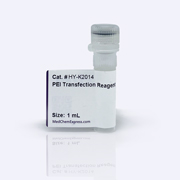
Cat. No.: HY-K2014

MCE PEI Transfection Reagent is designed based on 25 kDa PEI. It has high-efficiency, low-toxicity, strong-stability, and is suitable for many cell types, such as HEK-293、HEK-293T、CHO-K1、COS-1、COS-7、NIH/3T3、Sf9、HepG2 and HeLa et, even some hard-to-transfect cells. It can also be applied to large-scale recombinant protein expression and virus production. The 1 mL is defined as the base specification. All larger sizes correspond to incremental volumes of this base.

loading...
    loading...
2
2 Cited Publications
Cat. No.: HY-D1341
CAS No.: 878019-47-7
Research Areas:  

Cancer

Coumberone is a metabolic fluorogenic probe, and isoform-selective substrate for all AKR1C isoforms. Coumberone can be reduced by all four members of the AKR1C family to its fluorescent alcohol coumberol. Coumberone can be used for the research of AKR1C [1] .
loading...
    loading...
1
1 Cited Publications
Cat. No.: HY-107522
CAS No.: 205309-81-5
Purity:  99.54%
Target:  

EAAT

Research Areas:  

Neurological Disease

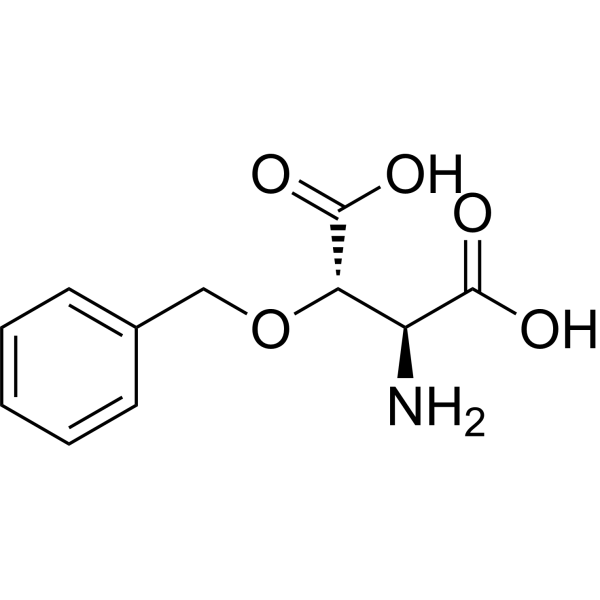
DL-TBOA is a potent non-transportable inhibitor of excitatory amino acid transporters with IC50s of 70 μM, 6 μM and 6 μM for excitatory amino acid transporter-1 (EAAT1), EAAT2 and EAAT3, respectively. DL-TBOA inhibits the uptake of [ 14C]glutamate in COS-1 cells expressing the human EAAT1 and EAAT2 with Ki valuesof 42 μM and 5.7 μM, respectively. DL-TBOA blocks EAAT4 and EAAT5 in a competitive manner with Ki values of 4.4 μM and 3.2 μM, respectively [1] .
loading...
    loading...
Cat. No.: HY-W203683
CAS No.: 375-95-1
Synonyms: PFNA; Heptadecafluorononanoic acid
Target:  

PPAR PERK

Research Areas:  

Metabolic Disease

Perfluorononanoic acid (PFNA) is an orally active PPARα activator. Perfluorononanoic acid activates PPARα-mediated gene expression, including upregulating target genes associated with lipid metabolism and triglyceride storage. Perfluorononanoic acid exhibits certain developmental and reproductive toxicity. Perfluorononanoic acid causes hepatomegaly in pregnant mice, induces high postnatal mortality in neonatal mice, and leads to dose-dependent delays in eye-opening time and puberty onset in mouse offspring [1] .
loading...
    loading...
Cat. No.: HY-E70183
Synonyms: EC:3.2.1.20; GAA
Lysosomal α-Glucosidase (EC:3.2.1.20) is a lysosomal α-Glucosidase that degrades glycogen into glucose and catalyzes the hydrolysis of α-1,4 and α-1,6 glycosidic linkages in glycogen, as well as that of natural and synthetic oligoglucosides. Deficiency of Lysosomal α-Glucosidase causes type II glycogen storage disease (Pompe disease), which is characterized by lysosomal glycogen accumulation in mammals and birds. Lysosomal α-Glucosidase can be used in research related to type II glycogen storage disease [1] .
loading...
    loading...
Cat. No.: HY-107522B
CAS No.: 2093503-71-8
Target:  

EAAT

Research Areas:  

Neurological Disease

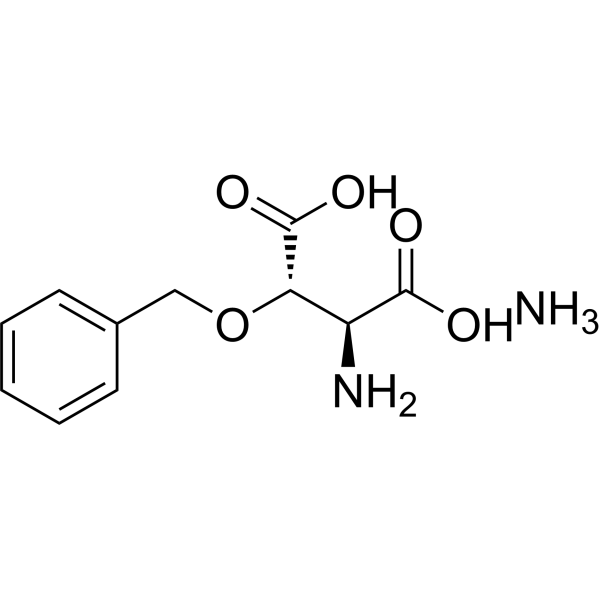
DL-TBOA ammonium is a potent non-transportable inhibitor of excitatory amino acid transporters with IC50s of 70 μM, 6 μM and 6 μM for excitatory amino acid transporter-1 (EAAT1), EAAT2 and EAAT3, respectively. DL-TBOA ammonium inhibits the uptake of [ 14C]glutamate in COS-1 cells expressing the human EAAT1 and EAAT2 with Ki valuesof 42 μM and 5.7 μM, respectively. DL-TBOA ammonium blocks EAAT4 and EAAT5 in a competitive manner with Ki values of 4.4 μM and 3.2 μM, respectively [1] .
loading...
    loading...
Cat. No.: HY-107627
CAS No.: 475498-26-1
Purity:  99.93%
Target:  

Melanocortin Receptor

Research Areas:  

Inflammation/Immunology

MCL0020 is a potent and selective melanocortin MC4 receptor antagonist, with an IC50 of 11.63 nM. MCL0020 dose-dependently and significantly attenuates restraint stress-induced anorexia without affecting food intake [1].
loading...
    loading...
Cat. No.: HY-120188
CAS No.: 1680204-90-3
Purity:  99.94%
Target:  

PPAR

Research Areas:  

Others

CC618 is a selective PPARβ/δ antagonist. CC618 covalently modifies conserved Cys249 in the PPARβ/δ ligand-binding pocket via nucleophilic aromatic substitution, converting its thiol moiety to a 5-trifluoromethyl-2-pyridylthioether [1] .
loading...
    loading...
Cat. No.: HY-173033
CAS No.: 2530027-71-3
MI-883 is orally active constitutive androstane receptor (CAR) (EC50 of 73 nM) agonist and pregnane X Receptor (PXR) (IC50 of 100 nM) antagonist. MI-883 binds to CAR and PXR ligand-binding domains, promotes CAR LBD assembly, activates CAR3 variant, stimulates CAR cytoplasmic-nuclear translocation, upregulates CAR target genes, recruits coactivators NCOA1, NCOA2, NCOA3, inhibits basal and agonist-induced PXR activation, downregulates PXR target genes, disrupts PXR-NCOR2 interaction, blocks agonist-mediated PXR-NCOA1 recruitment. MI-883 reduces plasma total cholesterol, LDL cholesterol, and hepatic free cholesterol levels, increases fecal bile acid excretion, regulates genes involved in xenobiotic metabolism, cholesterol homeostasis, and bile acid homeostasis. MI-883 exhibits metabolic stability, liver-predominant distribution, a safety profile with no observed toxicity, and does not stimulate human hepatocyte hypertrophy or hyperplasia. MI-883 can be used for the research of diet-induced hypercholesterolemia [1].
loading...
    loading...
Cat. No.: HY-117953
CAS No.: 155180-53-3
Target:  

Androgen Receptor

Research Areas:  

Cancer

RU 59063 is a high-affinity, selective nonsteroidal androgen receptor (AR) ligand that acts as a partial AR agonist/antagonist in CV-1 cell transcription assays. RU 59063 has a Ka value of 6.2×10 9 M -1 for human AR. RU 59063 induces a conformation of AR that can bind to the androgen response element (ARE), triggers partial AR-dependent transcriptional activation, and antagonizes testosterone-induced AR transcriptional activity. RU 59063 inhibits testosterone propionate-induced ornithine decarboxylase activity in mouse kidneys and testosterone propionate-induced prostate weight gain in rats. RU 59063 can be used in studies related to prostate cancer [1] .
loading...
    loading...
Cat. No.: HY-P12114
Research Areas:  

Infection Cancer

S3 peptide is a multifunctional synthetic peptide that acts as a LIMK1 inhibitor with an IC50 of 40 μg/mL. S3 peptide blocks cofilin phosphorylation and SDF-1α (HY-P4911)-induced T cell chemotaxis, and reduces viral particle production of HIV-1 and M-PMV. S3 peptide forms dimers via intermolecular disulfide bonds to bind and disrupt LPS micelles, exerting anti-Gram-negative bacterial activity. S3 peptide serves as a targeting moiety for NKA α1 and is used for the construction of PET tracers. S3 peptide is applicable to research related to HIV-1 infection, M-PMV infection, breast cancer, liver cancer and non-small cell lung cancer [1] .
loading...
    loading...
Cat. No.: HY-P11586
Target:  

Amylin Receptor

Research Areas:  

Metabolic Disease

San45 is a nonselective dual amylin and calcitonin receptor agonist (DACRA) with nonselective potency relative to calcitonin receptor (CTR) and amylin 1 receptor (AMY₁R), and acts as a stabilizer of receptor-ligand complex and prolonged activator of cAMP signaling. San45 carries a conjugated lipid modification that can be used for the research of obesity [1].
loading...
    loading...
  • 1

