1. Search Result
Search Result
Pathways Recommended: Stem Cell/Wnt Cell Cycle/DNA Damage
Results for "

HuH7 HCC cells

" in MedChemExpress (MCE) Product Catalog:

13

Inhibitors & Agonists

3

Natural
Products

Cat. No. Product Name Target Research Areas Chemical Structure
  • HY-12794
    Vps34-PIK-III
    10+ Cited Publications

    PI3K Autophagy Neurological Disease Cancer
    Vps34-PIK-III is an orally active and selective VPS34 inhibitor (IC50=18 nM). Vps34-PIK-III effectively inhibits autophagy and can be used as a molecular tool. vps34-PIK-III is also a PI3K inhibitor that inhibits the expression of genes in liver cancer stem cells (CSCs) .
    Vps34-PIK-III
  • HY-15897
    LDN-212854
    1 Publications Verification

    TGF-β Receptor Cancer
    LDN-212854 is a bone morphogenetic protein (BMP) inhibitor that potently inhibits ALK2 (IC50: 1.3 nM). LDN-212854 also inhibits ALK1 (IC50: 2.40 nM). LDN-212854 can be used in the research of fibrodysplasia ossificans progressive and cancers, such as hepatocellular carcinoma (HCC) .
    LDN-212854
  • HY-121204

    3-Methylthiopropyl isothiocyanate

    Apoptosis Reactive Oxygen Species (ROS) Cancer
    Iberverin (-Methylthiopropyl isothiocyanate) is a sulforaphane homolog. Iberverin has anticancer activity. Iberverin inhibits cell proliferation and migration. Iberverin induces mitochondrial-related apoptosis and intracellular reactive oxygen species .
    Iberverin
  • HY-178098

    YAP Cancer
    TEAD-IN-21 is a potent and orally active pan-TEAD inhibitor with an IC50 of 3 nM. TEAD-IN-21 effectively inhibited the proliferation of Huh-7 cells. TEAD-IN-21 selectively downregulates TEAD-dependent downstream genes. TEAD-IN-21 achieves tumor regression in a liver cancer-derived tumor xenograft mice model. TEAD-IN-21 can be used in the research of hepatocellular carcinoma (HCC) .
    TEAD-IN-21
  • HY-155046

    FGFR Cancer
    FGFR4-IN-14 (Compound 27i) is a FGFR4 inhibitor (IC50: 2.4 nM. FGFR4-IN-14 inhibits the proliferation of V550L and N535K mutant strains, with IC50s of 21 nM, 2.5 nM, 171 nM against huh7, BaF3/ETV6-FGFR4-V550L and BaF3/ETV6-FGFR4-N535K cells respectively. FGFR4-IN-14 has potent antitumor efficacy in the Huh7 xenograft model. FGFR4-IN-14 can be used for research of hepatocellular carcinoma (HCC) .
    FGFR4-IN-14
  • HY-168085

    YAP Apoptosis Cancer
    CV-4-26 (Compound 22) is a covalent inhibitor of TEAD. CV-4-26 inhibits YAP/TEAD-based transcription, leading to the reduction of CTGF and CYR61 expression. CV-4-26 inhibits Huh7 and HepG2 cell colony formation, induces cell cycle arrest, and apoptosis. CV-4-26 shows antitumor activity against hepatocellular carcinoma (HCC) and hepatoblastoma (HB) .
    CV-4-26
  • HY-168337

    JNK Pyruvate Kinase
    SET-171 is a JNK (c-Jun N-terminal kinase) inhibitor that exhibits significant anticancer activity and lipid metabolism regulation by inhibiting liver pyruvate kinase (PKL) expression. In anticancer studies, SET-171 shows IC50 values of 8.82 μM and 2.97 μM against HepG2 and Huh7 cell lines, respectively, indicating high cytotoxicity. Additionally, in non-alcoholic fatty liver disease (NAFLD)-related studies, SET-171 significantly reduces triacylglycerol (TAG) levels and inhibits the expression of steatosis-related proteins. SET-171 holds promise for research on hepatocellular carcinoma (HCC) and NAFLD .
    SET-171
  • HY-179381

    FGFR Cancer
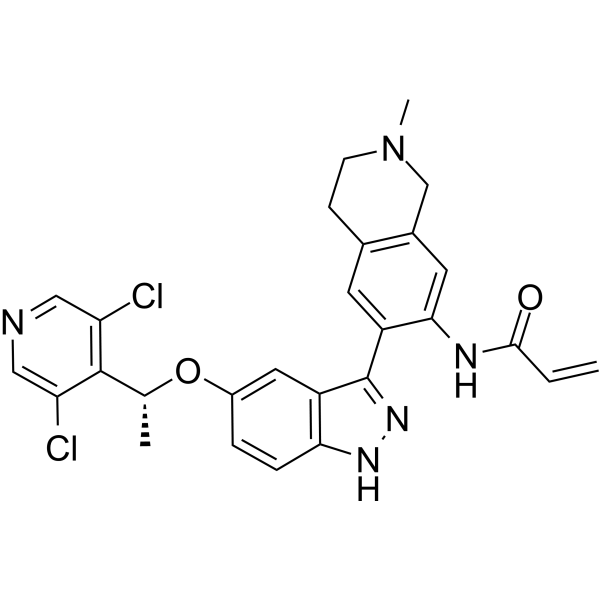
    FGFR4-IN-24 is a selective irreversible covalent FGFR4 inhibitor (IC50 = 1.2 nM). FGFR4-IN-24 shows much weaker activity against the other three FGFR family kinases (FGFR1-3). FGFR4-IN-24 inhibits the FGF19/FGFR4 signaling pathway, effectively suppressing the proliferation of the HuH-7 HCC cell line (GI50 = 17 nM). FGFR4-IN-24 exhibits significant antitumor activity in a HuH-7 mouse xenograft model. FGFR4-IN-24 can be used for the research of hepatocellular carcinoma .
    FGFR4-IN-24
  • HY-N2858

    Apoptosis Cancer
    Alpinumisoflavone acetate is a anticancer agent. Alpinumisoflavone acetate shows antiproliferative activity. Alpinumisoflavone acetate decreases the expression of phosphorylation of ERK1/2. Alpinumisoflavone acetate induces mitochondrial dysfunction and mitochondria-mediated Apoptosis. Alpinumisoflavone acetate has the potential for the research of HCC .
    Alpinumisoflavone acetate
  • HY-121204R

    3-Methylthiopropyl isothiocyanate (Standard)

    Reference Standards Apoptosis Reactive Oxygen Species (ROS) Cancer
    Iberverin (Standard) is the analytical standard of Iberverin. This product is intended for research and analytical applications. Iberverin (-Methylthiopropyl isothiocyanate) is a sulforaphane homolog. Iberverin has anticancer activity. Iberverin inhibits cell proliferation and migration. Iberverin induces mitochondrial-related apoptosis and intracellular reactive oxygen species[1].
    Iberverin (Standard)
  • HY-146504

    Topoisomerase PI3K Apoptosis Reactive Oxygen Species (ROS) Cancer
    Topoisomerase I/II inhibitor 3 (compound 7) is a potent topoisomerase I (Topo I) and II (Topo II) dual inhibitor. Topoisomerase I/II inhibitor 3 can inhibit cell proliferation, invasion and migration, and induce apoptosis by inhibiting PI3K/Akt/mTOR signaling pathway. Topoisomerase I/II inhibitor 3 can be used for liver cancer research .
    Topoisomerase I/II inhibitor 3
  • HY-183058

    Histone Methyltransferase Cancer
    EZM8266 is an orally active and selective G9a (EHMT2) histone methyltransferase inhibitor with a human EHMT2 IC50 of 1 pM. EZM8266 reduces repressive H3K9me2 marks at immune-stimulatory gene and endogenous retroviral element promoters. EZM8266 reduces colony formation, migration, and invasion of cancer cells. EZM8266 enhances IFN-γ response, increases MHC class I expression, and enhances CXCL10-mediated T cell recruitment in cancer cells. EZM8266 can be used for the research of hepatocellular carcinoma .
    EZM8266
  • HY-183753

    YAP Apoptosis Cancer
    LC-TD-05 is a non-covalent inhibitor of TEAD1, TEAD2 and TEAD4, with IC50 values of 116.6 nM, 168.7 nM and 68.3 nM, respectively; it shows weak activity against TEAD3, with a human IC50 of 1261.0 nM. LC-TD-05 induces apoptosis in hepatocellular carcinoma cells. LC-TD-05 can be used for the research of hepatocellular carcinoma .
    LC-TD-05

Inquiry Online

Your information is safe with us. * Required Fields.

Salutation


Country or Region *

Applicant Name *


Organization Name *

Department *


Email Address *


Product Name *

Cat. No.


Requested quantity *

Phone Number *


Remarks

Inquiry Online

Inquiry Information

Product Name:
Cat. No.:
Quantity:
MCE Japan Authorized Agent:

