33 Results for "

N-TFA

" in MedChemExpress (MCE) Product Catalog:
Products (33)

33 Results for "N-TFA" in MCE Product Catalog:

Cat. No.: HY-114118S3
Purity:  96.04%
Semaglutide- 13C6, 15N TFA is the 13C- and 15N-labeled Semaglutide TFA (HY-114118A). Semaglutide TFA is a long-acting, selective, competitive GLP-1R agonist that can penetrate the blood-brain barrier. After activating GLP-1R, Semaglutide TFA promotes insulin secretion, inhibits gastric emptying and appetite, and at the same time enhances autophagy, inhibits oxidative stress and apoptosis. Semaglutide TFA also regulates mitochondrial function and lipid metabolism (such as reducing de novo lipogenesis in the liver). Semaglutide TFA has activities such as lowering blood sugar, reducing weight, neuroprotection (such as improving motor function in Parkinson's disease models, reducing α-synuclein aggregation) and improving hepatic steatosis. Semaglutide TFA can be used for the study of neurodegenerative diseases and liver diseases such as type 2 diabetes, obesity, Parkinson's disease, metabolic associated fatty liver disease (MASLD), and cancer .
loading...
    loading...
Cat. No.: HY-13948BS
Purity:  98.11%
Synonyms: Angiotensin II-13C6,15N TFA; Ang II-13C6,15N TFA; DRVY(I-13C6,15N)HPF TFA
Research Areas:  

Cancer

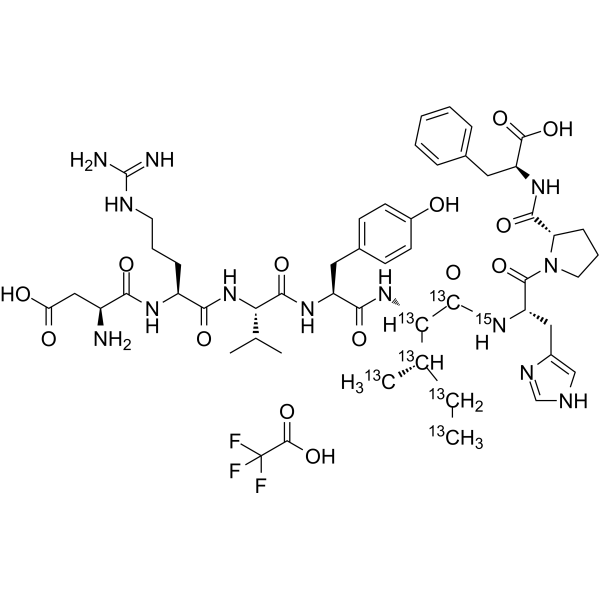
Angiotensin II human- 13C6, 15N TFA (Ang II- 13C6, 15N TFA) is 13C- and 15N-labeled Angiotensin II human (TFA) (HY-13948B). Angiotensin II human (Angiotensin II) TFA is a vasoconstrictor and a major bioactive peptide of the renin/angiotensin system. Angiotensin II human TFA plays a central role in regulating human blood pressure, which is mainly mediated by interactions between Angiotensin II and the G-protein-coupled receptors (GPCRs) Angiotensin II type 1 receptor (AT1R) and Angiotensin II type 2 receptor (AT2R). Angiotensin II human TFA stimulates sympathetic nervous stimulation, increases aldosterone biosynthesis and renal actions .
loading...
    loading...
Cat. No.: HY-17405S
Alarelin-(Leu-sup>13C10, 15N) TFA is the 13C- and 15N-labeled Alarelin TFA.
loading...
    loading...
Cat. No.: HY-101399SA
Synonyms: H-γ-Glu-Phe-OH-13C9,15N TFA; γ-Glutamylphenylalanine-13C9,15N TFA
γ-Glu-(Phe-13C9,15N) (γ-Glutamylphenylalanine-13C9,15N) TFA is the 13C- and 15N-labeled γ-Glu-Phe TFA (HY-101399A). γ-Glu-Phe TFA is synthesized by Bacillus amyloliquefaciens (GBA) and Aspergillus oryzae (GAO). γ-Glu-Phe TFA or the post-enzymatic reaction mixture enhances the umami intensity of commercial soy sauce and model chicken broth .
loading...
    loading...
Cat. No.: HY-P1033S1
Research Areas:  

Cardiovascular Disease

[Pyr1]-Apelin-13, Pro( 13C5, 15N) (TFA) is the 13C and 15N labeled isotope of [Pyr1]-Apelin-13(HY-P1033).[Pyr1]-Apelin-13 is a potent and selective endogenous apelin receptor agonist .
loading...
    loading...
Cat. No.: HY-113278S
Leucyl-phenylalanine- 13C6, 15N TFA is the 13C, 15N-labeled Leucyl-phenylalanine (HY-113278). Leucyl-phenylalanine is a linear dipeptide composed of L-leucine and L-phenylalanine, and also serves as a cyclization substrate. Leucyl-phenylalanine is an incomplete degradation product generated during protein breakdown or catabolism. Leucyl-phenylalanine undergoes heat-induced solid-state cyclization via an autocatalytic mechanism to form its cyclic diketopiperazine analog .
loading...
    loading...
Cat. No.: HY-13443S
Synonyms: Exenatide (Leu-13C6,15N) TFA
Exendin-4 (Leu- 13C6, 15N) TFA (Exenatide (Leu- 13C6, 15N) TFA) is the 13C, 15N-labeled Exendin-4 (HY-13443). Exendin‑4 (Exenatide) is an orally active, blood-brain barrier-permeable glucagon-like peptide-1 receptor (GLP‑1 receptor) agonist that resists degradation mediated by dipeptidyl peptidase IV. Exendin‑4 mediates multiple glucose-regulating effects, including stimulation of glucose-dependent insulin secretion, inhibition of glucagon production, increase in β-cell mass, delay of gastric emptying, reduction of food intake, improvement of peripheral insulin sensitivity, and restoration of normal islet structure. Exendin‑4 inhibits oxidative stress, alleviates inflammatory responses, and reduces neuronal apoptosis. Exendin‑4 reduces the aggregation level of mutant huntingtin, improves motor function, prolongs survival time, and regulates the expression levels of leptin and ghrelin. Exendin‑4 can be used in research related to type 2 diabetes, acute ischemic stroke, and Huntington's disease .
loading...
    loading...
Cat. No.: HY-P4473S
H-Phe-Ile-OH- 13C6, 15N TFA is the 13C- and 15N-labeled H-Phe-Ile-OH (HY-P4473). H-Phe-Ile-OH is a polypeptide that can be found by peptide screening. Peptide screening is a research tool that pools active peptides primarily by immunoassay. Peptide screening can be used for protein interaction, functional analysis, epitope screening, especially in the field of agent research and development .
loading...
    loading...
Cat. No.: HY-P1363S1
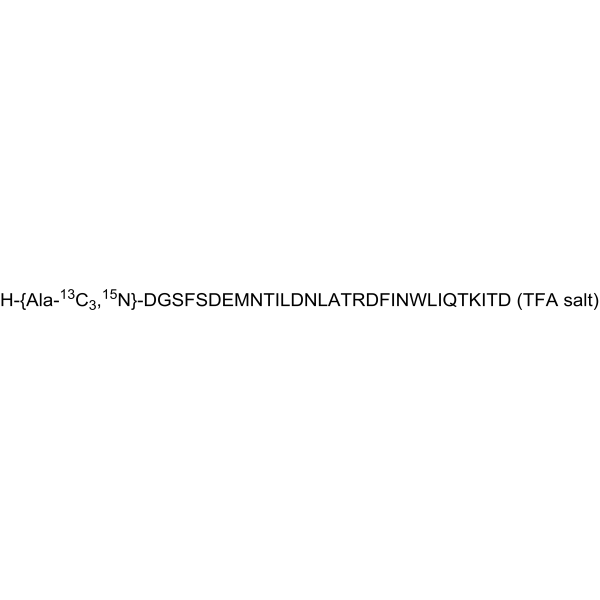
β-Amyloid (1-42), human, Ala( 13C3, 15N) TFA is the 13C and 15N-labeled β-Amyloid (1-42), human (HY-P1363A). β-Amyloid (1-42) (Amyloid β-peptide (1-42)), human, a 42-amino acid peptide that has not been treated with HFIP, is a brain-penetrant amyloid protein fragment, which can be used in research on Alzheimer's disease and Down’s syndrome. β-Amyloid (1-42), human remaining as a monomer exhibits antioxidant and neuroprotective effects. β-Amyloid (1-42), human, after being monomericized by HFIP and dissolved in DMSO to form the stock solution, on the one hand, can form soluble oligomers (AβOs) when incubated at 4 °C, which have synaptic toxicity and neurotoxicity; on the other hand, it can be incubated at 37 °C to form insoluble fibrils, with lower neurotoxicity, and participating in the oxidative damage process. Aβ42 oligomers bind to various neuronal surface receptors (such as PrPc, mGluR5, NMDA receptors, etc.), triggering oxidative stress, calcium homeostasis imbalance, and synaptic toxicity via activating downstream signaling pathways, leading to neuronal dysfunction and death .
loading...
    loading...
Cat. No.: HY-P0014S2
Research Areas:  

Others

Liraglutide- 13C6, 15 TFA is the 13C and 15N labeledLiraglutide(HY-P0014). Liraglutide is a glucagon-like peptide-1 (GLP-1) receptor agonist used for the study of type 2 diabetes mellitus .
loading...
    loading...
Cat. No.: HY-P0206S
Research Areas:  

Cardiovascular Disease

RPPGFSPF-(Arg- 13C6, 15N) TFA is the 13C- and 15N-labeled RPPGFSPF.
loading...
    loading...
Cat. No.: HY-P6696S
Research Areas:  

Others

β-CL, Ala(sup>13C3, 15N) TFA is the 13C- and 15N-labeled β-CL TFA.
loading...
    loading...
Cat. No.: HY-P1033S
Target:  

Apelin Receptor (APJ)

Research Areas:  

Cardiovascular Disease

Pyr1]-Apelin-13, Gly(15N) TFA is a Gly 15N labeled [Pyr1]-Apelin-13. [Pyr1]-Apelin-13 is a highly potent, selective endogenous apelin receptor agonist .
loading...
    loading...
Cat. No.: HY-W007035S
Synonyms: Valyl-alanine-13C5,15N TFA
H-Val-Ala-OH- 13C5, 15N (Valyl-alanine- 13C5, 15N) TFA is the 13C- and 15N-labeled H-Val-Ala-OH (HY-W007035). H-Val-Ala-OH (Valyl-alanine) is a dipeptide formed from L-Valine and L-Alanine residues. H-Val-Ala-OH has a role as a metabolite and also has a bitter taste .
loading...
    loading...
Cat. No.: HY-150400A
CAS No.: 2694057-55-9
Synonyms: MS132N TFA
Target:  

PROTACs WDR5

Research Areas:  

Cancer

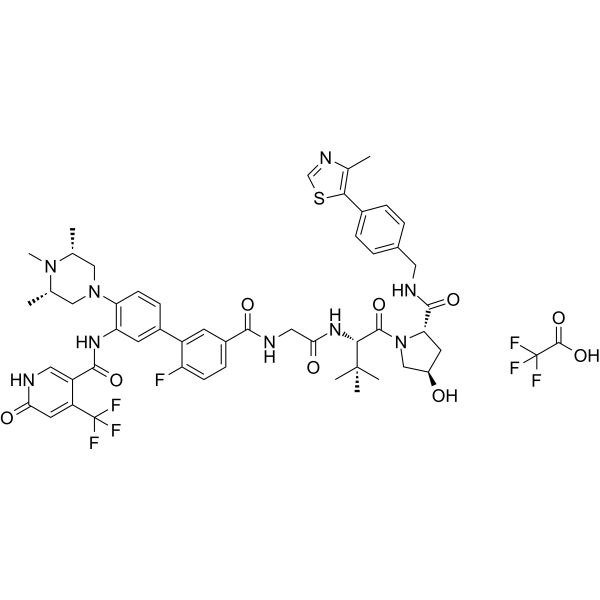
XF056-132 (MS132N TFA) is an inactive WDR5 PROTAC degrader with a Kd value of 106 nM against human targets, and exhibits no significant binding to the VHL complex, serves as a negative control for MS132. XF056-132 binds to WDR5, does not induce WDR5 degradation in pancreatic cancer cells, and exerts no inhibitory effect on adenocarcinoma cells. XF056-132 can be used in the research of pancreatic ductal adenocarcinoma .
loading...
    loading...
Cat. No.: HY-P2625S1
Research Areas:  

Metabolic Disease

GLP-2(3-33) (Leu- 13C6, 15N) TFA is 13C and 15N labeled GLP-2(3-33) (HY-P2625). GLP-2(3-33), generated naturally by dipeptidylpeptidase IV (DPPIV), acts as a partial agonist on GLP-2 receptor (EC50=5.8 nM).
loading...
    loading...
Cat. No.: HY-P1142S1
Research Areas:  

Others

GLP-2(rat) (Ala- 13C3, 15N) TFA is 13C and 15N labeled GLP-2(rat) (HY-P1142). GLP-2(rat) is an intestinal growth factor. GLP-2(rat) stimulates cell proliferation and inhibits apoptosis. GLP-2(rat) enhances mucosal mass and function in residual small intestine after massive small bowel resection (MSBR).
loading...
    loading...
Cat. No.: HY-P0119S
Lixisenatide (Leu- 13C6, 15N) TFA is the 13C- and 15N-labeled Lixisenatide (HY-P0119). Lixisenatide is a glucagon-like peptide-1 (GLP-1) receptor agonist. Lixisenatide inhibits the inflammatory response through down regulation of pro-inflammatory cytokines, and suppresses of the Akt-MEK1/2 signaling pathway. Lixisenatide can inhibit oxidative stress, mitochondrial dysfunction and apoptosis. Lixisenatide can be used for the researches of inflammation, metabolic disease, neurological disease and cardiovascular disease, such as rheumatoid arthritis, diabetes, Alzheimer's disease and atherosclerosis .
loading...
    loading...
Cat. No.: HY-W018386AS
CAS No.: 2704853-65-4
Synonyms: 3-Bromo-Tyr-13C9,15N TFA
3- Bromo- L- tyrosine- 13C9, 15N (3-Bromo-Tyr- 13C9, 15N) TFAis 13C and 15N labeled 3- Bromo- L- tyrosine (TFA). 3-Bromo-L-tyrosine (3-Bromo-Tyr) TFA is a tyrosine derivative .
loading...
    loading...
Cat. No.: HY-W1061588
CAS No.: 258343-51-0
Research Areas:  

Others

Amino(N-TFA)-modifier C3 Phosphoramidite is a phosphoramidite. Amino(N-TFA)-modifier C3 Phosphoramidite can be used for oligonucleotide synthesis research.
loading...
    loading...