15 Results for "

NCI-H187

" in MedChemExpress (MCE) Product Catalog:
Products (15)

15 Results for "NCI-H187" in MCE Product Catalog:

Cat. No.: HY-W779529
CAS No.: 25633-33-4
Synonyms: 2'-Acetylneriifolin
Target:  

Na+/K+ ATPase

Research Areas:  

Cancer

Cerberin is a cardiac glycoside that has been found in C. odollam and has cytotoxic and cardiac modulatory activities. It is cytotoxic to KB and NCI H187 cancer cells (IC50s=1.92 and 1.24 μg/mL).1 Cerberin inhibits Na+/K+-ATPase, increasing intracellular sodium levels and action potential duration in cardiac cells.
loading...
    loading...
Cat. No.: HY-N12232
CAS No.: 108073-63-8
Carbazomycin D exhibits antituberculosis and antimalarial activities, that inhibits Plasmodium falciparum with an IC50 > 10 μg/mL, inhibits Mycobacterium tuberculosis with MIC of 25 μg/mL. Carbazomycin D exhibits cytotoxicity in cell MCF-7, KB, NCI-H187 and Vero, with IC50s of 21.3, 33.2, 12.9, and 34.3 μg/mL, respectively .
loading...
    loading...
Cat. No.: HY-N12230
CAS No.: 1418291-70-9
Penicolinate B is a picolinic acid derivative that can be isolated from Penicillium sp. Penicolinate B exhibits antimalarial activity (IC50: 1.40 μg/mL), antitubercular activity (MIC: 25.0 μg/mL), activity against Bacillus cereus (IC50: 25.0 μg/mL), and activity against Candida albicans (IC50: 1.45 μg/mL). Penicolinate B also has certain cytotoxicity against cancer cells such as MCF-7, KB, and NCI-H187. Penicolinate B can be used in research on malaria, tuberculosis, bacterial/fungal infections and tumors .
loading...
    loading...
Cat. No.: HY-145379
CAS No.: 3039491-16-9
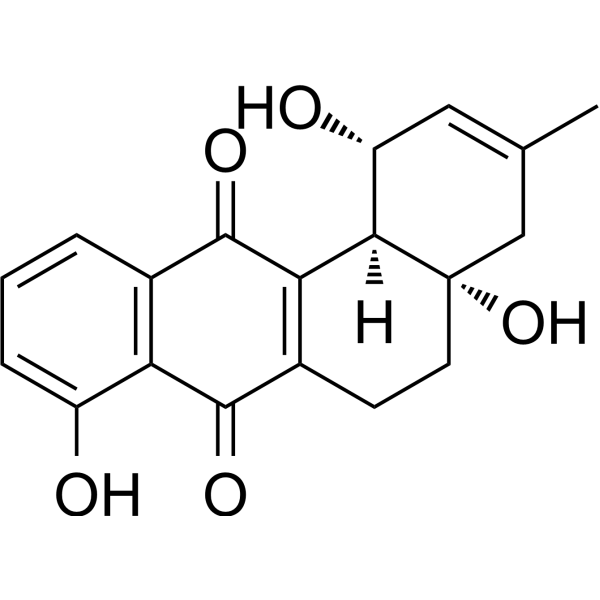
Miaosporone A, an angucyclic quinone, exhibits antimalarial activity against Plasmodium falciparum K1 and antibacterial activity against Mycobacterium tuberculosis with respective IC50 values of 2.5 and 2.4 μM and displays cytotoxic activities against both cancerous (MCF-7 and NCI-H187) and nonmalignant (Vero) cells .
loading...
    loading...
Cat. No.: HY-N15652
CAS No.: 30270-17-8
Versimide (Compound 15) can be isolated from the insect pathogenic fungus Gibellula sp. BCC36964. Versimide exhibits cytotoxicity in cell lines including MCF-7, KB, NCI-H187, and Vero with IC50s of 3.59, 4.83, 1.89, and 3.49 μg/mL, respectively, demonstrating its anticancer activity .
loading...
    loading...
Cat. No.: HY-N8470
CAS No.: 54526-94-2
Synonyms: NSC 204855; U 40615
Target:  

Bacterial

Research Areas:  

Infection

Steffimycin B is an anthracycline bacterial metabolite originally isolated from Streptomyces. It binds to DNA, preferentially intercalating at sites containing cytosine and guanine.2 Steffimycin B is cytotoxic to MCF-7, KB, NCI-H187, and Vero cells (IC50s=3.5, 6.75, 3.28, and 10.5 μM, respectively). It is active against M. tuberculosis (MIC=5.2 nM), B. cereus (MIC=1.56 μg/mL), and P. falciparum (IC50=2.19 μM).
loading...
    loading...
Cat. No.: HY-N7302
CAS No.: 1801750-22-0
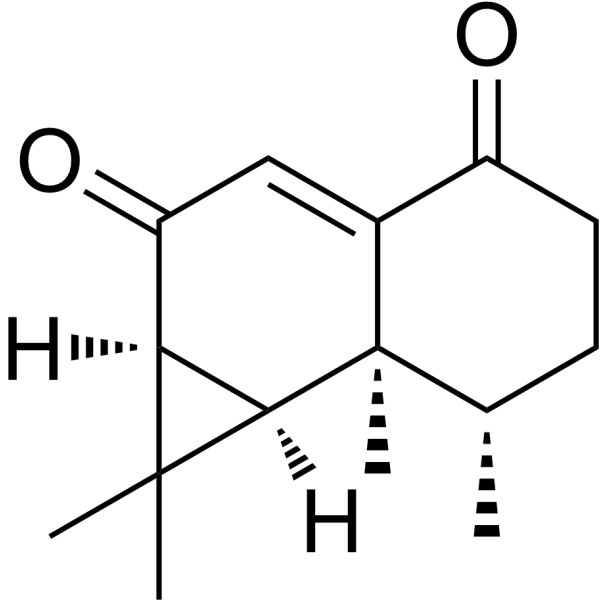
Anthracophyllone is an aristolane sesquiterpene that can be isolated from the mushroom Anthracophyllum. Anthracophyllone has cytotoxicity against MCF-7, KB, NCI-H187, Vero cells (IC50: 32.97, 18.02, 15.17, 18.06 μM) .
loading...
    loading...
Cat. No.: HY-N9475
CAS No.: 4439-98-9
Betulonaldehyde is a pentacyclic triterpenoid that can be isolated from Diospyros filipendula. Betulonaldehyde has antiplasmodial activity (IC50: 3.36 µg/mL). Betulonaldehyde has cytotoxic to NCI H187 lung cancer cells and non-cancerous Vero cells (IC50s: 19.23 and 17.09 µg/mL, respectively). Betulonaldehyde inhibits Phorbol 12-myristate 13-acetate (HY-18739) induced inflammation in mice .
loading...
    loading...
Cat. No.: HY-N21796
CAS No.: 1362114-29-1
4,5,4'-Trihydroxy-3,3'-dimethoxybibenzyl is a bibenzyl compound found in Dendrobium secundum. 4,5,4'-Trihydroxy-3,3'-dimethoxybibenzyl exhibits cytotoxicity against KB human oral epidermoid carcinoma cells, NCI‑H187 human non-small cell lung cancer cells, and MCF‑7 human breast cancer cells. 4,5,4'-Trihydroxy-3,3'-dimethoxybibenzyl can be used in cancer research .
loading...
    loading...
Cat. No.: HY-N15678
CAS No.: 52940-12-2
Synonyms: 1,3,6,8-THAQ
Rheoemodin is an anthraquinone and antibacterial agent. Rheoemodin can be isolated from Cordyceps morakotii BCC 56811. Rheoemodin exhibits antibacterial activity against Acinetobacter baumannii (MIC: 12.5 μg/mL). Rheoemodin also exhibits weak to moderate antimycobacterial and antifungal activity. Rheoemodin also exhibits anticancer activity against breast cancer and small cell lung cancer .
loading...
    loading...
Cat. No.: HY-178724
CAS No.: 1179374-63-0
Target:  

Fungal Bacterial Parasite

Research Areas:  

Infection Cancer

Mollicellin K is a depsidone that can be isolated from the fungus Chaetomium brasiliense. Mollicellin K exhibits antimicrobial activity against Myobacterium tuberculosis, antimalarial activity (IC50 = 1.2 μM) against Plasmodium falciparum as well as antifungal property (IC50 = 1.2 μM) against Candida albicans. Mollicellin K is cytotoxic against KB (IC50 = 1.9 μM), BC1 (IC50 = 6.8 μM), NCI-H187 (IC50 = 0.35 μM), and five cholangiocarcinoma cell lines. Mollicellin K also has an MIC of 12.5 μM for tuberculosis .
loading...
    loading...
Cat. No.: HY-N15054
CAS No.: 52762-28-4
17-O-Demethylgeldanamycin is a secondary metabolite that can be isolated from Streptomyces. 17-O-Demethylgeldanamycin exhibits cytotoxicity against a variety of tumor cells and has anti-tumor activity .
loading...
    loading...
Cat. No.: HY-N19792
CAS No.: 1810706-07-0
6-(3'-Methyl-1',3'-butadienyl)-5,7-dimethoxycoumarin is a cytotoxic coumarin compound that can be isolated from the stem bark of Toddalia asiatica. 6-(3'-Methyl-1',3'-butadienyl)-5,7-dimethoxycoumarin can be used for the research of small cell lung cancer .
loading...
    loading...
loading...
    loading...
Cat. No.: HY-N19651
CAS No.: 109175-37-3
Oxophoebine is a biologically active oxoaporphine alkaloid and also a DNA topoisomerase inhibitor. Oxophoebine acts as a cytotoxic agent against certain cancer cells. Oxophoebine binds to Measles Virus fusion protein, hemagglutinin and phosphoprotein, and interferes with viral entry, replication and particle assembly processes. Oxophoebine exhibits selective toxicity towards yeast mutants with defects in DNA repair and recombination. Oxophoebine can be used in studies related to measles and coronavirus disease 2019 (COVID-19) .
loading...
    loading...
  • 1

