9 Results for "

PANK2

" in MedChemExpress (MCE) Product Catalog:
Products (9)

9 Results for "PANK2" in MCE Product Catalog:

  • Isoforms Recommended:
  • Targets Recommended:
4
4 Cited Publications
Cat. No.: HY-124634
CAS No.: 2170608-82-7
Purity:  99.68%
Target:  

PANK

Research Areas:  

Neurological Disease

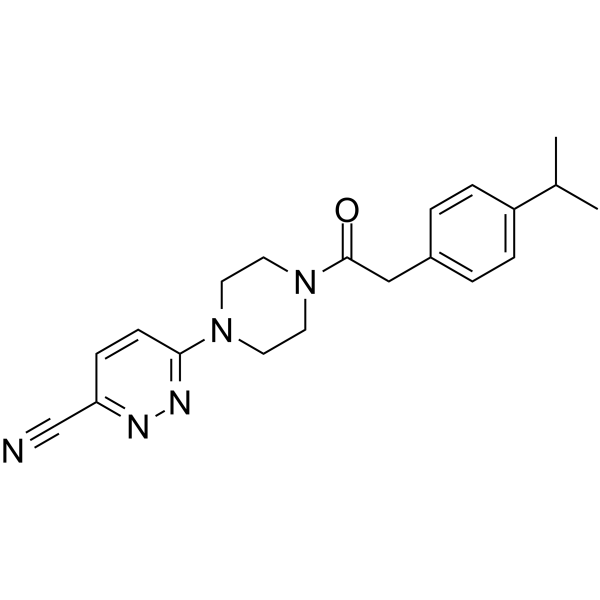
PZ-2891 is an orally bioavailable, brain penetrant pantothenate kinase (PANK) modulator. PZ-2891 act as an orthosteric inhibitor at high concentrations and an allosteric activator at lower sub-saturating concentrations. PZ-2891 inhibits human pantothenate kinases PANK1β, PANK2, and PANK3 with IC50s of 40.2 nM, 0.7 nM and 1.3 nM, respectively .
loading...
    loading...
2
2 Cited Publications
Cat. No.: HY-44170
CAS No.: 902614-04-4
Target:  

PANK

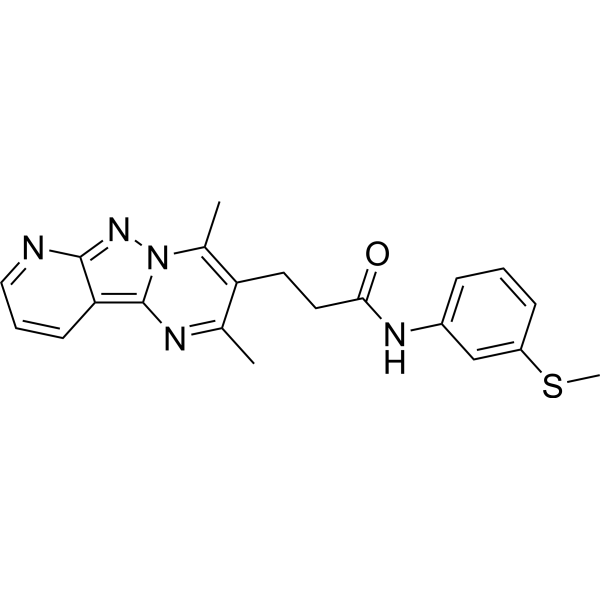
Pantothenate kinase-IN-2 is a pantothenate kinase inhibitor with IC50 values of 92 nM for PanK2, 70 nM for PanK1β, and 25 nM for PanK3. Pantothenate kinase-IN-2 can bind specifically to the ATP-PanK3 complex and block CoA biosynthesis. Pantothenate kinase-IN-2 can be used for the research of pank-associated neurodegeneration and type 2 diabetes .
loading...
    loading...
Cat. No.: HY-159509
CAS No.: 2361124-03-8
Synonyms: Claziprotamide; BBP-671
Target:  

PANK

Claziprotamidum (Claziprotamide; BBP-671) is a panthothenate kinase (PANK) activator with oral activity and blood-brain barrier permeability. Claziprotamidum binds to and activates all PANK isoforms, with the highest affinity for PANK3 (KD = 97 pM; IC50 = 1.39 nM). Claziprotamidum increases the intracellular biosynthesis of Coenzyme A (HY-128851) and restores mitochondrial function. Claziprotamidum can be used in the research of pantothenate kinase-associated neurodegeneration and propionic acidemia [2] .
loading...
    loading...
Cat. No.: HY-RS10017
Research Areas:  

Others

PANK2 Human Pre-designed siRNA Set A contains three designed siRNAs for PANK2 gene (Human), as well as a negative control, a positive control, and a FAM-labeled negative control.

loading...
    loading...
Cat. No.: HY-RS21012
Research Areas:  

Others

Pank2 Mouse Pre-designed siRNA Set A contains three designed siRNAs for Pank2 gene (Mouse), as well as a negative control, a positive control, and a FAM-labeled negative control.

loading...
    loading...
Cat. No.: HY-RS27529
Research Areas:  

Others

Pank2 Rat Pre-designed siRNA Set A contains three designed siRNAs for Pank2 gene (Rat), as well as a negative control, a positive control, and a FAM-labeled negative control.
loading...
    loading...
Cat. No.: HY-P88553
Synonyms: C20orf48; HARP; HSS; NBIA1; PKAN

Host:  

Mouse

Application:  

WB, IHC-P, ICC/IF, FC

Reactivity:  

Human, Dog, Rat, Monkey, Mouse

loading...
    loading...
Cat. No.: HY-P88553A
Synonyms: C20orf48; HARP; HSS; NBIA1; PKAN

Host:  

Mouse

Application:  

WB, IHC-P, ICC/IF, FC

Reactivity:  

Human, Dog, Rat, Monkey, Mouse

loading...
    loading...
Cat. No.: HY-W1143867
CAS No.: 2226-71-3
4’-Phosphopantetheine is an orally active coenzyme A (CoA) precursor. 4’-Phosphopantetheine is membrane-permeable and acts as a CoA precursor, a prosthetic group, and a reactive oxygen species (ROS) inhibitor. 4’-Phosphopantetheine binds covalently to rat liver fatty acid synthase, modifies the conserved serine residue in the PKS/NRPS carrier protein domain, and serves as a substrate for CoA synthase and PPAT. 4’-Phosphopantetheine undergoes non-catalytic exchange on rat liver fatty acid synthase, with a faster turnover rate than that of the enzyme complex, and restores intracellular CoA levels in cells with impaired de novo biosynthesis. 4’-Phosphopantetheine rescues phenotypes induced by CoA deficiency, normalizes PKAN-related biomarkers, restores mitochondrial enzyme activity, and alleviates vascular endothelial damage. 4’-Phosphopantetheine shows biological stability in serum, acts as a prosthetic group and degradation product of ACP, and inhibits the formation of atherosclerotic plaques. 4’-Phosphopantetheine can be used in the research of brain iron accumulation neurodegenerative diseases, pantothenate kinase-associated neurodegeneration, CoASY protein-associated neurodegenerative diseases, coronary heart disease, and atherosclerosis [2] .
loading...
    loading...

