14 Results for "

TLR1/TLR2

" in MedChemExpress (MCE) Product Catalog:
Products (14)

14 Results for "TLR1/TLR2" in MCE Product Catalog:

14
14 Cited Publications
Cat. No.: HY-123942
CAS No.: 2170867-89-5
Purity:  98.82%
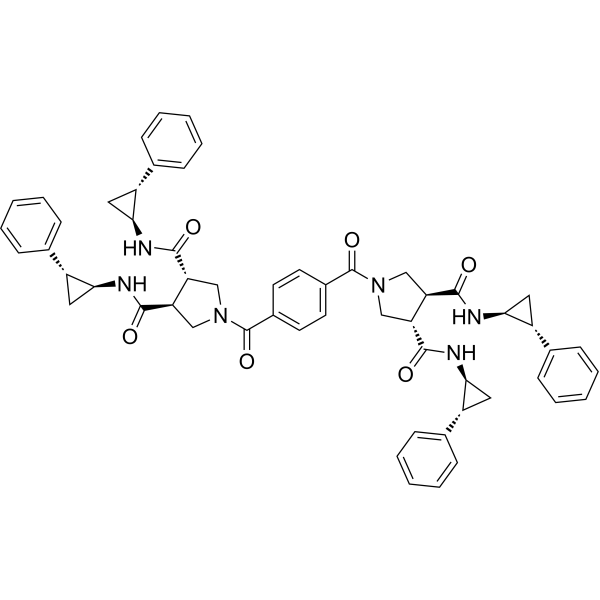
Diprovocim is a potent TLR1/TLR2 agonist. Diprovocim elicits full agonist activity in human THP-1 cells (EC50=110 pM). Diprovocim stimulates the release of TNF-α from mouse macrophages (EC50=1.3 nM). Diprovocim activates downstream MAPK and NF-κB signaling pathway. Diprovocim displays strong adjuvant activity in mice, particularly abetting cellular immune responses [1] [2].
loading...
    loading...
13
13 Cited Publications
Cat. No.: HY-110353
CAS No.: 1821387-73-8
Purity:  99.96%
Research Areas:  

Inflammation/Immunology Cancer

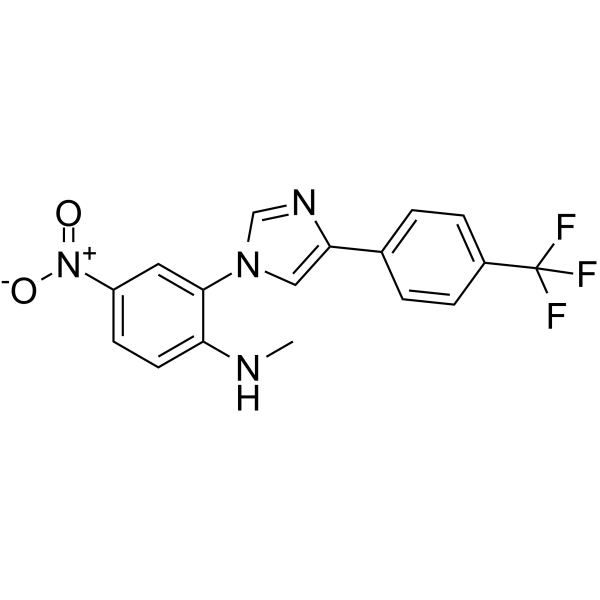
CU-T12-9 is a specific TLR1/2 agonist with EC50 of 52.9 nM in HEK-Blue hTLR2 SEAP assay. CU-T12-9 activates both the innate and the adaptive immune systems. CU-T12-9 selectively activates the TLR1/2 heterodimer, not TLR2/6. CU-T12-9 signals through NF-κB and invokes an elevation of the downstream effectors TNF-α, IL-10, and iNOS [1].
loading...
    loading...
Cat. No.: HY-N15936
CAS No.: 2936622-21-6
a15:0-i15:0 PE is a diacyl phosphatidylethanolamine with two branched chains. a15:0-i15:0 PE is a non-canonical TLR2-TLR1 heterodimer agonist and has immunogenic activity. a15:0-i15:0 PE activates T cells and DC signaling and shows anti-inflammatory activity. a15:0-i15:0 PE induces TNFα and IL-6 production. a15:0-i15:0 PE is a the major component (approximately 50%) of A. muciniphila’s lipid membrane [1] [2].
loading...
    loading...
Cat. No.: HY-150501
CAS No.: 3005274-77-8
Purity:  98.64%
Research Areas:  

Inflammation/Immunology

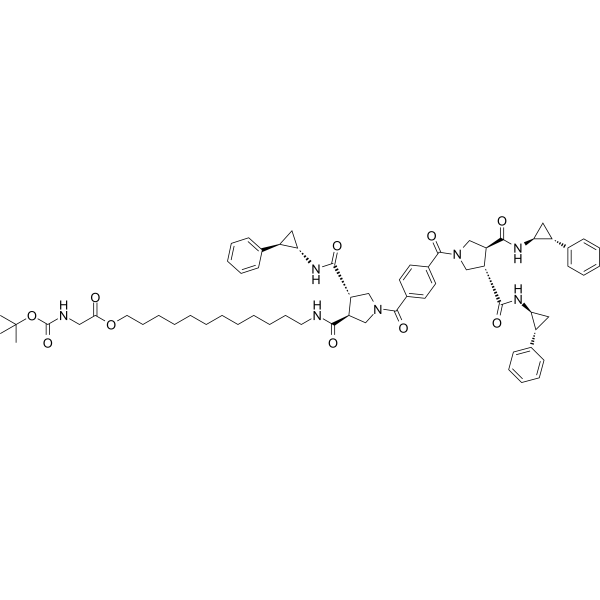
Diprovocim-X (compound 35) is a potent TLR1/TLR2 (toll-like receptor 1/2) agonist, with EC50 values of 0.14 and 0.75 nM for hTLR1/TLR2 and mTLR1/TLR2, respectively. Diprovocim-X is a potent adjuvant in vivo in mice, and serves to stimulate the adaptive immune response [1].
loading...
    loading...
Cat. No.: HY-178166
CAS No.: 2773474-99-8
ETI41 is an orally active, selective TLR inhibitor that targets the nucleoside-binding Site I on TLR7 (IC50 = 0.63 μM) and TLR9 (IC50 = 0.16 μM), sparing surface TLRs (including TLR1/TLR2, TLR2/TLR6, TLR4 and TLR5). ETI41 potently inhibits endosomal TLR-mediated pro-inflammatory signaling with nanomolar activity in cellular, biophysical and in vivo assays. ETI41 suppresses the expression of inflammation-associated genes and effectively ameliorates symptoms in mouse models of psoriasis, and systemic lupus erythematosus (SLE). ETI41 can be used for autoimmune and inflammatory diseases research [1].
loading...
    loading...
Cat. No.: HY-163829
CAS No.: 3093799-15-3
Research Areas:  

Cancer

TLR2 agonist 1 (Compound R-7d) is an agonist for human toll-like receptor 2 (TLR 2) with an EC50 of 116 pM. TLR2 agonist 1 enhances NF-κB promoter activation through TLR2/TLR1 heterodimers [1].
loading...
    loading...
Cat. No.: HY-158058
CAS No.: 3029403-05-9
WYJ-2 is a selective agonist for toll-like receptor 2/1 (TLR2/1) with EC50 of 18.57 nM in human TLR2 and TLR1 transient-cotransfected HEK 293T cells. WYJ-2 induces pyroptosis and exhibits anticancer activity against non-small cell lung cancer (NSCLC) [1].
loading...
    loading...
Cat. No.: HY-P1405
CAS No.: 1429504-10-8
Synonyms: Pam3Cys-Ser-(Lys)4-Biotin
Pam3CSK4-Biotin is biotinylated Pam3CSK4. Pam3CSK4-Biotin is a Toll-like receptor 1/2 (TLR1/2) agonist [1].
loading...
    loading...
Cat. No.: HY-178169
CAS No.: 2773475-11-7
ETI60 is an orally active, selective TLR inhibitor that targets the nucleoside-binding Site I on TLR7 (IC50 = 0.68 μM) and TLR9 (IC50 = 0.12 μM), sparing surface TLRs (including TLR1/TLR2, TLR2/TLR6, TLR4 and TLR5). ETI60 potently inhibits endosomal TLR-mediated pro-inflammatory signaling with nanomolar activity in cellular, biophysical and in vivo assays. ETI60 modulates the expression of genes associated with inflammation. ETI60 effectively ameliorates symptoms in mouse models of psoriasis, and systemic lupus erythematosus (SLE). ETI60 can be used for autoimmune and inflammatory diseases research [1].
loading...
    loading...
Cat. No.: HY-184285
Research Areas:  

Inflammation/Immunology

TLR2 antagonist-2 is a selective TLR2 antagonist with an IC50 of 0.94 μM. TLR2 antagonist-2 inhibits TLR1/2 and TLR2/6 heterodimers. TLR2 antagonist-2 is applicable to the research of inflammatory diseases [1].
loading...
    loading...
Cat. No.: HY-180507
CAS No.: 2377679-85-9
TLR2/9 antagonist 1 (Compound 24) is a reversible covalent TLR2 (IC₅₀ = 0.5 μM (TLR2/TLR6); IC₅₀ = 0.6 μM (TLR2/TLR1)) and TLR9 (IC₅₀ = 0.32 μM) antagonist. TLR2/9 antagonist 1 has no significant effect on other TLR subtypes. TLR2/9 antagonist 1 can be used for studying central nervous system diseases and malignant tumors caused by inflammation [1].
loading...
    loading...
Cat. No.: HY-122566
CAS No.: 903864-87-9
Synonyms: ZINC666243
Research Areas:  

Cancer

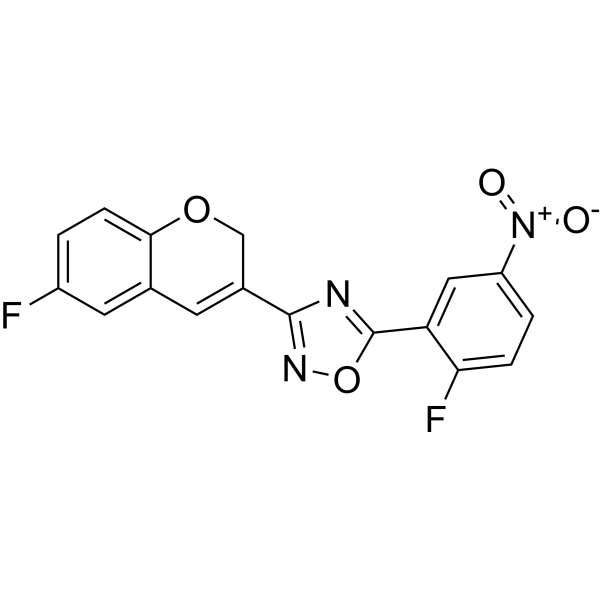
SMU127 is an agonist of the toll-like receptor 1/2 (TLR1/2) heterodimer. It induces NF-κB signaling in cells expressing human TLR2 (EC50=0.55 μM) but not cells expressing human TLR3, -4, -5, -7, or -8 when used at concentrations ranging from 0.1 to 100 μM. SMU127 induces the production of TNF-α in isolated human peripheral blood mononuclear cells (PBMCs) when used at concentrations ranging from 0.01 to 1 μM. In vivo, SMU127 (0.1 mg/animal) reduces tumor volume in a 4T1 murine mammary carcinoma model.
loading...
    loading...
Cat. No.: HY-P1405A
Synonyms: Pam3Cys-Ser-(Lys)4-Biotin TFA
Pam3CSK4-Biotin (Pam3Cys-Ser-(Lys)4-Biotin) TFA is biotinylated Pam3CSK4. Pam3CSK4-Biotin TFA is a Toll-like receptor 1/2 (TLR1/2) agonist [1].
loading...
    loading...
Cat. No.: HY-183301
Research Areas:  

Cardiovascular Disease

TLR2/1 agonist-1 is a selective agonist of the TLR2/1 heterodimer. TLR2/1 agonist-1 acts as a hematopoietic recovery inducer to accelerate the recovery of peripheral blood cells. TLR2/1 agonist-1 serves as a G-CSF production inducer to increase serum G-CSF levels. TLR2/1 agonist-1 exhibits radioprotective effects in mice exposed to radiation. TLR2/1 agonist-1 can be used in studies related to acute radiation syndrome [1].
loading...
    loading...
  • 1

