6 Results for "

castrated mice

" in MedChemExpress (MCE) Product Catalog:
Products (6)

6 Results for "castrated mice" in MCE Product Catalog:

Cat. No.: HY-W019704
CAS No.: 1115-47-5
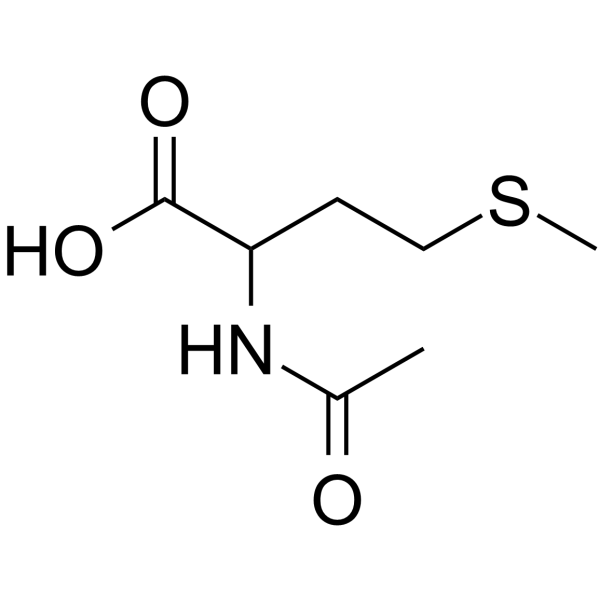
N-Acetyl-DL-methionine is an orally active methionine analog and a glutathione (GSH) precursor that can be metabolized into cysteine in vivo. N-Acetyl-DL-methionine increases plasma methionine concentration and the molar percentage of plasma lysine in castrated sheep, and can partially meet the methionine requirement of growing rats. N-Acetyl-DL-methionine is absorbable from the lower digestive tract of sheep and undergoes ruminal microbial degradation in vivo. N-Acetyl-DL-methionine alleviates Acetaminophen (HY-66005)-induced hepatic GSH depletion in mice, maintains hepatocyte integrity, and promotes de novo synthesis of hepatic GSH. N-Acetyl-DL-methionine can be used in studies related to acetaminophen-induced liver injury .
loading...
    loading...
Cat. No.: HY-158119A
CAS No.: 3036415-37-6
Synonyms: Felivotide mopaxetan
Target:  

PSMA

Research Areas:  

Cancer

PSMA-trillium (Felivotide mopaxetan) is a PSMA-targeted molecule that contains a highly specific PSMA-binding motif, an albumin-binding domain optimized for tumor uptake and retention, and a Macropa chelator conjugated to the α-emitter 225Ac. PSMA-trillium binds to albumin to prolong plasma retention time and binds to PSMA via its specific motif. 225Ac-PSMA-Trillium exhibits dose-dependent inhibition of LNCaP tumor growth in mice. PSMA-trillium can be used in research related to prostate cancer and metastatic castration-resistant prostate cancer .
loading...
    loading...
Cat. No.: HY-170820
CAS No.: 3006788-11-7
XYD049 is a CRBN-based molecular glue degrader targeting GSPT1, with a DC50 of 19 nM. XYD049 mediates the formation of a ternary complex between CRBN and GSPT1, thereby triggering CRBN- and proteasome-dependent degradation of GSPT1. By degrading GSPT1, XYD049 downregulates castration-resistant prostate cancer (CRPC)-related oncogenes, including BCL2, CDK2, E2F3, EGFR, HSP90B1, TMPRSS2, AR, AR-V7, PSA and c-Myc. XYD049 inhibits cancer cell growth and suppresses tumor growth in mice. XYD049 can be used for research on castration-resistant prostate cancer. XYD049 consists of a linker (black part) NH2-C5-NH-Boc (HY-W004710), a CRBN-based E3 ligase ligand (blue part) Thalidomide 4-fluoride (HY-41547), and a target protein ligand (red part) GSPT1 ligand-1 (HY-170821), among which the E3 ligase ligand plus linker forms the conjugate E3 Ligase Ligand-linker Conjugate 158 (HY-170822) .
loading...
    loading...
Cat. No.: HY-W019704R
CAS No.: 1115-47-5
N-Acetyl-DL-methionine (Standard) is the analytical standard of N-Acetyl-DL-methionine (HY-W019704). This product is intended for research and analytical applications. N-Acetyl-DL-methionine is an orally active methionine analog and a glutathione (GSH) precursor that can be metabolized into cysteine in vivo. N-Acetyl-DL-methionine increases plasma methionine concentration and the molar percentage of plasma lysine in castrated sheep, and can partially meet the methionine requirement of growing rats. N-Acetyl-DL-methionine is absorbable from the lower digestive tract of sheep and undergoes ruminal microbial degradation in vivo. N-Acetyl-DL-methionine alleviates Acetaminophen (HY-66005)-induced hepatic GSH depletion in mice, maintains hepatocyte integrity, and promotes de novo synthesis of hepatic GSH. N-Acetyl-DL-methionine can be used in studies related to acetaminophen-induced liver injury .
loading...
    loading...
Cat. No.: HY-106391
CAS No.: 33765-68-3
Synonyms: TSAA-291
Target:  

Androgen Receptor

Research Areas:  

Endocrinology

Oxendolone (TSAA-291) is a steroidal antiandrogen with partial agonist properties, exhibiting a Ki value of 1.4 nM for the androgen receptor. Oxendolone exerts tissue-specific androgen receptor activity, induces unique androgen receptor conformational changes, and drives differential cofactor recruitment. Oxendolone is recruited to the androgen receptor in a PIAS1-dependent manner. Oxendolone increases levator ani muscle weight in castrated mice. Oxendolone can be used for research on benign prostatic hyperplasia .
loading...
    loading...
Cat. No.: HY-181727
Research Areas:  

Cancer

AR/AR-V7 degrader-1 is an orally active AR and AR-V7 degrader. AR/AR-V7 degrader-1 disrupts the interaction between AR/AR-V7 and HSP90, leading to their ubiquitination and degradation in castration-resistant prostate cancer cells. AR/AR-V7 degrader-1 regulates the expression of cell cycle-related proteins in prostate cancer cells (downregulates CDK4, CDK6, Cyclin D1, Cyclin E1; upregulates P21) and induces G0/G1 phase arrest. AR/AR-V7 degrader-1 inhibits the proliferation and migration of prostate cancer cells. AR/AR-V7 degrader-1 suppresses the growth of castration-resistant prostate cancer tumors in nude mice and induces the degradation of AR and AR-V7 in tumor tissues. AR/AR-V7 degrader-1 is applicable to the research of castration-resistant prostate cancer .
loading...
    loading...

