

1. Search Result
Search Result
Results for "

colon tumor

" in MedChemExpress (MCE) Product Catalog:

269

Inhibitors & Agonists

1

Screening Libraries

4

Fluorescent Dyes

4

Biochemical Assay Reagents

17

Peptides

39

Inhibitory Antibodies

20

Natural
Products

3

Isotope-Labeled Compounds

5

Oligonucleotides

1

GMP Molecules

Cat. No. Product Name Target Research Area
  • HY-P10925

    FOG-001; I-66

    β-catenin Cancer
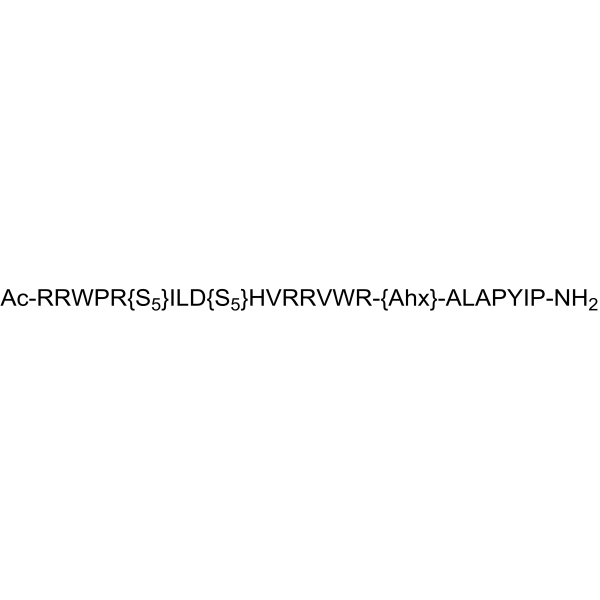
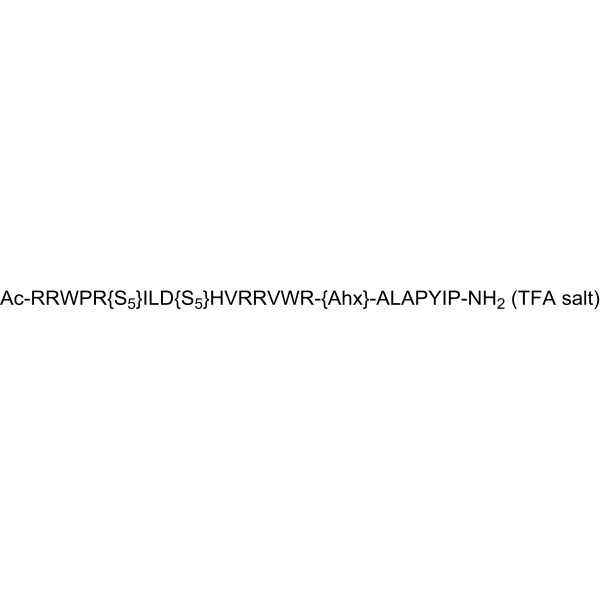
    Zolucatetide (FOG-001;I-66) is a potent β-catenin inhibitor with an IC50 of <50 nM. Zolucatetide can inhibits β-catenin and T-cell factor (TCF) transcription factor interaction. Zolucatetide inhibits cell proliferation and induces cell cycle arrest in target cells. Zolucatetide exhibits anti-tumor efficacy in mice bearing COLO320DM colon cancer cell (with APC, TP53 mutations) xenografts. Zolucatetide can be used for the study of colon cancer .
  • HY-P5819
    xStAx-VHLL
    3 Publications Verification

    Wnt PROTACs β-catenin Cancer
    xStAx-VHLL is a β-catenin PROTAC degrader that promotes ubiquitination and proteasome degradation of β-catenin. xStAx-VHLL inhibits the Wnt/β-catenin signaling pathway. xStAx-VHLL can inhibit the proliferation of colon cancer cells and has anti-tumor activity .
  • HY-P11115

    Apoptosis NF-κB Reactive Oxygen Species (ROS) Inflammation/Immunology Cancer
    CIGB-552 is a cell-penetrating peptide with anti-tumor properties with the IC50 of 23 μM in H460 cells. CIGB-552 can increase the level of protein COMMD1. CIGB-552 significantly inhibits the NF-κB signaling pathway. CIGB-552 can promote apoptosis of the tumor cells. CIGB-552 can induce the accumulation of reactive oxygen species (ROS) in tumor cells. CIGB-552 has anti-inflammatory and anti-angiogenic effects. CIGB-552 can be used for the research of the lung cancer and colon cancer.
  • HY-P5322

    Transmembrane Glycoprotein Cardiovascular Disease Cancer
    Thrombospondin (TSP-1)-derived CD36 binding motif is a bioactive hexapeptide. Thrombospondin (TSP-1)-derived CD36 binding motif interferes with the interaction between cells and the extracellular matrix by binding to CD36 and angiostatin, thereby affecting the cell adhesion and migration process. Thrombospondin (TSP-1)-derived CD36 binding motif inhibits platelet aggregation. Thrombospondin (TSP-1)-derived CD36 binding motif exerts an anti-tumor effect against colon cancer .
  • HY-P5819A
    xStAx-VHLL TFA
    3 Publications Verification

    PROTACs β-catenin Wnt Cancer
    xStAx-VHLL TFA is a β-catenin PROTAC degrader that promotes ubiquitination and proteasome degradation of β-catenin. xStAx-VHLL TFA inhibits the Wnt/β-catenin signaling pathway. xStAx-VHLL TFA can inhibit the proliferation of colon cancer cells and has anti-tumor activity .
  • HY-P1435

    NADPH Oxidase Cardiovascular Disease Cancer
    NoxA1ds is a potent and highly selective NADPH oxidase 1 (NOX1) inhibitor (IC50=20 nM). NoxA1ds inhibits NOX1-derived O 2- production in HT-29 human colon cancer cells. NoxA1ds attenuates VEGF-induced human pulmonary artery endothelial cell migration under hypoxic conditions in vitro. NoxA1ds can be used in the study of hypertension, atherosclerosis and tumors .
  • HY-P3099

    Guanylate Cyclase Cancer
    Uroguanylin (human) is a natural ligand for the Guanylyl Cyclase (GCC) receptor expressed in metastatic colorectal cancer tumors. Uroguanylin (human) has anti-tumor actions in an animal model for human colon cancer .
  • HY-P10941A

    Integrin FAK ERK Inflammation/Immunology Cancer
    VSLRGDTRG acetate is a synthetic peptide containing the RGD motif from cadherin 17 (CDH17), which binds to α2β1 integrin and activates its signaling pathway. VSLRGDTRG acetate promotes the high-affinity conformational change of β1 integrin through the RGD motif, enhancing cell adhesion and phosphorylation of FAK and ERK1/2, thereby driving tumor proliferation and metastasis. VSLRGDTRG acetate can be used in research on cancers expressing CDH17, such as colon cancer and pancreatic cancer .
  • HY-P5107

    LMWP; TDSP5

    VEGFR Cancer
    Low molecular weight protamine (LMWP;TDSP5) is a truncated arginine-rich protamine peptide, as well as a heparin/low-molecular-weight heparin antidote and a cell-penetrating delivery carrier. Low molecular weight protamine neutralizes heparin-induced anticoagulant activities, including aPTT, anti-Xa and anti-IIa activities, and also neutralizes anti-Xa activity of commercially available low-molecular-weight heparin preparations. Low molecular weight protamine translocates across mammalian cell membranes, delivers conjugated impermeable molecules across tumor tissues, enhances skin permeability of conjugated epidermal growth factor, and accelerates wound healing when conjugated with epidermal growth factor. Low molecular weight protamine retains the in vitro cell proliferation activity of conjugated EGF, and also enables site-specific conjugation with peptides or proteins via genetic recombination. Low molecular weight protamine can be used in studies related to colon adenocarcinoma, skin wounds and diabetic skin wounds .
  • HY-P10941

    Integrin FAK ERK Inflammation/Immunology Cancer
    VSLRGDTRG is a synthetic peptide containing the RGD motif from cadherin 17 (CDH17), which binds to α2β1 integrin and activates its signaling pathway. VSLRGDTRG promotes the high-affinity conformational change of β1 integrin through the RGD motif, enhancing cell adhesion and phosphorylation of FAK and ERK1/2, thereby driving tumor proliferation and metastasis. VSLRGDTRG can be used in research on cancers expressing CDH17, such as colon cancer and pancreatic cancer .
  • HY-P10364

    UBI(29-41)

    Bacterial Antibiotic Infection Inflammation/Immunology
    Ubiquicidin (29-41) (UBI (29-41)) is an Antimicrobial peptide and infection-localizing agent. Ubiquicidin (29-41) acts as an infection-specific imaging agent and infection-targeting agent. Ubiquicidin (29-41) serves as an antibiotic efficacy monitoring agent, and its aggregation level in infections induced by Staphylococcus aureus is higher than that in infections induced by Escherichia coli .
  • HY-P3099A

    Guanylate Cyclase Cancer
    Uroguanylin (human) (TFA) is a natural ligand for the Guanylyl Cyclase (GCC) receptor expressed in metastatic colorectal cancer tumors. Uroguanylin (human) (TFA) has anti-tumor actions in an animal model for human colon cancer .
  • HY-P11115A

    Apoptosis NF-κB Reactive Oxygen Species (ROS) Cancer
    CIGB-552 TFA is a cell-penetrating peptide with anti-tumor properties with the IC50 of 23 μM in H460 cells. CIGB-552 TFA can increase the level of protein COMMD1. CIGB-552 TFA significantly inhibits the NF-κB signaling pathway. CIGB-552 TFA can promote apoptosis of the tumor cells. CIGB-552 TFA can induce the accumulation of reactive oxygen species (ROS) in tumor cells. CIGB-552 TFA has anti-inflammatory and anti-angiogenic effects. CIGB-552 TFA can be used for the research of the lung cancer and colon cancer.
  • HY-P11011

    Pep R54; CXCR4 antagonist peptide 19

    CXCR Cancer
    Peptide R54 (Pep R54; CXCR4 antagonist peptide 19) is an antagonistic peptide targeting CXCR4 with significant anticancer activity. Peptide R54 inhibits CXCR4-dependent cell migration, epithelial-mesenchymal transition, and lung metastasis development, with better serum stability and higher CXCR4 affinity than the lead compound (IC50=20 nM). Peptide R54 synergizes with anti-PD-1 therapy to exert anti-tumor activity in vivo, enhances granzyme activity, and reduces infiltration of Foxp3 cells. Peptide R54 can be used in the study of colon cancer, ovarian cancer, and melanoma .
  • HY-P5107A

    LMWP acetate; TDSP5 acetate

    VEGFR Cancer
    Low molecular weight protamine acetate (LMWP acetate;TDSP5 acetate) is a truncated arginine-rich protamine peptide, which also acts as an antidote for heparin/low molecular weight heparin and a cell-penetrating delivery vector. Low molecular weight protamine acetate neutralizes heparin-induced anticoagulant activities, including aPTT, anti-Xa and anti-IIa activities. Low molecular weight protamine acetate translocates across mammalian cell membranes, delivers conjugated impermeable molecules through tumor tissues, enhances the skin permeability of conjugated epidermal growth factor, and accelerates wound healing when conjugated with epidermal growth factor. Low molecular weight protamine acetate retains the in vitro cell proliferation activity of conjugated EGF, and also enables site-specific conjugation with peptides or proteins via genetic recombination. Low molecular weight protamine acetate can be used in studies related to colon cancer, skin wounds and diabetic skin wounds .
  • HY-P10561

    Peptides Cancer
    CPK peptide is a tumor-localizing peptide. CPK peptide specifically binds to the monocarboxylate transporter 1 (MCT1) receptor, which is overexpressed in many human colon cancer cell lines but not in normal cells. CPK peptide can be used in tumor diagnosis research .
  • HY-P1435A

    NADPH Oxidase Cardiovascular Disease Cancer
    NoxA1ds TFA is a potent and highly selective NADPH oxidase 1 (NOX1) inhibitor (IC50=20 nM). NoxA1ds TFA inhibits NOX1-derived O 2- production in HT-29 human colon cancer cells. NoxA1ds TFA attenuates VEGF-induced human pulmonary artery endothelial cell migration under hypoxic conditions in vitro. NoxA1ds TFA can be used in the study of hypertension, atherosclerosis and tumors .

Inquiry Online

Your information is safe with us. * Required Fields.

Salutation


Country or Region *

Applicant Name *


Organization Name *

Department *


Email Address *


Product Name *

Cat. No.


Requested quantity *

Phone Number *


Remarks

Inquiry Online

Inquiry Information

Product Name:
Cat. No.:
Quantity:
MCE Japan Authorized Agent:

