1. Search Result
Search Result
Results for "

dermal sensitization

" in MedChemExpress (MCE) Product Catalog:

5

Inhibitors & Agonists

1

Natural
Products

Cat. No. Product Name Target Research Areas Chemical Structure
  • HY-A0169A
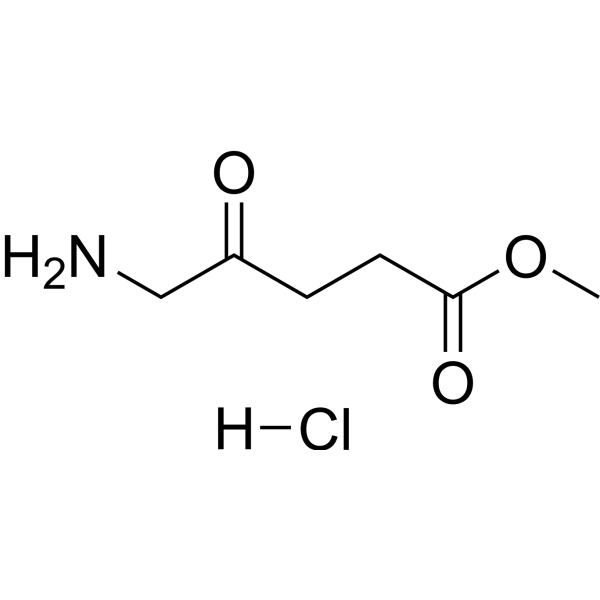
    Methyl aminolevulinate hydrochloride
    1 Publications Verification

    Reactive Oxygen Species (ROS) Photosensitizer Cancer
    Methyl aminolevulinate hydrochloride is a sensitizer used in photodynamic therapy (PDT). Methyl aminolevulinate hydrochloride penetrates the skin and induces the production of photoactive porphyrins including protoporphyrin IX in cells; upon exposure to appropriate light, it generates ROS, which triggers cellular oxidation and cell death. Methyl aminolevulinate hydrochloride acts as a photo-damage reversing agent through epidermal reconstruction, cytokine-mediated activation of dermal fibroblasts, elastin breakdown, new collagen formation, and compression of dilated capillaries. Methyl aminolevulinate hydrochloride reduces the expression of the proliferation marker Ki-67 and the early skin carcinogenesis marker TP53. Methyl aminolevulinate hydrochloride delays the onset of ultraviolet-induced skin tumors and reduces tumor burden in hairless mice. Methyl aminolevulinate hydrochloride is applicable to research related to actinic keratosis and basal cell carcinoma .
    Methyl aminolevulinate hydrochloride
  • HY-W015882
    4-Methylpentanoic acid
    1 Publications Verification

    Isocaproic acid

    Drug Metabolite Neurological Disease Metabolic Disease
    4-Methylpentanoic acid (Isocaproic Acid) is a short-chain fatty acid and a metabolite of 20 α-hydroxycholesterol (HY-12316) that can be detected in feces. The concentration of 4-Methylpentanoic acid is closely associated with several diseases, such as depression. 4-Methylpentanoic acid is also applicable to studies on cholesterol metabolism .
    4-Methylpentanoic acid
  • HY-A0169

    Reactive Oxygen Species (ROS) Photosensitizer Cancer
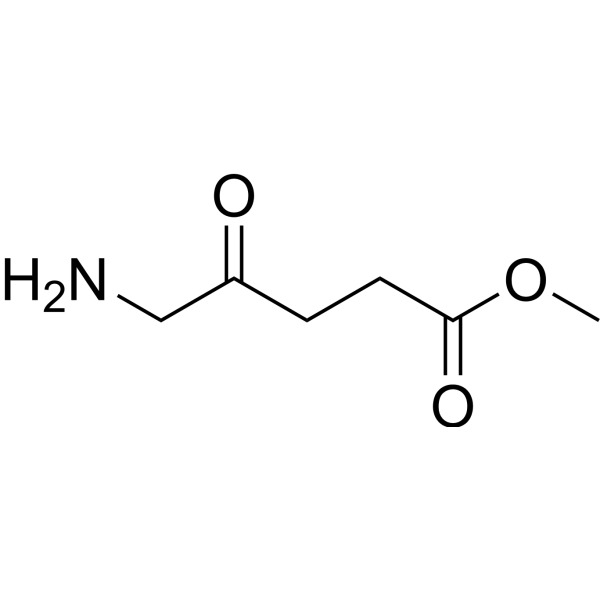
    Methyl aminolevulinate is a sensitizer used in photodynamic therapy (PDT). Methyl aminolevulinate penetrates the skin and induces the production of photoactive porphyrins including protoporphyrin IX in cells; upon exposure to appropriate light, it generates ROS, which triggers cellular oxidation and cell death. Methyl aminolevulinate acts as a photo-damage reversing agent through epidermal reconstruction, cytokine-mediated activation of dermal fibroblasts, elastin breakdown, new collagen formation, and compression of dilated capillaries. Methyl aminolevulinate reduces the expression of the proliferation marker Ki-67 and the early skin carcinogenesis marker TP53. Methyl aminolevulinate delays the onset of ultraviolet-induced skin tumors and reduces tumor burden in hairless mice. Methyl aminolevulinate is applicable to research related to actinic keratosis and basal cell carcinoma .
    Methyl aminolevulinate
  • HY-A0169AR

    Reactive Oxygen Species (ROS) Reference Standards Photosensitizer Inflammation/Immunology Cancer
    Methyl aminolevulinate hydrochloride (Standard) is the analytical standard of Methyl aminolevulinate hydrochloride. This product is intended for research and analytical applications. Methyl aminolevulinate hydrochloride is a sensitizer used in photodynamic therapy (PDT). Methyl aminolevulinate hydrochloride penetrates the skin and induces the production of photoactive porphyrins including protoporphyrin IX in cells; upon exposure to appropriate light, it generates ROS, which triggers cellular oxidation and cell death. Methyl aminolevulinate hydrochloride acts as a photo-damage reversing agent through epidermal reconstruction, cytokine-mediated activation of dermal fibroblasts, elastin breakdown, new collagen formation, and compression of dilated capillaries. Methyl aminolevulinate hydrochloride reduces the expression of the proliferation marker Ki-67 and the early skin carcinogenesis marker TP53. Methyl aminolevulinate hydrochloride delays the onset of ultraviolet-induced skin tumors and reduces tumor burden in hairless mice. Methyl aminolevulinate hydrochloride is applicable to research related to actinic keratosis and basal cell carcinoma .
    Methyl aminolevulinate hydrochloride (Standard)
  • HY-182517

    TRP Channel Inflammation/Immunology
    AG1529 is a TRPV1 inhibitor and capsaicinoid-based soft agent with a human TRPV1 IC50 of 0.9-0.93 μM. AG1529 reversibly blocks capsaicin-evoked TRPV1 activation, binds to the TRPV1 capsaicin binding site, moderately affects pH-induced TRPV1 gating, and does not alter voltage- or heat-mediated TRPV1 responses. AG1529 suppresses TRPV1-mediated neuronal excitability, reduces capsaicin- and pH-evoked neuronal firing, abolishes histaminergic and inflammation-mediated TRPV1 sensitization. AG1529 exhibits anti-nociceptive and antipruritic effects, attenuates in vivo hyperalgesia and pruritus, dose-dependently reduces acute histaminergic itch in rodents, and mildly blocks hTRPA1 and hTRPM8 channel activity. AG1529 undergoes hydrolysis and dermal deactivation, minimizes TRPV1-associated side reactions, does not evoke capsaicin-like burning sensation, and does not disrupt physiological thermal regulation. AG1529 can be used for the research of inflammatory cutaneous nociception and acute histaminergic pruritus .
    AG1529

Inquiry Online

Your information is safe with us. * Required Fields.

Salutation


Country or Region *

Applicant Name *


Organization Name *

Department *


Email Address *


Product Name *

Cat. No.


Requested quantity *

Phone Number *


Remarks

Inquiry Online

Inquiry Information

Product Name:
Cat. No.:
Quantity:
MCE Japan Authorized Agent:

