11 Results for "

fatty acid ethanolamides

" in MedChemExpress (MCE) Product Catalog:
Products (11)

11 Results for "fatty acid ethanolamides" in MCE Product Catalog:

Cat. No.: HY-112747
CAS No.: 97281-51-1
Synonyms: LPI; PE (soy)
Target:  

Phospholipase

Research Areas:  

Infection

Soy PE (LPI) is the most abundant phospholipid in prokaryotes and the second most abundant found in the membrane of mammalian, plant, and yeast cells, comprising approximately 25% of total mammalian phospholipids. In the brain, phosphatidylethanolamine comprises almost half of the total phospholipids. It is synthesized mainly through the cytidine diphosphate-ethanolamine and phosphatidylserine decarboxylation pathways, which occur in the endoplasmic reticulum (ER) and mitochondrial membranes, respectively. It is a precursor in the synthesis of phosphatidylcholine and arachidonoyl ethanolamide and is a source of ethanolamine used in various cellular functions. In E.coli, phosphatidylethanolamine deficiency prevents proper assembly of lactose permease, suggesting a role as a lipid chaperone. It is a cofactor in the propagation of prions in vitro and can convert recombinant mammalian proteins into infectious molecules even in the absence of RNA. This product contains phosphatidylethanolamine molecular species with variable fatty acyl chain lengths at the sn-1 and sn-2 positions .
loading...
    loading...
Cat. No.: HY-113421
CAS No.: 68171-52-8
Purity:  ≥98.0%
Synonyms: Linoleic acid monoethanolamide
Target:  

Cannabinoid Receptor

Research Areas:  

Neurological Disease

Linoleoyl ethanolamide (Linoleic acid monoethanolamide) is classified as a fatty acid ethanolamide. Linoleoyl ethanolamide only weakly binds G-protein-coupled cannabinoid receptors of type-1(CB1)and CB2 receptors, and inhibits the binding of [3H]CP-55,940 with Kis of 10 and 25 μM, respectively. Linoleoyl ethanolamide is 4-fold less potent than anandamide at causing catalepsy in mice and it does not prolong sleep time .
loading...
    loading...
Cat. No.: HY-157833
CAS No.: 53832-59-0
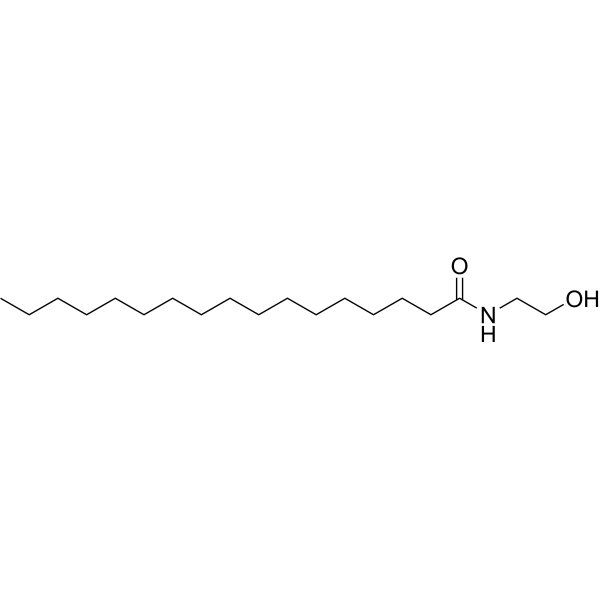
Heptadecanoyl ethanolamide is an endogenous cannabinoid. Heptadecanoyl ethanolamide is a synthetic analog of PEA which incorporates an odd-numbered (17-carbon) fatty acid chain .
loading...
    loading...
Cat. No.: HY-127061
CAS No.: 94421-67-7
Purity:  99.77%
Synonyms: POEA
Target:  

Endogenous Metabolite

Research Areas:  

Others

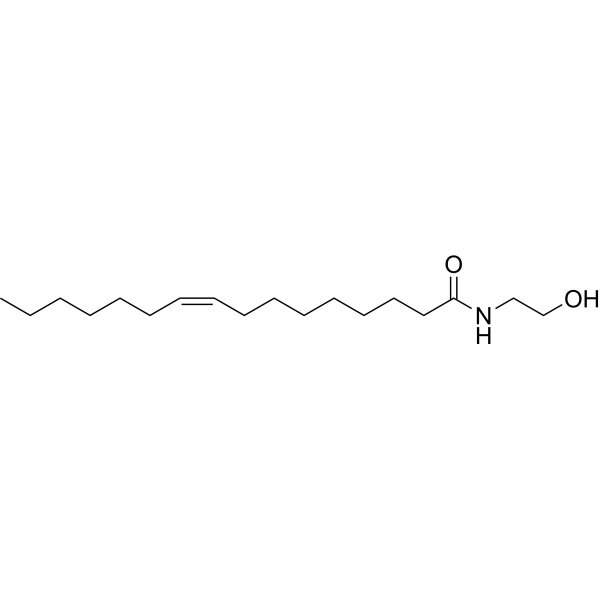
Palmitoleoyl ethanolamide (POEA) is an endogenous fatty amide with biological activity .
loading...
    loading...
Cat. No.: HY-113421S
CAS No.: 1451194-69-6
Linoleoyl ethanolamide-d4 is a deuterated labeled Linoleoyl ethanolamide . Linoleoyl ethanolamide (Linoleic acid monoethanolamide) is classified as a fatty acid ethanolamide. Linoleoyl ethanolamide only weakly binds G-protein-coupled cannabinoid receptors of type-1(CB1)and CB2 receptors, and inhibits the binding of [3H]CP-55,940 with Kis of 10 and 25 μM, respectively. Linoleoyl ethanolamide is 4-fold less potent than anandamide at causing catalepsy in mice and it does not prolong sleep time .
loading...
    loading...
Cat. No.: HY-124089
CAS No.: 109001-03-8
Target:  

Cannabinoid Receptor

Research Areas:  

Metabolic Disease

Eicosapentaenoyl ethanolamide, an omega-3 fatty acid, is one of N-acylethanolamines (NAEs). Eicosapentaenoyl ethanolamide is cannabinoid CB1/CB2 receptor agonist. Eicosapentaenoyl ethanolamide acts as a metabolic signal. Eicosapentaenoyl ethanolamide inhibits dietary restriction (DR)-induced lifespan extension in wild type animals and suppresses lifespan extension in a TOR pathway mutant .
loading...
    loading...
Cat. No.: HY-12909
CAS No.: 1207745-58-1
Target:  

FAAH

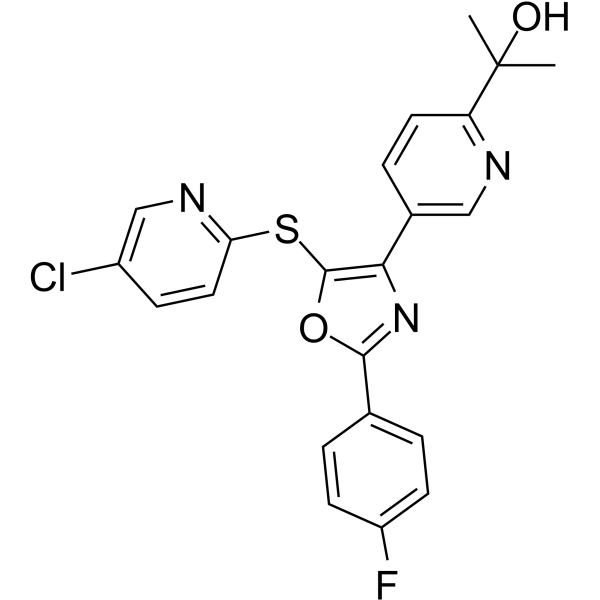
MK-4409 is an orally active and blood-brain barrier-penetrant fatty acid amide hydrolase (FAAH) inhibitor (human IC50 = 11 nM; rat IC50 = 11 nM) that reversibly and non-covalently inhibits this serine hydrolase, elevating endogenous fatty acid ethanolamides. MK-4409 alleviates inflammatory and neuropathic pain, with a long duration of action, and reduces edema. MK-4409 can be used for research on inflammatory and neuropathic pain .
loading...
    loading...
Cat. No.: HY-124089S
CAS No.: 946524-41-0
Purity:  ≥99.0%
Eicosapentaenoyl ethanolamide-d4 is the deuterium labeled Eicosapentaenoyl ethanolamide. Eicosapentaenoyl ethanolamide, an omega-3 fatty acid, is one of N-acylethanolamines (NAEs). Eicosapentaenoyl ethanolamide is cannabinoid CB1/CB2 receptor agonist. Eicosapentaenoyl ethanolamide acts as a metabolic signal. Eicosapentaenoyl ethanolamide inhibits dietary restriction (DR)-induced lifespan extension in wild type animals and suppresses lifespan extension in a TOR pathway mutant .
loading...
    loading...
Cat. No.: HY-165081
CAS No.: 18190-74-4
Synonyms: N-(2-Hydroxyethyl)-13Z-docosenamide
Research Areas:  

Others

Docosaenoyl ethanolamide (N-(2-Hydroxyethyl)-13Z-docosenamide) is one of a fatty N-acyl ethanolamines. Ethanolamines can be detected at relatively high levels in rat cerebrospinal fluid .
loading...
    loading...
Cat. No.: HY-115358
CAS No.: 10015-68-6
Synonyms: Tetracosanoic acid monoethanolamide
Target:  

Endogenous Metabolite

Research Areas:  

Metabolic Disease

Lignoceroyl ethanolamide is a member of the family of fatty N-acyl ethanolamines collectively called endocannabinoids. Whereas lignoceric acid has been detected at relatively high levels in rat cerebrospinal fluid, the specific role and relative importance of its ethanolamine metabolite have not been determined.
loading...
    loading...
Cat. No.: HY-175044
CAS No.: 1469713-10-7
Synonyms: (±)14(15)-Epoxy eicosatrienoyl ethanolamide
Target:  

Bacterial

Research Areas:  

Infection Inflammation/Immunology

(±)14(15)-EET Ethanolamide ((±)14(15)-Epoxy eicosatrienoyl ethanolamide) is a fatty acid monoepoxide. (±)-14(15)-EET ethanolamide can be used in the research of Pseudomonas aeruginosa infections and respiratory diseases .
loading...
    loading...
  • 1

