12 Results for "

fluorescence microscope

" in MedChemExpress (MCE) Product Catalog:
Products (12)

12 Results for "fluorescence microscope" in MCE Product Catalog:

Cat. No.: HY-D1366
CAS No.: 2183440-68-6
Target:  

Fluorescent Dye

Research Areas:  

Others

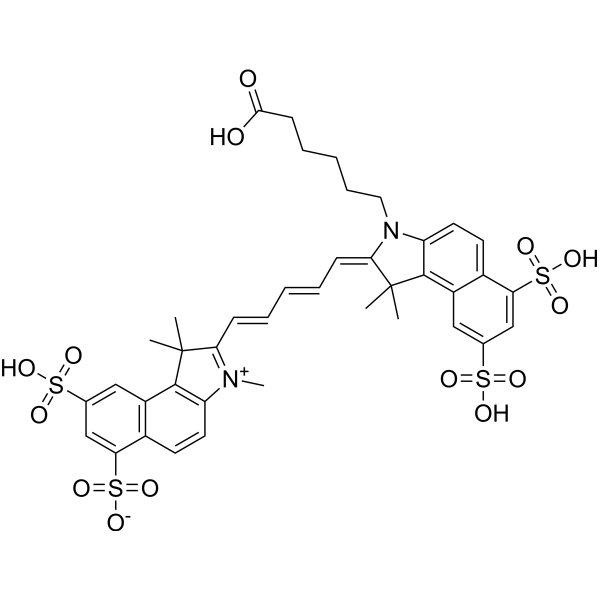
Sulfo-Cyanine5.5 carboxylic acid is a Fluorescent dye. Sulfo-Cyanine5.5 carboxylic acid emits red fluorescence, with a peak absorption wavelength of 673 nm. Sulfo-Cyanine5.5 carboxylic acid can be used to visualize aqueous sub-compartments and phase separation in synthetic multi-compartment microstructures. Sulfo-Cyanine5.5 carboxylic acid can serve as an intravenous contrast agent for in vivo cerebral perfusion imaging, mapping hemodynamics and perfusion regions .
loading...
    loading...
Cat. No.: HY-D1366A
CAS No.: 2183440-69-7
Target:  

Fluorescent Dye

Research Areas:  

Others

Sulfo-Cyanine5.5 carboxylic acid potassium is a Fluorescent dye. Sulfo-Cyanine5.5 carboxylic acid potassium emits red fluorescence, with a peak absorption wavelength of 673 nm. Sulfo-Cyanine5.5 carboxylic acid potassium can be used to visualize aqueous sub-compartments and phase separation in synthetic multi-compartment microstructures. Sulfo-Cyanine5.5 carboxylic acid potassium can serve as an intravenous contrast agent for in vivo cerebral perfusion imaging, mapping hemodynamics and perfusion regions .
loading...
    loading...
Cat. No.: HY-D3421
CAS No.: 3083251-08-2
Target:  

Fluorescent Dye

Research Areas:  

Others

DiOC14 (3) (hydroxyethanesulfonate) is a water-soluble lipophilic carbocyanine green fluorescent membrane dye used as a fluorescent probe for living cell membranes and lipid bilayers. DiOC14 (3) (hydroxyethanesulfonate) acts as a lipophilic tracer that integrates into cell membranes, with its fluorescence generated upon membrane integration independent of enzymatic hydrolysis, pH, or membrane potential. The Ex/Em of DiOC14 (3) (hydroxyethanesulfonate) is 477/525 nm.
loading...
    loading...
Cat. No.: HY-D3131
CAS No.: 2243068-74-6
Target:  

Fluorescent Dye

Research Areas:  

Others

Lyso-MPCB is a two-photon fluorescent probe used for lysosomal pH detection and autophagy monitoring. Lyso-MPCB integrates a benzimidazole pH-responsive group and a morpholine lysosome-targeting group, enabling specific localization to lysosomes. The fluorescence properties of Lyso-MPCB change with protonation, exhibiting blue fluorescence under alkaline conditions and green fluorescence under acidic conditions .
loading...
    loading...
Cat. No.: HY-D3108
CAS No.: 2569032-08-0
Target:  

Fluorescent Dye

Research Areas:  

Others

BV-1 is a fluorescent probe for viscosity detection and imaging in living cells. BV-1 can be used to detect changes in intracellular viscosity and mitochondrial viscosity in living cells. BV-1 responds to environmental viscosity via a molecular rotor mechanism. In a low-viscosity environment, the centrally located unsaturated structure induces a twisted intramolecular charge transfer (TICT) state and promotes non-radiative transitions, resulting in fluorescence quenching; when viscosity increases, molecular rotation is restricted, the TICT state is attenuated, and fluorescence is enhanced with a red shift. BV-1 can be used for real-time monitoring of changes in cytoplasmic viscosity and the viscosity increase during cell apoptosis. Ex/Em = 480/570 nm .
loading...
    loading...
Cat. No.: HY-D3112
Target:  

Fluorescent Dye

Research Areas:  

Neurological Disease

P2-Aggregate is a polarity-sensitive fluorescent probe for protein aggregation, which is based on the Nile Red scaffold and modified with a morpholine ring to enhance water solubility. P2-Aggregate improves anti-precipitation ability in aqueous phase via morpholine ring modification, and enables site-specific labeling of target proteins by combining with HaloTag technology. Utilizing the property that its emission wavelength blue-shifts with decreasing local polarity (excited at 543 nm), P2-Aggregate quantitatively detects changes in local polarity during protein aggregation and polarity heterogeneity inside aggregates in living cells. P2-Aggregate can be used in the research of diseases associated with the aggregation of Htt-110Q and SOD1 proteins, such as Huntington's disease and amyotrophic lateral sclerosis .
loading...
    loading...
Cat. No.: HY-D3098
Target:  

Fluorescent Dye

Research Areas:  

Others

Mito‑VR2 is a mitochondria-targeted molecular rotor-type viscosity fluorescent probe with high responsiveness to microenvironmental viscosity, which is suitable for synchronous imaging of mitochondrial viscosity during autophagy in living cells. Mito-VR2 achieves specific targeting of mitochondria through its hydrophobic cationic structure, and its fluorescence intensity responds only to microenvironmental viscosity. Mito-VR2 emits almost no fluorescence in low-viscosity media, but its fluorescence emission is significantly enhanced in high-viscosity environments .
loading...
    loading...
Cat. No.: HY-D3117
CAS No.: 2146114-18-1
Target:  

Fluorescent Dye

Research Areas:  

Others

MBCB is a two-photon Fluorescent probe for dual-detection of mitochondrial SO₂ derivatives and viscosity. For SO₂ derivatives detection, the probe utilizes a Michael addition mechanism: nucleophilic addition of SO₂ derivatives to the C=C bond between the carbazole skeleton and 3-methylbenzothiazolium moiety destroys the strong intramolecular charge transfer (ICT) system between these groups, while enhancing the weak ICT system between the benzothiazole group and carbazole framework; this causes the red emission at 600 nm to decrease and the blue emission at 434 nm to increase, creating a ratiometric response based on the I₄₃₄ₙₘ/I₆₀₀ₙₘ intensity ratio. For viscosity detection, in low-viscosity environments, steric hindrance creates a twisted ICT (TICT) system with weak fluorescence, while in high-viscosity environments, intramolecular rotation is blocked, the TICT state is disrupted, and the strong ICT system is recovered, leading to a strong red emission at 567 nm with negligible change to the short-wavelength emission at 415 nm, creating a ratiometric response based on the I₅₆₇ₙₘ/I₄₁₅ₙₘ intensity ratio that has a logarithmic linear relationship with viscosity. The probe has excitation/emission wavelengths of Ex/Em = 351/434, 600 nm for SO₂ derivatives detection and Ex/Em = 351/567 nm for viscosity detection, with two-photon excitation at 740 nm for bioimaging; it also exhibits good mitochondrial targeting ability with a Pearson's colocalization coefficient of 0.93 when paired with Mito-Tracker Green. The probe shows high sensitivity and selectivity for SO₂ derivatives, has low cell cytotoxicity, and can be applied to detect exogenous/endogenous HSO₃⁻ in living cells and in vivo, as well as visualize mitochondrial viscosity changes induced by nystatin[1].
loading...
    loading...
Cat. No.: HY-D3367
Target:  

Fluorescent Dye

Research Areas:  

Others

Th-TMR-S-SNAP is a fluorescent probe used for SNAP-tag labeling and wash-free live-cell imaging of intracellular SNAP-tag fusion proteins. The excitation wavelength of Th-TMR-S-SNAP is 561 nm, and its emission wavelength ranges from 570 to 620 nm .
loading...
    loading...
Cat. No.: HY-D3119
CAS No.: 2246946-49-4
Research Areas:  

Others

MitoAIE1 is a Fluorescent probe for mitochondrial viscosity detection. MitoAIE1 contains a pyridinium structural unit, which endows it with mitochondria-targeting specificity. The detection mechanism of this probe is based on aggregation-induced emission (AIE): in low-viscosity media such as PBS buffer, intramolecular rotation leads to non-radiative energy dissipation, resulting in only weak fluorescence; however, in high-viscosity environments such as the mitochondrial matrix or the vicinity of the inner mitochondrial membrane, such intramolecular motion is restricted, thereby significantly enhancing its fluorescent signal; in addition, this probe is not interfered by changes in microenvironment polarity and pH. Its emission wavelength is 625 nm, with absorption peaks at 325 nm and 450 nm; when transferred from low-viscosity PBS to high-viscosity 99% glycerol, its fluorescence intensity at 625 nm can be increased by 38-fold. It can be used to monitor changes in mitochondrial viscosity during processes such as Stauroporine (HY-15141)-induced apoptosis and starvation-induced mitophagy in live cells, and has good biocompatibility .
loading...
    loading...
Cat. No.: HY-D3124
Target:  

Fluorescent Dye

Research Areas:  

Others

Gol-SiRhoNox is a Golgi apparatus-targeted fluorescent probe with high selectivity for Fe (II), with a limit of detection of 50 nM. Gol-SiRhoNox integrates a myristoyl motif for Golgi apparatus targeting and a silicon-fused rhodamine N-oxide as the Fe (II)-sensitive moiety. Gol-SiRhoNox is non-fluorescent in its native state; Fe (II)-mediated deoxygenation of the N-oxide triggers fluorescence recovery. Its fluorescent product, Gol-SiR, has excitation/emission wavelengths of 630/665 nm and a maximum absorption wavelength of 655 nm .
loading...
    loading...
Cat. No.: HY-D3125
Target:  

Fluorescent Dye

Research Areas:  

Others

NtHzBtd is a fluorescent probe for detecting Fe 3+. NtHzBtd is applicable to the selective fluorescent detection of Fe 3+ ions and live cell imaging studies. NtHzBtd can selectively coordinate with Fe 3+ to form a 1:1 complex, triggering chelation enhanced quenching (CHEQ) and intramolecular charge transfer (ICT) processes, which result in fluorescence turn-off, thereby enabling sensitive detection of Fe 3+ and live cell fluorescence imaging. After binding to Fe 3+, NtHzBtd reduces fluorescence intensity, exhibits a rapid response property, with a limit of detection of 0.036 μM and a response time of approximately 55 s. The detection wavelengths are Ex/Em = 334/401 nm (solution system) .
loading...
    loading...
  • 1

