4 Results for "

inward-facing conformation

" in MedChemExpress (MCE) Product Catalog:
Products (4)

4 Results for "inward-facing conformation" in MCE Product Catalog:

1
1 Cited Publications
Cat. No.: HY-125176
CAS No.: 2244035-16-1
Purity:  98.14%
Target:  

Bacterial

Research Areas:  

Infection

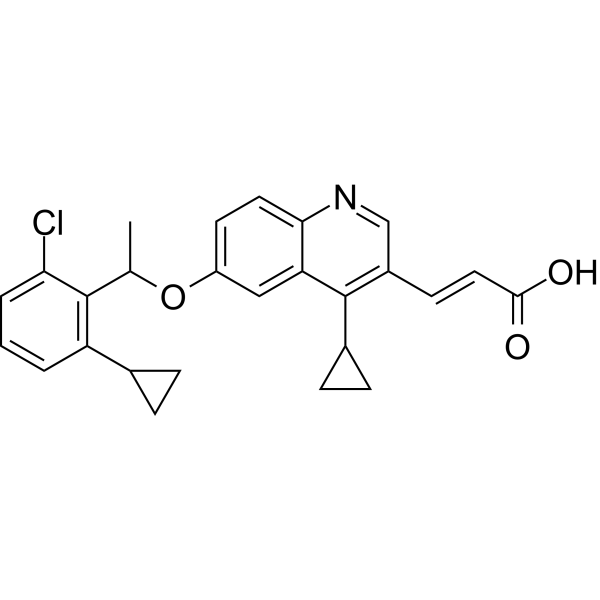
G907 is a selective antagonist of ATP-binding cassette (ABC) transporter MsbA with anti-microbial activity. G907 inhibits E. coli MsbA with an IC50 value of 18 nM. G907 traps MsbA in an inward-facing, lipopolysaccharide-bound conformation by wedging into an architecturally conserved transmembrane pocket .
loading...
    loading...
Cat. No.: HY-P10856
CAS No.: 3085809-95-3
Target:  

P-glycoprotein

Research Areas:  

Cancer

CPI1 is a multidrug resistance protein 1 (MRP1) inhibitor with a Ki value of 100 nM. CPI1 binds to the same substrate-binding site as leukotriene C4, stabilizes MRP1 in an apo-like inward-facing conformation, blocks the conformational changes required for ATP hydrolysis and substrate transport, and inhibits the ATPase activity of human and bovine MRP1. CPI1 serves as a tool for investigating the substrate transport mechanism of MRP1. CPI1 is applicable to research related to cancer multidrug resistance .
loading...
    loading...
Cat. No.: HY-187996
Target:  

P-glycoprotein

Research Areas:  

Cardiovascular Disease

P-gp-IN-37 is a ligand of P-glycoprotein (P-gp), with an EC50 value of 1.8 μM. P-gp-IN-37 stabilizes the inward-facing conformation of P-gp through hydrogen bonding and π-stacking interactions, and can be used as a PET radiotracer for imaging the function and expression of P-gp. P-gp-IN-37 is applied in the research of heart failure .
loading...
    loading...
Cat. No.: HY-189362
Target:  

Dopamine Transporter

Research Areas:  

Neurological Disease

DAT-IN-2 is an atypical dopamine transporter (DAT) inhibitor with blood-brain barrier permeability. DAT-IN-2 binds to human DAT with a Ki of 63.0 nM and stabilizes the transporter in an inward-facing conformation. DAT-IN-2 produces only weak locomotor stimulant effects and does not induce conditioned place preference in mice, indicating no rewarding effects. DAT-IN-2 can be used in research related to psychostimulant use disorder .
loading...
    loading...

