8 Results for "

living HeLa cells

" in MedChemExpress (MCE) Product Catalog:
Products (8)

8 Results for "living HeLa cells" in MCE Product Catalog:

Cat. No.: HY-149836
Purity:  98.07%
Target:  

Fluorescent Dye

Research Areas:  

Others

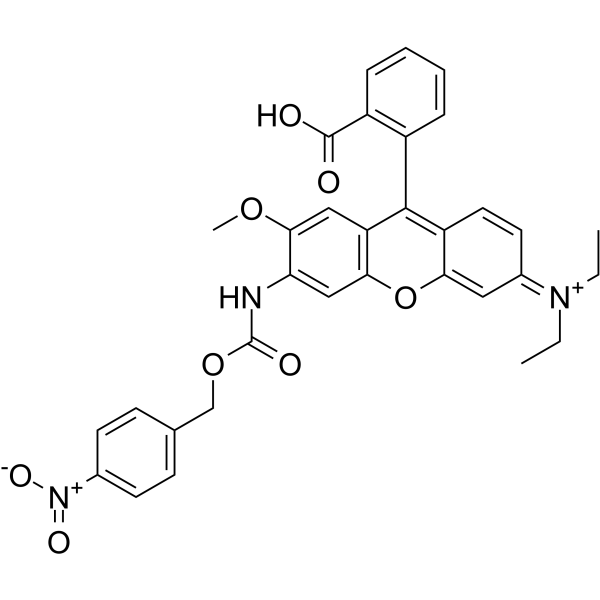
3-MeOARh-NTR is an activatable imaging probe with high selectivity, and good stability. 3-MeOARh-NTR possesses high selectivity and high signal-to-noise ratio for nitroreductase (NTR) detection, and serves as an efficient molecular tool for endogenous NTR detection .
loading...
    loading...
Cat. No.: HY-155382
Research Areas:  

Others Cancer

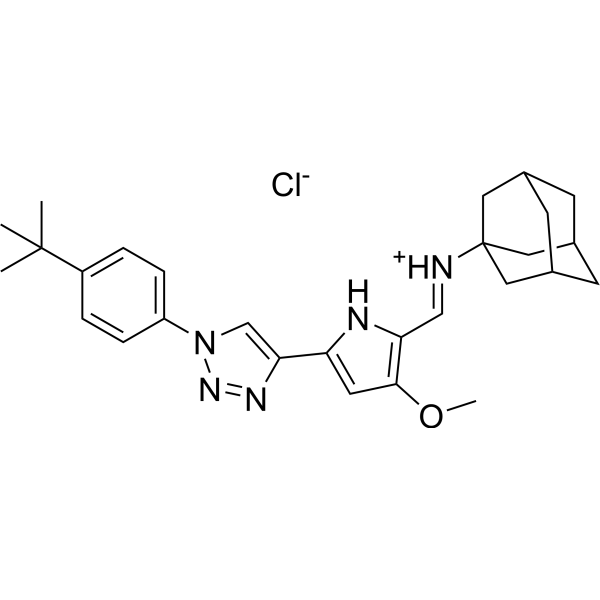
Lactate transportor 1 (compound 1) is an active lactate transporter in living cells. Lactate transportor 1 displays the cytotoxic effect, with IC50 values of 3.36, 3.27,5.58 and 7.66 μM in Hela, CAL27, MCF7 and MCF10A, respectively. Lactate transportor 1 has an additive effect with Cisplatin (HY-17394) observed in HeLa cells .
loading...
    loading...
Cat. No.: HY-149836A
Target:  

Fluorescent Dye

Research Areas:  

Others

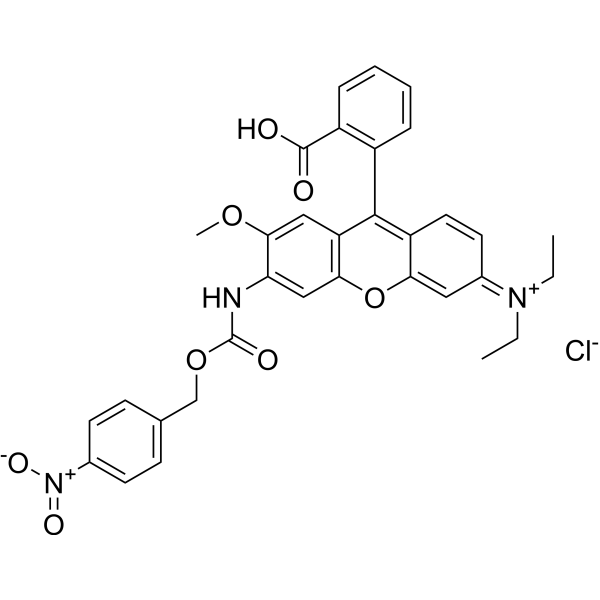
3-MeOARh-NTR chloride is an activatable imaging probe with high selectivity, and good stability. 3-MeOARh-NTR chloride possesses high selectivity and high signal-to-noise ratio for nitroreductase (NTR) detection, and serves as an efficient molecular tool for endogenous NTR detection .
loading...
    loading...
Cat. No.: HY-D3445
CAS No.: 3029700-80-6
Target:  

Fluorescent Dye

Research Areas:  

Others

JF629-HTL is a far-red fluorogenic HaloTag ligand. Binding of JF629-HTL to HaloTag protein alters the local environment of the dye, promoting the transition of rhodamine from a non-fluorescent state to a fluorescent state, thereby generating a fluorescence enhancement signal. In the light-controlled psHaloTag system, JF629-HTL shows a 6.7-fold fluorescence enhancement after irradiation at 450 nm. JF629-HTL serves as a research tool for far-red fluorescence imaging and the development of chemogenetic biosensors .
loading...
    loading...
Cat. No.: HY-D3152
CAS No.: 2361979-91-9
NRh-Cu is a highly sensitive near-infrared fluorescence turn-on indicator and Cu 2+-selective probe (λex=680 nm, λem=740 nm). When NRh-Cu interacts with Cu 2+, it undergoes a structural transition from a non-fluorescent spirocyclic state to a fluorescent ring-opened state, which drives the enhancement of fluorescence emission. NRh-Cu can be used for Cu 2+ imaging in live cells and in vivo .
loading...
    loading...
Cat. No.: HY-D3126
CAS No.: 2420449-92-7
Target:  

Fluorescent Dye

Research Areas:  

Others

IOPBA is a fluorescent probe that can be used for the detection and bioimaging of trivalent iron ions Fe 3+ and fluoride ions F - in living cells. IOPBA emits blue fluorescence in its native state, but upon the introduction of Fe 3+, it forms a Fe 3+-IOPBA π-complex, where Fe 3+ ions coordinate with two phenyl groups of IOPBA, resulting in fluorescence quenching. IOPBA returns to its free state and recovers its original fluorescence after F - sequesters Fe 3+ to form the more stable [FeF6] 3- and dissociates the Fe 3+-IOPBA complex. The excitation wavelength of IOPBA is 342 nm, and its emission wavelength is 458 nm .
loading...
    loading...
Cat. No.: HY-D3098
Target:  

Fluorescent Dye

Research Areas:  

Others

Mito‑VR2 is a mitochondria-targeted molecular rotor-type viscosity fluorescent probe with high responsiveness to microenvironmental viscosity, which is suitable for synchronous imaging of mitochondrial viscosity during autophagy in living cells. Mito-VR2 achieves specific targeting of mitochondria through its hydrophobic cationic structure, and its fluorescence intensity responds only to microenvironmental viscosity. Mito-VR2 emits almost no fluorescence in low-viscosity media, but its fluorescence emission is significantly enhanced in high-viscosity environments .
loading...
    loading...
Cat. No.: HY-D3160
Target:  

Fluorescent Dye

Research Areas:  

Others

Golgi-hNR is a cell membrane-permeable Golgi-targeted fluorescent probe containing a sulfonamide group. Golgi-hNR selectively accumulates in the Golgi apparatus of living cells, enabling real-time tracking and homeostasis assessment of reversible pH changes in the Golgi apparatus. Golgi-hNR exhibits a pH-dependent "off-on" fluorescence response mechanism within the pH 7.4-3.0 range, and its red fluorescence intensity decreases with increasing pH. The Ex/Em of Golgi-hNR is 560/664 nm and 580/664 nm, with the maximum emission peak located at 615 nm .
loading...
    loading...

