

4 Results for "

localized exposure

" in MedChemExpress (MCE) Product Catalog:
Products (4)

4 Results for "localized exposure" in MCE Product Catalog:

1
1 Cited Publications
Cat. No.: HY-P99813
CAS No.: 2227102-46-5
Synonyms: HER3-DXd; U3-1402
Research Areas:  

Cancer

Patritumab deruxtecan (HER3-DXd) is an antibody-drug conjugate (ADC) targeting HER3, consisting of the anti-HER3 IgG1 antibody Patritumab (HY-P99275), a cleavable tetrapeptide linker, and the membrane-permeable topoisomerase I (Topoisomerase Ⅰ) inhibitor DXd (HY-13631D). After binding to membrane-localized HER3, Patritumab deruxtecan is internalized into lysosomes, where the linker is cleaved to release DXd. DXd enters the nucleus to induce DNA damage and cell death, and exerts a bystander effect via transmembrane diffusion. Patritumab deruxtecan reduces the viability of HER3-positive cells and induces features of immunogenic cell death including CALR membrane exposure, ATP and HMGB1 release, and can be used in studies related to HER3-positive breast cancer and non-small cell lung cancer .
loading...
    loading...
1
1 Cited Publications
Cat. No.: HY-156675A
Purity:  99.34%
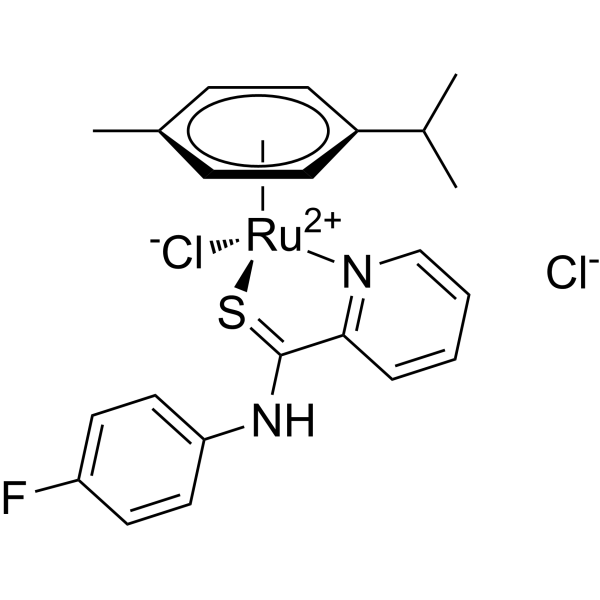
Plecstatin-1 hydrochloride is a metal complex that drives the aggregation and collapse of the plectin network, and disrupts the cytoskeletal structures of α‑tubulin and F‑actin. Plecstatin-1 hydrochloride triggers oxidative stress, mediates the phosphorylation of eIF2α, and induces molecular features associated with immunogenic cell death, including calreticulin membrane exposure, membrane localization of HSP70/HSP90, ATP secretion, and HMGB‑1 release. Plecstatin-1 hydrochloride induces apoptosis via the intrinsic mitochondrial pathway and exerts anti-invasive activity. Plecstatin-1 hydrochloride inhibits sphere proliferation and reduces clonogenicity in the 3D tumor spheroid model of colon cancer cells. Plecstatin-1 hydrochloride is applicable to relevant research on colorectal cancer .
loading...
    loading...
Cat. No.: HY-156675
CAS No.: 2119725-22-1
Plecstatin‑1 is a metal complex that drives the aggregation and collapse of the plectin network, and disrupts the cytoskeletal structures of α‑tubulin and F‑actin. Plecstatin-1 triggers oxidative stress, mediates the phosphorylation of eIF2α, and induces molecular features associated with immunogenic cell death, including calreticulin membrane exposure, membrane localization of HSP70/HSP90, ATP secretion, and HMGB‑1 release. Plecstatin-1 induces apoptosis via the intrinsic mitochondrial pathway and exerts anti-invasive activity. Plecstatin‑1 inhibits sphere proliferation and reduces clonogenicity in the 3D tumor spheroid model of colon cancer cells. Plecstatin-1 is applicable to relevant research on colorectal cancer .
loading...
    loading...
Cat. No.: HY-174777
Target:  

mRNA

Research Areas:  

Cancer

Human BAK1 mRNA encodes the human BCL2 antagonist/killer 1 (BAK1) protein, a member of the BCL2 protein family. BAK1 localizes to mitochondria, and functions to induce apoptosis. It also interacts with the tumor suppressor P53 after exposure to cell stress.
loading...
    loading...

