14 Results for "

murine STING

" in MedChemExpress (MCE) Product Catalog:
Products (14)

14 Results for "murine STING" in MCE Product Catalog:

80
80 Cited Publications
Cat. No.: HY-10964
CAS No.: 117570-53-3
Purity:  99.93%
Synonyms: DMXAA; ASA-404
Research Areas:  

Infection Cancer

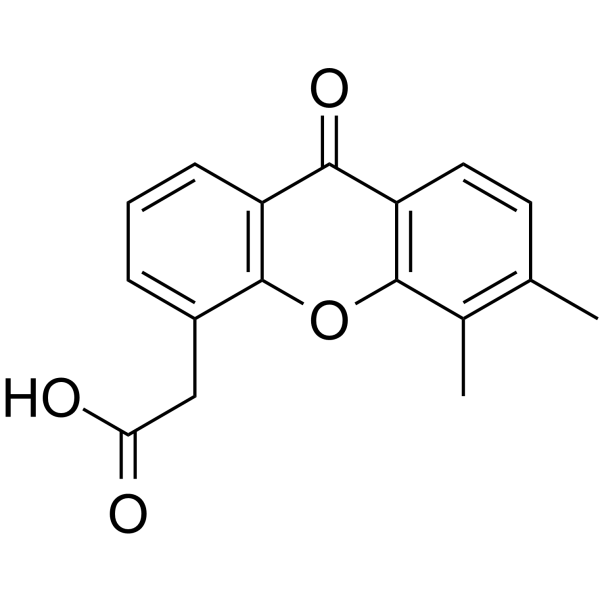
Vadimezan (DMXAA), the tumor vascular disrupting agent (tumor-VDA), is a murine agonist of the stimulator of interferon genes (STING) and also a potent inducer of type I IFNs and other cytokines. Vadimezan is unable to activate human STING. Vadimezan has anti-influenza virus H1N1-PR8 activities.
loading...
    loading...
1
1 Cited Publications
Cat. No.: HY-168034
CAS No.: 2138299-65-5
diABZI-4 is a STING activator and broad-spectrum antiviral agent with immunostimulatory activity. diABZI-4 triggers the TBK1-IRF3 and NF-κB signaling cascades by inducing STING oligomerization, thereby promoting the production of type I/III interferons and various proinflammatory cytokines. diABZI-4 exhibits broad-spectrum antiviral activity and effectively inhibits the replication of influenza A virus, SARS-CoV-2, herpes simplex virus, and other viruses. diABZI-4 also activates lymphocytes and macrophages to provide significant pre- and post-exposure protection in viral disease models. diABZI-4 can be used to study COVID-19, respiratory viral infections, and related immunopathological mechanisms .
loading...
    loading...
Cat. No.: HY-164278
CAS No.: 3035557-55-9
Target:  

STING Cathepsin

Research Areas:  

Cancer

diABZI-V/C-Mal is a STING agonist (with a STING EC50 of 314 nM in TH1 dual reporter cells) and a Cathepsin B substrate. diABZI-V/C-Mal activates STING, thereby triggering the IRF3 signaling pathway. diABZI-V/C-Mal is cleaved by Cathepsin B to regenerate diABZI-NH2 .
loading...
    loading...
Cat. No.: HY-160222
Target:  

HSV STING IFNAR NF-κB

Research Areas:  

Infection

HSV-60mer sodium is a 60 bp double-stranded DNA oligonucleotide derived from the HSV-1 genome, and also an IFNβ inducer. HSV-60mer sodium colocalizes with endogenous cytoplasmic IFI16 in immune cells. HSV-60mer sodium activates the transcription factors IRF3 and NF-κB, induces the production of proinflammatory cytokines, and inhibits HSV-1 replication in immune cells. HSV-60mer sodium can be used in studies related to herpes simplex virus type 1 infection .
loading...
    loading...
Cat. No.: HY-10964R
CAS No.: 117570-53-3
Synonyms: DMXAA (Standard); ASA-404 (Standard)
Vadimezan (Standard) (DMXAA (Standard)) is the analytical standard of Vadimezan (HY-10964). This product is intended for research and analytical applications. Vadimezan (DMXAA; ASA-404), the tumor vascular disrupting agent (tumor-VDA), is a murine agonist of the stimulator of interferon genes (STING) and also a potent inducer of type I IFNs and other cytokines. Vadimezan is unable to activate human STING. Vadimezan has anti-influenza virus H1N1-PR8 activities.
loading...
    loading...
Cat. No.: HY-175210
CAS No.: 2982807-58-7
STING-IN-16 is a STING inhibitor with IC50 values of 44 nM (human) and 32 nM (mice) for cellular STING inhibition. STING-IN-16 effectively inhibits the activation of the STING axis in both human and murine cells. STING-IN-16 can restore renal mitochondrial function, suppress reactive oxygen species (ROS) production, and reduce cell apoptosis. STING-IN-16 shows robust anti-inflammatory efiicacy in vivo. STING-IN-16 can be used for the study of autoimmune and autoinflammatory diseases .
loading...
    loading...
Cat. No.: HY-163749
Target:  

STING

Research Areas:  

Inflammation/Immunology

STING-IN-8 (Compound 15b) emerges as a potent stimulator of interferon gene (STING) inhibitor with an IC50 value of 0.121 μM in human and an IC50 value of 0.033 μM in mouse. STING-IN-8 inhibits MSA-2 (HY-136927) or 2’, 3’ -cGAMP (HY-100564)-stimulated STING signaling and suppresses immune-inflammatory cytokine levels in both human and murine cells. STING-IN-8 is promising for research in the field of STING-associated inflammatory and autoimmune diseases .
loading...
    loading...
Cat. No.: HY-172533
Target:  

STING

Research Areas:  

Cancer

3’,5’-DiOA-dC is a hydrophobic nucleotide lipid and a ligand for the STING agonist c-di-GMP (CDG). 3’,5’-DiOA-dC can assemble with CDG and form stable cyclic dinucleotide nanoparticles via various supramolecular forces driven by molecular recognition. 3’,5’-DiOA-dC can decrease tumor weight and volume, increase CD8 T cell, neutrophils as well as NK cell counts in tumor microenvironment in combination with CDG. 3’,5’-DiOA-dC also increases the levels of TNF-α and IFN-γ in murine melanoma model .
loading...
    loading...
Cat. No.: HY-130116A
CAS No.: 2243079-27-6
Target:  

STING

Research Areas:  

Cancer

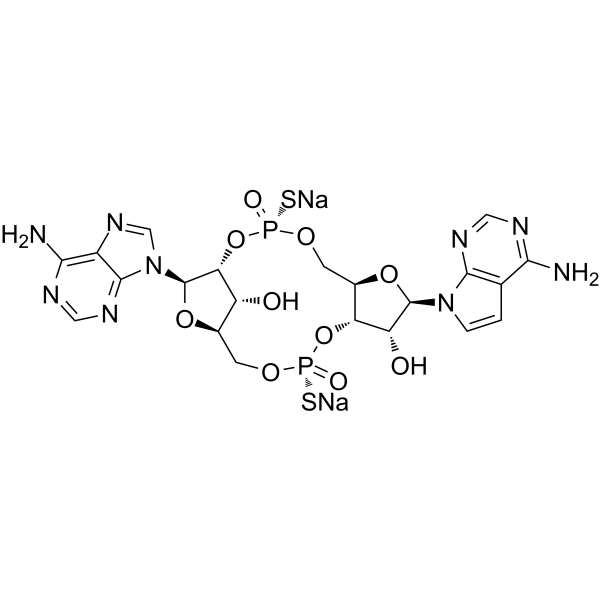
IACS-8779 disodium is a highly potent stimulator of interferon genes (STING) agonist with robust systemic antitumor efficacy. IACS-8779 disodium shows robust activation of the STING pathway in vitro and a superior systemic anti-tumor response in the B16 murine model of melanoma .
loading...
    loading...
Cat. No.: HY-W1150738
CAS No.: 2809367-71-1
DDO-6513 is a STING molecular glue inhibitor with an IC50 of 1.93 μM. DDO-6513 selectively targets human STING but not murine STING, and exhibits a Kd value of 151 nM for human STING. DDO-6513 induces aberrant head-to-head STING oligomerization and disrupts the formation of normal signal-competent linear STING polymers. DDO-6513 inhibits STING-dependent downstream activation of TBK1 and IRF3, and suppresses the expression of proinflammatory cytokines. DDO-6513 can be used for research on STING-related autoinflammatory diseases .
loading...
    loading...
Cat. No.: HY-181057
STING-IN-18 is an orally active STING inhibitor. STING-IN-18 exhibits an IC50 of 86 nM against STING in murine RAW-Lucia TM ISG cells. STING-IN-18 inhibits STING activation and blocks downstream signaling pathways. STING-IN-18 suppresses kidney injury and inflammation. STING-IN-18 can be used for the research of autoimmune and inflammatory diseases .
loading...
    loading...
Cat. No.: HY-178049A
Target:  

STING

Research Areas:  

Cardiovascular Disease

UM-259 hydrochloride is a STING inhibitor with activity against both murine and human STING (including the STING R232 mutant). UM-259 hydrochloride inhibits STING-dependent signaling pathways, blocks STING oligomerization, and acts on human primary CD14 + monocytes. UM-259 hydrochloride can be used for research on amyotrophic lateral sclerosis, lupus erythematosus, Aicardi-Goutières syndrome, and infant-onset STING-associated vasculopathy .
loading...
    loading...
Cat. No.: HY-183607
Research Areas:  

Cancer

SMU-3k is a STING activator and PD-L1 inhibitor, with a PD-L1 IC50 of 106 nM, a KD of 386 nM for human PD-L1, and a KD of 352 nM for murine PD-L1. SMU-3k activates the STING pathway, induces phosphorylation of TBK1 and IRF3, and promotes the expression of IFN-β, IL-6 and CXCL10. SMU-3k blocks the PD-1/PD-L1 interaction, reduces PD-L1 levels and induces PD-L1 internalization. Through dual immunomodulation, SMU-3k exerts synergistic tumor growth inhibitory effects in a mouse colon cancer model. SMU-3k can be used for the research of colon cancer .
loading...
    loading...
Cat. No.: HY-180555
Target:  

PROTACs STING

Research Areas:  

Inflammation/Immunology Cancer

SN38-(PEG)2-Pom-α is a selective PROTAC RPL15 degrader. SN38-(PEG)2-Pom-α induces ubiquitin-mediated degradation of RPL15 without affecting TOP1. SN38-(PEG)2-Pom-α induces damage-associated molecular pattern (DAMP) secretion from cancer cells, which activated cGAS-STING signaling in dendritic cells. SN38-(PEG)2-Pom-α enhances anti-PD-1 immunotherapy in a murine melanoma tumor model expressing human CRBN. SN38-(PEG)2-Pom-α can be used for melanoma research .
loading...
    loading...
  • 1

