7 Results for "

polymerization dynamics

" in MedChemExpress (MCE) Product Catalog:
Products (7)

7 Results for "polymerization dynamics" in MCE Product Catalog:

Cat. No.: HY-NP008
CAS No.: 9045-23-2
β-Lactoglobulin, a major whey protein, is a small globular protein from the lipocalin family. β-Lactoglobulin is an important source of the essential and branched-chain amino acids (leucine, isoleucine, and valine). β-Lactoglobulin shows antioxidant properties, because it contains two disulfide bonds and one free thiol group. β-Lactoglobulin is a ligand transport agent. β-Lactoglobulin is one of the major allergens in milk and can be utilized in the research for developing safe hypoallergenic dairy products .
loading...
    loading...
Cat. No.: HY-W007729
CAS No.: 79069-13-9
Boc-L-Alaninol is a Boc-protected chiral amino alcohol. Boc-L-Alaninol can be used in the synthesis of optically active bipyridine-containing polymers .
loading...
    loading...
Cat. No.: HY-146311
CAS No.: 2296731-38-7
Target:  

Microtubule/Tubulin

Research Areas:  

Cancer

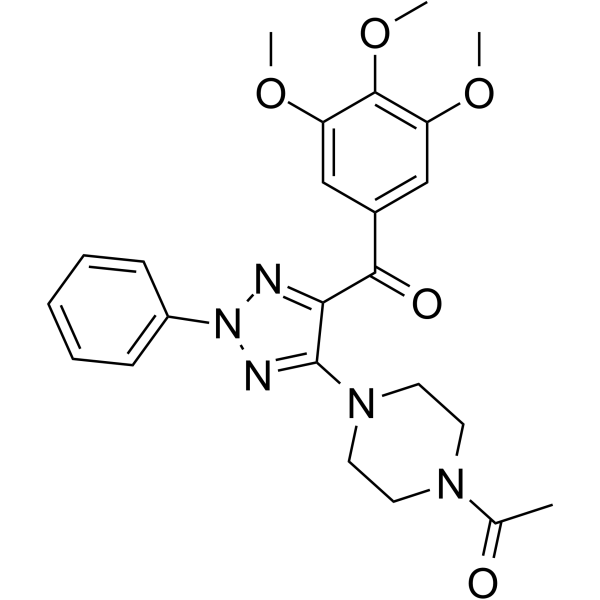
Tubulin polymerization-IN-16 (compound 5g) is a potent inhibitor of tubulin polymerization. Tubulin polymerization-IN-16 shows most potent against cancer cells, with IC50 values of 0.084-0.221 μM. Tubulin polymerization-IN-16 potently disrupts microtubule/tubulin dynamics, induces cell cycle arrest at G2/M phase in SGC-7901 cells .
loading...
    loading...
Cat. No.: HY-171165
CAS No.: 1784751-83-2
Target:  

Microtubule/Tubulin

Research Areas:  

Cancer

JC168 is a phenyl analog of peloruside and serves as a microtubule inhibitor, demonstrating antiproliferative and anticancer activities. JC168 promotes tubulin polymerization, thereby interfering with microtubule dynamics, and can be utilized in research related to microtubule-associated disorders .
loading...
    loading...
Cat. No.: HY-182478
CAS No.: 124711-23-5
Target:  

Microtubule/Tubulin

Research Areas:  

Cancer

MDL-27048, a tubulin inhibitor, binds competitively, reversibly to the Colchicine (HY-16569)-binding site on tubulin heterodimers. MDL-27048 inhibits microtubule assembly, induces slow depolymerization of preassembled microtubules, disrupts microtubule polymerization-depolymerization dynamics, and disrupts cytoplasmic microtubule networks. MDL-27048 exerts growth inhibitory effects on human cancer cells, induces mitotic arrest, and does not disrupt actin filaments at microtubule-depolymerizing concentrations. MDL-27048 can be used for the research of malignant tumors .
loading...
    loading...
Cat. No.: HY-180159
Research Areas:  

Cancer

Tubulin-IN-63 is a potent tubulin polymerization inhibitor targeting the colchicine-binding site, with an IC50 of 6.03 µM. Tubulin-IN-63 disrupts microtubule dynamics, induces G2/M arrest and apoptosis, thereby suppressing cancer cell proliferation. Tubulin-IN-63 disrupts capillary network formation in human umbilical vein endothelial cells (HUVECs) and exhibits in vivo antitumor efficacy in a B16-F10 mouse model. Tubulin-IN-63 can be used for the research of cancers, such as melanoma, lung cancer, and liver cancer .
loading...
    loading...
Cat. No.: HY-184334
Target:  

Bacterial

Research Areas:  

Infection

FtsZ-IN-15 is an inhibitor targeting the FtsZ protein of Xanthomonas oryzae pv. oryzae (Xoo) and a cell division inhibitor. FtsZ-IN-15 specifically binds to key residues of XooFtsZ, inhibits its GTPase activity and disrupts its polymerization. FtsZ-IN-15 induces cell elongation of Xanthomonas oryzae pv. oryzae and exhibits significant antibacterial activity against this strain. FtsZ-IN-15 shows good control efficacy against rice bacterial blight and can be used in relevant research on rice bacterial blight .
loading...
    loading...

