12 Results for "

protein sequencing

" in MedChemExpress (MCE) Product Catalog:
Products (12)

12 Results for "protein sequencing" in MCE Product Catalog:

2
2 Cited Publications
Cat. No.: HY-P3208
CAS No.: 72561-05-8
Research Areas:  

Others

Endoproteinase Lys-C is a protease that cleaves proteins on the C-terminal side of lysine residues and is commonly used for protein sequencing .
loading...
    loading...
1
1 Cited Publications
Cat. No.: HY-P3208A
CAS No.: 72561-05-8
Research Areas:  

Others

Endoproteinase Lys-C (Tag-free) is a protease that cleaves proteins on the C-terminal side of lysine residues and is commonly used for protein sequencing .
loading...
    loading...
Cat. No.: HY-D0017
CAS No.: 605-65-2
Synonyms: DNSCl
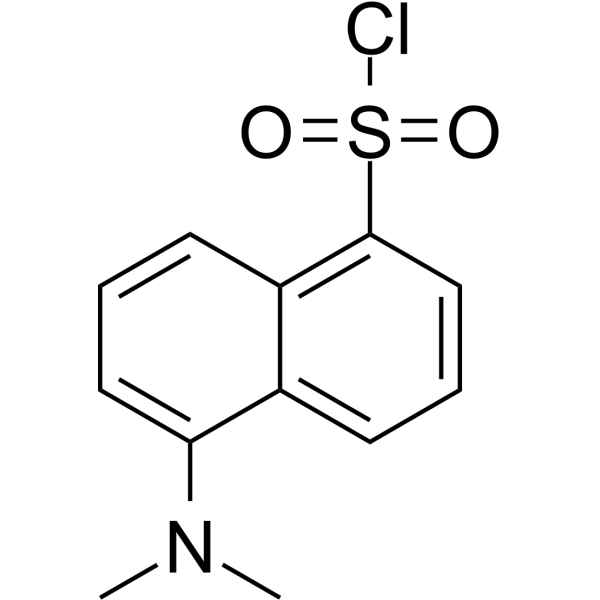
Dansyl chloride is a reagent that produces stable blue or blue-green fluorescent sulfonamide adducts in the reaction of aliphatic and aromatic amines with primary amino groups, and is widely used for modified amino acids, protein sequencing and amino acid analysis .
loading...
    loading...
Cat. No.: HY-NP008
CAS No.: 9045-23-2
β-Lactoglobulin, a major whey protein, is a small globular protein from the lipocalin family. β-Lactoglobulin is an important source of the essential and branched-chain amino acids (leucine, isoleucine, and valine). β-Lactoglobulin shows antioxidant properties, because it contains two disulfide bonds and one free thiol group. β-Lactoglobulin is a ligand transport agent. β-Lactoglobulin is one of the major allergens in milk and can be utilized in the research for developing safe hypoallergenic dairy products .
loading...
    loading...
Cat. No.: HY-134222A
CAS No.: 16354-58-8
Purity:  ≥98.0%
Synonyms: N-Acetyl-L-serine
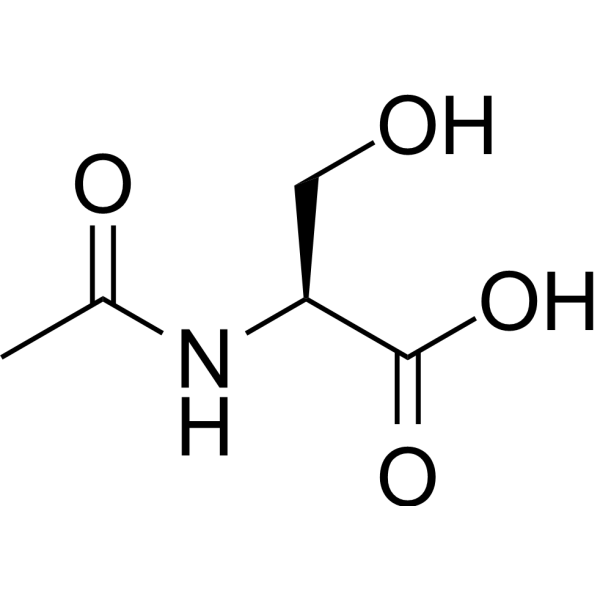
N-Acetylserine (N-Acetyl-L-serine) is a complement pathway modulator targeting activated third complement protein (C3b) and an amino-terminal residue (an N-terminal acetylation modification group). N-Acetylserine reacts with the exposed thioester group of C3b via its hydroxyl group, thereby blocking the covalent binding of glycerol to this thioester group. N-Acetylserine widely exists in soluble proteins of mammalian cells (accounting for approximately 80% of such proteins). N-Acetylserine has a blocking property that prevents direct Edman sequencing of proteins; deblocking is achievable through trifluoroacetic acid-catalyzed N→O acetyl migration followed by β-elimination. N-Acetylserine is suitable for sequencing of proteins with N-terminal acetylserine modification .
loading...
    loading...
Cat. No.: HY-D0017S
CAS No.: 1276379-68-0
Synonyms: DNSCl-d6
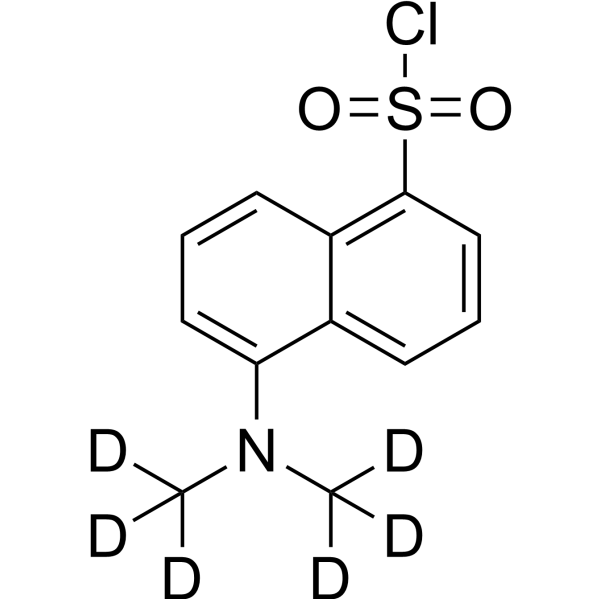
Dansyl chloride-d6 is the deuterium labeled Dansyl chloride (HY-D0017). Dansyl chloride is a reagent that produces stable blue or blue-green fluorescent sulfonamide adducts in the reaction of aliphatic and aromatic amines with primary amino groups, and is widely used for modified amino acids, protein sequencing and amino acid analysis .
loading...
    loading...
Cat. No.: HY-113352S
CAS No.: 17829-03-7
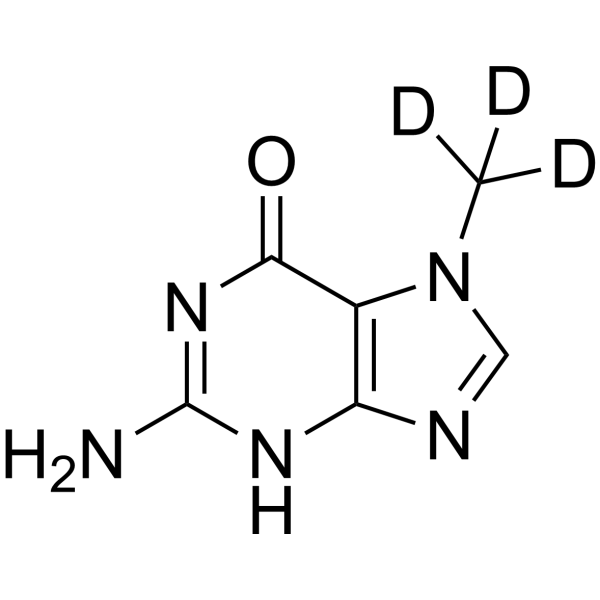
7-Methylguanine-d3 is the deuterium labeled 7-Methylguanine . 7-Methylguanine is a metabolite of DNA methylation. It can be generated by methylating agents, and used as a probe of protein–DNA interactions and a key component of DNA sequencing method .
loading...
    loading...
Cat. No.: HY-E70584
Target:  

DNA/RNA Synthesis

Research Areas:  

Infection

Recombinant APOBEC3A (A3A) Protein is a single-domain cytosine deaminase with antiviral activity that deaminates cytosine to uracil, thereby specifically detecting DNA methylation levels. Recombinant APOBEC3A (A3A) Protein is recombinantly expressed in E.coli and is suitable for bisulfite-free 5-hydroxymethylcytosine whole-genome sequencing (such as ACE-Seq), cytosine deamination, etc .
loading...
    loading...
Cat. No.: HY-E70582
Target:  

Adenosine Deaminase

Research Areas:  

Others

E.coli tRNA adenosine deaminase is derived from E.coli and is an adenine deaminase that can deaminate adenine in single-stranded RNA (ssRNA, mainly the loop region within tRNA) or double-stranded RNA (dsRNA), but has no deamination activity on DNA. E.coli tRNA adenosine deaminase is a protein-modified mutant of adenine deaminase, which can efficiently deaminate adenine in ssDNA and can be applied to adenine base editors (ABE) and RNA m6A methylation sequencing .
loading...
    loading...
Cat. No.: HY-D0017S1
CAS No.: 274250-28-1
Synonyms: DNSCl-13C2
Dansyl chloride- 13C2 is the 13C labeled Dansyl chloride (HY-D0017) . Dansyl chloride is a reagent that produces stable blue or blue-green fluorescent sulfonamide adducts in the reaction of aliphatic and aromatic amines with primary amino groups, and is widely used for modified amino acids, protein sequencing and amino acid analysis.
loading...
    loading...
Cat. No.: HY-LD005
1.2 billion compounds

Cyclic peptide library have advantages such as high affinity, high selectivity, and suitability for targeting proteinprotein interactions. Through DEL synthesis technology, the library size can achieve hundreds of millions. DEL cyclic peptide library have advantages like low cost andhigh screeing efficiency, making them valuable for discovering lead compounds against challenging drug targets.

This cyclic peptide library is constructed with unnatural amino acids as building block, synthesized through DNA-compatible chemical reactions. Each cyclic peptide consist of six amino acids and constrained conformations such as side-chain cross-linking, disulfide bonds, and macrocyclization. These cyclic peptides exhibit significantly improved stability and druggability compared with linear peptides, filling the gap between small molecules and macromolecular biologics. Each cyclic peptide is uniquely conjugated to a DNA barcode sequence for molecular identification and sequencing decoding.

MCE’s cyclic peptide library has8 independent sub-libraries, with a total molecular diversity of 1.2 billion. It is constructed via multi-round combinatorial assembly of building blocks and diverse cyclization strategies, facilitating the discovery of cyclic peptide leads for undruggable targets.

Cat. No.: HY-LD004
14 million compounds

DEL technology enables the simultaneous screening of millions or billions of compounds in a single tube by covalently linking each small molecule with a unique DNA sequence. Traditional DEL screening primarily focuses on identifying non-covalent binding molecules, where interactions with the target are reversible. In contrast, DNA‑encoded covalent library is an ultra‑high‑throughput screening library developed on the basis of conventional DNA‑encoded library technology. It incorporates controllable electrophilic covalent warheads capable of forming irreversible covalent bonds with amino acid residues at the active sites of target proteins, including Cys, Lys, Ser, Tyr, and others. This covalent binding enhances binding affinity, prolongs residence time at the target site, and has the potential to overcome challenges associated with traditional non-covalent inhibitors, such as drug resistance or off-target effects.

Each compound in the library contains both a binding domain and an electrophilic warhead. It first recognizes and binds to the target through non covalent interactions, and then forms a stable covalent bond with key amino acid residues to achieve irreversible inhibition. This library is specifically designed for the discovery of potent, long lasting, and highly selective covalent inhibitors, particularly for undruggable targets such as kinases, GPCRs, proteases, and mutant oncoproteins. Each molecule is uniquely labeled with a DNA barcode for molecular identification and sequencing decoding.

This library is an advanced and highly diverse collection, consists of 35 independent sub-libraries with a total scaleof 14 million compounds, It incorporates over 14 experimentally validated covalent warheads capable of targeting cysteine, lysine, arginine, aspartic acid and glutamic acid. This library is constructed with diverse drug like core scaffolds and integrated controllable covalent warheads, it features structural diversity, reaction spec

  • 1

