Search Result
Results for "
serotonin 5-HT2 receptors
" in MedChemExpress (MCE) Product Catalog:
2
Biochemical Assay Reagents
11
Isotope-Labeled Compounds
| Cat. No. |
Product Name |
Target |
Research Areas |
Chemical Structure |
-
- HY-N0737A
-
-
-
- HY-11018
-
-
-
- HY-103124
-
|
|
5-HT Receptor
|
Neurological Disease
|
|
DOI hydrochloride is a serotonin 5-HT2A/2C receptor agonist with Ki values of 0.7 nM, 2.4 nM and 20 nM for h5-HT2A, h5-HT2C and h5-HT2B receptors, respectively. DOI hydrochloride can across the blood-brain barrier. DOI hydrochloride increases head twitches in mice .
|
-
-
- HY-N0737
-
-
-
- HY-B1033
-
|
|
5-HT Receptor
Dopamine Receptor
Sodium Channel
|
Neurological Disease
|
|
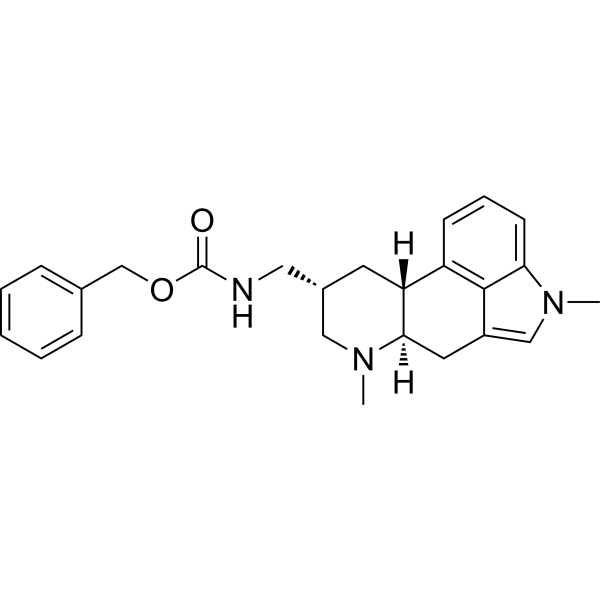
Metergoline is a serotonin (5-HT) receptor and dopamine receptors antagonist, with pKis of 8.64, 8.75 and 8.75 for 5-HT2A, 5-HT2B and 5-HT2C, respectively. Metergoline is a high-affinity ligand for the h5-HT7 receptor, with a Ki of 16 nM. Metergoline is also a reversible neural Na + channels inhibitor. Metergoline is commonly used for the research of seasonal affective disorder, prolactin hormone regulation .
|
-
-
- HY-A0095
-
|
BIMT-17; BIMT-17BS
|
5-HT Receptor
|
Neurological Disease
Cancer
|
|
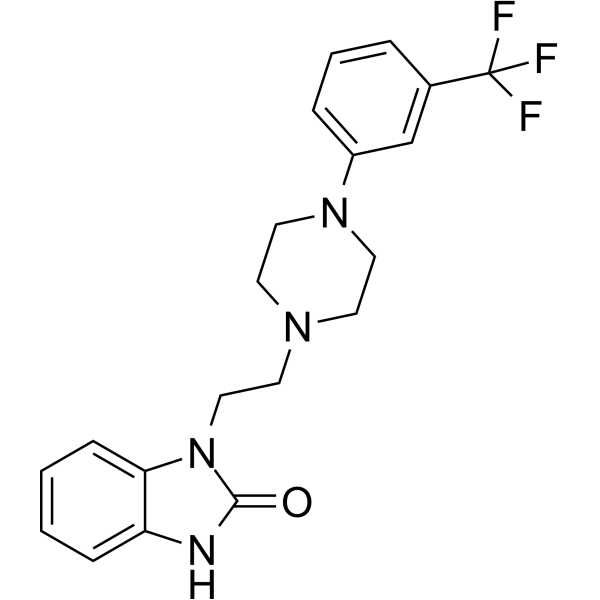
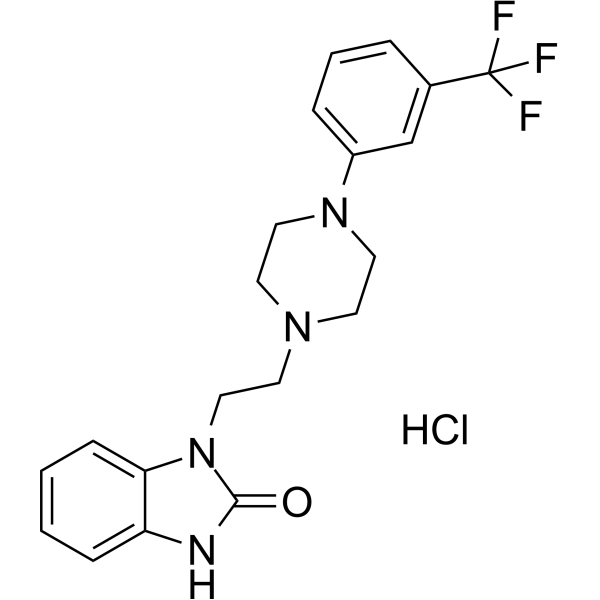
Flibanserin (BIMT-17; BIMT-17BS) is an orally active serotonin 5-HT1A receptor agonist and 5-HT2A receptor antagonist with Ki values of 1 nM and 49 nM, respectively. Flibanserin binds to dopamine D4 receptors with an Ki value of 4-24 nM. Flibanserin shows anti-depression and anti-anxiety effect, can be used to hypoactive sexual desire disorder (HSDD) research - .
|
-
-
- HY-B1213
-
|
|
5-HT Receptor
Bacterial
|
Neurological Disease
|
|
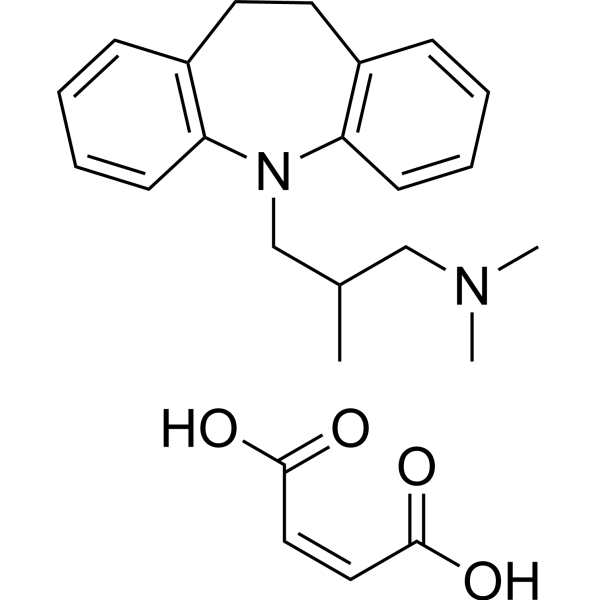
Trimipramine maleate is a 5-HT receptor antagonist, with blood-brain barrier permeability. Trimipramine maleate has pKi binding values of 6.39, 8.10, 4.66 for 5-HT1C, 5-HT2 and 5-HT1A, respectively. Trimipramine maleate is also a potent and selective inhibitor targeting human noradrenaline (hNAT), serotonin (hSERT) and organic cation transporters (hOCT1, hOCT2) with IC50 values of 4.99 μM, 2.11 μM, 3.72 μM, 8.00 μM, respectively. Trimipramine maleate has vascular activity and anxiolytic efficacy .
|
-
-
- HY-32329
-
|
Org-8282
|
5-HT Receptor
Adrenergic Receptor
|
Neurological Disease
|
|
Setiptiline (Org-8282) is a serotonin receptor antagonist. Setiptiline is a tetracyclic antidepressant (TeCA) which acts as a noradrenergic and specific serotonergic antidepressant (NaSSA). Setiptiline acts as a norepinephrine reuptake inhibitor, α2-adrenergic receptor antagonist, and serotonin receptor antagonist, likely at the 5-HT2A, 5-HT2C, and/or 5-HT3 subtypes, as well as an H1 receptor inverse agonist/antihistamine.
|
-
-
- HY-172420
-
|
GM-2505
|
5-HT Receptor
|
Neurological Disease
|
|
Bretisilocin (GM-2505) is the agonist for 5-HT2A receptor and a serotonin releaser. Bretisilocin exhibits antidepressant activity and can be used in the study of depression .
|
-
-
- HY-B1371
-
|
Spiroperidol
|
Dopamine Receptor
5-HT Receptor
Wnt
|
Neurological Disease
|
|
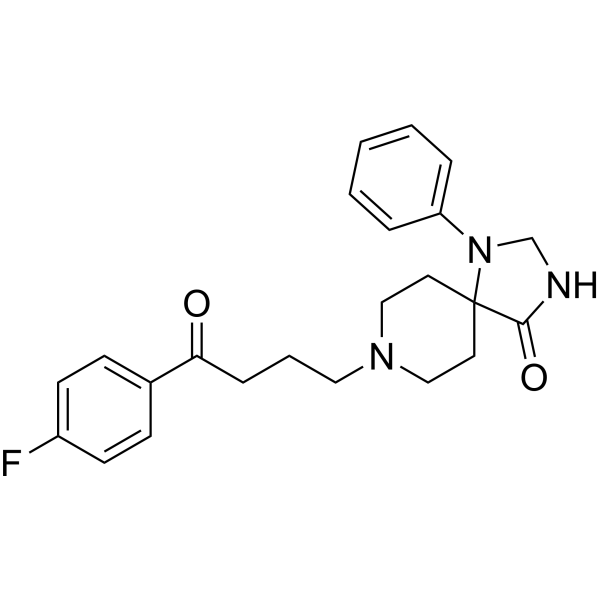
Spiperone (Spiroperidol) is a potent dopamine D2, serotonin 5-HT1A, and serotonin 5-HT2A antagonist. Spiperone is also a labelled ligand for neuroleptic receptors. Spiperone enhances intracellular calcium level and inhibits the Wnt signaling pathway. Spiperone has the potential for the research of neurology diseases .
|
-
-
- HY-14153
-
|
|
5-HT Receptor
Apoptosis
|
Metabolic Disease
Cancer
|
|
Tegaserod is an orally active serotonin receptor 4 (HTR4; 5-HT4R) agonist and a 5-HT2B receptor antagonist. Tegaserod has pKis of 7.5, 8.4 and 7.0 for human recombinant 5-HT2A, 5-HT2B and 5-HT2C receptors, respectively. Tegaserod causes tumor cell apoptosis, blunts PI3K/Akt/mTOR signaling and decreases S6 phosphorylation. Tegaserod has anti-tumor activity and has the potential for irritable bowel syndrome (IBS) research .
|
-
-
- HY-14153A
-
|
SDZ-HTF-919; HTF-919
|
5-HT Receptor
Apoptosis
|
Neurological Disease
Metabolic Disease
Cancer
|
|
Tegaserod maleate (SDZ-HTF-919) is an orally active serotonin receptor 4 (HTR4; 5-HT4R) agonist and a 5-HT2B receptor antagonist. Tegaserod maleate has pKis of 7.5, 8.4 and 7.0 for human recombinant 5-HT2A, 5-HT2B and 5-HT2C receptors, respectively. Tegaserod maleate causes tumor cell apoptosis, blunts PI3K/Akt/mTOR signaling and decreases S6 phosphorylation. Tegaserod maleate has anti-tumor activity and has the potential for irritable bowel syndrome (IBS) research .
|
-
-
- HY-B1107
-
|
Nafronyl oxalate salt
|
5-HT Receptor
|
Cardiovascular Disease
|
|
Naftidrofuryl oxalate (Nafronyl oxalate salt) is an orally active 5-HT2 receptor antagonist. Naftidrofuryl oxalate selectively blocks vascular and platelet 5-HT2 receptors, inhibiting Serotonin (HY-B1473A)-induced vasoconstriction, platelet aggregation, and vascular smooth muscle cell proliferation. Naftidrofuryl oxalate can be used for the research of intermittent claudication, peripheral occlusive arterial disease, and critical limb ischaemia .
|
-
-
- HY-100656
-
|
|
Dopamine Receptor
5-HT Receptor
|
Neurological Disease
|
|
Desmethyl cariprazine is a major active metabolite of cariprazine, with activities at human dopamine receptors and serotonin receptors, showing a pEC50 of 8.90 at human D2 receptors, a pEC50 of 8.09 at D3 receptors, and a pEC50 of 6.28 at 5-HT1A receptors. Desmethyl cariprazine inhibits forskolin-induced cAMP production at D2, D3 and 5-HT1A receptors, and suppresses serotonin-induced Ca 2+ release at 5-HT2B receptors. Desmethyl cariprazine is applicable to research related to schizophrenia, bipolar disorder type I and bipolar disorder.
|
-
-
- HY-109112
-
|
RP5063
|
Dopamine Receptor
5-HT Receptor
|
Neurological Disease
Inflammation/Immunology
|
|
Brilaroxazine (RP5603) is a potent and orally active multimodal dopamine (DA)/serotonin (5-HT) modulator. Brilaroxazine is a partial agonist of dopamine (DA) D2, D3, and D4 receptors, 5-HT1A (Ki=1.5 nM) and 5-HT2A (Ki=2.5 nM), and has antagonist activity at 5-HT2B (Ki=0.19 nM), and 5-HT7 (Ki=2.7 nM) receptors . Brilaroxazine is an atypical antipsychotic agent, and has the potential to improve cognitive impairments in neuropsychiatric and neurological diseases in vivo .
|
-
-
- HY-10457
-
|
TD-5108
|
5-HT Receptor
|
Neurological Disease
Metabolic Disease
|
|
Velusetrag (TD-5108) is an orally active, potent and selective agonist of serotonin 5-HT4 receptor (5-HT4R), with a pKi of 7.7. Velusetrag exhibits no affinity (Ki>10 μM) for 5-HT2A and 5-HT2B receptors. Velusetrag can be used for the research of gastrointestinal diseases and Parkinson's disease .
|
-
-
- HY-B0102C
-
|
|
Serotonin Transporter
|
Neurological Disease
|
|
(R)-Fluoxetine hydrochloride, an antidepressant, is serotonin reuptake inhibitor (SSRI). (R)-Fluoxetine hydrochloride has modest affinity at the 5-HT2A and 5-HT2C receptors .
|
-
-
- HY-100665
-
|
OPC-14857; DM-14857
|
5-HT Receptor
Dopamine Receptor
|
Neurological Disease
|
|
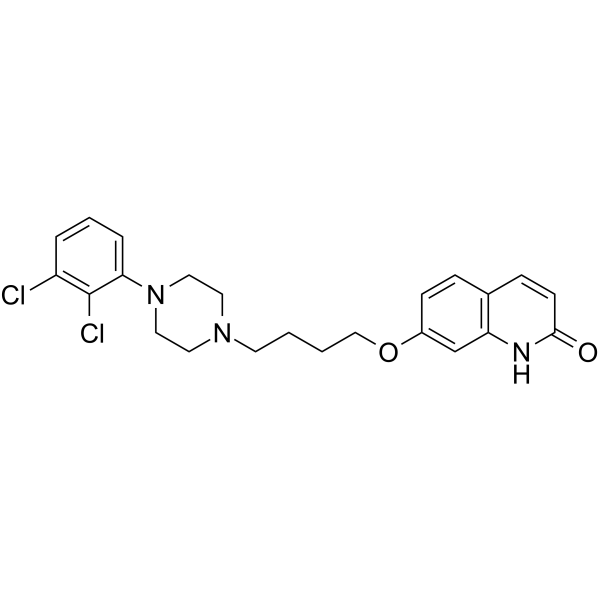
Dehydroaripiprazole (OPC-14857) is an active metabolite of Aripiprazole (HY-14546) and dopamine D2/D3 receptor partial agonist. Dehydroaripiprazole also has certain affinity for serotonin 5-HT1A, 5-HT2A and 5-HT2B receptors. Dehydroaripiprazole has antipsychotic activity equivalent to Aripiprazole .
|
-
-
- HY-B1737
-
-
-
- HY-103102
-
-
-
- HY-101250
-
|
MDL11939
|
Serotonin Transporter
|
Neurological Disease
|
|
Glemanserin (MDL11939) is a potent and selective antagonist for serotonin receptor 5-HT2A (Ki=2.89, 0.54 and 2.5 nM for rat 5-HT2A, rabbit 5-HT2A and human 5-HT2A, respectively) .
|
-
-
- HY-10792A
-
-
-
- HY-110232
-
|
R 64 766-d4
|
5-HT Receptor
Dopamine Receptor
P-glycoprotein
|
Neurological Disease
|
|
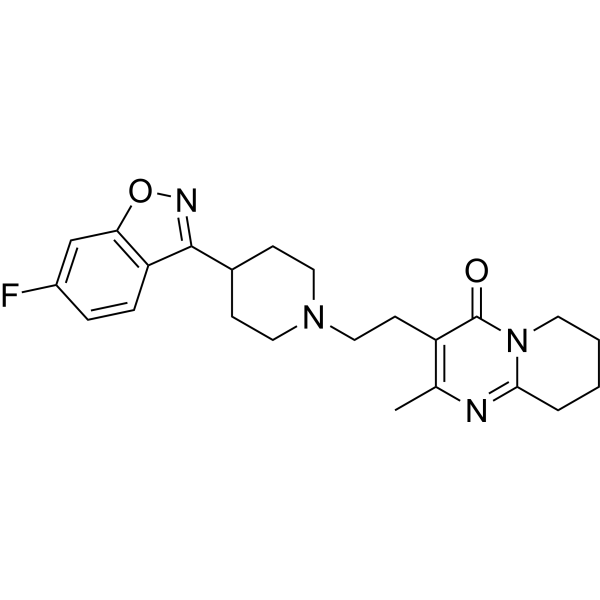
Risperidone-d4 is the deuterium labeled Risperidone. Risperidone is a serotonin 5-HT2 receptor blocker, P-Glycoprotein inhibitor and potent dopamine D2 receptor antagonist, with Kis of 4.8, 5.9 nM for 5-HT2A and dopamine D2 receptor, respectively.
|
-
-
- HY-100993
-
|
|
5-HT Receptor
|
Cardiovascular Disease
|
|
α-Methylserotonin maleate is a potent and selective agonist of 5-HT2 receptor. α-Methylserotonin maleate is an analogue of serotonin formed in vivo from α-Methyltryptophan. α-Methylserotonin maleate mediates the lymphatic smooth muscle contraction and prevents the up-regulation of serotonin-receptor-mediated phosphoinositide hydrolysis .
|
-
-
- HY-P3641A
-
|
|
GnRH Receptor
|
Neurological Disease
Metabolic Disease
|
|
Kisspeptin 13 TFA is the TFA salt form of Kisspeptin 13 (HY-P3641). Kisspeptin-13 TFA inhibits glucose-induced insulin secretion with an IC50 of 1.2 nM. Kisspeptin 13 TFA activates the hypothalamic-pituitary-adrenal (HPA) axis, causes hyperthermia, motor behavior and anxiety in rats. Kisspeptin 13 TFA interacts with α2-adrenergic and 5-HT2 serotonin receptors, exhibits antidepressant efficacy. Kisspeptin 13 TFA is an activator for GPR54 and GnRH receptor, which enhances memory and can be used in Alzheimer's disease research .
|
-
-
- HY-W077477
-
|
|
5-HT Receptor
|
Neurological Disease
|
|
IHCH-7113 (Compound 166) is an agonist of 5-HT2A serotonin receptor with antidepressant activity. IHCH-7113 is promising for research of antipsychotic agent .
|
-
-
- HY-G0002
-
|
|
Drug Metabolite
Dopamine Receptor
5-HT Receptor
|
Neurological Disease
|
|
Lurasidone metabolite 14326 is a minor active metabolite of Lurasidone (HY-B0032A) generated via metabolism by CYP3A4. Lurasidone metabolite 14326 shares similar receptor-binding properties with Lurasidone, acting as an antagonist of the dopamine D2 receptor (dopamine D2 receptor), an antagonist of the serotonin 5-HT2A and 5-HT7 receptors (5-HT2A and 5-HT7 receptor), and a partial agonist of the serotonin 5-HT1A receptor. Lurasidone metabolite 14326 can be used in the research of schizophrenia and bipolar depression .
|
-
-
- HY-10457A
-
|
TD-5108 hydrochloride
|
5-HT Receptor
|
Neurological Disease
Metabolic Disease
|
|
Velusetrag (TD-5108) hydrochloride is an orally active, potent and selective agonist of serotonin 5-HT4 receptor (5-HT4R), with a pKi of 7.7. Velusetrag hydrochloride exhibits no affinity (Ki>10 μM) for 5-HT2A and 5-HT2B receptors. Velusetrag hydrochloride can be used for the research of gastrointestinal diseases and Parkinson's disease .
|
-
-
- HY-124821
-
|
|
5-HT Receptor
|
Neurological Disease
Metabolic Disease
|
|
VA012 (compound 11) is a positive allosteric modulator (PAM) of the serotonin 5-HT2C receptor. VA012 reduces food intake and body weight gain without causing CNS-related malaise during subchronic administration. VA012 can be utilized in obesity research .
|
-
-
- HY-105285
-
|
Neu-P11
|
Melatonin Receptor
5-HT Receptor
P2X Receptor
TRP Channel
Sodium Channel
|
Neurological Disease
|
|
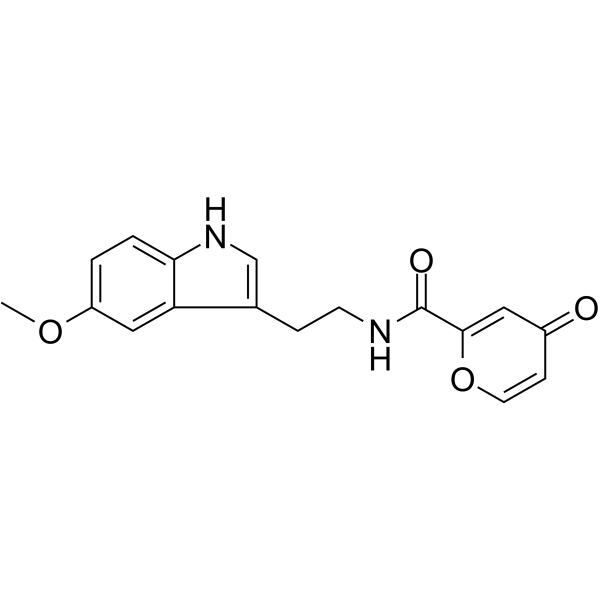
Piromelatine (Neu-P11) is a melatonin MT1/MT2 receptor agonist, serotonin 5-HT1A/5-HT1D agonist, and serotonin 5-HT2B antagonist. Piromelatine (Neu-P11) possesses sleep promoting, analgesic, anti-neurodegenerative, anxiolytic and antidepressant potentials. Piromelatine (Neu-P11) also possesses pain-related P2X3, TRPV1, and Nav1.7 channel-inhibition capacities .
|
-
-
- HY-32329A
-
|
MO-8282
|
5-HT Receptor
|
Neurological Disease
|
|
Setiptiline maleate (MO-8282 maleate) is a serotonin receptor antagonist. Setiptiline maleate is a tetracyclic antidepressant (TeCA) which acts as a noradrenergic and specific serotonergic antidepressant (NaSSA). Setiptiline maleate acts as a norepinephrine reuptake inhibitor, α2-adrenergic receptor antagonist, and serotonin receptor antagonist, likely at the 5-HT2A, 5-HT2C, and/or 5-HT3 subtypes, as well as an H1 receptor inverse agonist/antihistamine .
|
-
-
- HY-175511
-
|
|
5-HT Receptor
|
Neurological Disease
|
|
5-HT2A agonist 7 (Compound 45) is an orally active and highly selective serotonin receptor 2A (5-HT2A) agonist (EC50=12 nM). 5-HT2A agonist 7 is promising for research of psychiatric disorders such as depression .
|
-
-
- HY-W016194
-
|
1-Carboxycyclohexaneacetic acid; Gabapentin Impurity E; Gabapentin Related Compound E
|
5-HT Receptor
|
Neurological Disease
|
|
1-(Carboxymethyl)cyclohexanecarboxylic acid (1-Carboxycyclohexaneacetic acid; Gabapentin Impurity E) is a potential impurity in commercial preparations of the antiepileptic agent Gabapentin (HY-A0057). It is also used as a precursor for the synthesis of a serotonin (5-HT) receptor subtype 5-HT2A antagonist.
|
-
-
- HY-N0737AR
-
|
Telepathine (Standard)
|
Reference Standards
DYRK
5-HT Receptor
|
Neurological Disease
Cancer
|
|
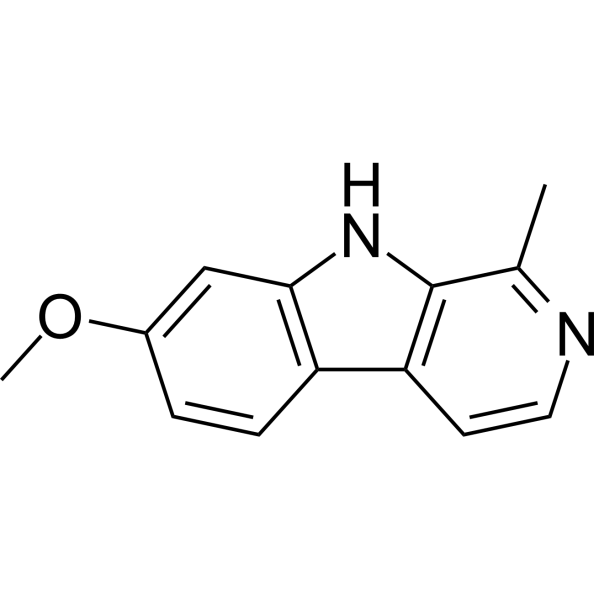
Harmine (Standard) is the analytical standard of Harmine. This product is intended for research and analytical applications. Harmine is a natural dual-specificity tyrosine phosphorylation-regulated kinase (DYRK) inhibitor with anticancer and anti-inflammatory activities. Harmine has a high affinity of 5-HT2A serotonin receptor, with an Ki of 397 nM .
|
-
-
- HY-N0737AG
-
|
Telepathine
|
DYRK
5-HT Receptor
|
Neurological Disease
Inflammation/Immunology
Cancer
|
|
Harmine (GMP) (Telepathine (GMP)) is Harmine (HY-N0737A) produced by using GMP guidelines. GMP small molecules works appropriately as an auxiliary reagent for cell therapy manufacture. Harmine is a natural dual-specificity tyrosine phosphorylation-regulated kinase (DYRK) inhibitor with anticancer and anti-inflammatory activities. Harmine has a high affinity of 5-HT2A serotonin receptor, with an Ki of 397 nM .
|
-
-
- HY-118796
-
|
4-HO-MET; 4-Hydroxy-N-methyl-N-ethyltryptamine
|
5-HT Receptor
Serotonin Transporter
|
Neurological Disease
|
|
4-Hydroxy MET (4-HO-MET; 4-Hydroxy-N-methyl-N-ethyltryptamine) is a synthetic tryptamine psychoactive substance. 4-Hydroxy MET is a partial 5-HT2A receptor agonist, a serotonin transporter inhibitor and weak norepinephrine transporter inhibitor. 4-Hydroxy MET affects emotional, motoric, and cognitive functions via serotonergic hallucinogenic activity .
|
-
-
- HY-A0095A
-
|
BIMT-17 hydrochloride (propan-2-ol) hydrate; BIMT-17BS hydrochloride (propan-2-ol) hydrate
|
5-HT Receptor
|
Neurological Disease
Cancer
|
|
Flibanserin (BIMT-17) hydrochloride (propan-2-ol) hydrate is an orally active serotonin 5-HT1A receptor agonist and 5-HT2A receptor antagonist with Ki values of 1 nM and 49 nM, respectively. Flibanserin hydrochloride (propan-2-ol) hydrate binds to dopamine D4 receptors with an Ki value of 4-24 nM. Flibanserin hydrochloride (propan-2-ol) hydrate shows anti-depression and anti-anxiety effect, can be used to hypoactive sexual desire disorder (HSDD) research - .
|
-
-
- HY-B1213A
-
|
|
5-HT Receptor
Bacterial
|
Neurological Disease
|
|
Trimipramine is a 5-HT receptor antagonist, with pKi binding values of 6.39, 8.10, 4.66 for 5-HT1C, 5-HT2 and 5-HT1A, respectively. Trimipramine is also a potent and selective inhibitor targeting human noradrenaline (hNAT), serotonin (hSERT) and organic cation transporters (hOCT1, hOCT2) with IC50 values of 4.99 μM, 2.11 μM, 3.72 μM, 8.00 μM, respectively. Trimipramine has vascular activity and anxiolytic efficacy .
|
-
-
- HY-11018B
-
-
-
- HY-145841
-
|
|
5-HT Receptor
|
Cardiovascular Disease
|
|
5-HT2A receptor agonist-2 is a highly potent serotonin 5-HT2 receptor agonists. 5-HT2A receptor agonist-2 inspires 5-HT2A, 5-HT2B, and 5-HT2C with EC50 values of 1.7, 0.58, and 0.50 nM, respectively .
|
-
-
- HY-P3641
-
|
|
GnRH Receptor
|
Neurological Disease
Metabolic Disease
|
|
Kisspeptin 13 inhibits glucose-induced insulin secretion with an IC50 of 1.2 nM. Kisspeptin 13 activates the hypothalamic-pituitary-adrenal (HPA) axis, causes hyperthermia, motor behavior and anxiety in rats. Kisspeptin 13 interacts with α2-adrenergic and 5-HT2 serotonin receptors, exhibits antidepressant efficacy. Kisspeptin 13 is an activator for GPR54 and GnRH receptor, which enhances memory and can be used in Alzheimer's disease research .
|
-
-
- HY-118557
-
|
S-MPEC
|
5-HT Receptor
|
Inflammation/Immunology
|
|
Iferanserin (S-MPEC) is a selective 5-HT receptor (serotonin receptor) antagonist with an affinity for 5-HT2A receptor. Iferanserin has the potential for internal hemorrhoid disease treatment .
|
-
-
- HY-101755
-
-
-
- HY-172995
-
|
|
5-HT Receptor
|
Neurological Disease
|
|
RS130-180 is a selective β-arrestin-biased agonist targeting the serotonin 2A receptor (5-HT2aR). RS130-180 is promising for research of neuropsychiatric disorders such as depression .
|
-
-
- HY-14827
-
|
Lu 31-130
|
Dopamine Receptor
5-HT Receptor
|
Neurological Disease
|
|
Zicronapine is an antipsychotic agent with a strong pro-cognitive effect in animal models and the potential to treat a number of neurological and psychiatric diseases. Zicronapine has potent antagonistic effects at dopamine D1/D2, and serotonin 5-HT2A receptors .
|
-
-
- HY-14827A
-
|
Lu 31-130 fumarate
|
Dopamine Receptor
5-HT Receptor
|
Neurological Disease
|
|
Zicronapine (Lu 31-130) fumarate is an antipsychotic agent with a strong pro-cognitive effect in animal models and the potential to treat a number of neurological and psychiatric diseases. Zicronapine (Lu 31-130) fumarate has potent antagonistic effects at dopamine D1/D2, and serotonin 5-HT2A receptors .
|
-
-
- HY-116680
-
|
|
5-HT Receptor
|
Cardiovascular Disease
Neurological Disease
|
|
LY53857 is a potent antagonist of vasoconstriction and serotonin-mediated 5-HT2 receptors. LY53857 did not reduce mean arterial blood pressure in spontaneously hypertensive rats (SHR) at doses that blocked the depressor response to serotonin and blocked central serotonin receptors. In addition, LY53857 was able to enhance neurotransmitter release in rat vas deferens and guinea pig ileal nerves .
|
-
-
- HY-162423
-
|
|
5-HT Receptor
Androgen Receptor
|
Neurological Disease
|
|
CYB210010 is an orally bioavailable, long-acting serotonin 5-HT2 receptor agonist that selectively targets 5-HT2A and 5-HT2C receptors (EC50: 4.1 n, 7.3 nM). CYB210010 can enter the central nervous system, cause a head twitch response (HTR), and is not prone to behavioral tolerance during chronic administration .
|
-
-
- HY-11018S2
-
|
R 64 766-d6
|
5-HT Receptor
Dopamine Receptor
P-glycoprotein
|
Neurological Disease
|
|
Risperidone-d6 (R 64 766-d6) is the deuterium labeled Risperidone (HY-11018). Risperidone is a serotonin 5-HT2 receptor blocker, P-Glycoprotein inhibitor and potent dopamine D2 receptor antagonist, with Kis of 4.8, 5.9 nM for 5-HT2A and dopamine D2 receptor, respectively .
|
-
-
- HY-121311
-
|
|
Serotonin Transporter
Adrenergic Receptor
|
Cardiovascular Disease
|
|
Metrenperone is an inhibitor for 5-HT2 receptor. Metrenperone exhibits α1 and α2 antagonist activity as well as anti-H1 and anti-dopaminergic efficacy. Metrenperone can lower the blood pressure, enhances bradycardia in peripheral ischemia, inhibits serotonin-induced platelet aggregation, and antagonizes serotonin-mediated vasoconstriction. Metrenperone promotes the repair of acutely damaged collagen tissue .
|
-
- HY-103115
-
|
EMD 281014; LY 2422347 hydrochloride
|
5-HT Receptor
|
Neurological Disease
|
|
Pruvanserin hydrochloride (EMD 281014) is a selective serotonin 5-HT2A receptor antagonist with IC50 values of 0.35 nM and 1 nM for human and rat 5-HT2A receptors. Pruvanserin (hydrochloride) can be used for the research of schizophrenia .
|
-
- HY-123044
-
-
- HY-179063
-
|
|
5-HT Receptor
Dopamine Receptor
Serotonin Transporter
|
Neurological Disease
|
5-HT2A receptor agonist-13 (Compound 28c) is a partial agonist of the 5-HT2A receptor, with an EC50 value of 416.9 nM and a Ki value of 113.9 nM. 5-HT2A receptor agonist-13 exhibits very weak agonistic activity towards the 5-HT2B receptor (EC50 = 120.2 nM), D2 receptor (Ki = 1298 nM), and has no activity towards the 5-HT2C receptor. 5-HT2A receptor agonist-13 exhibits weak inhibitory activity on the serotonin transporter (SERT) (EC50 = 977.2 nM). 5-HT2A receptor agonist-13 has antidepressant activity in mouse models and does not induce hallucinogenic behavior. 5-HT2A receptor agonist-13 can be used for the study of major depressive disorder (MDD) and treatment-resistant depression (TRD) .
|
-
- HY-139045
-
-
- HY-103148
-
|
|
5-HT Receptor
|
Neurological Disease
|
|
LY215840, a 5-HT7 receptor ligand and a 5-HT2 receptor antagonist, blocks serotonin-induced relaxation in canine coronary artery .
|
-
- HY-171790
-
|
NSC 294839
|
5-HT Receptor
|
Neurological Disease
|
|
W-2451 (NSC 294839) is a selective serotonin 5-HT2 receptor antagonist. W-2451 is promising for research of neurological disorders .
|
-
- HY-W713312
-
|
|
5-HT Receptor
|
Neurological Disease
|
|
2,6-DMA hydrochloride is classified as an amphetamine. 2,6-DMA hydrochloride is a serotonin 5-HT2 receptor agonist with an apparent pA2 value of 5.09.
|
-
- HY-123206
-
|
|
5-HT Receptor
|
Inflammation/Immunology
|
|
R-96544 (free base) is a potent, selective and competitive 5-HT2 receptor antagonist. R-96544 (free base) inhibits platelet aggregation induced by serotonin, and inhibits 5-HT2A receptor-mediated contraction of guinea pig trachea .
|
-
- HY-B1213AR
-
|
|
Reference Standards
5-HT Receptor
Bacterial
|
Neurological Disease
|
|
Trimipramine (Standard) is the analytical standard of Trimipramine. This product is intended for research and analytical applications. Trimipramine is a 5-HT receptor antagonist, with pKi binding values of 6.39, 8.10, 4.66 for 5-HT1C, 5-HT2 and 5-HT1A, respectively. Trimipramine is also a potent and selective inhibitor targeting human noradrenaline (hNAT), serotonin (hSERT) and organic cation transporters (hOCT1, hOCT2) with IC50 values of 4.99 μM, 2.11 μM, 3.72 μM, 8.00 μM, respectively. Trimipramine has vascular activity and anxiolytic efficacy .
|
-
- HY-B1213R
-
|
|
Reference Standards
5-HT Receptor
Bacterial
|
Neurological Disease
|
|
Trimipramine (maleate) (Standard) is the analytical standard of Trimipramine (maleate). This product is intended for research and analytical applications. Trimipramine maleate is a 5-HT receptor antagonist, with pKi binding values of 6.39, 8.10, 4.66 for 5-HT1C, 5-HT2 and 5-HT1A, respectively . Trimipramine maleate is also a potent and selective inhibitor targeting human noradrenaline (hNAT), serotonin (hSERT) and organic cation transporters (hOCT1, hOCT2) with IC50 values of 4.99 μM, 2.11 μM, 3.72 μM, 8.00 μM, respectively . Trimipramine maleate has vascular activity and anxiolytic efficacy .
|
-
- HY-135194
-
|
|
Drug Metabolite
|
Others
|
|
Risperidone E-oxime is an impurity of Risperidone . Risperidone is a serotonin 5-HT2 receptor blocker, P-Glycoprotein inhibitor and potent dopamine D2 receptor antagonist, with Kis of 4.8, 5.9 nM for 5-HT2A and dopamine D2 receptor, respectively .
|
-
- HY-11018R
-
|
R 64 766 (Standard)
|
Dopamine Receptor
5-HT Receptor
P-glycoprotein
Reference Standards
|
Neurological Disease
|
|
Risperidone (Standard) is the analytical standard of Risperidone. This product is intended for research and analytical applications. Risperidone is a serotonin 5-HT2 receptor blocker, P-Glycoprotein inhibitor and potent dopamine D2 receptor antagonist, with Kis of 4.8, 5.9 nM for 5-HT2A and dopamine D2 receptor, respectively.
|
-
- HY-145463
-
|
|
5-HT Receptor
|
Cardiovascular Disease
|
|
α-Methylserotonin is a potent and selective agonist of 5-HT2 receptor. α-Methylserotonin is an analogue of serotonin formed in vivo from α-methyltryptophan. α-Methylserotonin mediates the lymphatic smooth muscle contraction and prevents the up-regulation of serotonin-receptor-mediated phosphoinositide hydrolysis .
|
-
- HY-11018S1
-
-
- HY-135194R
-
|
|
Drug Metabolite
Reference Standards
|
Others
|
|
Risperidone E-oxime (Standard) is the analytical standard of Risperidone E-oxime. This product is intended for research and analytical applications. Risperidone E-oxime is an impurity of Risperidone . Risperidone is a serotonin 5-HT2 receptor blocker, P-Glycoprotein inhibitor and potent dopamine D2 receptor antagonist, with Kis of 4.8, 5.9 nM for 5-HT2A and dopamine D2 receptor, respectively .
|
-
- HY-106617
-
|
|
5-HT Receptor
Adrenergic Receptor
|
Neurological Disease
|
|
Etoperidone, an antidepressant agent, is an orally active serotonin and nor-adrenaline re-uptake antagonist. Etoperidone shows Kd values of 36 nM, 38 nM, 85 nM, and 570 nM for 5-HT2 receptor, α1-adrenergic receptor, 5-HT1A receptor, and α2-adrenergic receptor, respectively .
|
-
- HY-106617A
-
|
|
5-HT Receptor
Adrenergic Receptor
|
Neurological Disease
|
|
Etoperidone hydrochloride, an antidepressant agent, is an orally active serotonin and nor-adrenaline re-uptake antagonist. Etoperidone hydrochloride shows Kd values of 36 nM, 38 nM, 85 nM, and 570 nM for 5-HT2 receptor, α1-adrenergic receptor, 5-HT1A receptor, and α2-adrenergic receptor, respectively .
|
-
- HY-106805
-
|
|
5-HT Receptor
|
Others
|
|
ICI 169369 is an orally active, specific serotonin and 5-HT2/5-HT1C receptor competitive antagonist. ICI 169369 exhibits Ki values of 1.79 x 10 −8 and 1.58 x 10 −6 M for 5-HT2 and 5-HT1, respectively .
|
-
- HY-130351
-
|
|
5-HT Receptor
|
Neurological Disease
|
|
25H-NBOMe hydrochloride is an agonist for the rat and human serotonin 5-HT2A receptors with Ki values of 1.19 and 2.83 nM, respectively .
|
-
- HY-N0737R
-
|
Telepathine hydrochloride (Standard)
|
Reference Standards
DYRK
5-HT Receptor
|
Neurological Disease
Cancer
|
|
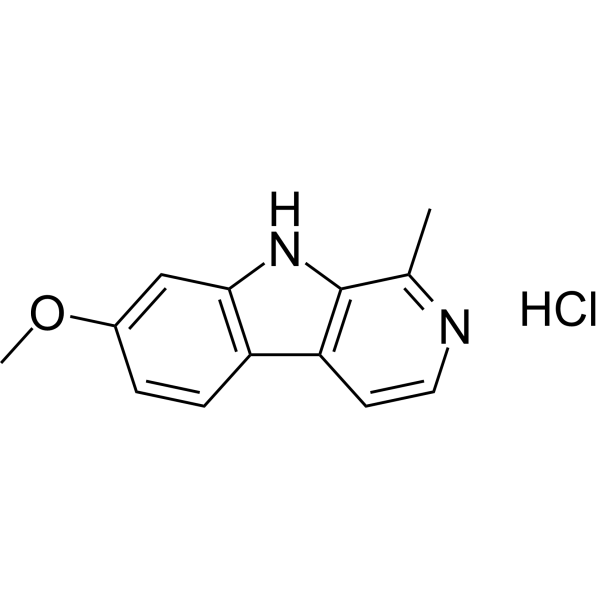
Harmine Hydrochloride (Telepathine Hydrochloride) is a natural DYRK inhibitor with anticancer and anti-inflammatory activities. Harmine has a high affinity of 5-HT2A serotonin receptor, with an Ki of 397 nM .
|
-
- HY-N9418R
-
|
|
Phytohormone
Reference Standards
|
Others
|
|
Trimipramine (Standard) is the analytical standard of Trimipramine. This product is intended for research and analytical applications. Trimipramine is a 5-HT receptor antagonist, with pKi binding values of 6.39, 8.10, 4.66 for 5-HT1C, 5-HT2 and 5-HT1A, respectively. Trimipramine is also a potent and selective inhibitor targeting human noradrenaline (hNAT), serotonin (hSERT) and organic cation transporters (hOCT1, hOCT2) with IC50 values of 4.99 μM, 2.11 μM, 3.72 μM, 8.00 μM, respectively. Trimipramine has vascular activity and anxiolytic efficacy .
|
-
- HY-32329S
-
|
|
Isotope-Labeled Compounds
5-HT Receptor
Adrenergic Receptor
|
Neurological Disease
|
|
Setiptiline-d3 is the deuterium labeled Setiptiline. Setiptiline (Org-8282) is a serotonin receptor antagonist. Setiptiline is a tetracyclic antidepressant (TeCA) which acts as a noradrenergic and specific serotonergic antidepressant (NaSSA). Setiptiline acts as a norepinephrine reuptake inhibitor, α2-adrenergic receptor antagonist, and serotonin receptor antagonist, likely at the 5-HT2A, 5-HT2C, and/or 5-HT3 subtypes, as well as an H1 receptor inverse agonist/antihistamine .
|
-
- HY-32329R
-
|
Org-8282 (Standard)
|
5-HT Receptor
Adrenergic Receptor
Reference Standards
|
Neurological Disease
|
|
Setiptiline (Standard) is the analytical standard of Setiptiline. This product is intended for research and analytical applications. Setiptiline (Org-8282) is a serotonin receptor antagonist. Setiptiline is a tetracyclic antidepressant (TeCA) which acts as a noradrenergic and specific serotonergic antidepressant (NaSSA). Setiptiline acts as a norepinephrine reuptake inhibitor, α2-adrenergic receptor antagonist, and serotonin receptor antagonist, likely at the 5-HT2A, 5-HT2C, and/or 5-HT3 subtypes, as well as an H1 receptor inverse agonist/antihistamine.
|
-
- HY-32329AR
-
|
MO-8282 (Standard)
|
5-HT Receptor
Reference Standards
|
Neurological Disease
|
|
Setiptiline (maleate) (Standard) is the analytical standard of Setiptiline (maleate). This product is intended for research and analytical applications. Setiptiline maleate (MO-8282 maleate) is a serotonin receptor antagonist. Setiptiline maleate is a tetracyclic antidepressant (TeCA) which acts as a noradrenergic and specific serotonergic antidepressant (NaSSA). Setiptiline maleate acts as a norepinephrine reuptake inhibitor, α2-adrenergic receptor antagonist, and serotonin receptor antagonist, likely at the 5-HT2A, 5-HT2C, and/or 5-HT3 subtypes, as well as an H1 receptor inverse agonist/antihistamine .
|
-
- HY-101250R
-
|
MDL11939 (Standard)
|
Reference Standards
Serotonin Transporter
|
Neurological Disease
|
|
Glemanserin (Standard) is the analytical standard of Glemanserin. This product is intended for research and analytical applications. Glemanserin (MDL11939) is a potent and selective antagonist for serotonin receptor 5-HT2A (Ki=2.89, 0.54 and 2.5 nM for rat 5-HT2A, rabbit 5-HT2A and human 5-HT2A, respectively) .
|
-
- HY-170387
-
|
|
5-HT Receptor
|
Cardiovascular Disease
|
|
MRS8209 is the antagonist for serotonin receptor with a Ki of 4.27 nM for 5-HT2BR. MRS8209 exhibits protective effect on pressure at airway opening (PAO), and can be used in research of pulmonary fibrosis .
|
-
- HY-133858
-
|
|
5-HT Receptor
|
Neurological Disease
|
|
25N-NBOMe hydrochloride, a 2C-N derivative, is a 5-HT2A and 5-HT2C receptors agonist with Ki values of 0.144 nM and 1.06 nM, respectively. 25N-NBOMe hydrochloride has little to no efficacy at inducing release of preloaded neurotransmitter from recombinant dopamine, serotonin and norepinephrine transporters .
|
-
- HY-A0095S
-
|
BIMT-17-d4; BIMT-17BS-d4
|
5-HT Receptor
|
Neurological Disease
|
|
Flibanserin-d4 is a deuterium labeled Flibanserin (BIMT-17). Flibanserin is a full agonist of the serotonin 5-HT1A receptor (Ki=1 nM) and an antagonist of 5-HT2A (49 nM) .
|
-
- HY-B1033R
-
|
|
5-HT Receptor
Dopamine Receptor
Sodium Channel
Reference Standards
|
Neurological Disease
|
|
Metergoline (Standard) is the analytical standard of Metergoline. This product is intended for research and analytical applications. Metergoline is a serotonin (5-HT) receptor and dopamine receptors antagonist, with pKis of 8.64, 8.75 and 8.75 for 5-HT2A, 5-HT2B and 5-HT2C, respectively. Metergoline is a high-affinity ligand for the h5-HT7 receptor, with a Ki of 16 nM. Metergoline is also a reversible neural Na+ channels inhibitor. Metergoline is commonly used for the research of seasonal affective disorder, prolactin hormone regulation .
|
-
- HY-169791
-
|
|
5-HT Receptor
|
Neurological Disease
|
|
ECPLA, a lysergamide lysergic acid diethylamidean (LSD) analog, is a potent 5-HT2A agonist (EC50 of 14.6 nM) for Gq-mediated calcium flux. ECPLA has high affinity for most serotonin receptors, α2-adrenoceptors, and D2-like dopamine receptors .
|
-
- HY-14153S
-
|
|
5-HT Receptor
Apoptosis
Isotope-Labeled Compounds
|
Metabolic Disease
Cancer
|
|
Tegaserod-d11 is deuterated labeled Tegaserod (HY-14153). Tegaserod is an orally active serotonin receptor 4 (HTR4; 5-HT4R) agonist and a 5-HT2B receptor antagonist. Tegaserod has pKis of 7.5, 8.4 and 7.0 for human recombinant 5-HT2A, 5-HT2B and 5-HT2C receptors, respectively. Tegaserod causes tumor cell apoptosis, blunts PI3K/Akt/mTOR signaling and decreases S6 phosphorylation. Tegaserod has anti-tumor activity and has the potential for irritable bowel syndrome (IBS) research .
|
-
- HY-100665R
-
|
OPC-14857 (Standard); DM-14857 (Standard)
|
Reference Standards
5-HT Receptor
|
Neurological Disease
|
|
Dehydroaripiprazole (Standard) is the analytical standard of Dehydroaripiprazole. This product is intended for research and analytical applications. Dehydroaripiprazole (OPC-14857) is an active metabolite of Aripiprazole (HY-14546) and dopamine D2/D3 receptor partial agonist. Dehydroaripiprazole also has certain affinity for serotonin 5-HT1A, 5-HT2A and 5-HT2B receptors. Dehydroaripiprazole has antipsychotic activity equivalent to Aripiprazole .
|
-
- HY-B1371R
-
|
Spiroperidol (Standard)
|
Dopamine Receptor
5-HT Receptor
Wnt
Reference Standards
|
Neurological Disease
|
|
Spiperone (Standard) is the analytical standard of Spiperone. This product is intended for research and analytical applications. Spiperone (Spiroperidol) is a potent dopamine D2, serotonin 5-HT1A, and serotonin 5-HT2A antagonist. Spiperone is also a labelled ligand for neuroleptic receptors. Spiperone enhances intracellular calcium level and inhibits the Wnt signaling pathway. Spiperone has the potential for the research of neurology diseases .
|
-
- HY-101435
-
|
CNPZ
|
5-HT Receptor
Adrenergic Receptor
|
Neurological Disease
|
|
Centpropazine (CNPZ) is a brain-penetrant and non-selective antagonist of serotonin (5-HT1/5-HT2) and adrenergic (α1) receptors. Centpropazine functions by modulating monoamine neurotransmission, particularly reducing serotonin and norepinephrine reuptake, to exert antidepressant effects. Centpropazine is promising for research of depression .
|
-
- HY-A0095S1
-
|
BIMT-17-d4-1; BIMT-17BS-d4-1
|
Isotope-Labeled Compounds
5-HT Receptor
|
Neurological Disease
|
|
Flibanserin-d4-1 is deuterium labeled Flibanserin. Flibanserin (BIMT-17) is a full agonist of the serotonin 5-HT1A receptor (Ki=1 nM) and an antagonist of 5-HT2A (49 nM). Flibanserin binds to dopamine D4 receptors (4-24 nM), and has negligible affinity for a variety of other neurotransmitter receptors and ion channels. Flibanserin is efficacious in treating hypoactive sexual desire disorder (HSDD) .
|
-
- HY-109112R
-
|
RP5063 (Standard)
|
Reference Standards
Dopamine Receptor
5-HT Receptor
|
Neurological Disease
Inflammation/Immunology
|
|
Brilaroxazine (Standard) is the analytical standard of Brilaroxazine. This product is intended for research and analytical applications. Brilaroxazine (RP5603) is a potent and orally active multimodal dopamine (DA)/serotonin (5-HT) modulator. Brilaroxazine is a partial agonist of dopamine (DA) D2, D3, and D4 receptors, 5-HT1A (Ki=1.5 nM) and 5-HT2A (Ki=2.5 nM), and has antagonist activity at 5-HT2B (Ki=0.19 nM), and 5-HT7 (Ki=2.7 nM) receptors . Brilaroxazine is an atypical antipsychotic agent, and has the potential to improve cognitive impairments in neuropsychiatric and neurological diseases in vivo .
|
-
- HY-A0095R
-
|
BIMT-17 (Standard); BIMT-17BS (Standard)
|
Reference Standards
5-HT Receptor
|
Neurological Disease
Cancer
|
|
Flibanserin (Standard) is the analytical standard of Flibanserin. This product is intended for research and analytical applications. Flibanserin (BIMT-17; BIMT-17BS) is an orally active serotonin 5-HT1A receptor agonist and 5-HT2A receptor antagonist with Ki values of 1 nM and 49 nM, respectively. Flibanserin binds to dopamine D4 receptors with an Ki value of 4-24 nM. Flibanserin shows anti-depression and anti-anxiety effect, can be used to hypoactive sexual desire disorder (HSDD) research - .
|
-
- HY-135774R
-
|
|
Reference Standards
Drug Metabolite
Phosphatase
|
Cardiovascular Disease
|
|
1-(Carboxymethyl)cyclohexanecarboxylic acid (Standard) is the analytical standard of 1-(Carboxymethyl)cyclohexanecarboxylic acid. This product is intended for research and analytical applications. 1-(Carboxymethyl)cyclohexanecarboxylic acid (1-Carboxycyclohexaneacetic acid; Gabapentin Impurity E) is a potential impurity in commercial preparations of the antiepileptic agent Gabapentin (HY-A0057). It is also used as a precursor for the synthesis of a serotonin (5-HT) receptor subtype 5-HT2A antagonist.
|
-
- HY-W016194R
-
|
1-Carboxycyclohexaneacetic acid (Standard); Gabapentin Impurity E (Standard); Gabapentin Related Compound E (Standard)
|
5-HT Receptor
Reference Standards
|
Neurological Disease
|
|
1-(Carboxymethyl)cyclohexanecarboxylic acid (Standard) is the analytical standard of 1-(Carboxymethyl)cyclohexanecarboxylic acid. This product is intended for research and analytical applications. 1-(Carboxymethyl)cyclohexanecarboxylic acid (1-Carboxycyclohexaneacetic acid; Gabapentin Impurity E) is a potential impurity in commercial preparations of the antiepileptic agent Gabapentin (HY-A0057). It is also used as a precursor for the synthesis of a serotonin (5-HT) receptor subtype 5-HT2A antagonist.
|
-
- HY-111136
-
|
|
GABA Receptor
5-HT Receptor
Dopamine Receptor
Histamine Receptor
|
Neurological Disease
|
|
BL-1020 mesylate is the mesylate salt form of BL-1020. BL-1020 mesylate is an antipsychotic agent. BL-1020 mesylate is inhibitor for dopamine receptor and serotonin receptor (5-HT receptor), with Ki of 0.066, 0.062 and 0.21 nM, for D2L, D2S and 5-HT2A receptors, respectively. BL-1020 mesylate is agonist for GABAA receptor with Ki of 3.74 μM, and enhances the GABA release. BL-1020 mesylate exhibits high affinity with histamine receptor (Ki is 0.47 nM). BL-1020 mesylate reduces Amphetamine-induced hyperactivity, with lower catalepsy and sedation. BL-1020 mesylate is blood-brain barrier penetrate .
|
-
- HY-106324A
-
-
- HY-138176
-
|
7-RispOH
|
Drug Metabolite
|
Neurological Disease
|
|
7-Hydroxyrisperidone (7-RispOH) is a metabolite of Risperidone (HY-11018). Risperidone is a serotonin 5-HT2 receptor blocker, P-Glycoprotein inhibitor and potent dopamine D2 receptor antagonist .
|
-
- HY-401563
-
|
|
5-HT Receptor
Dopamine Receptor
|
Neurological Disease
|
|
5-HT2A antagonist 4 methanesulfonate (Example 29) is a dopamine D2 receptor and serotonin 5HT2A receptor antagonist. 5-HT2A antagonist 4 methanesulfonate can be used for the study of central nervous system diseases .
|
-
- HY-103102R
-
-
- HY-103124R
-
|
|
Reference Standards
5-HT Receptor
|
Neurological Disease
|
|
DOI hydrochloride (Standard) is the analytical standard of DOI hydrochloride (HY-103124). This product is intended for research and analytical applications. DOI hydrochloride is a serotonin 5-HT2A/2C receptor agonist with Ki values of 0.7 nM, 2.4 nM and 20 nM for h5-HT2A, h5-HT2C and h5-HT2B receptors, respectively. DOI hydrochloride can across the blood-brain barrier. DOI hydrochloride increases head twitches in mice .
|
-
- HY-165594A
-
|
|
5-HT Receptor
|
Cardiovascular Disease
|
|
AT-1015 is a selective and orally active 5-HT2A serotonin receptor antagonist. AT-1015 exhibits antithrombotic effect. AT-1015 prolongs the time needed to occlusion of the artery with thrombus. AT-1015 impairs platelet aggregation and vasoconstriction .
|
-
- HY-101755R
-
|
Lu AA24530 hydrobromide (Standard)
|
Reference Standards
5-HT Receptor
Adrenergic Receptor
|
Neurological Disease
Endocrinology
|
|
Tedatioxetine hydrobromide (Standard) (Lu AA24530 hydrobromide (Standard)) is the analytical standard of Tedatioxetine hydrobromide (HY-101755). This product is intended for research and analytical applications. Tedatioxetine (Lu AA24530) hydrobromide acts as a serotonin and norepinephrine (NE)-preferring triple reuptake inhibitor (TRI) and 5-HT2A, 5-HT2C, 5-HT3 and α1A-adrenergic receptor antagonist .
,
|
-
- HY-10457AR
-
|
TD-5108 hydrochloride (Standard)
|
Reference Standards
5-HT Receptor
|
Neurological Disease
Metabolic Disease
|
|
Velusetrag hydrochloride (Standard) is the analytical standard of Velusetrag hydrochloride (HY-10457A). This product is intended for research and analytical applications. Velusetrag (TD-5108) hydrochloride is an orally active, potent and selective agonist of serotonin 5-HT4 receptor (5-HT4R), with a pKi of 7.7. Velusetrag hydrochloride exhibits no affinity (Ki>10 μM) for 5-HT2A and 5-HT2B receptors. Velusetrag hydrochloride can be used for the research of gastrointestinal diseases and Parkinson's disease .
|
-
- HY-10457R
-
|
TD-5108 (Standard)
|
Reference Standards
5-HT Receptor
|
Neurological Disease
Metabolic Disease
|
|
Velusetrag (Standard) is the analytical standard of Velusetrag (HY-10457). This product is intended for research and analytical applications. Velusetrag (TD-5108) is an orally active, potent and selective agonist of serotonin 5-HT4 receptor (5-HT4R), with a pKi of 7.7. Velusetrag exhibits no affinity (Ki>10 μM) for 5-HT2A and 5-HT2B receptors. Velusetrag can be used for the research of gastrointestinal diseases and Parkinson's disease .
|
-
- HY-100656AS
-
|
|
Isotope-Labeled Compounds
Dopamine Receptor
5-HT Receptor
|
Neurological Disease
|
|
Desmethyl cariprazine-d8 is the deuterium labeled Desmethyl cariprazine (HY-100656). Desmethyl cariprazine is a major active metabolite of cariprazine, with activities at human dopamine receptors and serotonin receptors, showing a pEC50 of 8.90 at human D2 receptors, a pEC50 of 8.09 at D3 receptors, and a pEC50 of 6.28 at 5-HT1A receptors. Desmethyl cariprazine inhibits forskolin-induced cAMP production at D2, D3 and 5-HT1A receptors, and suppresses serotonin-induced Ca 2+ release at 5-HT2B receptors. Desmethyl cariprazine is applicable to research related to schizophrenia, bipolar disorder type I and bipolar disorder.
|
-
- HY-176060
-
|
|
Histamine Receptor
Adrenergic Receptor
5-HT Receptor
|
Cardiovascular Disease
Cancer
|
|
Platelet aggregation-IN-3 (Compound 5) is a ligand for H2 histamine receptors, α2(A,C)-adrenergic receptors (α2-AR), and 5-HT2(B,C) serotonin receptors. Platelet aggregation-IN-3 can inhibit platelet aggregation induced by ADP and collagen and can also modulate tumour cell-induced platelet aggregation (TCIPA). Platelet aggregation-IN-3 is promising for research of antiplatelet therapy in cardiovascular diseases and the prevention of cancer-related thrombosis and tumour metastasis .
|
-
- HY-14539B
-
|
HF 1854 dihydrochloride
|
Dopamine Receptor
mAChR
Adrenergic Receptor
5-HT Receptor
|
Neurological Disease
Cancer
|
|
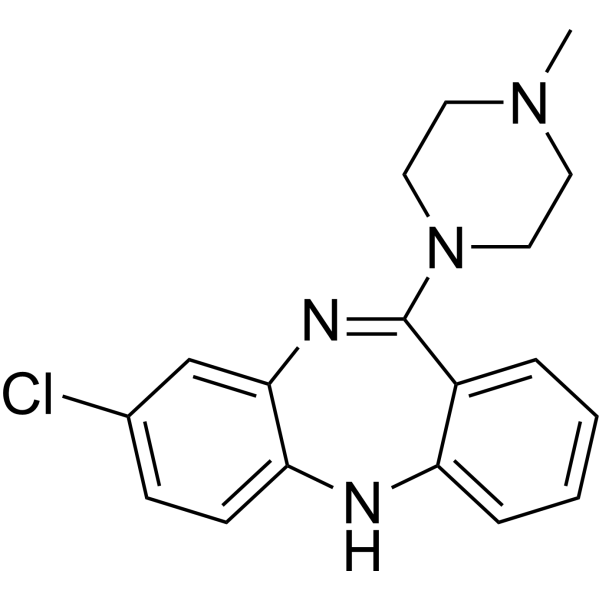
Clozapine (HF 1854) dihydrochloride is an antipsychotic used for the research of schizophrenia. Clozapine has high affinity for a number of neuroreceptors. Clozapine is a potent antagonist of dopamine D2 with a Ki of 75 nM. Clozapine inhibits the muscarinic M1 receptor and serotonin 5HT2A receptor with Kis of 9.5 nM and 4 nM, respectively . Clozapine is also a potent and selective agonist at the muscarinic M4 receptor (EC50=11 nM) .
|
-
- HY-14539
-
|
HF 1854; ZINC000019796155
|
Dopamine Receptor
mAChR
Adrenergic Receptor
5-HT Receptor
Ligands for E3 Ligase
|
Neurological Disease
Cancer
|
|
Clozapine (HF 1854) is an antipsychotic used for the research of schizophrenia. Clozapine has high affinity for a number of neuroreceptors. Clozapine is a potent antagonist of dopamine D2 with a Ki of 75 nM. Clozapine inhibits the muscarinic M1 receptor and serotonin 5HT2A receptor with Kis of 9.5 nM and 4 nM, respectively . Clozapine is also a potent and selective agonist at the muscarinic M4 receptor (EC50=11 nM) .
|
-
- HY-14539A
-
|
HF 1854 hydrochloride
|
Dopamine Receptor
mAChR
Adrenergic Receptor
5-HT Receptor
|
Neurological Disease
|
|
Clozapine hydrochloride (HF 1854 hydrochloride) is an antipsychotic used for the research of schizophrenia. Clozapine hydrochloride has high affinity for a number of neuroreceptors. Clozapine hydrochloride is a potent antagonist of dopamine D2 with a Ki of 75 nM. Clozapine hydrochloride inhibits the muscarinic M1 receptor and serotonin 5HT2A receptor with Kis of 9.5 nM and 4 nM, respectively . Clozapine hydrochloride is also a potent and selective agonist at the muscarinic M4 receptor (EC50=11 nM) .
|
-
- HY-14541A
-
|
LY170053 hydrochloride
|
5-HT Receptor
Dopamine Receptor
mAChR
Adrenergic Receptor
Autophagy
Mitophagy
Apoptosis
|
Neurological Disease
Cancer
|
|
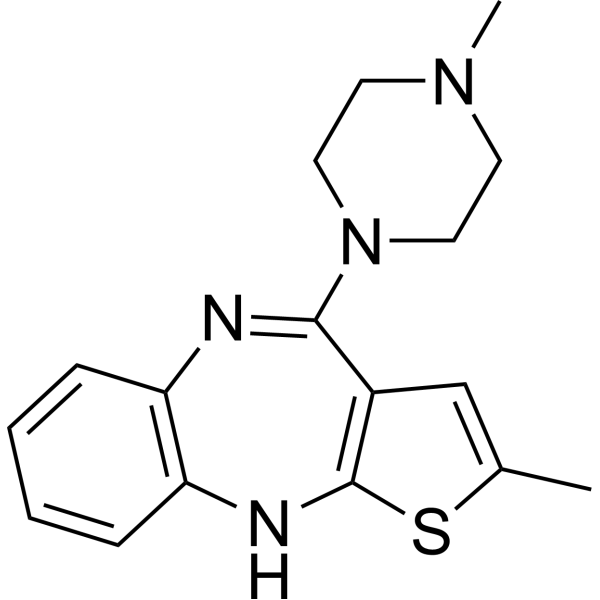
Olanzapine hydrochloride is a selective, orally active monoaminergic antagonist with high affinity binding to serotonin H1, 5HT2A/2C, 5HT3, 5HT6 (Ki=7, 4, 11, 57, and 5 nM, respectively), dopamine D1-4 (Ki=11 to 31 nM), muscarinic M1-5 (Ki=1.9-25 nM), and adrenergic α1 receptor (Ki=19 nM). Olanzapine hydrochloride is an atypical antipsychotic .
|
-
- HY-105285R
-
|
Neu-P11 (Standard)
|
Reference Standards
Melatonin Receptor
5-HT Receptor
P2X Receptor
TRP Channel
Sodium Channel
|
Neurological Disease
|
|
Piromelatine (Standard) is the analytical standard of Piromelatine. This product is intended for research and analytical applications. Piromelatine (Neu-P11) is a melatonin MT1/MT2 receptor agonist, serotonin 5-HT1A/5-HT1D agonist, and serotonin 5-HT2B antagonist. Piromelatine (Neu-P11) possesses sleep promoting, analgesic, anti-neurodegenerative, anxiolytic and antidepressant potentials. Piromelatine (Neu-P11) also possesses pain-related P2X3, TRPV1, and Nav1.7 channel-inhibition capacities .
|
-
- HY-14541
-
|
LY170053
|
5-HT Receptor
Dopamine Receptor
mAChR
Adrenergic Receptor
Autophagy
Mitophagy
Apoptosis
|
Neurological Disease
Cancer
|
|
Olanzapine (LY170053) is a selective, orally active monoaminergic antagonist with high affinity binding to serotonin H1, 5HT2A/2C, 5HT3, 5HT6 (Ki=7, 4, 11, 57, and 5 nM, respectively), dopamine D1-4 (Ki=11 to 31 nM), muscarinic M1-5 (Ki=1.9-25 nM), and adrenergic α1 receptor (Ki=19 nM). Olanzapine is an atypical antipsychotic .
|
-
- HY-14539R
-
|
HF 1854 (Standard)
|
Reference Standards
Dopamine Receptor
mAChR
Adrenergic Receptor
5-HT Receptor
|
Neurological Disease
|
|
Clozapine (Standard) is the analytical standard of Clozapine. This product is intended for research and analytical applications. Clozapine (HF 1854) is an antipsychotic used for the research of schizophrenia. Clozapine has high affinity for a number of neuroreceptors. Clozapine is a potent antagonist of dopamine D2 with a Ki of 75 nM. Clozapine inhibits the muscarinic M1 receptor and serotonin 5HT2A receptor with Kis of 9.5 nM and 4 nM, respectively . Clozapine is also a potent and selective agonist at the muscarinic M4 receptor (EC50=11 nM) .
|
-
- HY-14541R
-
|
LY170053 (Standard)
|
Reference Standards
5-HT Receptor
Dopamine Receptor
mAChR
Adrenergic Receptor
Autophagy
Mitophagy
Apoptosis
|
Neurological Disease
Cancer
|
|
Olanzapine (Standard) is the analytical standard of Olanzapine. This product is intended for research and analytical applications. Olanzapine (LY170053) is a selective, orally active monoaminergic antagonist with high affinity binding to serotonin H1, 5HT2A/2C, 5HT3, 5HT6 (Ki=7, 4, 11, 57, and 5 nM, respectively), dopamine D1-4 (Ki=11 to 31 nM), muscarinic M1-5 (Ki=1.9-25 nM), and adrenergic α1 receptor (Ki=19 nM). Olanzapine is an atypical antipsychotic .
|
-
- HY-14541S2
-
|
LY170053-d8
|
Isotope-Labeled Compounds
Apoptosis
Dopamine Receptor
Autophagy
mAChR
Mitophagy
5-HT Receptor
Adrenergic Receptor
|
Neurological Disease
|
|
Olanzapine-d8 is a deuterated labeled Olanzapine . Olanzapine (LY170053) is a selective, orally active monoaminergic antagonist with high affinity binding to serotonin H1, 5HT2A/2C, 5HT3, 5HT6 (Ki=7, 4, 11, 57, and 5 nM, respectively), dopamine D1-4 (Ki=11 to 31 nM), muscarinic M1-5 (Ki=1.9-25 nM), and adrenergic α1 receptor (Ki=19 nM). Olanzapine is an atypical antipsychotic .
|
-
- HY-14541S
-
|
LY170053-d3
|
Isotope-Labeled Compounds
5-HT Receptor
Dopamine Receptor
mAChR
Adrenergic Receptor
Autophagy
Mitophagy
Apoptosis
|
Neurological Disease
Cancer
|
|
Olanzapine-d3 (LY170053-d3) is the deuterium labeled Olanzapine. Olanzapine is a selective, orally active monoaminergic antagonist with high affinity binding to serotonin H1, 5HT2A/2C, 5HT3, 5HT6 (Ki=7, 4, 11, 57, and 5 nM, respectively), dopamine D1-4 (Ki=11 to 31 nM), muscarinic M1-5 (Ki=1.9-25 nM), and adrenergic α1 receptors (Ki=19 nM). Olanzapine is an atypical antipsychotic .
|
-
- HY-14539S3
-
|
HF 1854-d3
|
Isotope-Labeled Compounds
5-HT Receptor
Adrenergic Receptor
Dopamine Receptor
mAChR
|
Neurological Disease
Cancer
|
|
Clozapine-d3 (HF 1854-d3) is deuterium labeled Clozapine. Clozapine (HF 1854) is an antipsychotic used for the research of schizophrenia. Clozapine has high affinity for a number of neuroreceptors. Clozapine is a potent antagonist of dopamine D2 with a Ki of 75 nM. Clozapine inhibits the muscarinic M1 receptor and serotonin 5HT2A receptor with Kis of 9.5 nM and 4 nM, respectively . Clozapine is also a potent and selective agonist at the muscarinic M4 receptor (EC50=11 nM) .
|
-
- HY-109067A
-
|
VVZ-149 hydrochloride
|
GlyT
5-HT Receptor
P2X Receptor
|
Neurological Disease
|
|
Opiranserin (VVZ-149) hydrochloride, a non-opioid and non-NSAID analgesic candidate, is a dual antagonist of glycine transporter type 2 (GlyT2) and serotonin receptor 2A (5HT2A), with IC50s of 0.86 and 1.3 μM, respectively. Opiranserin hydrochloride shows antagonistic activity on rP2X3 (IC50=0.87 μM). Opiranserin hydrochloride is development as an injectable agent for the treatment of postoperative pain .
|
-
- HY-109067
-
|
VVZ-149
|
GlyT
5-HT Receptor
P2X Receptor
|
Neurological Disease
|
|
Opiranserin (VVZ-149), a non-opioid and non-NSAID analgesic candidate, is a dual antagonist of glycine transporter type 2 (GlyT2) and serotonin receptor 2A (5HT2A), with IC50s of 0.86 and 1.3 μM, respectively. Opiranserin shows antagonistic activity on rP2X3 (IC50=0.87 μM). Opiranserin is development as an injectable agent for the treatment of postoperative pain .
|
-
- HY-134807
-
|
|
P2X Receptor
5-HT Receptor
Autophagy
|
Cancer
|
|
Indophagolin is a potent, indoline-containing autophagy inhibitor (IC50=140 nM). Indophagolin antagonizes the purinergic receptor P2X4 as well as P2X1 and P2X3 with IC50s of 2.71, 2.40 and 3.49 μM, respectively. Indophagolin also antagonizes the Gq-protein-coupled P2Y4, P2Y6, and P2Y11 receptors (IC50s =3.4~15.4 μM). Indophagolin has a strong antagonistic effect on serotonin receptor 5-HT6 (IC50=1.0 μM) and a moderate effect on receptors 5-HT1B, 5-HT2B, 5-HT4e, and 5-HT7 .
|
-
- HY-109067AR
-
|
VVZ-149 hydrochloride (Standard)
|
Reference Standards
GlyT
5-HT Receptor
P2X Receptor
|
Neurological Disease
|
|
Opiranserin hydrochloride (Standard) is the analytical standard of Opiranserin (hydrochloride) (HY-109067A). This product is intended for research and analytical applications. Opiranserin (VVZ-149) hydrochloride, a non-opioid and non-NSAID analgesic candidate, is a dual antagonist of glycine transporter type 2 (GlyT2) and serotonin receptor 2A (5HT2A), with IC50s of 0.86 and 1.3 μM, respectively. Opiranserin hydrochloride shows antagonistic activity on rP2X3 (IC50=0.87 μM). Opiranserin hydrochloride is development as an injectable agent for the treatment of postoperative pain .
|
-
- HY-12783A
-
|
|
GABA Receptor
|
Neurological Disease
|
|
SCH 50911 is a selective, orally active, blood-brain barrier permeable GABA-B receptor (GABA-B Receptor) antagonist with an IC50 of 1.1 μM in rats. SCH 50911 blocks baclofen-induced antitussive effects, regulates neuronal firing and GABA release. SCH 50911 promotes spontaneous seizures during withdrawal in ethanol-dependent rats, alters reward-related neurotransmission, and reduces or suppresses lever responding and self-administration behaviors of alcohol and sucrose in rats. SCH 50911 is applicable to research related to ethanol withdrawal syndrome, absence epilepsy and alcohol use disorder .
|
-
- HY-106584
-
|
Clospipramine
|
Drug Derivative
Dopamine Receptor
5-HT Receptor
|
Neurological Disease
|
|
Mosapramine (Clospipramine) is an orally active antipsychotic agent and one of the metabolites of Clocapramine (HY-B2073) after oral absorption. Mosapramine exerts its effects by specifically binding to striatal dopamine D2 receptors and frontal lobe 5-HT2 receptors, with a D2/5-HT2 receptor occupancy ratio of 7.4. Mosapramine induces typical neuropharmacological responses in rat brain regions, including extrapyramidal symptoms, hyperprolactinemia, increased salivation, constipation, and upregulated Fos protein expression. Mosapramine also features a reduced incidence of weight loss. Mosapramine is applicable to research related to schizophrenia .
|
-
| Cat. No. |
Product Name |
Type |
-
- HY-N0737AG
-
|
Telepathine
|
Fluorescent Dyes
|
|
Harmine (GMP) (Telepathine (GMP)) is Harmine (HY-N0737A) produced by using GMP guidelines. GMP small molecules works appropriately as an auxiliary reagent for cell therapy manufacture. Harmine is a natural dual-specificity tyrosine phosphorylation-regulated kinase (DYRK) inhibitor with anticancer and anti-inflammatory activities. Harmine has a high affinity of 5-HT2A serotonin receptor, with an Ki of 397 nM .
|
| Cat. No. |
Product Name |
Type |
-
- HY-100993
-
|
|
Biochemical Assay Reagents
|
|
α-Methylserotonin maleate is a potent and selective agonist of 5-HT2 receptor. α-Methylserotonin maleate is an analogue of serotonin formed in vivo from α-Methyltryptophan. α-Methylserotonin maleate mediates the lymphatic smooth muscle contraction and prevents the up-regulation of serotonin-receptor-mediated phosphoinositide hydrolysis .
|
-
- HY-N0737AG
-
|
Telepathine
|
Biochemical Assay Reagents
|
|
Harmine (GMP) (Telepathine (GMP)) is Harmine (HY-N0737A) produced by using GMP guidelines. GMP small molecules works appropriately as an auxiliary reagent for cell therapy manufacture. Harmine is a natural dual-specificity tyrosine phosphorylation-regulated kinase (DYRK) inhibitor with anticancer and anti-inflammatory activities. Harmine has a high affinity of 5-HT2A serotonin receptor, with an Ki of 397 nM .
|
| Cat. No. |
Product Name |
Target |
Research Area |
-
- HY-P3641A
-
|
|
GnRH Receptor
|
Neurological Disease
Metabolic Disease
|
|
Kisspeptin 13 TFA is the TFA salt form of Kisspeptin 13 (HY-P3641). Kisspeptin-13 TFA inhibits glucose-induced insulin secretion with an IC50 of 1.2 nM. Kisspeptin 13 TFA activates the hypothalamic-pituitary-adrenal (HPA) axis, causes hyperthermia, motor behavior and anxiety in rats. Kisspeptin 13 TFA interacts with α2-adrenergic and 5-HT2 serotonin receptors, exhibits antidepressant efficacy. Kisspeptin 13 TFA is an activator for GPR54 and GnRH receptor, which enhances memory and can be used in Alzheimer's disease research .
|
-
- HY-P3641
-
|
|
GnRH Receptor
|
Neurological Disease
Metabolic Disease
|
|
Kisspeptin 13 inhibits glucose-induced insulin secretion with an IC50 of 1.2 nM. Kisspeptin 13 activates the hypothalamic-pituitary-adrenal (HPA) axis, causes hyperthermia, motor behavior and anxiety in rats. Kisspeptin 13 interacts with α2-adrenergic and 5-HT2 serotonin receptors, exhibits antidepressant efficacy. Kisspeptin 13 is an activator for GPR54 and GnRH receptor, which enhances memory and can be used in Alzheimer's disease research .
|
| Cat. No. |
Product Name |
Category |
Target |
Chemical Structure |
-
- HY-N0737A
-
-
-
- HY-N0737
-
-
-
- HY-N0737AR
-
-
-
- HY-N0737AG
-
|
Telepathine
|
Alkaloids
Zygophyllaceae
Peganum harmala Linn.
Plants
Indole Alkaloids
Source Classification
|
DYRK
5-HT Receptor
|
|
Harmine (GMP) (Telepathine (GMP)) is Harmine (HY-N0737A) produced by using GMP guidelines. GMP small molecules works appropriately as an auxiliary reagent for cell therapy manufacture. Harmine is a natural dual-specificity tyrosine phosphorylation-regulated kinase (DYRK) inhibitor with anticancer and anti-inflammatory activities. Harmine has a high affinity of 5-HT2A serotonin receptor, with an Ki of 397 nM .
|
-
-
- HY-N0737R
-
-
-
- HY-N9418R
-
|
|
Rosaceae
Plants
Rosa canina Gremli ex Christ
Source Classification
|
Phytohormone
Reference Standards
|
|
Trimipramine (Standard) is the analytical standard of Trimipramine. This product is intended for research and analytical applications. Trimipramine is a 5-HT receptor antagonist, with pKi binding values of 6.39, 8.10, 4.66 for 5-HT1C, 5-HT2 and 5-HT1A, respectively. Trimipramine is also a potent and selective inhibitor targeting human noradrenaline (hNAT), serotonin (hSERT) and organic cation transporters (hOCT1, hOCT2) with IC50 values of 4.99 μM, 2.11 μM, 3.72 μM, 8.00 μM, respectively. Trimipramine has vascular activity and anxiolytic efficacy .
|
-
| Cat. No. |
Product Name |
Chemical Structure |
-
- HY-110232
-
|
|
|
Risperidone-d4 is the deuterium labeled Risperidone. Risperidone is a serotonin 5-HT2 receptor blocker, P-Glycoprotein inhibitor and potent dopamine D2 receptor antagonist, with Kis of 4.8, 5.9 nM for 5-HT2A and dopamine D2 receptor, respectively.
|
-
-
- HY-14541S
-
|
|
|
Olanzapine-d3 (LY170053-d3) is the deuterium labeled Olanzapine. Olanzapine is a selective, orally active monoaminergic antagonist with high affinity binding to serotonin H1, 5HT2A/2C, 5HT3, 5HT6 (Ki=7, 4, 11, 57, and 5 nM, respectively), dopamine D1-4 (Ki=11 to 31 nM), muscarinic M1-5 (Ki=1.9-25 nM), and adrenergic α1 receptors (Ki=19 nM). Olanzapine is an atypical antipsychotic .
|
-
-
- HY-11018S2
-
|
|
|
Risperidone-d6 (R 64 766-d6) is the deuterium labeled Risperidone (HY-11018). Risperidone is a serotonin 5-HT2 receptor blocker, P-Glycoprotein inhibitor and potent dopamine D2 receptor antagonist, with Kis of 4.8, 5.9 nM for 5-HT2A and dopamine D2 receptor, respectively .
|
-
-
- HY-11018S1
-
|
|
|
Risperidone-d4-1 (R 64 766-d4-1) is the deuterium labeled Risperidone (HY-11018). Risperidone is a serotonin 5-HT2 receptor blocker, P-Glycoprotein inhibitor and potent dopamine D2 receptor antagonist, with Kis of 4.8, 5.9 nM for 5-HT2A and dopamine D2 receptor, respectively.
|
-
-
- HY-32329S
-
|
|
|
Setiptiline-d3 is the deuterium labeled Setiptiline. Setiptiline (Org-8282) is a serotonin receptor antagonist. Setiptiline is a tetracyclic antidepressant (TeCA) which acts as a noradrenergic and specific serotonergic antidepressant (NaSSA). Setiptiline acts as a norepinephrine reuptake inhibitor, α2-adrenergic receptor antagonist, and serotonin receptor antagonist, likely at the 5-HT2A, 5-HT2C, and/or 5-HT3 subtypes, as well as an H1 receptor inverse agonist/antihistamine .
|
-
-
- HY-A0095S
-
|
|
|
Flibanserin-d4 is a deuterium labeled Flibanserin (BIMT-17). Flibanserin is a full agonist of the serotonin 5-HT1A receptor (Ki=1 nM) and an antagonist of 5-HT2A (49 nM) .
|
-
-
- HY-14153S
-
|
|
|
Tegaserod-d11 is deuterated labeled Tegaserod (HY-14153). Tegaserod is an orally active serotonin receptor 4 (HTR4; 5-HT4R) agonist and a 5-HT2B receptor antagonist. Tegaserod has pKis of 7.5, 8.4 and 7.0 for human recombinant 5-HT2A, 5-HT2B and 5-HT2C receptors, respectively. Tegaserod causes tumor cell apoptosis, blunts PI3K/Akt/mTOR signaling and decreases S6 phosphorylation. Tegaserod has anti-tumor activity and has the potential for irritable bowel syndrome (IBS) research .
|
-
-
- HY-A0095S1
-
|
|
|
Flibanserin-d4-1 is deuterium labeled Flibanserin. Flibanserin (BIMT-17) is a full agonist of the serotonin 5-HT1A receptor (Ki=1 nM) and an antagonist of 5-HT2A (49 nM). Flibanserin binds to dopamine D4 receptors (4-24 nM), and has negligible affinity for a variety of other neurotransmitter receptors and ion channels. Flibanserin is efficacious in treating hypoactive sexual desire disorder (HSDD) .
|
-
-
- HY-14541S2
-
|
|
|
Olanzapine-d8 is a deuterated labeled Olanzapine . Olanzapine (LY170053) is a selective, orally active monoaminergic antagonist with high affinity binding to serotonin H1, 5HT2A/2C, 5HT3, 5HT6 (Ki=7, 4, 11, 57, and 5 nM, respectively), dopamine D1-4 (Ki=11 to 31 nM), muscarinic M1-5 (Ki=1.9-25 nM), and adrenergic α1 receptor (Ki=19 nM). Olanzapine is an atypical antipsychotic .
|
-
-
- HY-14539S3
-
|
|
|
Clozapine-d3 (HF 1854-d3) is deuterium labeled Clozapine. Clozapine (HF 1854) is an antipsychotic used for the research of schizophrenia. Clozapine has high affinity for a number of neuroreceptors. Clozapine is a potent antagonist of dopamine D2 with a Ki of 75 nM. Clozapine inhibits the muscarinic M1 receptor and serotonin 5HT2A receptor with Kis of 9.5 nM and 4 nM, respectively . Clozapine is also a potent and selective agonist at the muscarinic M4 receptor (EC50=11 nM) .
|
-
-
- HY-100656AS
-
|
|
|
Desmethyl cariprazine-d8 is the deuterium labeled Desmethyl cariprazine (HY-100656). Desmethyl cariprazine is a major active metabolite of cariprazine, with activities at human dopamine receptors and serotonin receptors, showing a pEC50 of 8.90 at human D2 receptors, a pEC50 of 8.09 at D3 receptors, and a pEC50 of 6.28 at 5-HT1A receptors. Desmethyl cariprazine inhibits forskolin-induced cAMP production at D2, D3 and 5-HT1A receptors, and suppresses serotonin-induced Ca 2+ release at 5-HT2B receptors. Desmethyl cariprazine is applicable to research related to schizophrenia, bipolar disorder type I and bipolar disorder.
|
-
| Cat. No. |
Product Name |
|
Classification |
-
- HY-172995
-
|
|
|
Alkynes
|
|
RS130-180 is a selective β-arrestin-biased agonist targeting the serotonin 2A receptor (5-HT2aR). RS130-180 is promising for research of neuropsychiatric disorders such as depression .
|
| Cat. No. |
Product Name |
Target |
Research Areas |
Chemical Structure |
-
- HY-N0737AG
-
|
Telepathine
|
DYRK
5-HT Receptor
|
Neurological Disease
Inflammation/Immunology
Cancer
|
|
Harmine (GMP) (Telepathine (GMP)) is Harmine (HY-N0737A) produced by using GMP guidelines. GMP small molecules works appropriately as an auxiliary reagent for cell therapy manufacture. Harmine is a natural dual-specificity tyrosine phosphorylation-regulated kinase (DYRK) inhibitor with anticancer and anti-inflammatory activities. Harmine has a high affinity of 5-HT2A serotonin receptor, with an Ki of 397 nM .
|
-
Your information is safe with us. * Required Fields.
Inquiry Information
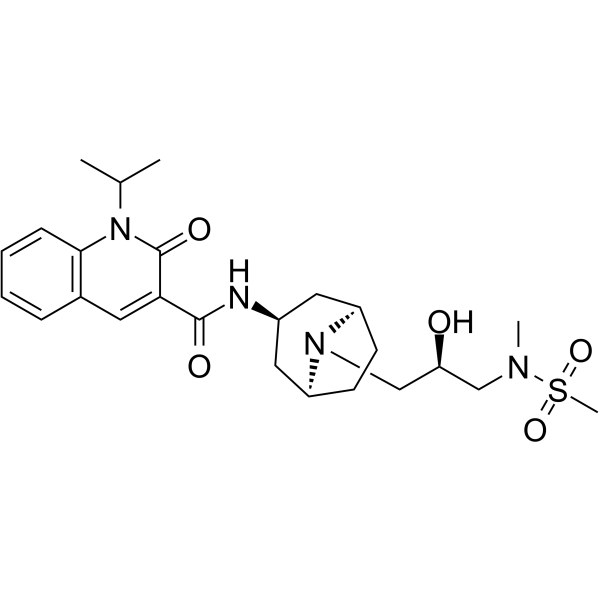
- Product Name:
- Cat. No.:
- Quantity:
- MCE Japan Authorized Agent:

