9 Results for "

social recognition model

" in MedChemExpress (MCE) Product Catalog:
Products (9)

9 Results for "social recognition model" in MCE Product Catalog:

2
2 Cited Publications
Cat. No.: HY-138830
CAS No.: 1818252-53-7
Purity:  99.81%
Target:  

Histone Demethylase

Research Areas:  

Neurological Disease

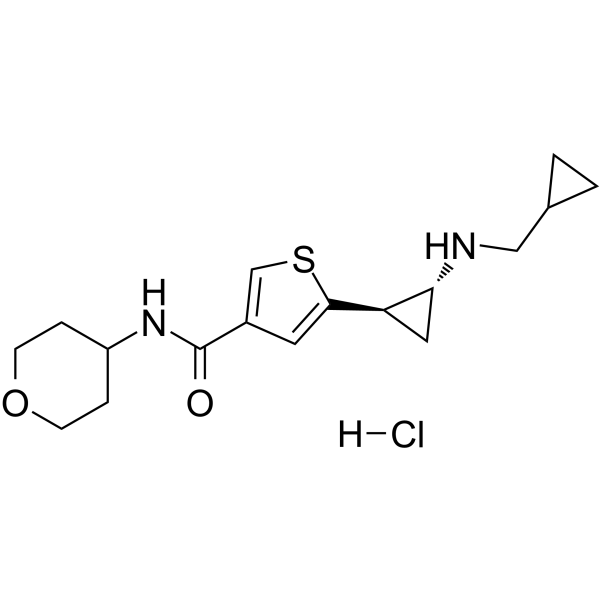
TAK-418 is an orally active, blood-brain barrier-penetrant LSD1 inhibitor with a human IC50 of 2.9 nM. TAK-418 irreversibly inhibits LSD1 by forming a compact flavin-FAD adduct with the catalytic domain FAD, blocking the demethylation of H3K4me1/2 and H3K9me1/2 without disrupting the LSD1-GFI1B interaction. TAK-418 restores normally dysregulated brain gene expression and DNA methylation, increases H3K4me1/2/3 and H3K9me2 at the Ucp2 locus, and induces Ucp2 mRNA expression. TAK-418 rescues defective H3K4 histone modifications, normalizes adult neurogenesis, and improves recognition memory, social behavior, and cognition in rodent models. TAK-418 can be used in research related to neurodevelopmental disorders, Alzheimer's disease, and autism spectrum disorders .
loading...
    loading...
1
1 Cited Publications
Cat. No.: HY-P0267
CAS No.: 121062-08-6
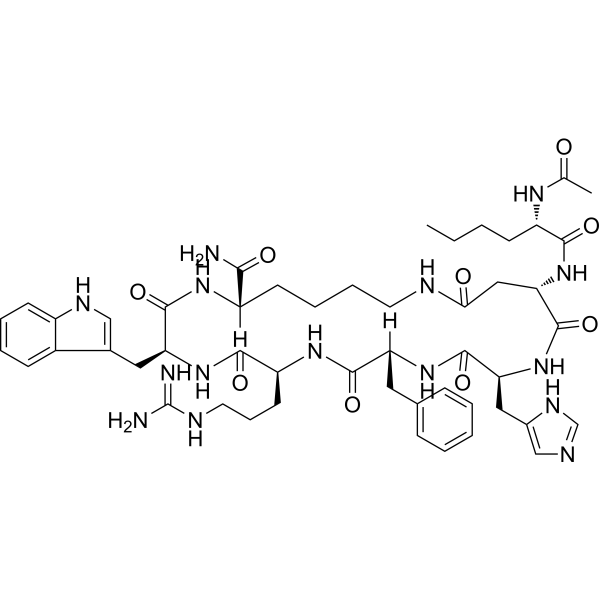
Melanotan (MT)-II is a melanocortin receptor agonist. Melanotan (MT)-II activates melanocortin receptor 3 and melanocortin receptor 4, and stimulates the release of central endogenous oxytocin. Melanotan (MT)-II reverses recognition memory impairment, increased anxiety levels and reduced exploratory tendency in zebrafish exposed to short-term high-fat diet. Melanotan (MT)-II improves impaired social behavior indicators in mouse models of autism spectrum disorder. Melanotan (MT)-II induces weight loss, reduces food intake and exerts anorectic effects. Melanotan (MT)-II increases intracavernous pressure and erectile activity in brown rats. Melanotan (MT)-II can be used in studies related to memory impairment, anxiety, reduced exploratory behavior, autism spectrum disorder, obesity and erectile dysfunction .
loading...
    loading...
Cat. No.: HY-109968
CAS No.: 1005402-19-6
Purity:  99.38%
Synonyms: CEP-26401
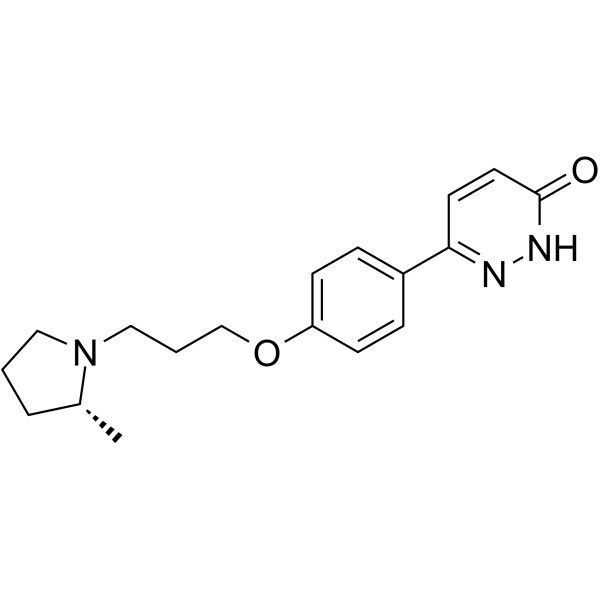
Irdabisant (CEP-26401) is a selective, orally active and blood-brain barrier (BBB) penetrant histamine H3 receptor (H3R) inverse agonist/inverse agonist with Ki values of 7.2 nM and 2.0 nM for rat H3R and human H3R, respectively. Irdabisant has relatively low inhibitory activity against hERG current with an IC50 of 13.8 μM. Irdabisant has cognition-enhancing and wake-promoting activities in the rat social recognition model. Irdabisant can be used to research schizophrenia or cognitive impairment .
loading...
    loading...
Cat. No.: HY-110190
CAS No.: 1630936-95-6
Purity:  99.94%
Synonyms: ML396
Target:  

mGluR

Research Areas:  

Neurological Disease

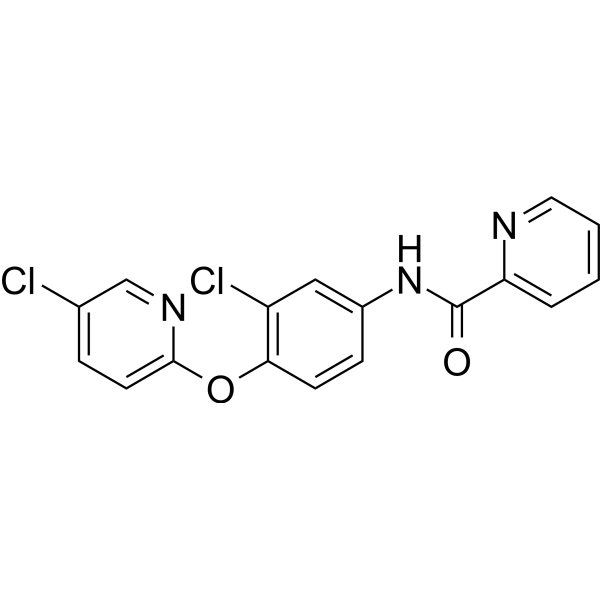
VU0422288 (ML396) is a positive allosteric modulator of group III mGluRs. VU0422288 inhibits mGluRs with EC50s of 125 nM, 146 nM, and 108 nM for mGluR4, mGluR7, and mGluR8, respectively in calcium mobilization assays. VU0422288 reverses deficits in contextual fear memory, social recognition, and apneas in Rett syndrome (RTT) model mice .
loading...
    loading...
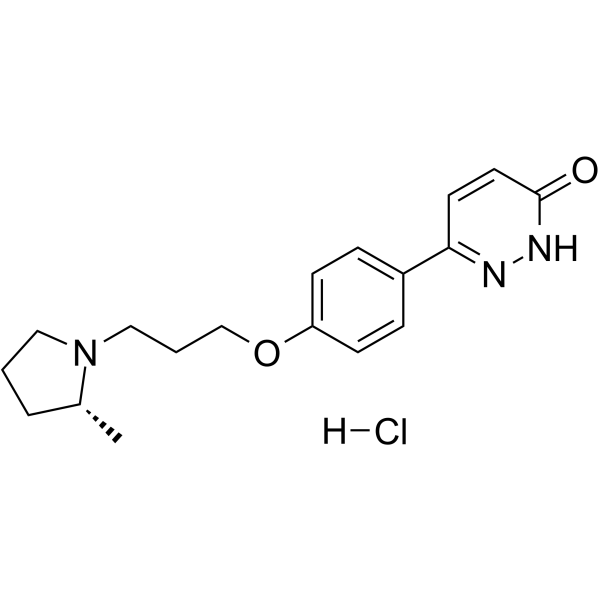
Cat. No.: HY-109968A
CAS No.: 1005398-61-7
Synonyms: CEP-26401 hydrochloride
Target:  

Histamine Receptor

Research Areas:  

Neurological Disease

Irdabisant (CEP-26401) hydrochloride is a selective, orally active and blood-brain barrier (BBB) penetrant histamine H3 receptor (H3R) inverse agonist/inverse agonist with Ki values of 7.2 nM and 2.0 nM for rat H3R and human H3R, respectively. Irdabisant hydrochloride has relatively low inhibitory activity against hERG current with an IC50 of 13.8 μM. Irdabisant hydrochloride has cognition-enhancing and wake-promoting activities in the rat social recognition model. Irdabisant hydrochloride can be used to research schizophrenia or cognitive impairment .
loading...
    loading...
Cat. No.: HY-110190R
CAS No.: 1630936-95-6
Synonyms: ML396 (Standard)
Research Areas:  

Neurological Disease

VU0422288 (Standard) is the analytical standard of VU0422288 (HY-110190). This product is intended for research and analytical applications. VU0422288 (ML396) is a positive allosteric modulator of group III mGluRs. VU0422288 inhibits mGluRs with EC50s of 125 nM, 146 nM, and 108 nM for mGluR4, mGluR7, and mGluR8, respectively in calcium mobilization assays. VU0422288 reverses deficits in contextual fear memory, social recognition, and apneas in Rett syndrome (RTT) model mice .
loading...
    loading...
Cat. No.: HY-109968R
CAS No.: 1005402-19-6
Synonyms: CEP-26401 (Standard)
Irdabisant (Standard) is the analytical standard of Irdabisant (HY-109968). This product is intended for research and analytical applications. Irdabisant (CEP-26401) is a selective, orally active and blood-brain barrier (BBB) penetrant histamine H3 receptor (H3R) inverse agonist/inverse agonist with Ki values of 7.2 nM and 2.0 nM for rat H3R and human H3R, respectively. Irdabisant has relatively low inhibitory activity against hERG current with an IC50 of 13.8 μM. Irdabisant has cognition-enhancing and wake-promoting activities in the rat social recognition model. Irdabisant can be used to research schizophrenia or cognitive impairment .
loading...
    loading...
Cat. No.: HY-P0267A
CAS No.: 1036322-26-5
Melanotan (MT)-II acetate is a melanocortin receptor agonist. Melanotan (MT)-II acetate activates melanocortin receptor 3 and melanocortin receptor 4, and stimulates the release of central endogenous oxytocin. Melanotan (MT)-II acetate reverses recognition memory impairment, increased anxiety levels and reduced exploratory tendency in zebrafish exposed to short-term high-fat diet. Melanotan (MT)-II acetate improves impaired social behavior indicators in mouse models of autism spectrum disorder. Melanotan (MT)-II acetate induces weight loss, reduces food intake and exerts anorectic effects. Melanotan (MT)-II acetate increases intracavernous pressure and erectile activity in brown rats. Melanotan (MT)-II acetate can be used in studies related to memory impairment, anxiety, reduced exploratory behavior, autism spectrum disorder, obesity and erectile dysfunction .
loading...
    loading...
Cat. No.: HY-138830B
CAS No.: 1818252-52-6
Target:  

Histone Demethylase

Research Areas:  

Neurological Disease

TAK-418 free base is an orally active, blood-brain barrier-penetrant LSD1 inhibitor with a human IC50 of 2.9 nM. TAK-418 free base irreversibly inhibits LSD1 by forming a compact flavin-FAD adduct with the catalytic domain FAD, blocking the demethylation of H3K4me1/2 and H3K9me1/2 without disrupting the LSD1-GFI1B interaction. TAK-418 free base restores normally dysregulated brain gene expression and DNA methylation, increases H3K4me1/2/3 and H3K9me2 at the Ucp2 locus, and induces Ucp2 mRNA expression. TAK-418 free base rescues defective H3K4 histone modifications, normalizes adult neurogenesis, and improves recognition memory, social behavior, and cognition in rodent models. TAK-418 free base can be used in research related to neurodevelopmental disorders, Alzheimer's disease, and autism spectrum disorders .
loading...
    loading...

