1. Search Result
Search Result
Results for "

tubulin heterodimer

" in MedChemExpress (MCE) Product Catalog:

6

Inhibitors & Agonists

1

Isotope-Labeled Compounds

Targets Recommended:
Cat. No. Product Name Target Research Areas Chemical Structure
  • HY-17029
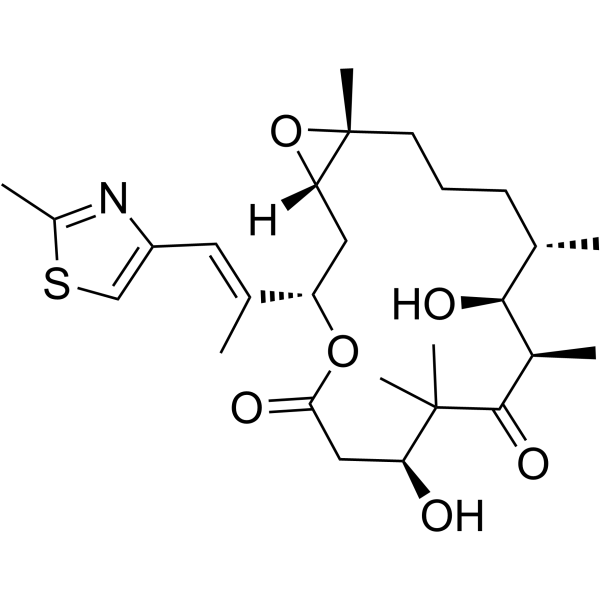
    Epothilone B
    5+ Cited Publications

    EPO 906; Patupilone

    Microtubule/Tubulin Fungal Apoptosis Antibiotic Bacterial Infection Cancer
    Epothilone B is a microtubule stabilizer (MSA) with a Ki of 0.71μM, and is a MSA with blood-brain barrier permeability. Epothilone B acts by binding to the αβ-tubulin heterodimer subunit which causes decreasing of αβ-tubulin dissociation .
    Epothilone B
  • HY-17029R

    EPO 906 (Standard); Patupilone (Standard)

    Reference Standards Microtubule/Tubulin Fungal Apoptosis Antibiotic Bacterial Infection Cancer
    Epothilone B (Standard) is the analytical standard of Epothilone B. This product is intended for research and analytical applications. Epothilone B is a microtubule stabilizer with a Ki of 0.71μM. It acts by binding to the αβ-tubulin heterodimer subunit which causes decreasing of αβ-tubulin dissociation.
    Epothilone B (Standard)
  • HY-W754654

    Isotope-Labeled Compounds Microtubule/Tubulin Fungal Apoptosis Bacterial Antibiotic Cancer
    Epothilone B-d3 (synthetic) is the deuterium labeled Epothilone B (HY-17029). Epothilone B is a microtubule stabilizer with a Ki of 0.71μM. It acts by binding to the αβ-tubulin heterodimer subunit which causes decreasing of αβ-tubulin dissociation.
    Epothilone B-d3 (synthetic)
  • HY-150511

    Microtubule/Tubulin Apoptosis Cancer
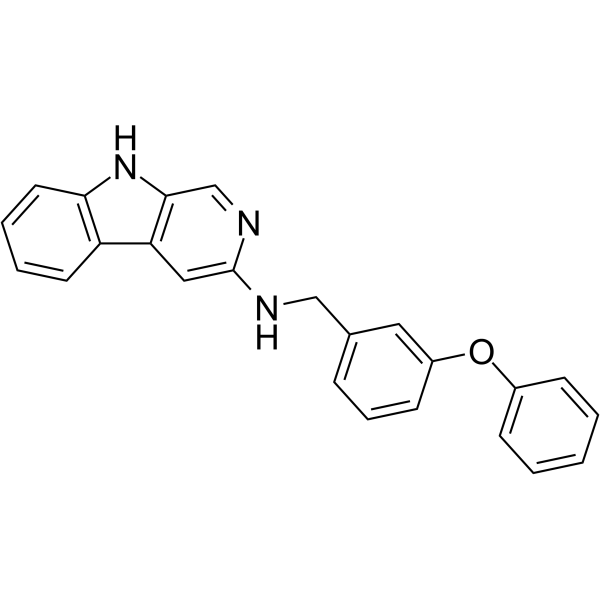
    3-(3-Phenoxybenzyl)amino-β-carboline is a potent tubulin inhibitor. 3-(3-Phenoxybenzyl)amino-β-carboline promotes selective degradation of αβ-tubulin heterodimers. 3-(3-Phenoxybenzyl)amino-β-carboline induces G2/M phase cell cycle arrest and apoptosis. 3-(3-Phenoxybenzyl)amino-β-carboline exhibits anticancer activity .
    3-(3-Phenoxybenzyl)amino-β-carboline
  • HY-182039

    Microtubule/Tubulin Caspase Apoptosis Cancer
    Tubulin polymerization-IN-89 is a tubulin polymerization inhibitor. Tubulin polymerization-IN-89 binds to the colchicine-binding site on tubulin heterodimers, disrupting tubulin polymerization and microtubule formation. Tubulin polymerization-IN-89 induces apoptosis in melanoma cells and arrests the cell cycle at the G2/M phase. Tubulin polymerization-IN-89 can be used in studies related to metastatic melanoma .
    Tubulin polymerization-IN-89
  • HY-182478

    Microtubule/Tubulin Cancer
    MDL-27048, a tubulin inhibitor, binds competitively, reversibly to the Colchicine (HY-16569)-binding site on tubulin heterodimers. MDL-27048 inhibits microtubule assembly, induces slow depolymerization of preassembled microtubules, disrupts microtubule polymerization-depolymerization dynamics, and disrupts cytoplasmic microtubule networks. MDL-27048 exerts growth inhibitory effects on human cancer cells, induces mitotic arrest, and does not disrupt actin filaments at microtubule-depolymerizing concentrations. MDL-27048 can be used for the research of malignant tumors .
    MDL-27048

Inquiry Online

Your information is safe with us. * Required Fields.

Salutation


Country or Region *

Applicant Name *


Organization Name *

Department *


Email Address *


Product Name *

Cat. No.


Requested quantity *

Phone Number *


Remarks

Inquiry Online

Inquiry Information

Product Name:
Cat. No.:
Quantity:
MCE Japan Authorized Agent:

