



SF-1 antagonist-1
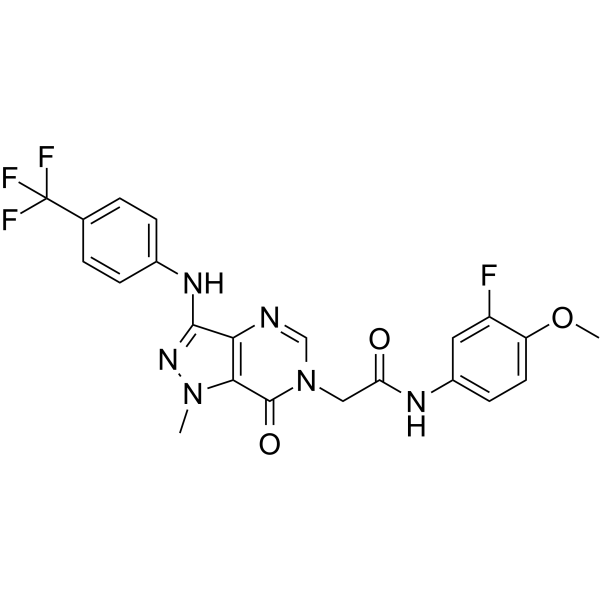
SF-1 antagonist-1 (compound 11) is a antagonist of steroidogenic factor 1 (SF-1). SF-1 antagonist-1 affects SF-1 transcriptional activity with an EC50 value of <200 nM. SF-1 antagonist-1 inhibits the proliferation of Rat Leydig tumor cells. SF-1 antagonist-1 can be used for the research of cancer.
Nur für Forschungszwecke. Wir verkaufen nicht an Patienten.
- CAS. Nr.: 2842079-86-9
- Formel: C22H18F4N6O3
- Molecular Weight:490.41
-
Speicherung:
Please store the product under the recommended conditions in the Certificate of Analysis.

To place orders, for customer services and technical support, please contact: MedChemExpress USA
Tel: 609-228-6898 E-mail: [email protected] [email protected]


-
 Biologische Aktivität
-
Chemical Information
- Protokoll
- Reinheit & Dokumentation
- Verweise
-
 Help & FAQs




Biologische Aktivität
Beschreibung
In Vitro
SF-1 antagonist-1 (0-20 μM) affects SF-1 transcriptional activity with an EC50 value of <200 nM[1]. SF-1 antagonist-1 (0-20 μM; 48 h) affects proliferation of R2C cells[1].
MedChemExpress (MCE) has not independently confirmed the accuracy of these methods. They are for reference only. Further protocols information, click here.
-
Cell Line:Rat Leydig tumor cell line, R2C
-
Concentration:0-20 μM
-
Incubation Time:48 h
-
Result:Inhibited proliferation of R2C cells with an EC50 value of <200 nM.


Chemical Information
-
CAS. Nr. 2842079-86-9
-
Molecular Weight 490.41
-
Formel C22H18F4N6O3
-
SMILES
FC(F)(F)C(C=C1)=CC=C1NC2=NN(C)C3=C2N=CN(CC(NC4=CC=C(OC)C(F)=C4)=O)C3=O
-
Versand
Room temperature in continental US; may vary elsewhere.
-
Speicherung
Please store the product under the recommended conditions in the Certificate of Analysis.

Protokoll
-
Dual Luciferin reporter gene assay
Luciferin reporter gene assay is a reporting system to detect the activity of Firefly Luciferase using luciferin as a substrate, which is often used in the research of miRNA target gene verification and promoter transcriptive activity regulation. Dual luciferase usually refers to Firefly luciferase and Renilla luciferase.
-
Cell Viability Determination by MTT Colorimetric Assay
The following protocol uses the MTT colorimetric assay as a classic literature-established method for assessing cell viability/metabolic activity in cultured mammalian cells. MTT[3-(4,5-dimethylthiazol-2-yl)-2,5-diphenyltetrazolium bromide] is reduced by metabolically active cells to a colored formazan product; the amount of formazan is quantified spectrophotometrically and provides an indirect measure of metabolically active viable cells. Importantly, MTT reduction reflects cellular oxidoreductase/metabolic activity rather than an absolute direct count of living cells, so changes in cellular metabolism can alter the signal independently of cell number.


Reinheit & Dokumentation
Verweise

Calculators
Konzentration (Stammlösung) × Volumen (Stammlösung) = Konzentration (Ziellösung) × Volumen (Ziellösung)


SF-1 antagonist-1 Related Classifications
HY-148259 Related Classifications
 Powered by Bioz