



Sperm motility agonist-2

Based on 1 Customer Validation
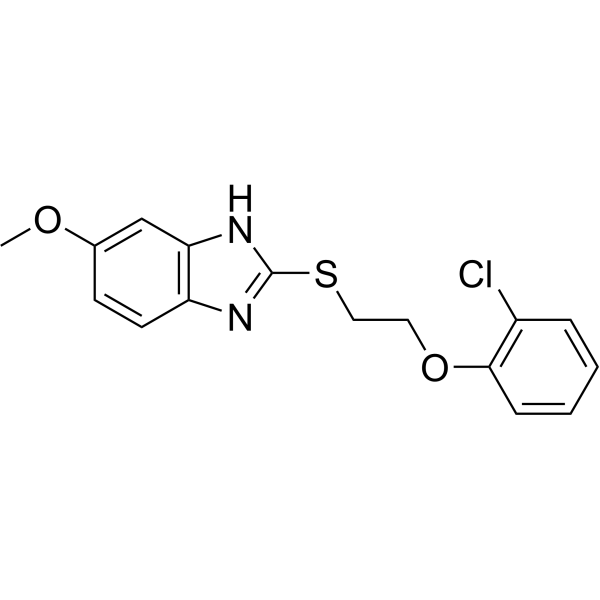
Sperm motility agonist-2 (compound 797) is a Sperm motility agonist, that may affect mitochondrial function. Sperm motility agonist-2 can be used in studies of infertility and enhancement of fertility.
For research use only. We do not sell to patients.
- Purity : 98.51%
- CAS No.: 926079-67-6
- Formula: C16H15ClN2O2S
- Molecular Weight:334.82
-
Storage:Powder -20°C, 3 years , 4°C, 2 years ; In solvent -80°C, 6 months , -20°C, 1 month

To place orders, for customer services and technical support, please contact: MedChemExpress USA
Tel: 609-228-6898 E-mail: [email protected] [email protected]


-
 Biological Activity
-
Chemical Information
-
Solvent & Solubility
- Protocols
- Purity & Documentation
- References
-
 Help & FAQs




Biological Activity
Description


Chemical Information
-
CAS No. 926079-67-6
-
Appearance Solid
-
Molecular Weight 334.82
-
Formula C16H15ClN2O2S
-
Color White to off-white
-
SMILES
ClC1=C(OCCSC2=NC3=C(N2)C=C(OC)C=C3)C=CC=C1
-
Shipping
Room temperature in continental US; may vary elsewhere.
-
Storage
Powder -20°C 3 years 4°C 2 years In solvent -80°C 6 months -20°C 1 month


Solvent & Solubility
In Vitro:
DMSO : 250 mg/mL (746.67 mM; Need ultrasonic; Hygroscopic DMSO has a significant impact on the solubility of product, please use newly opened DMSO)
Please refer to the solubility information to select the appropriate solvent. Once prepared, please aliquot and store the solution to prevent product inactivation from repeated freeze-thaw cycles.
Storage method and period of stock solution: -80°C, 6 months; -20°C, 1 month. When stored at -80°C, please use it within 6 months. When stored at -20°C, please use it within 1 month.
Please refer to the solubility information to select the appropriate solvent. Once prepared, please aliquot and store the solution to prevent product inactivation from repeated freeze-thaw cycles.
Storage method and period of stock solution: -80°C, 6 months; -20°C, 1 month. When stored at -80°C, please use it within 6 months. When stored at -20°C, please use it within 1 month.
Concentration (start) × Volume (start) = Concentration (final) × Volume (final)

Protocols
-
Reproductive and Developmental Toxicity Study
Reproductive and developmental toxicity studies detect adverse effects of prenatal or peri/postnatal exposure on maternal condition, pregnancy maintenance, embryo-fetal survival, fetal growth, structural development, and offspring reproductive or developmental endpoints; classic rat protocols generate readouts by comparing treated groups with vehicle, pair-fed, or untreated controls for implantation, resorption, fetal weight, crown-rump length, external morphology, visceral morphology, skeletal ossification, anogenital distance, nipple/areola retention, and postnatal cohort outcomes.
-
Mitochondrial membrane-potential fluorescent assay
Mitochondrial membrane potential fluorescent assays estimate ΔΨm in living cells using lipophilic cationic dyes such as TMRM, TMRE, rhodamine 123, and JC-1, which accumulate in mitochondria according to membrane polarization; loss of signal after FCCP or CCCP treatment is interpreted as mitochondrial depolarization. TMRM/TMRE and rhodamine 123 are commonly used for semi-quantitative live-cell microscopy or flow cytometry, while JC-1 can report a shift from red aggregate fluorescence to green monomer fluorescence during depolarization; interpretation requires controls because dye concentration, quenching mode, cell type, dye efflux, and mitochondrial mass can affect fluorescence independently of ΔΨm.
-
Mitochondrial membrane-potential and mitochondrial mass staining
Mitochondrial membrane potential staining measures the electrochemical polarization across the mitochondrial inner membrane in live cells using lipophilic cationic fluorescent probes; early rhodamine-based work showed that selective mitochondrial dye accumulation is lost when the mitochondrial transmembrane potential is dissipated. JC-1 reports mitochondrial polarization by shifting from green monomer fluorescence to red J-aggregate fluorescence as dye concentration increases within energized mitochondria; therefore, the red/green fluorescence ratio is used as a relative readout of mitochondrial membrane potential. TMRE or TMRM staining provides a single-channel relative readout because these cationic rhodamine esters accumulate in polarized mitochondria, and lower fluorescence indicates reduced mitochondrial polarization when acquisition and dye-loading conditions are controlled. Mitochondrial mass staining is commonly performed with MitoTracker Green FM or related MitoTracker dyes as
-
Sperm Thawing for Functional Recovery
Sperm thawing for functional recovery is a post-cryopreservation procedure designed to restore and measure sperm motility, viability, membrane/acrosome integrity, DNA integrity, and usable motile sperm yield after freezing-induced injury; published human studies show that cryopreservation reduces motility and viability and can damage the plasmalemma, acrosome, tail, and DNA integrity. The experimental readout is generated by comparing post-thaw motility recovery, viability, acrosomal status, DNA integrity, and recovered motile sperm after thawing and optional sperm-selection steps; thawing at 40°C improved motility recovery compared with 20-37°C without significant differences in viability, ATP content, acrosomal status, or DNA integrity in one human donor-semen study.


Purity & Documentation
-
Data Sheet (266 KB)
-
SDS (393 KB)
- English - EN (393 KB)
- Français - FR (393 KB)
- Deutsch - DE (393 KB)
- Norwegian - NO (393 KB)
- Español - ES (393 KB)
- Swedish - SV (393 KB)
- Italian - IT (393 KB)
- Korean - KR (393 KB)
- Portuguese - PT (393 KB)
-
Handling Instructions (2659 KB)
References


Complete Stock Solution Preparation Table
Please refer to the solubility information to select the appropriate solvent. Once prepared, please aliquot and store the solution to prevent product inactivation from repeated freeze-thaw cycles.
Storage method and period of stock solution: -80°C, 6 months; -20°C, 1 month. When stored at -80°C, please use it within 6 months. When stored at -20°C, please use it within 1 month.
| Optional Solvent | Concentration Solvent Mass | 1 mg | 5 mg | 10 mg | 25 mg |
|---|---|---|---|---|---|
| DMSO | 1 mM | 2.9867 mL | 14.9334 mL | 29.8668 mL | 74.6670 mL |
| 5 mM | 0.5973 mL | 2.9867 mL | 5.9734 mL | 14.9334 mL | |
| 10 mM | 0.2987 mL | 1.4933 mL | 2.9867 mL | 7.4667 mL | |
| 15 mM | 0.1991 mL | 0.9956 mL | 1.9911 mL | 4.9778 mL | |
| 20 mM | 0.1493 mL | 0.7467 mL | 1.4933 mL | 3.7333 mL | |
| 25 mM | 0.1195 mL | 0.5973 mL | 1.1947 mL | 2.9867 mL | |
| 30 mM | 0.0996 mL | 0.4978 mL | 0.9956 mL | 2.4889 mL | |
| 40 mM | 0.0747 mL | 0.3733 mL | 0.7467 mL | 1.8667 mL | |
| 50 mM | 0.0597 mL | 0.2987 mL | 0.5973 mL | 1.4933 mL | |
| 60 mM | 0.0498 mL | 0.2489 mL | 0.4978 mL | 1.2444 mL | |
| 80 mM | 0.0373 mL | 0.1867 mL | 0.3733 mL | 0.9333 mL | |
| 100 mM | 0.0299 mL | 0.1493 mL | 0.2987 mL | 0.7467 mL |


Sperm motility agonist-2 Related Classifications
HY-153819 Related Classifications
 Powered by Bioz