



trans-Zeatinriboside
Based on 1 publication(s) in Google Scholar
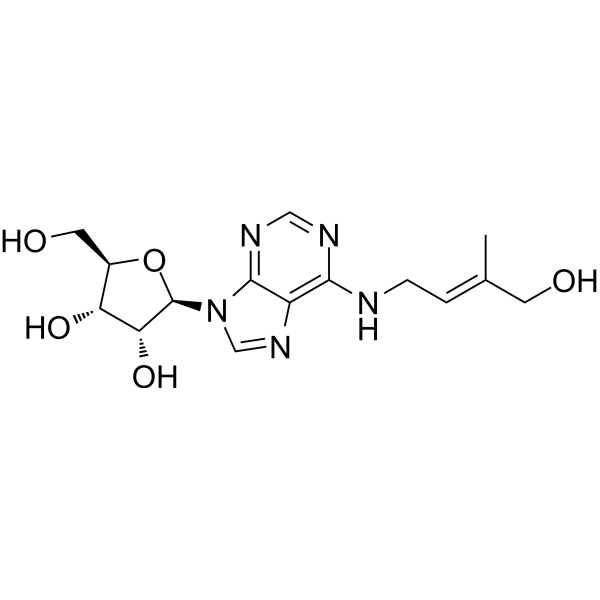
trans-Zeatinriboside is a zeatin-type cytokinin and plant growth regulator. trans-Zeatinriboside is produced by the terrestrial filamentous cyanobacterium Nostoc sp. HK-01 and Agrobacterium tumefaciens (including Ti plasmid-dependent and Ti plasmid-independent strains). trans-Zeatinriboside is detectable as a cytokinin component in growing crown galls, and accumulates in large amounts in CHRK1-silenced transgenic tobacco accompanied by pleiotropic developmental abnormalities. trans-Zeatinriboside can be used in studies related to crown galls.
Nos produits utilisent uniquement pour la recherche. Nous ne vendons pas aux patients.
- Pureté : 99.76%
- CAS No.: 6025-53-2
- Formule: C15H21N5O5
- Masse moléculaire:351.36
-
Stockage:Powder -20°C, 3 years ; In solvent -80°C, 6 months , -20°C, 1 month

To place orders, for customer services and technical support, please contact: MedChemExpress USA
Tel: 609-228-6898 E-mail: [email protected] [email protected]


-
 Activité biologique
-
Chemical Information
-
Solvant et solubilité
- Pureté et documentation
- Références
-
 Help & FAQs


-
HY-19700
trans-ZeatinCytokinin -
HY-W011209
N6-IsopentenyladenosineCytokinin Nucleoside/Autophagy Inhibitor -
HY-112103
6-(γ,γ-Dimethylallylamino)purineNatural Product -
HY-N0186
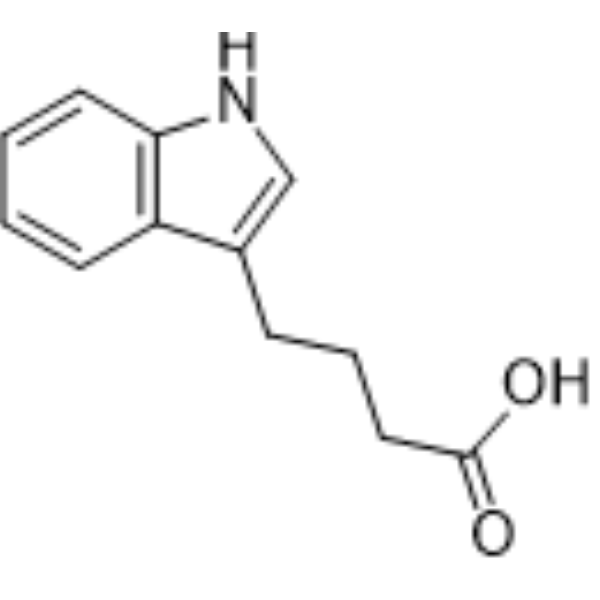
Indole-3-butyric acidEndogenous Metabolite -
HY-B0941
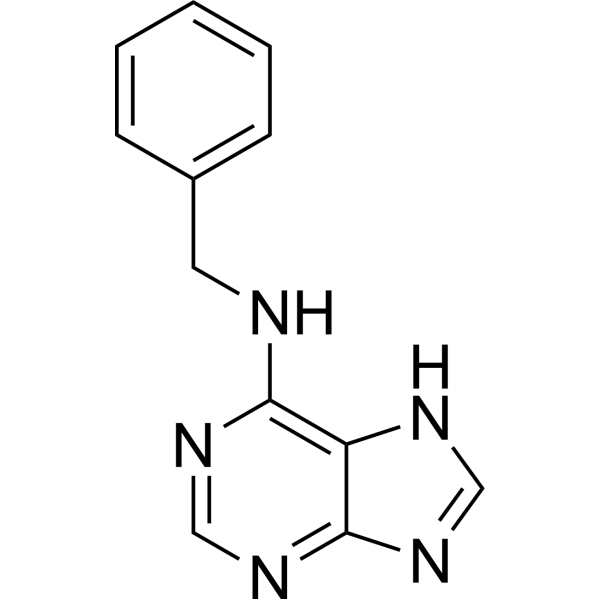
6-BenzylaminopurineCytokinin -
HY-N0160
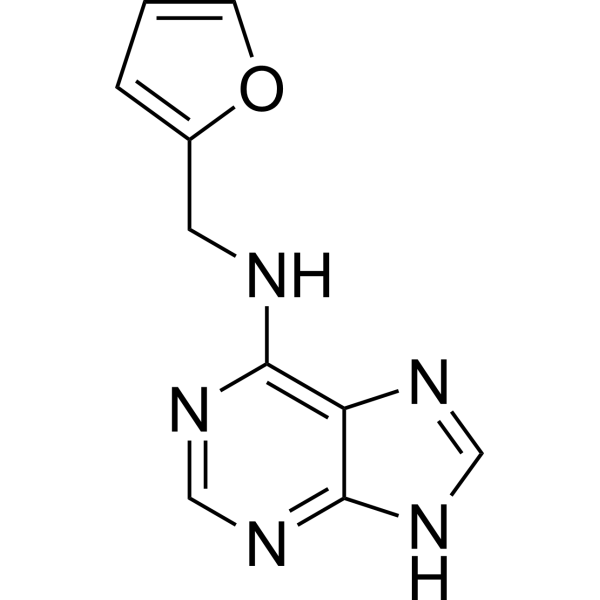
KinetinPlant Hormone -

HY-W011151R
trans-Zeatinriboside (Standard) -
HY-119349
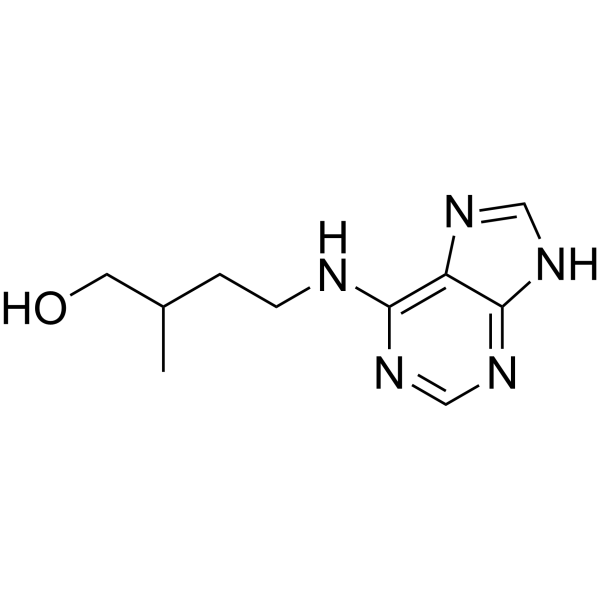
(±)-DihydrozeatinCytokinin -
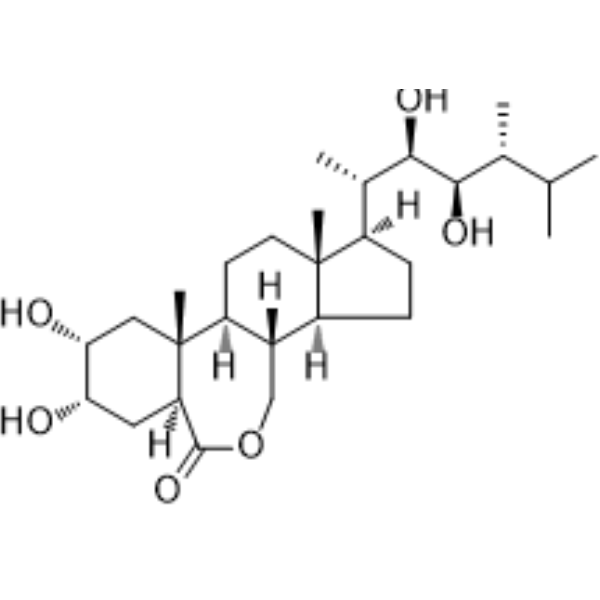
HY-N0848
EpibrassinolideApoptosis Inducer -
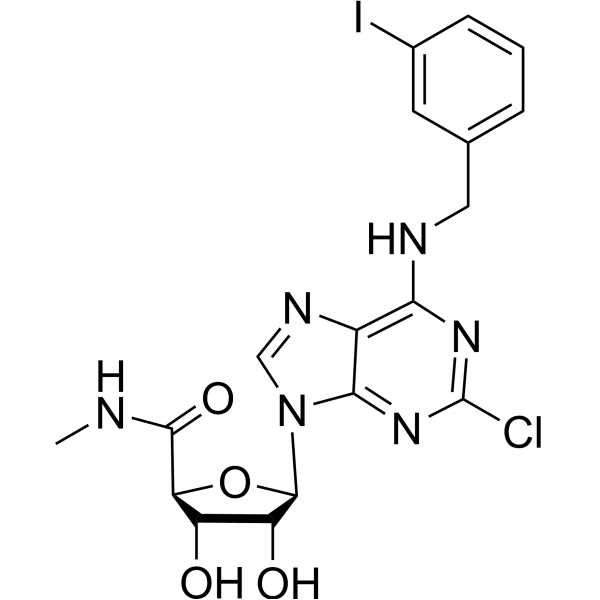
HY-12365
NamodenosonA3AR Agonist -
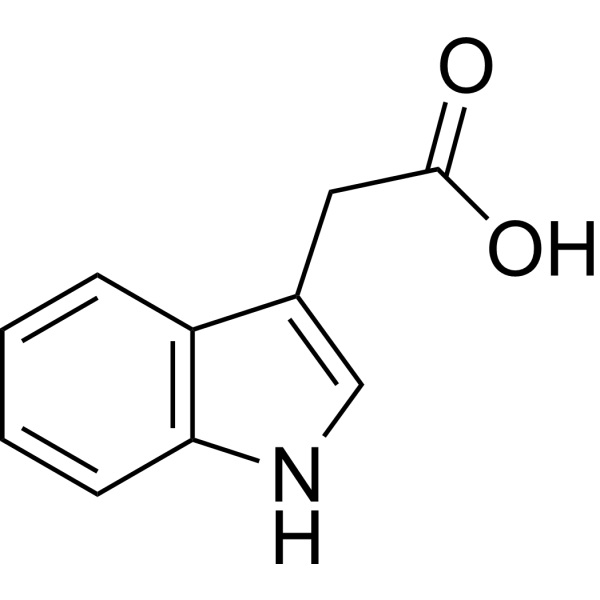
HY-18569
3-Indoleacetic acidPlant Growth Regulator -
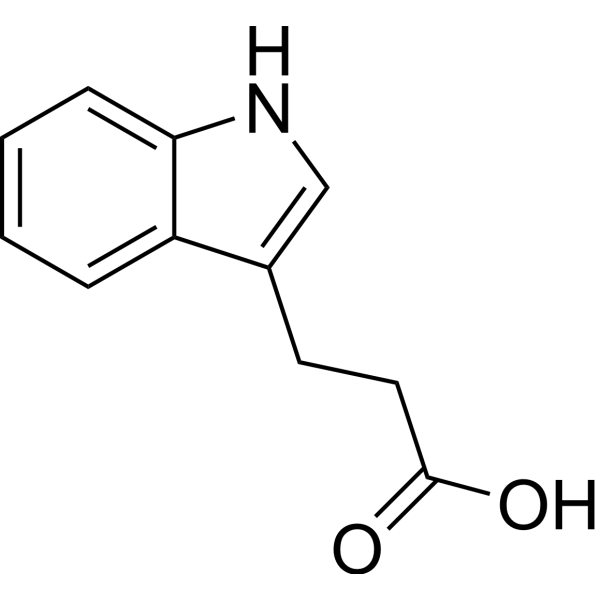
HY-W015229
3-Indolepropionic acid
Publications Citing Use of MedChemExpress (MCE) trans-Zeatinriboside
MoreVoir tous les produits spécifiques à Isoform Phytohormone
More

Activité biologique
Description
In Vitro
Compared with wild-type seedlings, the endogenous trans-Zeatinriboside level increases 5.9-fold in 10-day-old CHRK1-silenced transgenic Nicotiana tabacum cv. Xanthi seedlings, and 3.0-fold in CHRK1-silenced transgenic Nicotiana tabacum cv. Xanthi clustered calli; meanwhile, the total cytokinin level in transgenic tissues increases 3-fold[2].
trans-Zeatinriboside exhibits extremely low cross-reactivity (only 1.8%) with the anti-isopentenyladenosine antiserum used in radioimmunoassay[3].
trans-Zeatinriboside is produced at detectable low levels in stationary-phase liquid cultures of the virulent Agrobacterium tumefaciens strain B6 and the avirulent strain B6-37[3].
trans-Zeatinriboside (at 48 h, 360 h, 500 h, 7 days, and 21 days after inoculation) significantly increases the level of trans-zeatin riboside-equivalent cytokinins in established crown galls across multiple angiosperm species, including Euphorbia lathyris, Helianthus annuus, Sinapis alba, and Catharanthus roseus, with the maximum increase reaching up to 190-fold (Euphorbia lathyris); however, this elevation is not observed in some tumor-forming species after infection with Agrobacterium tumefaciens B6[3].
The content of trans-Zeatinriboside varies drastically among bacteria-free crown gall callus cultures grown on hormone-free medium, ranging from undetectable (Nicotiana tabacum) to 429 nmol/g DW (Tavaresia glandiflora)[3].
MedChemExpress (MCE) has not independently confirmed the accuracy of these methods. They are for reference only.


Chemical Information
-
CAS No. 6025-53-2
-
Appearance Solid
-
Masse moléculaire 351.36
-
Formule C15H21N5O5
-
Color White to off-white
-
SMILES
C/C(CO)=C\CNC1=C(N=CN2[C@H]3[C@H](O)[C@H](O)[C@H](O3)CO)C2=NC=N1
-
Structure Classification
-
Initial Source
-
Livraison
Room temperature in continental US; may vary elsewhere.
-
Stockage
Powder -20°C 3 years In solvent -80°C 6 months -20°C 1 month


Publications (1)
-
Journal Impact Factor
-
Most Recent
-
Nat Commun
2025 Apr 11;16(1):3475. PMID: 40216803


Solvant et solubilité
In Vitro:
DMSO : ≥ 100 mg/mL (284.61 mM; Hygroscopic DMSO has a significant impact on the solubility of product, please use newly opened DMSO)
* "≥" means soluble, but saturation unknown.
Please refer to the solubility information to select the appropriate solvent. Once prepared, please aliquot and store the solution to prevent product inactivation from repeated freeze-thaw cycles.
Storage method and period of stock solution: -80°C, 6 months; -20°C, 1 month. When stored at -80°C, please use it within 6 months. When stored at -20°C, please use it within 1 month.
Please refer to the solubility information to select the appropriate solvent. Once prepared, please aliquot and store the solution to prevent product inactivation from repeated freeze-thaw cycles.
Storage method and period of stock solution: -80°C, 6 months; -20°C, 1 month. When stored at -80°C, please use it within 6 months. When stored at -20°C, please use it within 1 month.
Concentration (start) × Volume (start) = Concentration (final) × Volume (final)
In Vivo:
Select the appropriate dissolution method based on your experimental animal and administration route.
- For the following dissolution methods, please ensure to first prepare a clear stock solution using an In Vitro approach and then sequentially add co-solvents:
- To ensure reliable experimental results, the clarified stock solution can be appropriately stored based on storage conditions. As for the working solution for In Vivo experiments, it is recommended to prepare freshly and use it on the same day.
- The percentages shown for the solvents indicate their volumetric ratio in the final prepared solution. If precipitation or phase separation occurs during preparation, heat and/or sonication can be used to aid dissolution.
Add each solvent one by one: 10% DMSO 40% PEG300 5% Tween-80 45% Saline
Solubility: ≥ 2.08 mg/mL (5.92 mM); Clear solution
This protocol yields a clear solution of ≥ 2.08 mg/mL (saturation unknown).
Taking 1 mL working solution as an example, add 100 μL DMSO stock solution (20.8 mg/mL) to 400 μL PEG300, and mix evenly; then add 50 μL Tween-80 and mix evenly; then add 450 μL Saline to adjust the volume to 1 mL.
Preparation of Saline: Dissolve 0.9 g sodium chloride in ddH₂O and dilute to 100 mL to obtain a clear Saline solution.
Add each solvent one by one: 10% DMSO 90% (20% SBE-β-CD in Saline)
Solubility: ≥ 2.08 mg/mL (5.92 mM); Clear solution
This protocol yields a clear solution of ≥ 2.08 mg/mL (saturation unknown).
Taking 1 mL working solution as an example, add 100 μL DMSO stock solution (20.8 mg/mL) to 900 μL 20% SBE-β-CD in Saline, and mix evenly.
Preparation of 20% SBE-β-CD in Saline (4°C, storage for one week): 2 g SBE-β-CD powder is dissolved in 10 mL Saline, completely dissolve until clear.
In Vivo Dissolution Calculator
Please enter the basic information of animal experiments:
-
-
-
-
Recommended: Prepare an additional quantity of animals to account for potential losses during experiments.
Please enter your animal formula composition:
-
%DMSO +
Recommended: Keep the proportion of DMSO in working solution below 2% if your animal is weak.
-
%+
-
+%Tween-80 + +
-
%Saline +
The co-solvents required include: DMSO, . All of co-solvents are available by MedChemExpress (MCE). , Tween 80. All of co-solvents are available by MedChemExpress (MCE).
Working solution concentration: 0.22 mg/mL
Method for preparing stock solution: mg drug dissolved in μL DMSO. Stock solution concentration: mg/mL.
1. Take μL DMSO stock solution;
2. Add μL .
μL , mix evenly;
3. Then add μL Tween 80, mix evenly;
4. Then add μL
Please ensure that the stock solution in the first step is dissolved to a clear state, and add co-solvents in sequence. You can use ultrasonic heating (ultrasonic cleaner, recommended frequency 20-40 kHz), vortexing, etc. to assist dissolution.


Pureté et documentation
-
Fiche technique (274 KB)
-
SDS (394 KB)
- English - EN (394 KB)
- Français - FR (394 KB)
- Deutsch - DE (394 KB)
- Norwegian - NO (394 KB)
- Español - ES (394 KB)
- Swedish - SV (394 KB)
- Italian - IT (394 KB)
- Korean - KR (394 KB)
- Portuguese - PT (394 KB)
-
Instruction de manipulation (2659 KB)
Références
[2]. Lee JH, et al. CHRK1, a chitinase-related receptor-like kinase, plays a role in plant development and cytokinin homeostasis in tobacco. Plant Mol Biol. 2003;53(6):877-890. [Content Brief]
[3]. Weiler EW, et al. Phytohormones in the formation of crown gall tumors. Planta. 1981;153(4):326-337. [Content Brief]


Complete Stock Solution Preparation Table
Please refer to the solubility information to select the appropriate solvent. Once prepared, please aliquot and store the solution to prevent product inactivation from repeated freeze-thaw cycles.
Storage method and period of stock solution: -80°C, 6 months; -20°C, 1 month. When stored at -80°C, please use it within 6 months. When stored at -20°C, please use it within 1 month.
| Optional Solvent | Concentration Solvent Mass | 1 mg | 5 mg | 10 mg | 25 mg |
|---|---|---|---|---|---|
| DMSO | 1 mM | 2.8461 mL | 14.2304 mL | 28.4608 mL | 71.1521 mL |
| 5 mM | 0.5692 mL | 2.8461 mL | 5.6922 mL | 14.2304 mL | |
| 10 mM | 0.2846 mL | 1.4230 mL | 2.8461 mL | 7.1152 mL | |
| 15 mM | 0.1897 mL | 0.9487 mL | 1.8974 mL | 4.7435 mL | |
| 20 mM | 0.1423 mL | 0.7115 mL | 1.4230 mL | 3.5576 mL | |
| 25 mM | 0.1138 mL | 0.5692 mL | 1.1384 mL | 2.8461 mL | |
| 30 mM | 0.0949 mL | 0.4743 mL | 0.9487 mL | 2.3717 mL | |
| 40 mM | 0.0712 mL | 0.3558 mL | 0.7115 mL | 1.7788 mL | |
| 50 mM | 0.0569 mL | 0.2846 mL | 0.5692 mL | 1.4230 mL | |
| 60 mM | 0.0474 mL | 0.2372 mL | 0.4743 mL | 1.1859 mL | |
| 80 mM | 0.0356 mL | 0.1779 mL | 0.3558 mL | 0.8894 mL | |
| 100 mM | 0.0285 mL | 0.1423 mL | 0.2846 mL | 0.7115 mL |


trans-Zeatinriboside Related Classifications
HY-W011151 Related Classifications
 Powered by Bioz