



Tribenoside

Based on 1 Customer Validation
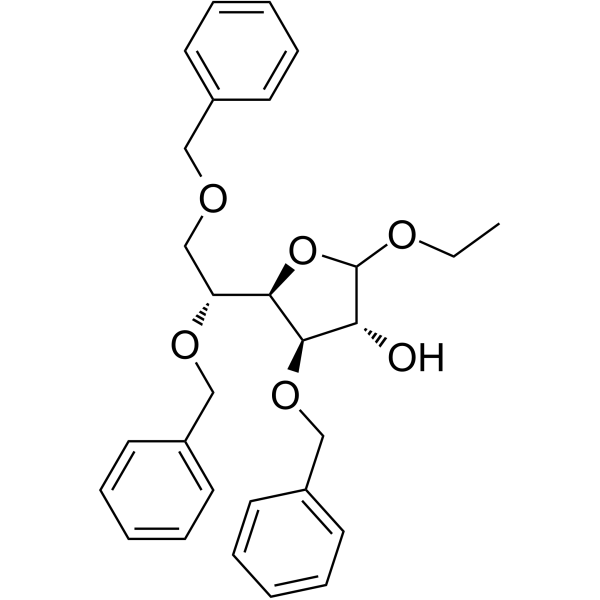
Tribenoside is a vasoprotective agent, can be used for the research of hemorrhoids. Tribenoside has mild anti-inflammatory, analgesic, and wound healing properties.
For research use only. We do not sell to patients.
- Purity : 98.02%
- CAS No.: 10310-32-4
- Formula: C29H34O6
- Molecular Weight:478.58
-
Storage:Pure form -20°C, 3 years , 4°C, 2 years ; In solvent -80°C, 6 months , -20°C, 1 month

To place orders, for customer services and technical support, please contact: MedChemExpress USA
Tel: 609-228-6898 E-mail: [email protected] [email protected]


-
 Biological Activity
-
Chemical Information
-
Solvent & Solubility
- Protocols
- Purity & Documentation
- References
-
 Help & FAQs


-

HY-108249R
Tribenoside (Standard)Vasoprotective Agent -
HY-N0691
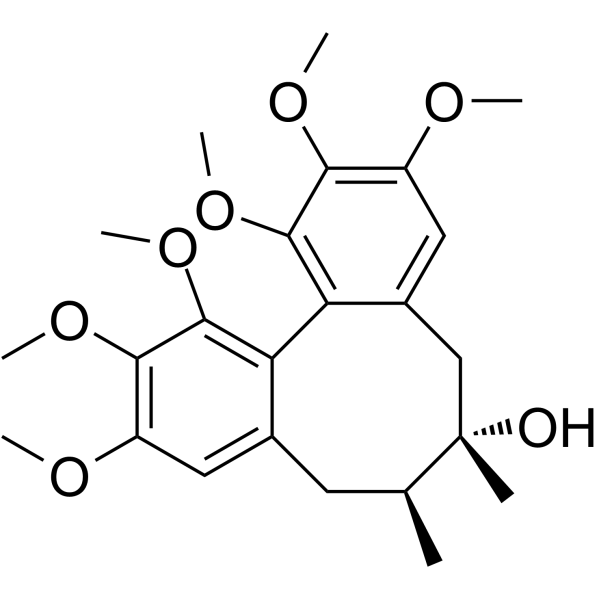
SchisandrinAutophagy Inducer -

HY-117037
FR900359Gαq/11/14 Inhibitor -

HY-N0691R
Schisandrin (Standard)Autophagy Inducer -
HY-116003
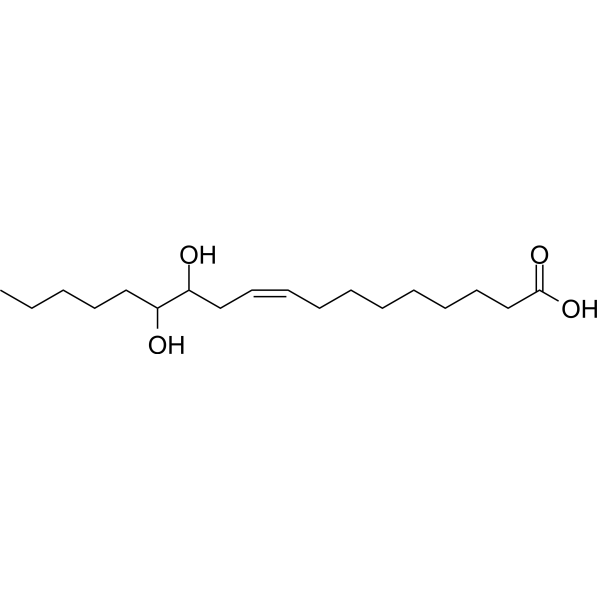
12,13-DiHOMEBAT Activator -

HY-W357105
3,5,6-tri-O-Benzyl-1,2-O-isopropylidene-D-glucofuranoseSugar -

HY-W357105R
3,5,6-tri-O-Benzyl-1,2-O-isopropylidene-D-glucofuranose (Standard)Sugar


Biological Activity
Description
In Vitro
Tribenoside (1 nM-100 μM) exhibits cytotoxic effect against HeLa cells with the EC50 of 13.74 μM[2].
MedChemExpress (MCE) has not independently confirmed the accuracy of these methods. They are for reference only. Further protocols information, click here.
-
Cell Line:HeLa cells
-
Concentration:1 nM, 10 nM, 100 nM, 1 µM, 10 µM, 100 µM
-
Incubation Time:72 hours
-
Result:Reduced HeLa cells viability in a dose-responsive manner.
In Vivo
MedChemExpress (MCE) has not independently confirmed the accuracy of these methods. They are for reference only.
-
Animal Model:male C57 black mice[3]
-
Dosage:500 and 1,200 mg/kg weekly
-
Administration:Oral administration
-
Result:Led to a significant reduction in the overall arthrotic involvement.
Clinical Trial
| NCT Number | Sponsor | Condition | Start Date |
Phase

|
|---|---|---|---|---|
| NCT01329991 | Plexxikon| | 2011-05 | PHASE1 |


Chemical Information
-
CAS No. 10310-32-4
-
Appearance Viscous liquid
-
Molecular Weight 478.58
-
Formula C29H34O6
-
Color colorless
-
SMILES
O[C@H]([C@H]([C@@H]([C@@H](COCC1=CC=CC=C1)OCC2=CC=CC=C2)O3)OCC4=CC=CC=C4)C3OCC
-
Shipping
Room temperature in continental US; may vary elsewhere.
-
Storage
Pure form -20°C 3 years 4°C 2 years In solvent -80°C 6 months -20°C 1 month


Solvent & Solubility
In Vitro:
DMSO : 100 mg/mL (208.95 mM; Need ultrasonic; Hygroscopic DMSO has a significant impact on the solubility of product, please use newly opened DMSO)
Please refer to the solubility information to select the appropriate solvent. Once prepared, please aliquot and store the solution to prevent product inactivation from repeated freeze-thaw cycles.
Storage method and period of stock solution: -80°C, 6 months; -20°C, 1 month. When stored at -80°C, please use it within 6 months. When stored at -20°C, please use it within 1 month.
Please refer to the solubility information to select the appropriate solvent. Once prepared, please aliquot and store the solution to prevent product inactivation from repeated freeze-thaw cycles.
Storage method and period of stock solution: -80°C, 6 months; -20°C, 1 month. When stored at -80°C, please use it within 6 months. When stored at -20°C, please use it within 1 month.
Concentration (start) × Volume (start) = Concentration (final) × Volume (final)
In Vivo:
Select the appropriate dissolution method based on your experimental animal and administration route.
- For the following dissolution methods, please ensure to first prepare a clear stock solution using an In Vitro approach and then sequentially add co-solvents:
- To ensure reliable experimental results, the clarified stock solution can be appropriately stored based on storage conditions. As for the working solution for In Vivo experiments, it is recommended to prepare freshly and use it on the same day.
- The percentages shown for the solvents indicate their volumetric ratio in the final prepared solution. If precipitation or phase separation occurs during preparation, heat and/or sonication can be used to aid dissolution.
In Vivo Dissolution Calculator
Please enter the basic information of animal experiments:
-
-
-
-
Recommended: Prepare an additional quantity of animals to account for potential losses during experiments.
Please enter your animal formula composition:
-
%DMSO +
Recommended: Keep the proportion of DMSO in working solution below 2% if your animal is weak.
-
%+
-
+%Tween-80 + +
-
%Saline +
The co-solvents required include: DMSO, . All of co-solvents are available by MedChemExpress (MCE). , Tween 80. All of co-solvents are available by MedChemExpress (MCE).
Working solution concentration: 0.22 mg/mL
Method for preparing stock solution: mg drug dissolved in μL DMSO. Stock solution concentration: mg/mL.
1. Take μL DMSO stock solution;
2. Add μL .
μL , mix evenly;
3. Then add μL Tween 80, mix evenly;
4. Then add μL
Please ensure that the stock solution in the first step is dissolved to a clear state, and add co-solvents in sequence. You can use ultrasonic heating (ultrasonic cleaner, recommended frequency 20-40 kHz), vortexing, etc. to assist dissolution.

Protocols
-
Cell migration
Cell migration is a method that plays an important role in wound healing, cell differentiation, embryonic development, etc.
-
Research Protocol for Inflammation-related Diseases
The NLRP3 inflammasome is a cytosolic innate immune signaling platform that integrates priming signals and danger-signal activation to promote caspase-1 activation, maturation of IL-1β and IL-18, and gasdermin D-mediated pyroptotic cell death. The core experimental logic is to determine whether inflammatory disease phenotypes are driven by increased NLRP3 expression, ASC-containing inflammasome assembly, caspase-1 cleavage, GSDMD cleavage, and extracellular release of IL-1β/IL-18 rather than by nonspecific cell injury alone. The pathway is strongly linked to inflammation-related disease phenotypes because monosodium urate crystals activate NALP3/NLRP3 inflammasome signaling in gout-like crystal inflammation, cholesterol crystals activate NLRP3 inflammasomes in atherogenesis models, and DSS-induced intestinal inflammation has been reported to involve NLRP3 inflammasome activity. However, experimental colitis studies also show context-dependent protective effects of NLRP3 inflammasome co
-
Cell-Exclusion Zone Migration Assay
The Cell-Exclusion Zone (CEZ) migration assay is an in vitro 2D cell migration method in which a defined cell-free area is created using removable physical barriers such as silicone stoppers, allowing cells to be seeded around the barrier and subsequently migrate into the cleared zone after barrier removal. This approach enables quantification of collective cell migration by monitoring repopulation of the initially cell-free region over time using microscopy-based imaging. Compared with scratch-based wound healing assays, barrier-based exclusion methods are designed to avoid mechanical damage to the extracellular matrix and reduce injury-induced effects on boundary cells, thereby improving interpretability of migration behavior in vitro. The assay readout is typically the progressive reduction in the cell-free area or the number of cells invading the exclusion zone, reflecting coordinated cell motility relevant to physiological processes such as wound healing, epithelial repair, and ca


Purity & Documentation
-
Data Sheet (292 KB)
-
SDS (394 KB)
- English - EN (394 KB)
- Français - FR (394 KB)
- Deutsch - DE (394 KB)
- Norwegian - NO (394 KB)
- Español - ES (394 KB)
- Swedish - SV (394 KB)
- Italian - IT (394 KB)
- Korean - KR (394 KB)
- Portuguese - PT (394 KB)
-
Handling Instructions (2659 KB)
References
[1]. Yamato Kikkawa, et al. The influence of Tribenoside on expression and deposition of epidermal laminins in HaCaT cells. Biol Pharm Bull. 2010;33(2):307-10. [Content Brief]
[2]. Yu-Chen Lo, et al. Computational Cell Cycle Profiling of Cancer Cells for Prioritizing FDA-Approved Drugs with Repurposing Potential. Sci Rep. 2017 Sep 12;7(1):11261. [Content Brief]
[3]. G Wilhelmi, et al. Suitability of the C57 black mouse as an experimental animal for the study of skeletal changes due to ageing, with special reference to osteo-arthrosis and its response to tribenoside. Pharmacology. 1976;14(4):289-96. [Content Brief]


Complete Stock Solution Preparation Table
Please refer to the solubility information to select the appropriate solvent. Once prepared, please aliquot and store the solution to prevent product inactivation from repeated freeze-thaw cycles.
Storage method and period of stock solution: -80°C, 6 months; -20°C, 1 month. When stored at -80°C, please use it within 6 months. When stored at -20°C, please use it within 1 month.
| Optional Solvent | Concentration Solvent Mass | 1 mg | 5 mg | 10 mg | 25 mg |
|---|---|---|---|---|---|
| DMSO | 1 mM | 2.0895 mL | 10.4476 mL | 20.8951 mL | 52.2379 mL |
| 5 mM | 0.4179 mL | 2.0895 mL | 4.1790 mL | 10.4476 mL | |
| 10 mM | 0.2090 mL | 1.0448 mL | 2.0895 mL | 5.2238 mL | |
| 15 mM | 0.1393 mL | 0.6965 mL | 1.3930 mL | 3.4825 mL | |
| 20 mM | 0.1045 mL | 0.5224 mL | 1.0448 mL | 2.6119 mL | |
| 25 mM | 0.0836 mL | 0.4179 mL | 0.8358 mL | 2.0895 mL | |
| 30 mM | 0.0697 mL | 0.3483 mL | 0.6965 mL | 1.7413 mL | |
| 40 mM | 0.0522 mL | 0.2612 mL | 0.5224 mL | 1.3059 mL | |
| 50 mM | 0.0418 mL | 0.2090 mL | 0.4179 mL | 1.0448 mL | |
| 60 mM | 0.0348 mL | 0.1741 mL | 0.3483 mL | 0.8706 mL | |
| 80 mM | 0.0261 mL | 0.1306 mL | 0.2612 mL | 0.6530 mL | |
| 100 mM | 0.0209 mL | 0.1045 mL | 0.2090 mL | 0.5224 mL |


Tribenoside Related Classifications
HY-108249 Related Classifications
 Powered by Bioz