



Metaldehyde

Based on 1 Customer Validation
Metaldehyde is an orally active molluscicide. Metaldehyde acts as a feeding inhibitor. Metaldehyde disrupts the feeding cycle, impairs righting ability, delays fecal excretion, induces toxic symptoms in slugs, reduces the concentrations of neurotransmitters (Noradrenaline, 5-HT (HY-B1473A)) in the mouse brain, and induces lethal clonic-tonic convulsions in mice.
For research use only. We do not sell to patients.
- Purity : 98.0%
- CAS No.: 108-62-3
- Formula: C8H16O4
- Molecular Weight:176.21
-
Storage:Powder -20°C, 3 years , 4°C, 2 years ; In solvent -80°C, 6 months , -20°C, 1 month

To place orders, for customer services and technical support, please contact: MedChemExpress USA
Tel: 609-228-6898 E-mail: [email protected] [email protected]


-
 Biological Activity
-
Chemical Information
-
Solvent & Solubility
- Purity & Documentation
- References
-
 Help & FAQs




Biological Activity
Description
In Vitro
MedChemExpress (MCE) has not independently confirmed the accuracy of these methods. They are for reference only.
In Vivo
Metaldehyde (p.o.) exhibits moderate acute oral toxicity in dogs, with an LD50 range of 100-1000 mg/kg, and lethal effects occur at doses of 250-1000 mg/kg[1].
Metaldehyde (p.o.) exhibits moderate acute oral toxicity in guinea pigs, with an LD50 range of 175-700 mg/kg[1].
Metaldehyde (p.o.) exhibits moderate acute oral toxicity in mice, with an LD50 of 200 mg/kg[1].
Metaldehyde (p.o.) exhibits moderate acute oral toxicity in rabbits, with an LD50 ranging from 290 to 1250 mg/kg[1].
Metaldehyde (p.o.) exhibits moderate acute oral toxicity in rats, with an LD50 range of 227-690 mg/kg, and an acute oral toxicity value of 630 mg/kg has been reported[1].
MedChemExpress (MCE) has not independently confirmed the accuracy of these methods. They are for reference only.
-
Animal Model:unspecified strain; unspecified strain[1]
-
Dosage:Not specified
-
Administration:water exposure
-
Result:Recorded LD50 values of not more than 100 µg/L for both species.
-
Animal Model:Albino mice (both sexes, adult, 30-35 g, laboratory-bred)[4]
-
Dosage:1 g/kg; 30 mg
-
Administration:p.o.; single dose
-
Result:Killed all mice within 2 hours.
Reduced brain noradrenaline (NA), 5-hydroxytryptamine (5-HT), and 5-hydroxyindoleacetic acid (5-HIAA) concentrations significantly relative to control values.
Reduced brain NA, 5-HT, and 5-HIAA concentrations to 12%, 17%, and 17% of control values, respectively (all significantly lower than control values at P < 0.001).


Chemical Information
-
CAS No. 108-62-3
-
Appearance Solid
-
Molecular Weight 176.21
-
Formula C8H16O4
-
Color White to off-white
-
SMILES
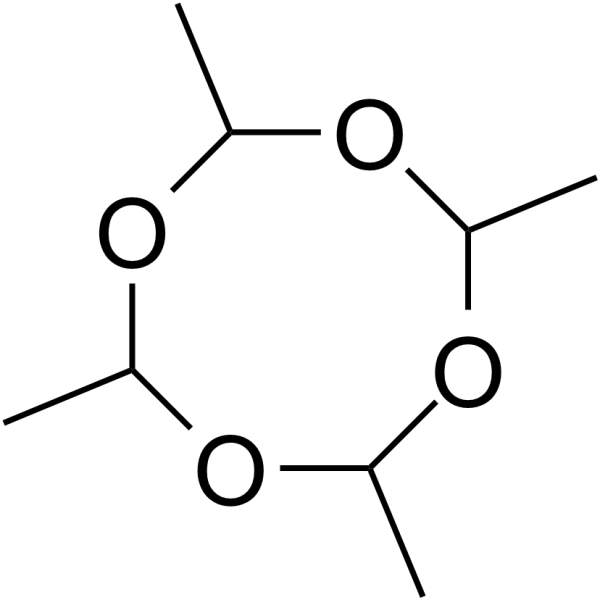
CC1OC(C)OC(C)OC(C)O1
-
Shipping
Room temperature in continental US; may vary elsewhere.
-
Storage
Powder -20°C 3 years 4°C 2 years In solvent -80°C 6 months -20°C 1 month


Solvent & Solubility
In Vitro:
DMSO : 1.82 mg/mL (10.33 mM; ultrasonic and warming and heat to 60°C; Hygroscopic DMSO has a significant impact on the solubility of product, please use newly opened DMSO)
Please refer to the solubility information to select the appropriate solvent. Once prepared, please aliquot and store the solution to prevent product inactivation from repeated freeze-thaw cycles.
Storage method and period of stock solution: -80°C, 6 months; -20°C, 1 month. When stored at -80°C, please use it within 6 months. When stored at -20°C, please use it within 1 month.
Please refer to the solubility information to select the appropriate solvent. Once prepared, please aliquot and store the solution to prevent product inactivation from repeated freeze-thaw cycles.
Storage method and period of stock solution: -80°C, 6 months; -20°C, 1 month. When stored at -80°C, please use it within 6 months. When stored at -20°C, please use it within 1 month.
Concentration (start) × Volume (start) = Concentration (final) × Volume (final)


Purity & Documentation
-
Data Sheet (277 KB)
-
SDS (394 KB)
- English - EN (394 KB)
- Français - FR (394 KB)
- Deutsch - DE (394 KB)
- Norwegian - NO (394 KB)
- Español - ES (394 KB)
- Swedish - SV (394 KB)
- Italian - IT (394 KB)
- Korean - KR (394 KB)
- Portuguese - PT (394 KB)
-
Handling Instructions (2659 KB)
References
[3]. Moreau P, et al. In vivo effects of metaldehyde on Pacific oyster, Crassostrea gigas: comparing hemocyte parameters in two oyster families. Environmental science and pollution research international. 2015 Jun;22(11):8003-9. [Content Brief]
[4]. Homeida AM, et al. Pharmacological aspects of metaldehyde poisoning in mice. Journal of veterinary pharmacology and therapeutics. 1982 Mar;5(1):77-81. [Content Brief]


Complete Stock Solution Preparation Table
Please refer to the solubility information to select the appropriate solvent. Once prepared, please aliquot and store the solution to prevent product inactivation from repeated freeze-thaw cycles.
Storage method and period of stock solution: -80°C, 6 months; -20°C, 1 month. When stored at -80°C, please use it within 6 months. When stored at -20°C, please use it within 1 month.
| Optional Solvent | Concentration Solvent Mass | 1 mg | 5 mg | 10 mg | 25 mg |
|---|---|---|---|---|---|
| DMSO | 1 mM | 5.6750 mL | 28.3752 mL | 56.7505 mL | 141.8762 mL |
| 5 mM | 1.1350 mL | 5.6750 mL | 11.3501 mL | 28.3752 mL | |
| 10 mM | 0.5675 mL | 2.8375 mL | 5.6750 mL | 14.1876 mL |


Metaldehyde Related Classifications
HY-B1870 Related Classifications
 Powered by Bioz