



ZXH-4-130 TFA
Based on 2 publication(s) in Google Scholar
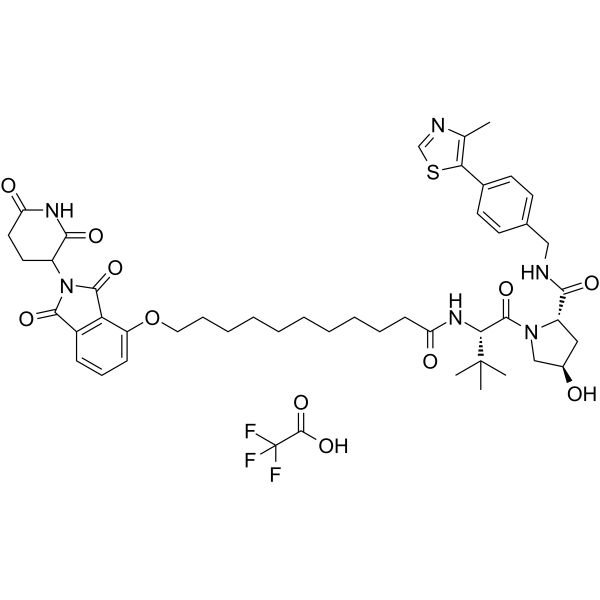
ZXH-4-130 TFA is a potent and selective Cereblon (CRBN) degrader. ZXH-4-130 TFA recruits the VHL E3 ligase to specifically target CRBN as a substrate for selective degradation as a hetero-PROTAC molecule. ZXH-4-130 TFA can be applied in studies on the biological functions of CRBN and related research of frontotemporal dementia.
(Pink: Cereblon ligand (HY-14658); Blue: VHL ligand (HY-125845); Black: linker (HY-W142804)).
For research use only. We do not sell to patients.
- Purity : 99.71%
- CAS No.: 2711006-67-4
- Formula: C48H59F3N6O11S
- Molecular Weight:985.08
-
Storage:
-20°C, sealed storage, away from moisture and light
* In solvent : -80°C, 6 months; -20°C, 1 month (sealed storage, away from moisture and light)

To place orders, for customer services and technical support, please contact: MedChemExpress USA
Tel: 609-228-6898 E-mail: [email protected] [email protected]


-
 Biological Activity
-
Chemical Information
-
Solvent & Solubility
- Purity & Documentation
- References
-
 Help & FAQs


Publications Citing Use of MedChemExpress (MCE) ZXH-4-130 TFA
MoreAll PROTACs Isoforms
More

Biological Activity
Description
IC50 & Target
[1]|
Cereblon |
VHL |
In Vitro
ZXH-4-130 (10-500 nM; 1-24 h) potently and selectively degrades CRBN in MM1.S cells[1].
ZXH-4-130 (50-100 nM; 6-24 h) exhibits high selectivity for CRBN in Kelly, SK-N-DZ, HEK293T, and MOLT-4 cell lines, and does not affect the expression of other components (DDB1, CUL4A, ROC1) of the CRBN E3 ligase complex[1].
ZXH-4-130 (50 nM; 2 h) mediates CRBN knockdown in MM1.S cells and blocks CC-885 (HY-101488)-induced, CRBN-dependent GSPT1 degradation[1].
ZXH-4-130 (0.1 μM; 2 h) partially blocks THAL-SNS-032 (HY-123937)-induced degradation of CDK9 in MOLT-4 cells[1].
ZXH-4-130 (100 nM; 2 h pretreatment) significantly reverses the decrease in cell viability induced by Pomalidomide (HY-10984) (1 μM; 96 h) in MM1.S cells[1].
ZXH-4-130 (1 μM; 6 h pre-incubation + 24 h co-treatment) blocks the rescue effect of QC-01-175 (HY-134850) on the LDL-induced increase in the p-tau/total tau ratio in P301L tau induced pluripotent stem cell (iPSC)-derived neurons, indicating that ZXH-4-130 inhibits the Cereblon-dependent activity of QC-01-175[2].
MedChemExpress (MCE) has not independently confirmed the accuracy of these methods. They are for reference only.
-
Cell Line:MM1.S
-
Concentration:10, 50, 100, 500 nM
-
Incubation Time:1, 2, 4, 8, 16, 24 h
-
Result:Potently and dose-dependently degraded CRBN to an extent comparable to CRBN-6-5-5-VHL and superior to St-15a.
Induced sustained CRBN degradation, exhibiting maximal degradative activity between 2 and 8 hours.
-
Cell Line:MM1.S
-
Concentration:100 nM pre-treatment for 2 h, followed by 1 μM Pomalidomide
-
Incubation Time:96 h
-
Result:Significantly blocked pomalidomide-induced cytotoxicity, restoring cell viability.


Chemical Information
-
CAS No. 2711006-67-4
-
Appearance Solid
-
Molecular Weight 985.08
-
Formula C48H59F3N6O11S
-
Color Off-white to gray
-
SMILES
O=C([C@H]1N(C([C@@H](NC(CCCCCCCCCCOC2=CC=CC(C(N3C(CC4)C(NC4=O)=O)=O)=C2C3=O)=O)C(C)(C)C)=O)C[C@H](O)C1)NCC5=CC=C(C6=C(C)N=CS6)C=C5.OC(C(F)(F)F)=O
-
Shipping
Room temperature in continental US; may vary elsewhere.
-
Storage
-20°C, sealed storage, away from moisture and light
* In solvent : -80°C, 6 months; -20°C, 1 month (sealed storage, away from moisture and light)


Publications (2)
-
Journal Impact Factor
-
Most Recent
-
J Med Chem
Discovery and Characterization of a First-In-Class HCK/BTK PROTAC DFCI-002-06 for the Treatment of MYD88 Mutated B Cell Malignancies. [Abstract]2026 Jan 22;69(2):1119-1134. PMID: 41482966 -
bioRxiv
Cholesterol Dysregulation Drives Seed-Dependent Tau Aggregation in Patient Stem Cell-Derived Models of Tauopathy. [Abstract]2023 Dec 12:2023.12.11.571147. PMID: 38168389


Solvent & Solubility
In Vitro:
DMSO : 170 mg/mL (172.57 mM; Need ultrasonic; Hygroscopic DMSO has a significant impact on the solubility of product, please use newly opened DMSO)
Please refer to the solubility information to select the appropriate solvent. Once prepared, please aliquot and store the solution to prevent product inactivation from repeated freeze-thaw cycles.
Storage method and period of stock solution: -80°C, 6 months; -20°C, 1 month (sealed storage, away from moisture and light). When stored at -80°C, please use it within 6 months. When stored at -20°C, please use it within 1 month.
Please refer to the solubility information to select the appropriate solvent. Once prepared, please aliquot and store the solution to prevent product inactivation from repeated freeze-thaw cycles.
Storage method and period of stock solution: -80°C, 6 months; -20°C, 1 month (sealed storage, away from moisture and light). When stored at -80°C, please use it within 6 months. When stored at -20°C, please use it within 1 month.
Concentration (start) × Volume (start) = Concentration (final) × Volume (final)
In Vivo:
Select the appropriate dissolution method based on your experimental animal and administration route.
- For the following dissolution methods, please ensure to first prepare a clear stock solution using an In Vitro approach and then sequentially add co-solvents:
- To ensure reliable experimental results, the clarified stock solution can be appropriately stored based on storage conditions. As for the working solution for In Vivo experiments, it is recommended to prepare freshly and use it on the same day.
- The percentages shown for the solvents indicate their volumetric ratio in the final prepared solution. If precipitation or phase separation occurs during preparation, heat and/or sonication can be used to aid dissolution.
In Vivo Dissolution Calculator
Please enter the basic information of animal experiments:
-
-
-
-
Recommended: Prepare an additional quantity of animals to account for potential losses during experiments.
Please enter your animal formula composition:
-
%DMSO +
Recommended: Keep the proportion of DMSO in working solution below 2% if your animal is weak.
-
%+
-
+%Tween-80 + +
-
%Saline +
The co-solvents required include: DMSO, . All of co-solvents are available by MedChemExpress (MCE). , Tween 80. All of co-solvents are available by MedChemExpress (MCE).
Working solution concentration: 0.22 mg/mL
Method for preparing stock solution: mg drug dissolved in μL DMSO. Stock solution concentration: mg/mL. * In solvent : -80°C, 6 months; -20°C, 1 month (sealed storage, away from moisture and light)
1. Take μL DMSO stock solution;
2. Add μL .
μL , mix evenly;
3. Then add μL Tween 80, mix evenly;
4. Then add μL
Please ensure that the stock solution in the first step is dissolved to a clear state, and add co-solvents in sequence. You can use ultrasonic heating (ultrasonic cleaner, recommended frequency 20-40 kHz), vortexing, etc. to assist dissolution.


Purity & Documentation
-
Data Sheet (286 KB)
-
SDS (252 KB)
- English - EN (252 KB)
- Français - FR (252 KB)
- Deutsch - DE (252 KB)
- Norwegian - NO (252 KB)
- Español - ES (252 KB)
- Swedish - SV (252 KB)
- Italian - IT (252 KB)
- Korean - KR (252 KB)
- Portuguese - PT (252 KB)
-
Handling Instructions (2659 KB)
References
[1]. Powell CE, et al. Selective degradation-inducing probes for studying cereblon (CRBN) biology. RSC medicinal chemistry. 2021 Aug 18;12(8):1381-1390. [Content Brief]
[2]. Lam M, et al. Cholesterol Dysregulation Drives Seed-Dependent Tau Aggregation in Patient Stem Cell-Derived Models of Tauopathy. bioRxiv [Preprint]. 2023 Dec 12:2023.12.11.571147. [Content Brief]


Complete Stock Solution Preparation Table
Please refer to the solubility information to select the appropriate solvent. Once prepared, please aliquot and store the solution to prevent product inactivation from repeated freeze-thaw cycles.
Storage method and period of stock solution: -80°C, 6 months; -20°C, 1 month (sealed storage, away from moisture and light). When stored at -80°C, please use it within 6 months. When stored at -20°C, please use it within 1 month.
| Optional Solvent | Concentration Solvent Mass | 1 mg | 5 mg | 10 mg | 25 mg |
|---|---|---|---|---|---|
| DMSO | 1 mM | 1.0151 mL | 5.0757 mL | 10.1515 mL | 25.3786 mL |
| 5 mM | 0.2030 mL | 1.0151 mL | 2.0303 mL | 5.0757 mL | |
| 10 mM | 0.1015 mL | 0.5076 mL | 1.0151 mL | 2.5379 mL | |
| 15 mM | 0.0677 mL | 0.3384 mL | 0.6768 mL | 1.6919 mL | |
| 20 mM | 0.0508 mL | 0.2538 mL | 0.5076 mL | 1.2689 mL | |
| 25 mM | 0.0406 mL | 0.2030 mL | 0.4061 mL | 1.0151 mL | |
| 30 mM | 0.0338 mL | 0.1692 mL | 0.3384 mL | 0.8460 mL | |
| 40 mM | 0.0254 mL | 0.1269 mL | 0.2538 mL | 0.6345 mL | |
| 50 mM | 0.0203 mL | 0.1015 mL | 0.2030 mL | 0.5076 mL | |
| 60 mM | 0.0169 mL | 0.0846 mL | 0.1692 mL | 0.4230 mL | |
| 80 mM | 0.0127 mL | 0.0634 mL | 0.1269 mL | 0.3172 mL | |
| 100 mM | 0.0102 mL | 0.0508 mL | 0.1015 mL | 0.2538 mL |


ZXH-4-130 TFA Related Classifications
HY-132857A Related Classifications
 Powered by Bioz