



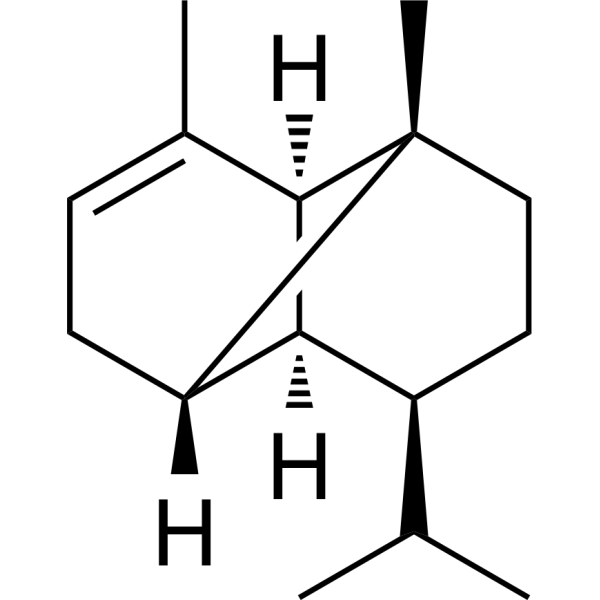
α-Copaene

Based on 1 Customer Validation
α-Copaene is a potent attractant for male Mediterranean fruit flies Ceratitis capitata.α-Copaene can be found as a minor component in the essential oils of various plant species. α-Copaene can inhibit bacterial growth with a minimum inhibitory concentration of 0.5-1 μL/mL. α-Copaene suppresses biofilm formation by decreasing the hydrophobicity of the cell surface. α-Copaene can be used as an oviposition promoter of Bactrocera oleae.
For research use only. We do not sell to patients.
- Purity : 97.10%
- CAS No.: 3856-25-5
- Formula: C15H24
- Molecular Weight:204.35
-
Storage:Pure form -20°C, 3 years ; In solvent -80°C, 6 months , -20°C, 1 month

To place orders, for customer services and technical support, please contact: MedChemExpress USA
Tel: 609-228-6898 E-mail: [email protected] [email protected]


-
 Biological Activity
-
Chemical Information
- Protocols
- Purity & Documentation
- References
-
 Help & FAQs




Biological Activity
Description
In Vitro
α-Copaene inhibits bacterial growth with a minimum inhibitory concentration of 0.5-1 μL/mL[3].
α-Copaene (0.125-4 μL/mL) exhibits concentration-dependent antibacterial and bactericidal activities as well as markedly decreases the survival rate of foodbourne pathogenic bacteria concentration-dependently[3].
α-Copaene (0.25-1 μL/mL, 6 h) causes foodborne pathogenic bacteria apoptosis[3].
α-Copaene (0.25-1 μL/mL) results in varying degrees of damage of bacteria cell membrane and cell wall dose-dependently[3].
α-Copaene (0.5-2 μL/mL) promotes protein and DNA leakage concentration-dependently[3].
MedChemExpress (MCE) has not independently confirmed the accuracy of these methods. They are for reference only. Further protocols information, click here.


Chemical Information
-
CAS No. 3856-25-5
-
Appearance Oil
-
Molecular Weight 204.35
-
Formula C15H24
-
Color Colorless to light yellow
-
SMILES
C[C@]12[C@@]3([H])[C@]([C@@H](CC2)C(C)C)([H])[C@]1([H])CC=C3C
-
Structure Classification
-
Initial Source
-
Shipping
Room temperature in continental US; may vary elsewhere.
-
Storage
Pure form -20°C 3 years In solvent -80°C 6 months -20°C 1 month

Protocols
-
Aerobic Bacterial Batch Culture on Broth/Agar
Aerobic bacterial batch culture grows a closed inoculated population in broth or on agar without continuous medium replacement; growth readouts include turbidity/OD for total suspended biomass and colony-forming units for viable cells able to form colonies on agar. OD-based growth curves reflect light scattering by cells, but OD is instrument-, pathlength-, species-, cell-size-, and density-dependent, so OD should be calibrated or interpreted alongside viable counts when quantitative cell density is required.
-
Fungal Biofilm Culture
Fungal biofilm culture is an in vitro method for growing surface-attached fungal communities, most commonly Candida albicans, on abiotic substrates such as polystyrene wells, silicone elastomer, or polymethylmethacrylate; the assay models adhesion, proliferation, filamentation, extracellular-matrix-associated maturation, and dispersion. Biofilm output can be read by optical density at 600 nm for adherent biomass, XTT reduction for metabolic activity, CFU recovery for viable attached or dispersed cells, and microscopy for architecture.


Purity & Documentation
-
Data Sheet (279 KB)
-
SDS (557 KB)
- English - EN (557 KB)
- Français - FR (557 KB)
- Deutsch - DE (557 KB)
- Norwegian - NO (557 KB)
- Español - ES (557 KB)
- Swedish - SV (557 KB)
- Italian - IT (557 KB)
- Korean - KR (557 KB)
- Portuguese - PT (557 KB)
-
Handling Instructions (2659 KB)
References

Calculators
Concentration (start) × Volume (start) = Concentration (final) × Volume (final)


α-Copaene Related Classifications
HY-122485 Related Classifications
 Powered by Bioz