



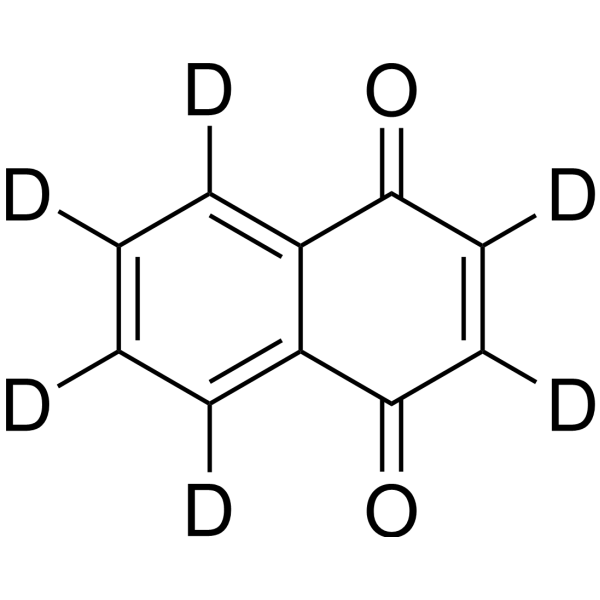
1,4-Naphthoquinone-d6

Based on 1 Customer Validation
1,4-Naphthoquinone-d6 is the deuterium labeled 1,4-Naphthoquinone. 1,4-Naphthoquinone is an inhibitor with broad-spectrum inhibitory activity targeting DNA polymerase, NF-κB and monoamine oxidase (MAO-A/B), with antibacterial and anti-biofilm efficacy. 1,4-Naphthoquinone is a competitive inhibitor of MAO-B (Ki=1.4 μM) and a non-competitive inhibitor of MAO-A (Ki=7.7 μM). 1,4-Naphthoquinone inhibits DNA polymerase pol α, β, γ, δ, ε, λ with IC50 ranging from 5.57-128 μM. 1,4-Naphthoquinone inhibits tumor cell proliferation, induces apoptosis and necrosis, and has anti-angiogenic and anti-inflammatory activities by inducing oxidative stress, depleting glutathione (GSH), inhibiting DNA polymerase-mediated DNA synthesis and blocking NF-κB nuclear translocation. 1,4-Naphthoquinone can be used in anti-bacterial , anti-tumor and anti-inflammatory studies, including inhibition of melanoma and colon cancer cell growth and endothelial cell function, as well as LPS-induced inflammation models.
For research use only. We do not sell to patients.
- Purity : 99.2%
- CAS No.: 26473-08-5
- Formula: C10D6O2
- Molecular Weight:164.19
-
Storage:Powder -20°C, 3 years , 4°C, 2 years ; In solvent -80°C, 6 months , -20°C, 1 month

To place orders, for customer services and technical support, please contact: MedChemExpress USA
Tel: 609-228-6898 E-mail: [email protected] [email protected]


-
 Biological Activity
-
Chemical Information
-
Solvent & Solubility
- Purity & Documentation
- References
-
 Help & FAQs


All DNA/RNA Synthesis Isoforms
More

Biological Activity
Description
IC50 & Target
|
DNA Polymerase |
In Vitro
Stable heavy isotopes of hydrogen, carbon, and other elements have been incorporated into drug molecules, largely as tracers for quantitation during the drug development process. Deuteration has gained attention because of its potential to affect the pharmacokinetic and metabolic profiles of drugs[1].
MedChemExpress (MCE) has not independently confirmed the accuracy of these methods. They are for reference only.
Application
1. This compound can be used as a tracer
2. This compound can be used as an internal standard for quantitative analysis by NMR, GC-MS, or LC-MS.


Chemical Information
-
CAS No. 26473-08-5
-
Unlabeled CAS 130-15-4
-
Appearance Solid
-
Molecular Weight 164.19
-
Formula C10D6O2
-
Color Light yellow to yellow
-
SMILES
O=C1C2=C([2H])C([2H])=C([2H])C([2H])=C2C(C([2H])=C1[2H])=O
-
Shipping
Room temperature in continental US; may vary elsewhere.
-
Storage
Powder -20°C 3 years 4°C 2 years In solvent -80°C 6 months -20°C 1 month


Solvent & Solubility
In Vitro:
DMSO : 33.33 mg/mL (203.00 mM; Need ultrasonic; Hygroscopic DMSO has a significant impact on the solubility of product, please use newly opened DMSO)
Please refer to the solubility information to select the appropriate solvent. Once prepared, please aliquot and store the solution to prevent product inactivation from repeated freeze-thaw cycles.
Storage method and period of stock solution: -80°C, 6 months; -20°C, 1 month. When stored at -80°C, please use it within 6 months. When stored at -20°C, please use it within 1 month.
Please refer to the solubility information to select the appropriate solvent. Once prepared, please aliquot and store the solution to prevent product inactivation from repeated freeze-thaw cycles.
Storage method and period of stock solution: -80°C, 6 months; -20°C, 1 month. When stored at -80°C, please use it within 6 months. When stored at -20°C, please use it within 1 month.
Concentration (start) × Volume (start) = Concentration (final) × Volume (final)


Purity & Documentation
-
Data Sheet (279 KB)
-
SDS (394 KB)
- English - EN (394 KB)
- Français - FR (394 KB)
- Deutsch - DE (394 KB)
- Norwegian - NO (394 KB)
- Español - ES (394 KB)
- Swedish - SV (394 KB)
- Italian - IT (394 KB)
- Korean - KR (394 KB)
- Portuguese - PT (394 KB)
-
Handling Instructions (2659 KB)
References
[1]. Russak EM, et al. Impact of Deuterium Substitution on the Pharmacokinetics of Pharmaceuticals. Ann Pharmacother. 2019 Feb;53(2):211-216. [Content Brief]
[2]. Kumar MR, et al. Cytotoxic, genotoxic and oxidative stress induced by 1,4-naphthoquinone in B16F1 melanoma tumor cells. Toxicol In Vitro. 2009 Mar;23(2):242-50. [Content Brief]
[3]. Kayashima T, et al. 1,4-Naphthoquinone is a potent inhibitor of human cancer cell growth and angiogenesis. Cancer Lett. 2009 Jun 8;278(1):34-40. [Content Brief]
[4]. Kobayashi K, et al. Effects of quinone derivatives, such as 1,4-naphthoquinone, on DNA polymerase inhibition and anti-inflammatory action. Med Chem. 2011 Jan;7(1):37-44. [Content Brief]
[5]. Samreen, et al. Antibacterial and anti-biofilm efficacy of 1,4-naphthoquinone against Chromobacterium violaceum: an in vitro and in silico investigation. Arch Microbiol. 2024 Dec 7;207(1):11. [Content Brief]
[6]. Coelho Cerqueira E, et al. Molecular insights into human monoamine oxidase (MAO) inhibition by 1,4-naphthoquinone: evidences for menadione (vitamin K3) acting as a competitive and reversible inhibitor of MAO. Bioorg Med Chem. 2011 Dec 15;19(24):7416-24. [Content Brief]


Complete Stock Solution Preparation Table
Please refer to the solubility information to select the appropriate solvent. Once prepared, please aliquot and store the solution to prevent product inactivation from repeated freeze-thaw cycles.
Storage method and period of stock solution: -80°C, 6 months; -20°C, 1 month. When stored at -80°C, please use it within 6 months. When stored at -20°C, please use it within 1 month.
| Optional Solvent | Concentration Solvent Mass | 1 mg | 5 mg | 10 mg | 25 mg |
|---|---|---|---|---|---|
| DMSO | 1 mM | 6.0905 mL | 30.4525 mL | 60.9050 mL | 152.2626 mL |
| 5 mM | 1.2181 mL | 6.0905 mL | 12.1810 mL | 30.4525 mL | |
| 10 mM | 0.6091 mL | 3.0453 mL | 6.0905 mL | 15.2263 mL | |
| 15 mM | 0.4060 mL | 2.0302 mL | 4.0603 mL | 10.1508 mL | |
| 20 mM | 0.3045 mL | 1.5226 mL | 3.0453 mL | 7.6131 mL | |
| 25 mM | 0.2436 mL | 1.2181 mL | 2.4362 mL | 6.0905 mL | |
| 30 mM | 0.2030 mL | 1.0151 mL | 2.0302 mL | 5.0754 mL | |
| 40 mM | 0.1523 mL | 0.7613 mL | 1.5226 mL | 3.8066 mL | |
| 50 mM | 0.1218 mL | 0.6091 mL | 1.2181 mL | 3.0453 mL | |
| 60 mM | 0.1015 mL | 0.5075 mL | 1.0151 mL | 2.5377 mL | |
| 80 mM | 0.0761 mL | 0.3807 mL | 0.7613 mL | 1.9033 mL | |
| 100 mM | 0.0609 mL | 0.3045 mL | 0.6091 mL | 1.5226 mL |


1,4-Naphthoquinone-d6 Related Classifications
HY-W015490S Related Classifications
 Powered by Bioz