



2,6-Dichloro-4-nitroaniline

Based on 1 Customer Validation
2,6-Dichloro-4-nitroaniline is an orally active Herbicide, Fungicide and uncoupler. 2,6-Dichloro-4-nitroaniline uncouples oxidative phosphorylation and inhibits electron transport. 2,6-Dichloro-4-nitroaniline induces biphenyl hydroxylase activity in rat liver. 2,6-Dichloro-4-nitroaniline increases the relative liver weight of rats via hepatomegaly without altering their body weight.
For research use only. We do not sell to patients.
- Purity : ≥99.0%
- CAS No.: 99-30-9
- Formula: C6H4Cl2N2O2
- Molecular Weight:207.01
-
Storage:
4°C, protect from light
* In solvent : -80°C, 6 months; -20°C, 1 month (protect from light)


To place orders, for customer services and technical support, please contact: MedChemExpress USA
Tel: 609-228-6898 E-mail: [email protected] [email protected]


-
 Biological Activity
-
Chemical Information
-
Solvent & Solubility
- Protocols
- Purity & Documentation
- References
-
 Help & FAQs


-
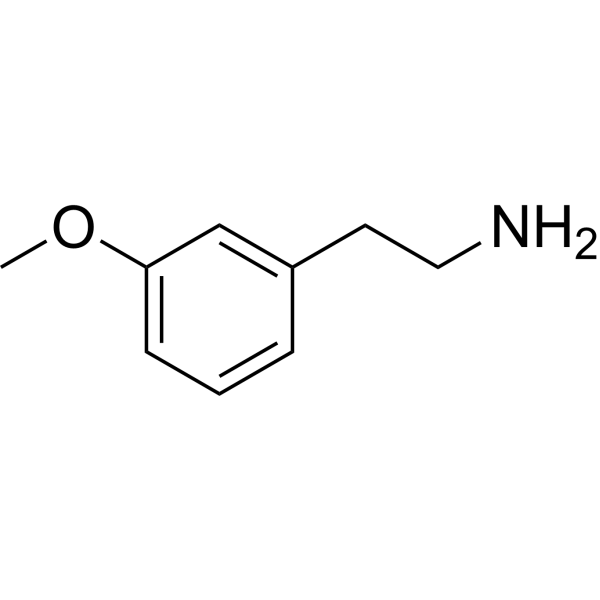
HY-41268
3-MethoxyphenylethylamineCYP2D6 Substrate -
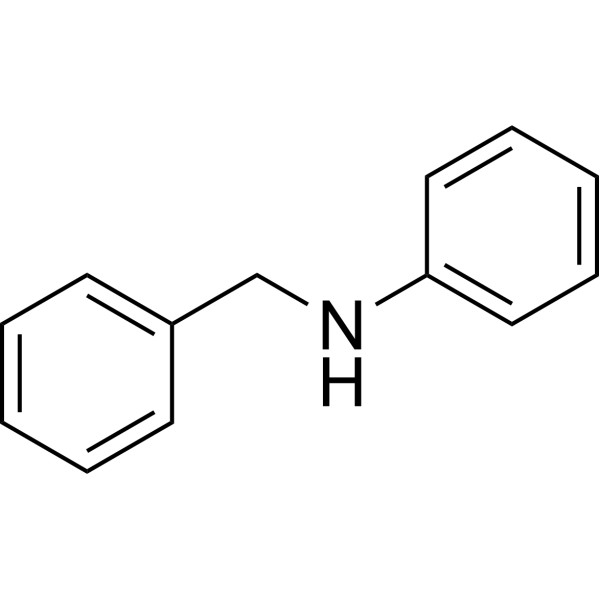
HY-W016321
N-BenzylanilineN-alkylated Derivative -
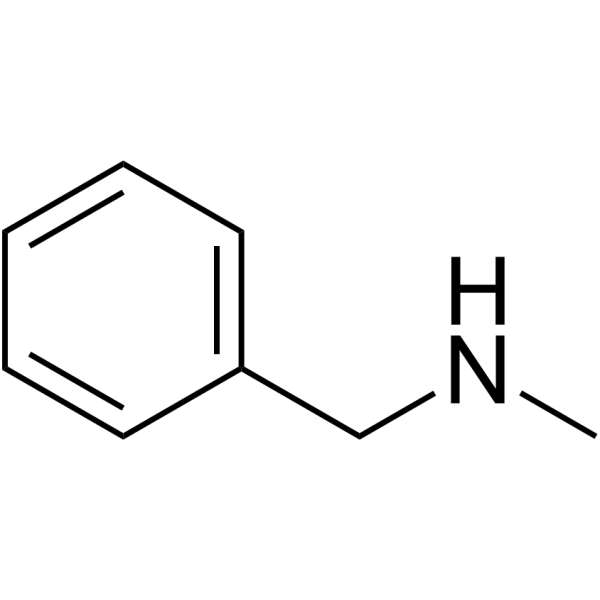
HY-W007426
N-Methylbenzylamine -
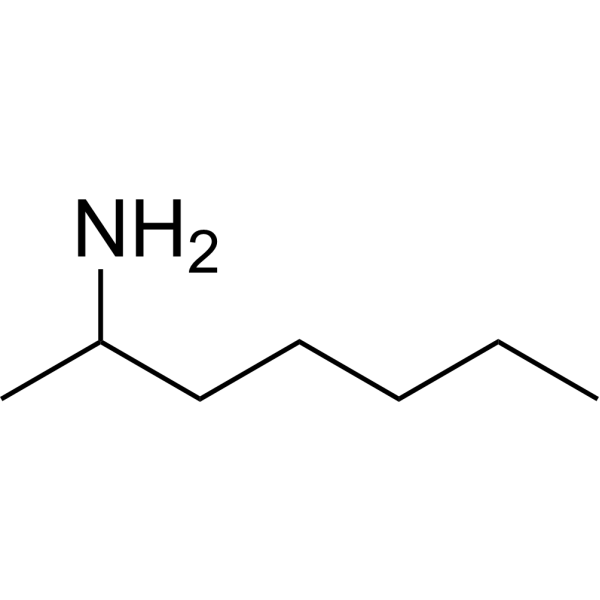
HY-B0952
2-AminoheptaneNorepinephrine Transporter Inhibitor -

HY-W011998
Triphenylamine -

HY-W235067
N,N-DimethyldodecylamineDynamin I Inhibitor -

HY-W016234
Nimesulide impurity 4Drug Impurity -
HY-77822
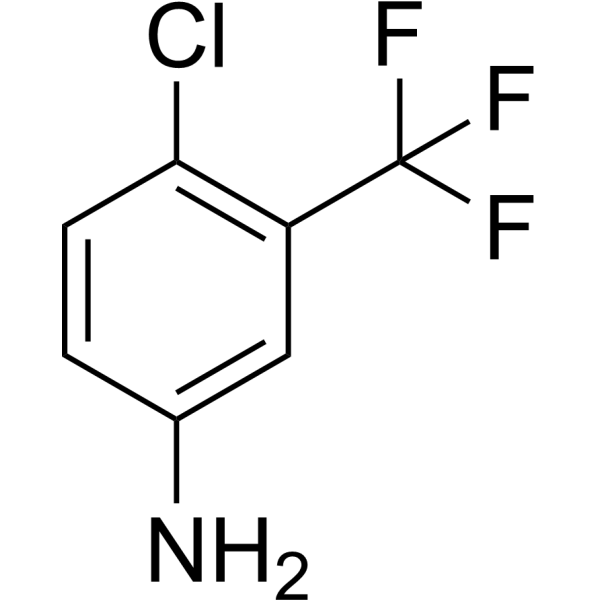
5-Amino-2-chlorobenzotrifluorideBiochemical Reagent -

HY-Y1684
N,N'-Dimethyl-1,3-propylenediaminePROTAC Linker -

HY-W099525
DidecylamineBiochemical Assay Reagent -

HY-W100310
N,2-DimethylanilineAniline Derivative -

HY-W103306
3-AminofluorantheneNitro-PAH


Biological Activity
Description
In Vitro
2,6-Dichloro-4-nitroaniline (1×10⁻⁵-1×10⁻⁴ M) uncouples oxidative phosphorylation and inhibits electron transport in isolated liver mitochondria[1].
MedChemExpress (MCE) has not independently confirmed the accuracy of these methods. They are for reference only. Further protocols information, click here.
In Vivo
MedChemExpress (MCE) has not independently confirmed the accuracy of these methods. They are for reference only.
-
Animal Model:Sprague-Dawley (female, 100-150 g)[1]
-
Dosage:500-1000 mg/kg; 1000 mg/kg (single dose); 1000 mg/kg (daily for 4 days); 500 mg/kg (daily for up to 12 weeks)
-
Administration:p.o.; single dose; daily (4 consecutive days); daily (up to 12 weeks)
-
Result:Increased hepatic mitochondrial respiratory rate by 18% (16 hours post single 1000 mg/kg dose, succinate as substrate).
Did not alter ADP/O ratio at 1, 16, or 24 hours post single 1000 mg/kg dose.
Increased hepatic 4-OH biphenyl hydroxylase activity to 2.545 μmol/hr/g fresh liver and 2-OH biphenyl hydroxylase activity to 0.513 μmol/hr/g fresh liver (24 hours post single 1000 mg/kg dose).
Increased hepatic mitochondrial respiratory rate to 54.15, 50.94, and 44.53 nmol O2/min/mg protein (1000 mg/kg daily for 2, 3, 4 days respectively, succinate as substrate).
Did not alter ADP/O ratio (1000 mg/kg daily for 2, 3, 4 days).
Increased relative liver weight to 7.10, 7.43, and 6.10 (1000 mg/kg daily for 2, 3, 4 days respectively).
Increased hepatic 4-OH biphenyl hydroxylase activity to 3.705, 5.205, and 4.275 μmol/hr/g fresh liver and 2-OH biphenyl hydroxylase activity to 3.715, 5.181, and 4.385 μmol/hr/g fresh liver (1000 mg/kg daily for 2, 3, 4 days respectively).
Increased relative liver weight to 6.7, 8.1, 6.1, and 5.6 (500 mg/kg daily for 2, 4, 8, 12 weeks respectively).
Increased hepatic 4-OH biphenyl hydroxylase activity to 1.710, 2.27, 1.16, and 3.46 μmol/hr/g fresh liver and 2-OH biphenyl hydroxylase activity to 2.378, 1.48, 1.05, and 4.45 μmol/hr/g fresh liver (500 mg/kg daily for 2, 4, 8, 12 weeks respectively).
Elevated respiratory activity in 33,000 g·min heavy mitochondrial pellet throughout 3 months of 500 mg/kg daily treatment.
Detected ~1×10⁻⁵ M DCNA in whole liver homogenate and crude nuclear pellet (500 mg/kg daily for 4 days).
Detected 37.2 μg/mL DCNA in urine (single 1000 mg/kg dose) and 30.6 μg/mL DCNA in urine (500 mg/kg daily for 30 days).


Chemical Information
-
CAS No. 99-30-9
-
Appearance Solid
-
Molecular Weight 207.01
-
Formula C6H4Cl2N2O2
-
Color Light yellow to yellow
-
SMILES
ClC(C=C1[N+]([O-])=O)=C(C(Cl)=C1)N
-
Shipping
Room temperature in continental US; may vary elsewhere.
-
Storage
4°C, protect from light
* In solvent : -80°C, 6 months; -20°C, 1 month (protect from light)


Solvent & Solubility
In Vitro:
DMSO : 16.67 mg/mL (80.53 mM; Need ultrasonic; Hygroscopic DMSO has a significant impact on the solubility of product, please use newly opened DMSO)
Please refer to the solubility information to select the appropriate solvent. Once prepared, please aliquot and store the solution to prevent product inactivation from repeated freeze-thaw cycles.
Storage method and period of stock solution: -80°C, 6 months; -20°C, 1 month (protect from light). When stored at -80°C, please use it within 6 months. When stored at -20°C, please use it within 1 month.
Please refer to the solubility information to select the appropriate solvent. Once prepared, please aliquot and store the solution to prevent product inactivation from repeated freeze-thaw cycles.
Storage method and period of stock solution: -80°C, 6 months; -20°C, 1 month (protect from light). When stored at -80°C, please use it within 6 months. When stored at -20°C, please use it within 1 month.
Concentration (start) × Volume (start) = Concentration (final) × Volume (final)

Protocols
-
Kinase activity and phosphorylation assays
Kinase activity assays measure the ability of kinases to transfer phosphate groups from ATP to specific substrates, while phosphorylation assays detect the presence and levels of phosphorylated proteins. Common methods include radiolabeled ATP incorporation (e. g. ,), ADP release detection via bioluminescence (e. g. ,[3]), enzyme-linked immunosorbent assays (ELISA) for phospho-specific epitopes (e. g. ,[6]), and microtiter-based formats for high-throughput screening (e. g. ,[8]). The ADP-Glo assay quantifies kinase activity by measuring ADP produced during phosphorylation using a luciferase-based system. Radiometric assays involve autoradiography or scintillation counting after incorporation of 32P-labeled ATP into substrate proteins. ELISA-based approaches rely on phospho-specific antibodies to detect activated kinases in cell lysates or purified samples.
-
Western Blot
Western blotting (WB) is a commonly used experimental method in molecular biology, biochemistry, and immunogenetics for identifying and quantifying target proteins. It combines gel electrophoresis with immunoassay, enabling researchers to analyze protein expression, post-translational modifications, and molecular weight.
-
Protocol for Kinase activity and phosphorylation assays
Kinase activity assays measure transfer of phosphate from ATP to a protein or peptide substrate, generating phosphorylated substrate, ADP, or incorporated radiolabeled phosphate as the readout; phosphorylation assays measure site-specific phosphorylation in cells or tissues as a proxy for kinase-pathway activation, inhibition, or substrate regulation. Phosphorylation can be detected by phospho-specific Western blot, immunoprecipitation kinase assay, phospho-immunofluorescence, phospho-flow cytometry, luminescent ADP detection, radiolabeled ATP incorporation, or reporter-based pathway assays, and these readouts can be applied to cancer cells, primary neurons, mouse tumors, organoids, inflammatory macrophages, ferroptosis studies, and mitophagy studies when the kinase target is biologically relevant.


Purity & Documentation
-
Data Sheet (274 KB)
-
SDS (789 KB)
- English - EN (789 KB)
- Français - FR (789 KB)
- Deutsch - DE (789 KB)
- Norwegian - NO (789 KB)
- Español - ES (789 KB)
- Swedish - SV (789 KB)
- Italian - IT (789 KB)
- Korean - KR (789 KB)
- Portuguese - PT (789 KB)
-
Handling Instructions (2659 KB)
References


Complete Stock Solution Preparation Table
Please refer to the solubility information to select the appropriate solvent. Once prepared, please aliquot and store the solution to prevent product inactivation from repeated freeze-thaw cycles.
Storage method and period of stock solution: -80°C, 6 months; -20°C, 1 month (protect from light). When stored at -80°C, please use it within 6 months. When stored at -20°C, please use it within 1 month.
| Optional Solvent | Concentration Solvent Mass | 1 mg | 5 mg | 10 mg | 25 mg |
|---|---|---|---|---|---|
| DMSO | 1 mM | 4.8307 mL | 24.1534 mL | 48.3068 mL | 120.7671 mL |
| 5 mM | 0.9661 mL | 4.8307 mL | 9.6614 mL | 24.1534 mL | |
| 10 mM | 0.4831 mL | 2.4153 mL | 4.8307 mL | 12.0767 mL | |
| 15 mM | 0.3220 mL | 1.6102 mL | 3.2205 mL | 8.0511 mL | |
| 20 mM | 0.2415 mL | 1.2077 mL | 2.4153 mL | 6.0384 mL | |
| 25 mM | 0.1932 mL | 0.9661 mL | 1.9323 mL | 4.8307 mL | |
| 30 mM | 0.1610 mL | 0.8051 mL | 1.6102 mL | 4.0256 mL | |
| 40 mM | 0.1208 mL | 0.6038 mL | 1.2077 mL | 3.0192 mL | |
| 50 mM | 0.0966 mL | 0.4831 mL | 0.9661 mL | 2.4153 mL | |
| 60 mM | 0.0805 mL | 0.4026 mL | 0.8051 mL | 2.0128 mL | |
| 80 mM | 0.0604 mL | 0.3019 mL | 0.6038 mL | 1.5096 mL |


2,6-Dichloro-4-nitroaniline Related Classifications
HY-W040305 Related Classifications
 Powered by Bioz
Keywords
- 2,6-Dichloro-4-nitroaniline
- 99-30-9
- Environmental Pollutants
- Herbicide
- Mitochondrial Metabolism
- Fungal
- drug-processing enzymes
- electron transport
- rats
- hepatic lysosome
- smooth endoplasmic reticulum
- microsomal hydroxylation
- oxidative phosphorylation
- hepatic mitochondria
- respiratory enzymes
- biphenyl hydroxylase
- Inhibitor
- inhibitor
- inhibit