



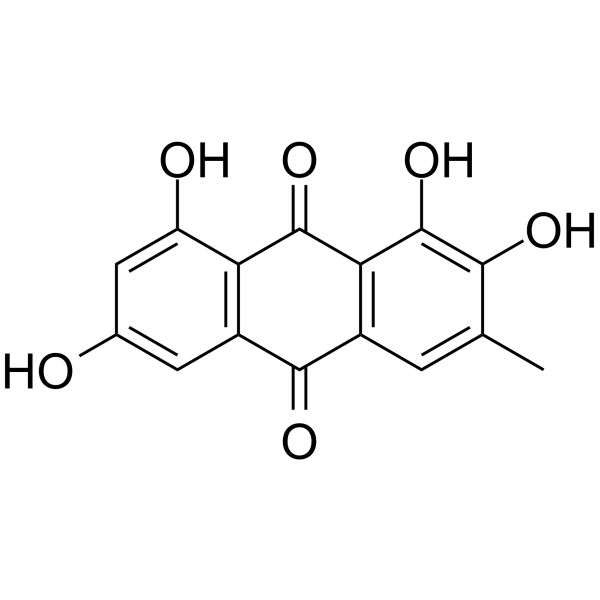
2-Hydroxyemodin
2-Hydroxyemodin is an active metabolite of emodin in the hepatic microsomes. Emodin is an anthraquinone present in fungal metabolites and constituent of rhubarb. 2-Hydroxyemodin proves to be mutagenic to Salmonella typhimurium TA1537 in the absence of activation system.
For research use only. We do not sell to patients.
- CAS No.: 641-90-7
- Formula: C15H10O6
- Molecular Weight:286.24
-
Storage:
4°C, sealed storage, away from moisture and light
* In solvent : -80°C, 6 months; -20°C, 1 month (sealed storage, away from moisture and light)

To place orders, for customer services and technical support, please contact: MedChemExpress USA
Tel: 609-228-6898 E-mail: [email protected] [email protected]


-
 Biological Activity
-
Chemical Information
- Protocols
- Purity & Documentation
- References
-
 Help & FAQs




Biological Activity
Description


Chemical Information
-
CAS No. 641-90-7
-
Appearance Solid
-
Molecular Weight 286.24
-
Formula C15H10O6
-
Color Orange to red
-
SMILES
O=C1C2=C(C(C3=C1C=C(C)C(O)=C3O)=O)C(O)=CC(O)=C2
-
Structure Classification
-
Initial Source
-
Shipping
Room temperature in continental US; may vary elsewhere.
-
Storage
4°C, sealed storage, away from moisture and light
* In solvent : -80°C, 6 months; -20°C, 1 month (sealed storage, away from moisture and light)

Protocols
-
Genotoxicity/Mutagenicity Study
The bacterial reverse mutation assay detects point mutations that restore amino-acid prototrophy in auxotrophic Salmonella typhimurium or Escherichia coli tester strains; after exposure to a test article, mutagenic activity is read out as an increased number of revertant colonies on minimal agar compared with the vehicle control. The assay uses tester strains with different mutation targets so that base-substitution and frameshift mutagens can be detected, and testing is performed with and without exogenous mammalian metabolic activation because some chemicals require biotransformation to become mutagenic.


Purity & Documentation
-
Data Sheet (268 KB)
-
SDS (251 KB)
- English - EN (251 KB)
- Français - FR (251 KB)
- Deutsch - DE (251 KB)
- Norwegian - NO (251 KB)
- Español - ES (251 KB)
- Swedish - SV (251 KB)
- Italian - IT (251 KB)
- Korean - KR (251 KB)
- Portuguese - PT (251 KB)
-
Handling Instructions (2659 KB)
References

Calculators
Concentration (start) × Volume (start) = Concentration (final) × Volume (final)


2-Hydroxyemodin Related Classifications
HY-N10322 Related Classifications
 Powered by Bioz