



DiO
Based on 31 publication(s) in Google Scholar
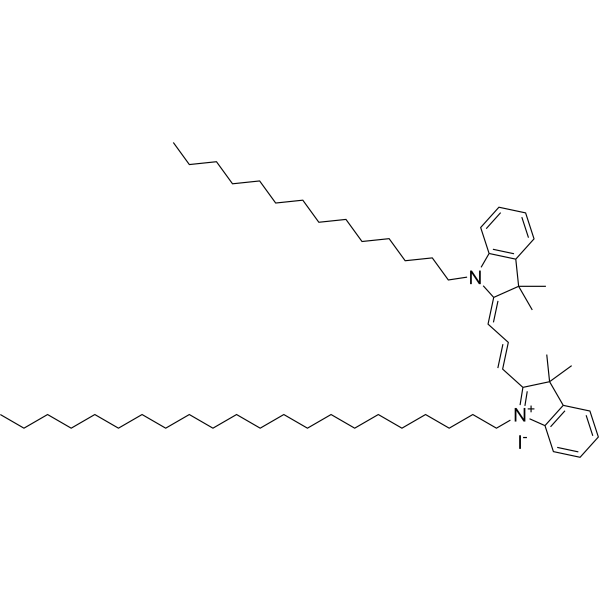
DiO is a long-chain carbocyanine dye. Carbocyanine dyes are widely used as Di to label cells, organelles, liposomes, viruses and lipoproteins.
For research use only. We do not sell to patients.
- Purity : 99.60%
- CAS No.: 34215-57-1
- Formula: C53H85ClN2O6
- Molecular Weight:881.70
-
Storage:
4°C, sealed storage, away from moisture and light
* In solvent : -80°C, 6 months; -20°C, 1 month (sealed storage, away from moisture and light)

To place orders, for customer services and technical support, please contact: MedChemExpress USA
Tel: 609-228-6898 E-mail: [email protected] [email protected]


-
 Biological Activity
-
Chemical Information
-
Solvent & Solubility
- Purity & Documentation
- References
-
 Help & FAQs


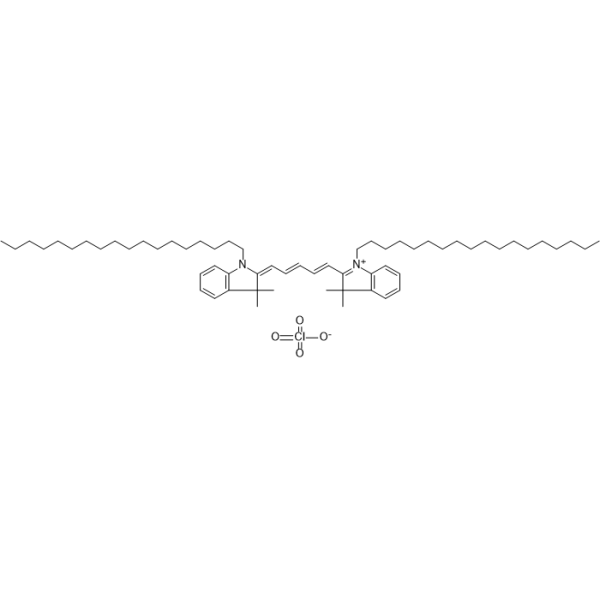
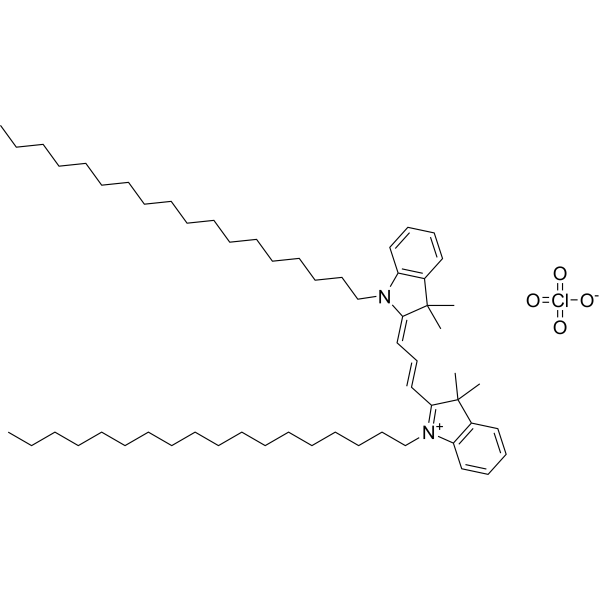
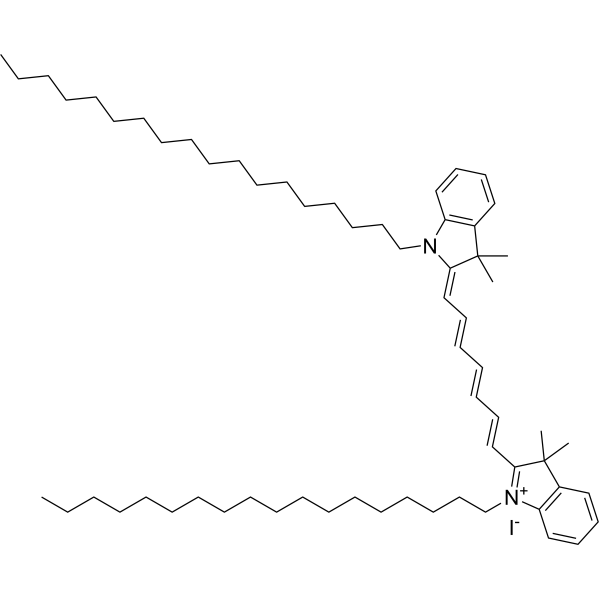
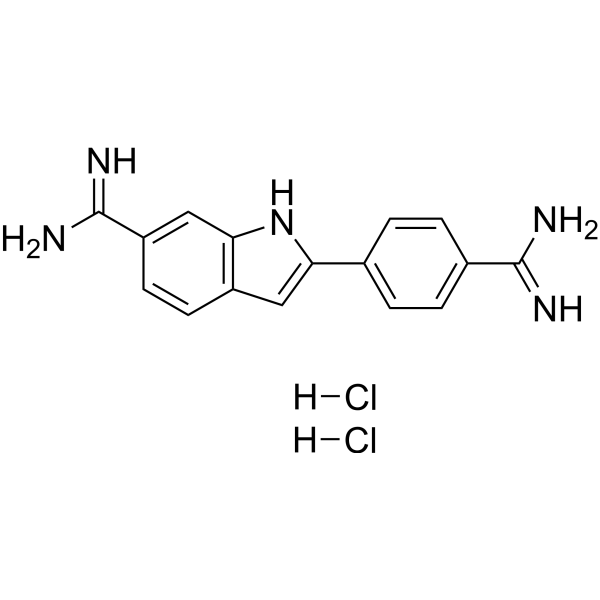
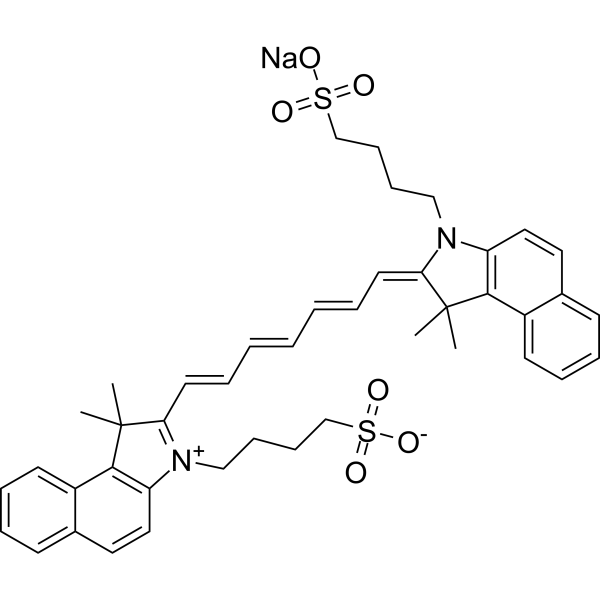
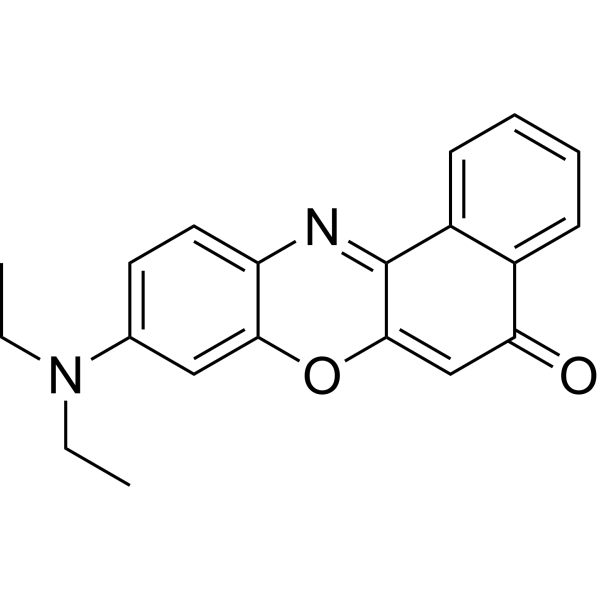
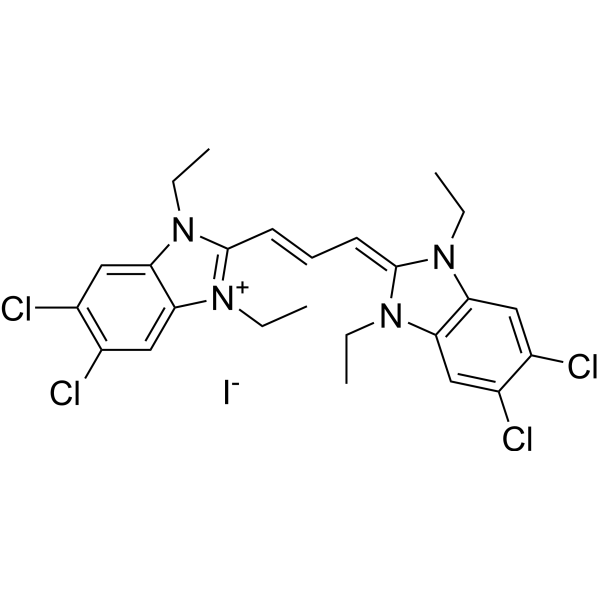
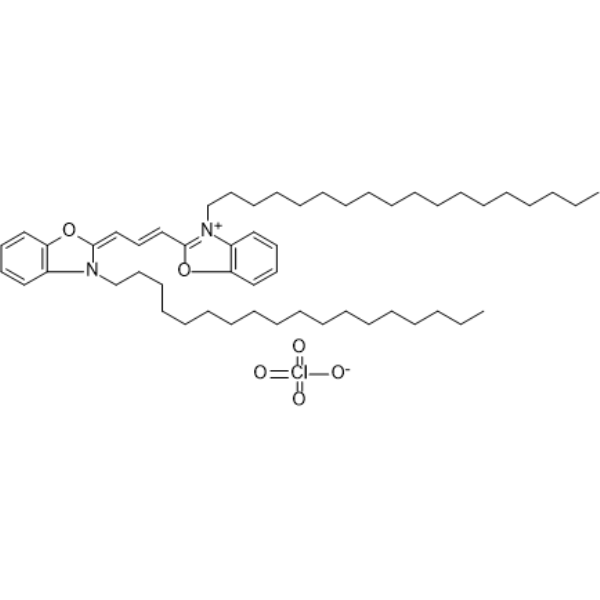
Publications Citing Use of MedChemExpress (MCE) DiO
More- ACS Nano. 2023 May 9;17(9):8204-8222. [Abstract]
- Adv Sci (Weinh). 2025 Jun;12(23):e2500139. [Abstract]
- Adv Sci (Weinh). 2025 May;12(18):e2410629. [Abstract]
- Adv Sci (Weinh). 2025 May;12(19):e2501772. [Abstract]
- Sci Adv. 2026 Jun 19;12(25):eaea6844. [Abstract]
- Sci Adv. 2025 May 2;11(18):eadt3943. [Abstract]
- Chem Eng J. 2026 Jul 3;544:179078.
- Chem Eng J. 2024 Feb 16, 149761.
- Rare Metals. 2026 May 25;45(5):e70339.
- Phytomedicine. 2026 Jul:156:158199. [Abstract]
- Mater Today Bio. 2025 Dec 19.
- Mater Today Bio. 2025 Nov 13:35:102547. [Abstract]
- Biomater Res. 2026 Mar 6:30:0319. [Abstract]
- Biomater Res. 2023 Apr 15;27(1):30. [Abstract]
- J Transl Med. 2022 Jul 6;20(1):307. [Abstract]
- Int J Nanomedicine. 2026 Jun 8:21:599389. [Abstract]
- Int J Biol Macromol. 2026 Jan 7;340:150099.
- Int J Nanomedicine. 2025 Sep 2:20:10683-10700. [Abstract]
- Br J Pharmacol. 2026 Jun;183(11):3049-3073. [Abstract]
- Br J Pharmacol. 2026 Apr 26. [Abstract]
- Anal Chem. 2023 Sep 19;95(37):13880-13888. [Abstract]
- PLoS Pathog. 2022 Oct 12;18(10):e1010907. [Abstract]
- Eur J Med Res. 2026 Jan 14. [Abstract]
- Biomedicines. 2026 May 11;14(5):1083. [Abstract]
- Microb Pathog. 2024 Feb:187:106527. [Abstract]
- ChemNanoMat. 2025 Oct 28.
- Pharmacological Research Modern Chinese Medicine. 2026 Mar 11.
- bioRxiv. 2025 Oct 1.
- SSRN. 2025 Jun 11.
- SSRN. 2025 May 8.
- Res Sq. 2024 Aug 29.
 Customer Validation & Images

-
Flow Cytometry
-
Cell Imaging/Staining
-
Cell Imaging/Staining

-
Cell Imaging/Staining
-
Cell Migration/Invasion Assay


Biological Activity
Description
In Vitro
Carbocyanine dyes are widely used as Di to label cells, organelles, liposomes, viruses and lipoproteins. Long-chain carbocyanines which include DiO (DiOC18(3)), DiI (DiIC18(3)), DiD (DiIC18(5)) and DiR, and dialkyl aminostyryl dye DiA (4-Di-16-ASP) are used for labeling membranes and other hydrophobic structures. DiIC16(3) has shorter alkyl substituents (C16) than DiI (C18). They have extremely high extinction coefficients, environmental dependent fluorescence and short excited-state lifetimes in lipid environments. They are oils at room temperature and weakly fluorescent in water but highly fluorescent and quite photostable when incorporated into membranes or bound to lipophilic biomolecules. These optical characteristics make them ideal for staining the cytoplasmic membranes of cells. Once applied to cells, these dyes diffuse laterally within the plasma membrane, resulting in staining of the entire cell[1].
DiO, DiI, DiD and DiR exhibit distinct green, orange, red and infrared fluorescence, respectively thus facilitating multicolor imaging and flow cytometric analysis of live cells . DiO and DiI can be used with standard FITC and TRITC filters respectively. Among them DiI and its analogs are most frequently used since they usually exhibit very low cell toxicity. In addition, DiI is widely used for determining lipoproteins such as LDL and HDL. The lipophilic aminostyryl dye DiA is also often used for neuronal tracing[2].
Guide (Following is our recommended protocol. This protocol only provides a guideline, and should be modified according to your specific needs).
1. Preparing Stain Solutions of DiO
1.1 Prepare DMF, DMSO or ethanol stock solutions
The stock solutions should be prepared in dimethyl formamide (DMF), dimethylsulfoxide (DMSO, or ethanol at 1-5 mM.
Note: DMF is preferable to ethanol as a solvent for DiO. The stock solution should be used promptly. Any unused solution need to be aliquoted and refrozen at least -20°C. Avoid repeated freeze/thaw cycle. The solution can be stored for 6 months.
1.2 Prepare working solutions
Dilute the stock solutions into a suitable buffer such as serum-free culture medium, HBSS or PBS to make 1-5 μM working solutions. We do not recommend storing the aqueous solution for more than one day.
Note: The final concentration of the working solution should be empirically determined for different cell types and/or experimental conditions.
2. Cell staining (suspended cells)
2.1 Centrifuge at 1000 g at 4°C for 3-5 minutes and then discard the supernatant. Wash twice with PBS, 5 minutes each time. The cell density is 1×10⁶/mL.
2.2 Add 1 mL of DiO working solution, and then incubate at room temperature for 5-30 minutes.
2.3 Centrifuge at 400 g at 4°C for 3-4 minutes and then discard the supernatant.
2.4 Wash twice with PBS, 5 minutes each time.
2.5 Resuspend cells with serum-free cell culture medium or PBS. Observation by fluorescence microscopy or flow cytometry.
3. Cell staining (adherent cells)
3.1 Culture adherent cells on sterile coverslips.
3.2 Remove the coverslip from the medium and aspirate excess medium.
3.3 Add 100 μL of working solution, gently shake it to completely cover the cells, and then incubate at room temperature for 5-30 minutes.
3.4 Wash twice with medium, 5 minutes each time. Observation by fluorescence microscopy or flow cytometry.
MedChemExpress (MCE) has not independently confirmed the accuracy of these methods. They are for reference only.
Emission (Em)
501
Excitation (Ex)
483
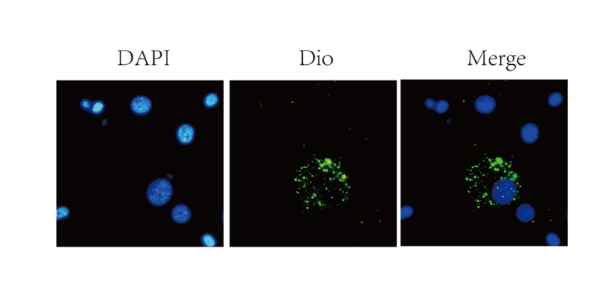
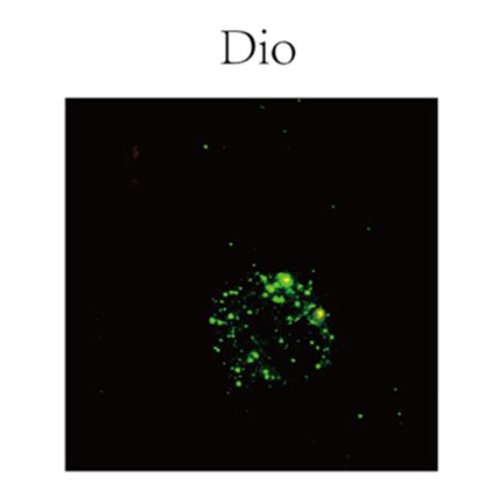
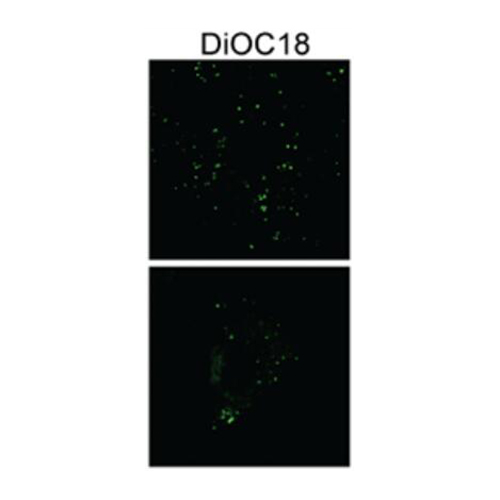
Dyeing Example


Chemical Information
-
CAS No. 34215-57-1
-
Appearance Solid
-
Molecular Weight 881.70
-
Formula C53H85ClN2O6
-
Color Brown to red
-
SMILES
O=Cl(=O)([O-])=O.CCCCCCCCCCCCCCCCCCN1C(C=CC=C2)=C2O/C1=C/C=C/C(OC3=C4C=CC=C3)=[N+]4CCCCCCCCCCCCCCCCCC
-
Synonyms
DiOC18(3); 3,3'-Dioctadecyloxacarbocyanine perchlorate
-
Shipping
Room temperature in continental US; may vary elsewhere.
-
Storage
4°C, sealed storage, away from moisture and light
* In solvent : -80°C, 6 months; -20°C, 1 month (sealed storage, away from moisture and light)


Publications (31)
-
Journal Impact Factor
-
Most Recent
-
ACS Nano
Biomimetic Nanoparticle-Mediated Target Delivery of Hypoxia-Responsive Plasmid of Angiotensin-Converting Enzyme 2 to Reverse Hypoxic Pulmonary Hypertension. [Abstract]2023 May 9;17(9):8204-8222. PMID: 37071566 -
Adv Sci (Weinh)
Locoregional Immune Checkpoint Blockade and Remodeling of Lymph Nodes by Engineered Dendritic Cell-Derived Exosomes for Suppressing Tumor Progression and Metastasis. [Abstract]2025 Jun;12(23):e2500139. PMID: 40178201
DiO purchased from MedChemExpress. Usage Cited in: Adv Sci (Weinh). 2025 Jun;12(23):e2500139. [Abstract]
Exosomes were first incubated with DiO (0.5 mM) at a ratio of 100:1 in volume for 5 min at 37 °C. Then, the DiO-labeled exosomes were washed with PBS by using 30 kDa ultrafilter. Cellular uptake of different groups of exosomes by 4T1 cells and DC2.4 cells was assessed.
-
Adv Sci (Weinh)
Antigen-Targeting Inserted Nanomicelles Guide Pre-Existing Immunity to Kill Head and Neck Cancer. [Abstract]2025 May;12(18):e2410629. PMID: 40091501 -
Adv Sci (Weinh)
Rational Design and Organoid-Based Evaluation of a Cocktail CAR-γδ T Cell Therapy for Heterogeneous Glioblastoma. [Abstract]2025 May;12(19):e2501772. PMID: 40112194 -
Sci Adv
Piezobiomimetic delivery nanosystem converts cold tumors to hot by parallel PANoptosis/STING activation in hepatocellular carcinoma. [Abstract]2026 Jun 19;12(25):eaea6844. PMID: 42308311 -
Sci Adv
A rationally designed injury kidney targeting peptide library and its application in rescuing acute kidney injury. [Abstract]2025 May 2;11(18):eadt3943. PMID: 40315322 -
-
-
-
Phytomedicine
Chlorella pyrenoidosa-derived extracellular vesicles ameliorate ulcerative colitis through microbiota-mediated AKT/mTOR/ferroptosis pathway. [Abstract]2026 Jul:156:158199. PMID: 42030800 -
-
Mater Today Bio
SLC7A11-independent disulfidptosis induced by a two-pronged delivery strategy for bladder cancer chemotherapy and cisplatin-resistance reverse. [Abstract]2025 Nov 13:35:102547. PMID: 41322137 -
Biomater Res
Near-Infrared Responsive Nanoplatform for Synergistic Photothermal Therapy/Chemotherapy of Lung Cancer. [Abstract]2026 Mar 6:30:0319. PMID: 41800141 -
Biomater Res
Neutrophil-inspired photothermo-responsive drug delivery system for targeted treatment of bacterial infection and endotoxins neutralization. [Abstract]2023 Apr 15;27(1):30. PMID: 37061741
DiO purchased from MedChemExpress. Usage Cited in: Biomater Res. 2023 Apr 15;27(1):30. [Abstract]
CLSM images of normal and LPS-stimulated HUVECs after incubation with NMVs (50 µg/mL) at 37 °C for 2 h. (Green: DiO-labelled NMs; blue: Hoechst-labeled nuclei. Scale bar, 50 μm.)
DiO purchased from MedChemExpress. Usage Cited in: Biomater Res. 2023 Apr 15;27(1):30. [Abstract]
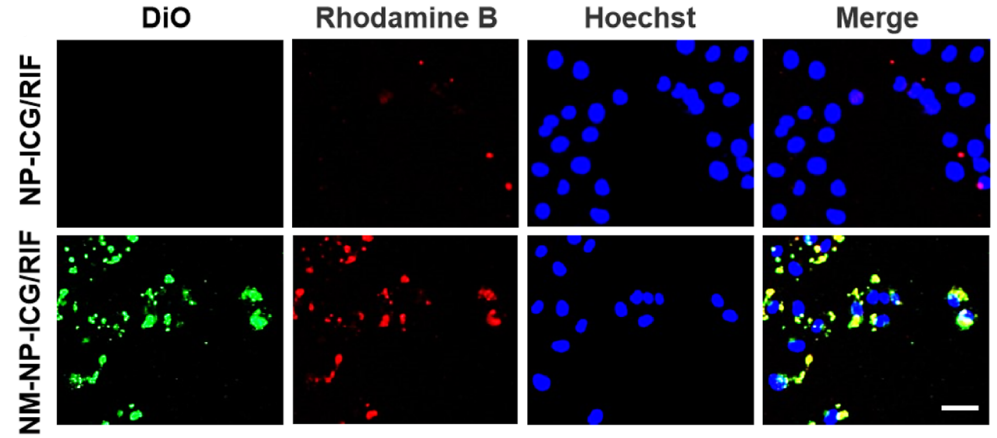
CLSM images of LPS-stimulated HUVECs after incubation with NP-ICG/RIF (50 µg/mL) and NM-NP-ICG/RIF (50 µg/mL) at 37 °C for 2 h. (Green: DiO-labeled NMVs; red: Rhodamine B-labeled NP-ICG/RIF; blue: Hoechst-labeled nuclei. Scale bar: 50 μm).
-
J Transl Med
Extracellular vesicle miR-32 derived from macrophage promotes arterial calcification in mice with type 2 diabetes via inhibiting VSMC autophagy. [Abstract]2022 Jul 6;20(1):307. PMID: 35794619
DiO purchased from MedChemExpress. Usage Cited in: J Transl Med. 2022 Jul 6;20(1):307. [Abstract]
DiO (1 μM; 30 min). Fluorescence microscope observes VSMC uptaking macrophage extracellular vesicles.
-
Int J Nanomedicine
ROS-Triggered Self-Aggregation of a β-Elemene Olefin-Rich Nanoemulsion for Mitochondrial-Targeted Metabolic Reprogramming and Colitis Inflammation Alleviation. [Abstract]2026 Jun 8:21:599389. PMID: 42292035 -
-
Int J Nanomedicine
Comparison of the Cytotoxicity, Internalization and Anti-Cancer Drug Delivery Efficacy of Nature Killer Cell Derived Nanovesicles and Extracellular Vesicles. [Abstract]2025 Sep 2:20:10683-10700. PMID: 40918949
DiO purchased from MedChemExpress. Usage Cited in: Int J Nanomedicine. 2025 Sep 2:20:10683-10700. [Abstract]
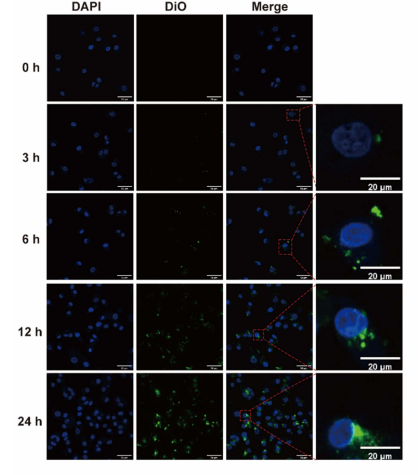
Internalization of NK-NVs by cancer cells. Confocal microscopy analysis of Panc-1 cells after co-incubation with DiO-labelled NK-NVs at different time periods (3, 6, 12 and 24 h).
-
Br J Pharmacol
Reprogramming tumour-associated macrophages in breast cancer via si-FOXM1-loaded lipid nanoparticles enhances immune checkpoint inhibitor efficacy. [Abstract]2026 Jun;183(11):3049-3073. PMID: 41723880 -
Br J Pharmacol
Curcumin controls lysosomal acidification and exocytosis to ameliorate lysosomal cholesterol accumulation in Niemann-Pick type C disease. [Abstract]2026 Apr 26. PMID: 42036241 -
Anal Chem
2023 Sep 19;95(37):13880-13888. PMID: 37677106 -
PLoS Pathog
2022 Oct 12;18(10):e1010907. PMID: 36223419 -
Eur J Med Res
2026 Jan 14. PMID: 41535913 -
Biomedicines
Adipose Stem Cell-Derived Apoptotic Vesicles Attenuate Hypertrophic Scarring by Targeting the CDC20/WNT Signaling Pathway. [Abstract]2026 May 11;14(5):1083. PMID: 42193410 -
Microb Pathog
Extracellular vesicles of Bacteroides fragilis regulated macrophage polarization through promoted Sema7a expression. [Abstract]2024 Feb:187:106527. PMID: 38163490 -
-
-
-
-
-


Solvent & Solubility
In Vitro:
DMF : 10 mg/mL (11.34 mM; Need ultrasonic)
DMSO : 5 mg/mL (5.67 mM; ultrasonic and warming and heat to 60°C; Hygroscopic DMSO has a significant impact on the solubility of product, please use newly opened DMSO)
Please refer to the solubility information to select the appropriate solvent. Once prepared, please aliquot and store the solution to prevent product inactivation from repeated freeze-thaw cycles.
Storage method and period of stock solution: -80°C, 6 months; -20°C, 1 month (sealed storage, away from moisture and light). When stored at -80°C, please use it within 6 months. When stored at -20°C, please use it within 1 month.
Please refer to the solubility information to select the appropriate solvent. Once prepared, please aliquot and store the solution to prevent product inactivation from repeated freeze-thaw cycles.
Storage method and period of stock solution: -80°C, 6 months; -20°C, 1 month (sealed storage, away from moisture and light). When stored at -80°C, please use it within 6 months. When stored at -20°C, please use it within 1 month.
Concentration (start) × Volume (start) = Concentration (final) × Volume (final)


Purity & Documentation
-
Data Sheet (275 KB)
-
SDS (393 KB)
- English - EN (393 KB)
- Français - FR (393 KB)
- Deutsch - DE (393 KB)
- Norwegian - NO (393 KB)
- Español - ES (393 KB)
- Swedish - SV (393 KB)
- Italian - IT (393 KB)
- Korean - KR (393 KB)
- Portuguese - PT (393 KB)
-
Handling Instructions (2659 KB)
References
[1]. Gan WB, et al. Multicolor "DiOlistic" labeling of the nervous system using lipophilic dye combinations. Neuron. 2000 Aug;27(2):219-25. [Content Brief]
[2]. Warren GL, et al. Redistribution of cell membrane probes following contraction-induced injury of mouse soleus muscle. [Content Brief]
[3]. Bhowmik BB, et al. Photophysical studies of 3,3' dioctadecyloxacarbocyanine dye in model biological membranes and different solvents. Chem Phys Lipids. 2001 Feb;109(2):175-83. [Content Brief]
[4]. Bhowmik BB, et al. Photophysical studies of 3,3' dioctadecyloxacarbocyanine dye in model biological membranes and different solvents. Chem Phys Lipids. 2001 Feb;109(2):175-83. [Content Brief]


Complete Stock Solution Preparation Table
Please refer to the solubility information to select the appropriate solvent. Once prepared, please aliquot and store the solution to prevent product inactivation from repeated freeze-thaw cycles.
Storage method and period of stock solution: -80°C, 6 months; -20°C, 1 month (sealed storage, away from moisture and light). When stored at -80°C, please use it within 6 months. When stored at -20°C, please use it within 1 month.
| Optional Solvent | Concentration Solvent Mass | 1 mg | 5 mg | 10 mg | 25 mg |
|---|---|---|---|---|---|
| DMSO / DMF | 1 mM | 1.1342 mL | 5.6709 mL | 11.3417 mL | 28.3543 mL |
| 5 mM | 0.2268 mL | 1.1342 mL | 2.2683 mL | 5.6709 mL | |
| DMF | 10 mM | 0.1134 mL | 0.5671 mL | 1.1342 mL | 2.8354 mL |


DiO Related Classifications
HY-D0969 Related Classifications
 Powered by Bioz