



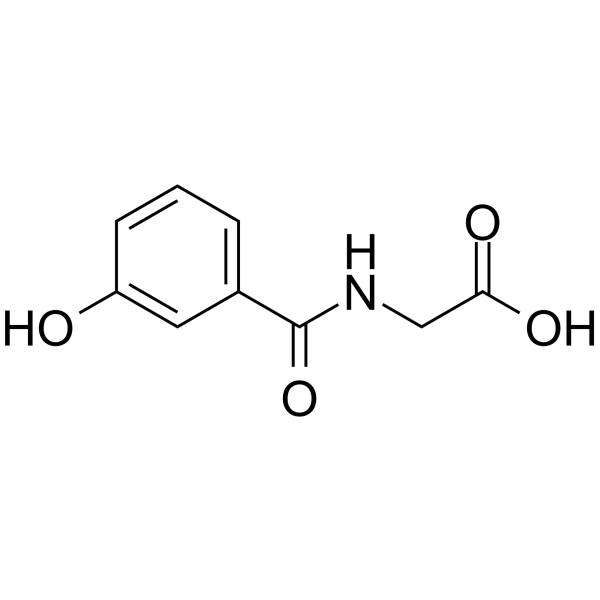
3-Hydroxyhippuric acid (Standard)

Based on 1 Customer Validation
3-Hydroxyhippuric acid (Standard) is the analytical standard of 3-Hydroxyhippuric acid. This product is intended for research and analytical applications. 3-Hydroxyhippuric acid is an acyl glycine. 3-Hydroxyhippuric acid inhibits kynureninase (Ki = 60 μM). 3-Hydroxyhippuric acid is found in higher concentrations in autistic group than in the controls. 3-Hydroxyhippuric acid is a marker of Clostridium species, and has a positive correlation with the level of Clostridia. 3-Hydroxyhippuric acid is one of the main metabolites formed from the catechin diet and wine polyphenol diets.
For research use only. We do not sell to patients.
- Purity : 99.74%
- CAS No.: 1637-75-8
- Formula: C9H9NO4
- Molecular Weight:195.17
-
Storage:
Please store the product under the recommended conditions in the Certificate of Analysis.


To place orders, for customer services and technical support, please contact: MedChemExpress USA
Tel: 609-228-6898 E-mail: [email protected] [email protected]


-
 Product Information
-
Chemical Information
- Purity & Documentation
-
 Help & FAQs




Product Information
Information
Application
The compound is the grade of analytical standard, which is the reference standard supplied assay. It is commonly used in qualitative, quantitative and methodological research experiments in HPLC, GC and MS.


Chemical Information
-
CAS No. 1637-75-8
-
Appearance Solid
-
Molecular Weight 195.17
-
Formula C9H9NO4
-
Color White to off-white
-
SMILES
O=C(O)CNC(C1=CC=CC(O)=C1)=O
-
Structure Classification
-
Initial Source
-
Shipping
Room temperature in continental US; may vary elsewhere.
-
Storage
Please store the product under the recommended conditions in the Certificate of Analysis.


Purity & Documentation
-
SDS (252 KB)
- English - EN (252 KB)
- Français - FR (252 KB)
- Deutsch - DE (252 KB)
- Norwegian - NO (252 KB)
- Español - ES (252 KB)
- Swedish - SV (252 KB)
- Italian - IT (252 KB)
- Korean - KR (252 KB)
- Portuguese - PT (252 KB)
-
Handling Instructions (2659 KB)
References
[1]. Xiong, X., et al., (2016). Urinary 3-(3-Hydroxyphenyl)-3-hydroxypropionic Acid, 3-Hydroxyphenylacetic Acid, and 3-Hydroxyhippuric Acid Are Elevated in Children with Autism Spectrum Disorders. BioMed research international, 2016, 9485412. [Content Brief]
[2]. Gonthier, M. P., et al., (2003). Microbial aromatic acid metabolites formed in the gut account for a major fraction of the polyphenols excreted in urine of rats fed red wine polyphenols. The Journal of nutrition, 133(2), 461–467. [Content Brief]
[3]. Lima, S., Kumar, S., (2009). Crystal structure of the Homo sapiens kynureninase-3-hydroxyhippuric acid inhibitor complex: insights into the molecular basis of kynureninase substrate specificity. Journal of medicinal chemistry, 52(2), 389–396. [Content Brief]

Calculators
Concentration (start) × Volume (start) = Concentration (final) × Volume (final)


3-Hydroxyhippuric acid (Standard) Related Classifications
HY-113085R Related Classifications
 Powered by Bioz