



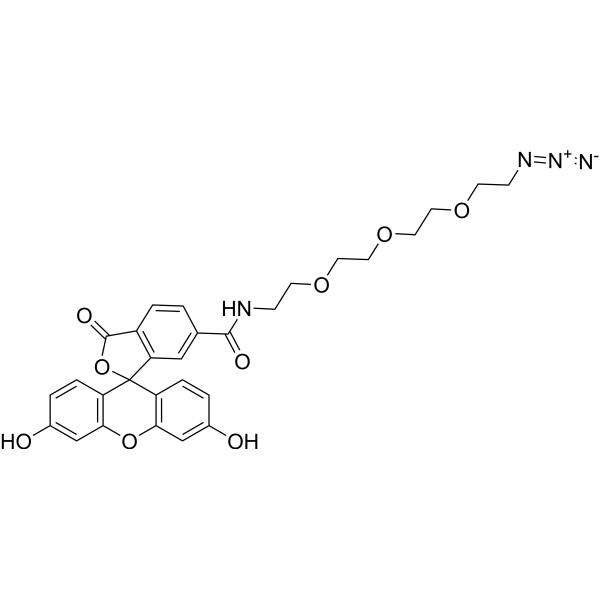
6-FAM-PEG3-Azide

Based on 1 Customer Validation
6-FAM-PEG3-Azide is a PEG-modified azide-functionalized fluorescein derivative that is used for labeling oligonucleotides. 6-FAM-PEG3-Azide is also a click chemistry reagent. It contains an Azide group and can undergo a copper-catalyzed azide-alkyne cycloaddition reaction (CuAAc) with molecules containing an Alkyne group. When 6-FAM-PEG3-Azide is co-incubated with boron clusters in a non-covalent manner, it enhances the cellular uptake and membrane permeability of 6-FAM (HY-66021). 6-FAM-PEG3-azide is applicable for fluorescence bioconjugation and probe development-related research.
For research use only. We do not sell to patients.
- Purity : 98.46%
- CAS No.: 412319-45-0
- Formula: C29H28N4O9
- Molecular Weight:576.55
-
Storage:
-20°C, protect from light
* In solvent : -80°C, 6 months; -20°C, 1 month (protect from light)

To place orders, for customer services and technical support, please contact: MedChemExpress USA
Tel: 609-228-6898 E-mail: [email protected] [email protected]


-
 Biological Activity
-
Chemical Information
-
Solvent & Solubility
- Protocols
- Purity & Documentation
- References
-
 Help & FAQs




Biological Activity
Description
In Vitro
6-FAM-PEG3-azide (20 μM; 1.5 h) shows no detectable transmembrane transport in HeLa cells in the absence of boron cluster reagents; in the presence of 50 μM different superchaotropic boron cluster anions, the transmembrane transport of this molecule exhibits significant differences: [B12Br12]2− and [B12I11OH]2− mediate its efficient cellular entry; [B12I12]2− achieves transport but causes cell membrane damage[1].
6-FAM-PEG3-azide translocates into HeLa cells in the presence of [B12Br12]2− (1) or [B12Cl12]2− (2), but not in their absence or in the presence of boron cluster 9[2].
MedChemExpress (MCE) has not independently confirmed the accuracy of these methods. They are for reference only. Further protocols information, click here.
Emission (Em)
532


Chemical Information
-
CAS No. 412319-45-0
-
Appearance Solid
-
Molecular Weight 576.55
-
Formula C29H28N4O9
-
Color Light yellow to yellow
-
SMILES
O=C(C1=CC(C2(C3=C(OC4=C2C=CC(O)=C4)C=C(O)C=C3)O5)=C(C=C1)C5=O)NCCOCCOCCOCCN=[N+]=[N-]
-
Shipping
Room temperature in continental US; may vary elsewhere.
-
Storage
-20°C, protect from light
* In solvent : -80°C, 6 months; -20°C, 1 month (protect from light)


Solvent & Solubility
In Vitro:
DMSO : 50 mg/mL (86.72 mM; Need ultrasonic; Hygroscopic DMSO has a significant impact on the solubility of product, please use newly opened DMSO)
Please refer to the solubility information to select the appropriate solvent. Once prepared, please aliquot and store the solution to prevent product inactivation from repeated freeze-thaw cycles.
Storage method and period of stock solution: -80°C, 6 months; -20°C, 1 month (protect from light). When stored at -80°C, please use it within 6 months. When stored at -20°C, please use it within 1 month.
Please refer to the solubility information to select the appropriate solvent. Once prepared, please aliquot and store the solution to prevent product inactivation from repeated freeze-thaw cycles.
Storage method and period of stock solution: -80°C, 6 months; -20°C, 1 month (protect from light). When stored at -80°C, please use it within 6 months. When stored at -20°C, please use it within 1 month.
Concentration (start) × Volume (start) = Concentration (final) × Volume (final)

Protocols
-
EdU Incorporation Assay (Click Chemistry-Based DNA Synthesis Measurement)
The EdU incorporation assay measures DNA synthesis by adding the thymidine analog 5-ethynyl-2′-deoxyuridine to cells or tissues, where it is incorporated into newly synthesized DNA during S phase. Incorporated EdU is detected by copper-catalyzed azide-alkyne cycloaddition, in which a fluorescent azide covalently reacts with the ethynyl group on EdU, allowing S-phase cells to be detected by fluorescence microscopy, flow cytometry, or high-content imaging. EdU detection does not require DNA denaturation or anti-BrdU antibody access, which preserves sample structure and improves compatibility with immunostaining and multiparameter cytometry compared with BrdU-based detection. EdU can be cytotoxic in a cell-type- and exposure-dependent manner, so pulse duration, concentration, and continuous-labeling designs should be validated for each cell type.
-
Transepithelial/transendothelial electrical resistance assay
TEER measures electrical resistance across epithelial or endothelial monolayers cultured on permeable supports, and the readout reflects ionic conductance through the cell barrier, especially the paracellular pathway regulated by junctional integrity. TEER can be measured without destroying the monolayer and is commonly used before or during transport, permeability, barrier-disruption, and barrier-maturation experiments. TEER values are influenced by biological maturation and technical conditions; reported factors include temperature, medium formulation, passage number, electrode geometry, membrane properties, and junctional length during early monolayer maturation. Therefore, TEER should be interpreted with blank-insert subtraction, area normalization, repeated readings, and, when possible, orthogonal barrier readouts such as FITC-dextran flux or tight-junction staining.


Purity & Documentation
-
Data Sheet (280 KB)
-
SDS (251 KB)
- English - EN (251 KB)
- Français - FR (251 KB)
- Deutsch - DE (251 KB)
- Norwegian - NO (251 KB)
- Español - ES (251 KB)
- Swedish - SV (251 KB)
- Italian - IT (251 KB)
- Korean - KR (251 KB)
- Portuguese - PT (251 KB)
-
Handling Instructions (2659 KB)
References


Complete Stock Solution Preparation Table
Please refer to the solubility information to select the appropriate solvent. Once prepared, please aliquot and store the solution to prevent product inactivation from repeated freeze-thaw cycles.
Storage method and period of stock solution: -80°C, 6 months; -20°C, 1 month (protect from light). When stored at -80°C, please use it within 6 months. When stored at -20°C, please use it within 1 month.
| Optional Solvent | Concentration Solvent Mass | 1 mg | 5 mg | 10 mg | 25 mg |
|---|---|---|---|---|---|
| DMSO | 1 mM | 1.7345 mL | 8.6723 mL | 17.3445 mL | 43.3614 mL |
| 5 mM | 0.3469 mL | 1.7345 mL | 3.4689 mL | 8.6723 mL | |
| 10 mM | 0.1734 mL | 0.8672 mL | 1.7345 mL | 4.3361 mL | |
| 15 mM | 0.1156 mL | 0.5782 mL | 1.1563 mL | 2.8908 mL | |
| 20 mM | 0.0867 mL | 0.4336 mL | 0.8672 mL | 2.1681 mL | |
| 25 mM | 0.0694 mL | 0.3469 mL | 0.6938 mL | 1.7345 mL | |
| 30 mM | 0.0578 mL | 0.2891 mL | 0.5782 mL | 1.4454 mL | |
| 40 mM | 0.0434 mL | 0.2168 mL | 0.4336 mL | 1.0840 mL | |
| 50 mM | 0.0347 mL | 0.1734 mL | 0.3469 mL | 0.8672 mL | |
| 60 mM | 0.0289 mL | 0.1445 mL | 0.2891 mL | 0.7227 mL | |
| 80 mM | 0.0217 mL | 0.1084 mL | 0.2168 mL | 0.5420 mL |


6-FAM-PEG3-Azide Related Classifications
HY-135835 Related Classifications
 Powered by Bioz