



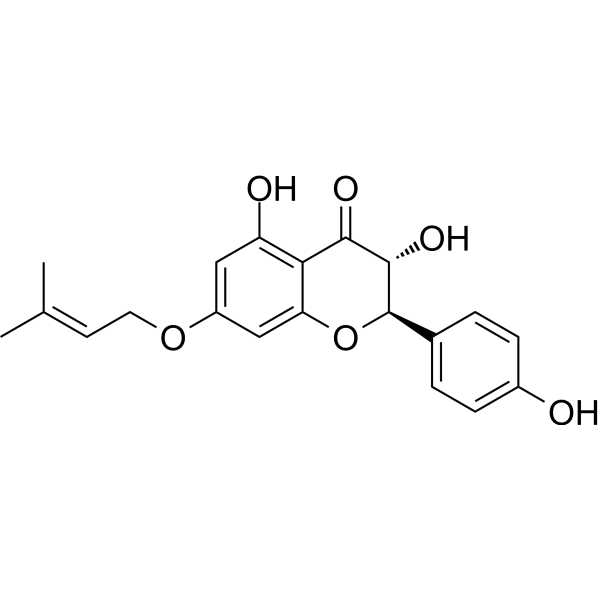
7-Prenyloxyaromadendrin

Based on 1 Customer Validation
7-Prenyloxyaromadendrin is a flavonoid from Pterocaulon alopecuroides with antitumor activity. 7-Prenyloxyaromadendrin shows good antiproliferative activity in tumor cell lines.
For research use only. We do not sell to patients.
- Purity : 97.0%
- CAS No.: 78876-50-3
- Formula: C20H20O6
- Molecular Weight:356.37
-
Storage:
4°C, protect from light
* In solvent : -80°C, 6 months; -20°C, 1 month (protect from light)

To place orders, for customer services and technical support, please contact: MedChemExpress USA
Tel: 609-228-6898 E-mail: [email protected] [email protected]


-
 Biological Activity
-
Chemical Information
- Protocols
- Purity & Documentation
- References
-
 Help & FAQs




Biological Activity
Description
In Vitro
7-Prenyloxyaromadendrin (compound 5) shows antiproliferative activity with GI50 values in the range 16-20 μM in A549, HBL-100, HeLa, SW1573, T-47D cells[2].
7-Prenyloxyaromadendrin (compound 5) is inactive on B. subtilis and B. cereus (there is no zone of inhibition at the concentration of 50 μg/disk)[1].
MedChemExpress (MCE) has not independently confirmed the accuracy of these methods. They are for reference only. Further protocols information, click here.


Chemical Information
-
CAS No. 78876-50-3
-
Appearance Solid
-
Molecular Weight 356.37
-
Formula C20H20O6
-
Color White to light yellow
-
SMILES
O=C1[C@H](O)[C@@H](C2=CC=C(O)C=C2)OC3=CC(OC/C=C(C)/C)=CC(O)=C13
-
Structure Classification
-
Shipping
Room temperature in continental US; may vary elsewhere.
-
Storage
4°C, protect from light
* In solvent : -80°C, 6 months; -20°C, 1 month (protect from light)

Protocols
-
Subcutaneous Cell-Line-Derived Xenograft
Subcutaneous cell-line-derived xenograft (CDX) models are established by implanting cultured human cancer cell lines into immunodeficient mice, where the injected cells form localized tumors that can be monitored in vivo as a measure of tumorigenic potential, growth kinetics, and treatment response. These models are widely used in oncology research because they allow reproducible tumor formation and enable comparative assessment of tumor growth between different cell lines or genetic manipulations in a controlled in vivo microenvironment. Subcutaneous implantation of cancer cells in immunodeficient mice is a standard approach for evaluating tumor growth behavior and therapeutic response across multiple cancer types, including prostate, esophageal, pancreatic, and colon cancer models.
-
Cell Viability Determination by MTT Colorimetric Assay
The following protocol uses the MTT colorimetric assay as a classic literature-established method for assessing cell viability/metabolic activity in cultured mammalian cells. MTT[3-(4,5-dimethylthiazol-2-yl)-2,5-diphenyltetrazolium bromide] is reduced by metabolically active cells to a colored formazan product; the amount of formazan is quantified spectrophotometrically and provides an indirect measure of metabolically active viable cells. Importantly, MTT reduction reflects cellular oxidoreductase/metabolic activity rather than an absolute direct count of living cells, so changes in cellular metabolism can alter the signal independently of cell number.


Purity & Documentation
-
Data Sheet (266 KB)
-
SDS (252 KB)
- English - EN (252 KB)
- Français - FR (252 KB)
- Deutsch - DE (252 KB)
- Norwegian - NO (252 KB)
- Español - ES (252 KB)
- Swedish - SV (252 KB)
- Italian - IT (252 KB)
- Korean - KR (252 KB)
- Portuguese - PT (252 KB)
-
Handling Instructions (2659 KB)
References

Calculators
Concentration (start) × Volume (start) = Concentration (final) × Volume (final)


7-Prenyloxyaromadendrin Related Classifications
HY-N7611 Related Classifications
 Powered by Bioz