



Atractylodin
Based on 3 publication(s) in Google Scholar
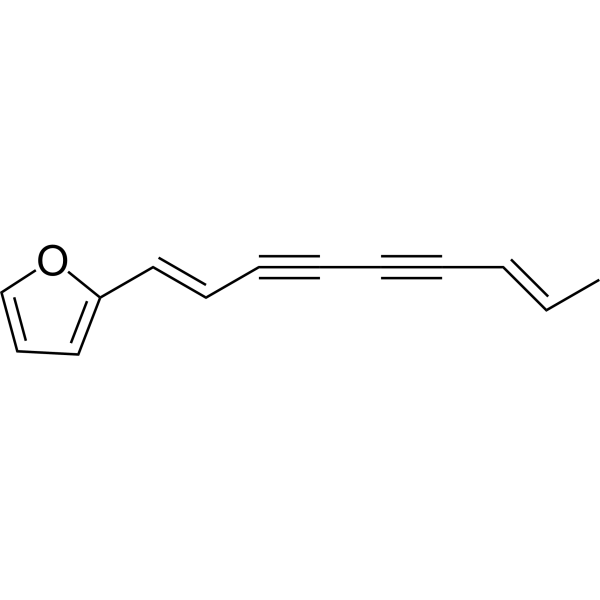
Atractylodin (Atractydin) is an orally active active ingredient obtained from the rhizome of Atractylodes lancea and A. chinensis. Atractylodin is a natural insecticide. Atractylodin has anti-inflammatory activity.
For research use only. We do not sell to patients.
- Purity : 99.86%
- CAS No.: 55290-63-6
- Formula: C13H10O
- Molecular Weight:182.22
-
Storage:
-20°C, protect from light
* In solvent : -80°C, 6 months; -20°C, 1 month (protect from light)

To place orders, for customer services and technical support, please contact: MedChemExpress USA
Tel: 609-228-6898 E-mail: [email protected] [email protected]


-
 Biological Activity
-
Chemical Information
-
Solvent & Solubility
- Protocols
- Purity & Documentation
- References
-
 Help & FAQs




Publications Citing Use of MedChemExpress (MCE) Atractylodin
More Customer Validation & Images

-
Cell Proliferation/Viability Assay
-
WB
-
RT-PCR
-
Histological Imaging/Staining
-
In Vivo Efficacy Study


Biological Activity
Description
Cellular Effect
|
Cell Line

|
Type | Value | Description | References |
|---|---|---|---|---|
| Huh-7 | IC50 |
22.36 μM
Compound: Atractylodin
|
Cytotoxicity against human Huh-7 cells assessed as reduction in cell viability incubated for 72 hrs by MTT assay
Cytotoxicity against human Huh-7 cells assessed as reduction in cell viability incubated for 72 hrs by MTT assay
|
[PMID: 38306267] |
In Vitro
Atractylodin (50 μM, 48 h) significantly inhibits tumor necrosis factor-α-induced activated B-nuclear factor-κ-light chain enhancer phosphorylation in HCT116 cells[2].
Atractylodin (10, 20, 40 μM, 24 h) alleviates HFD-induced NAFLD by inhibiting hepatocyte sideroptosis[3].
MedChemExpress (MCE) has not independently confirmed the accuracy of these methods. They are for reference only.
-
Cell Line:NCM460, SW480, HCT116
-
Concentration:1, 10, 25, 50, 100 μM
-
Incubation Time:24 h
-
Result:Decreased viability at a concentration of 100 µM in HCT116 cells.
-
Cell Line:HCT116
-
Concentration:50 μM
-
Incubation Time:1 h
-
Result:Inhibited TNF-α-induced phosphorylation of NF-κB p65.
In Vivo
Atractylodin (20, 40, 80 mg/kg, gavage) alleviates the oxidative stress of HepG2 cells induced by high-fat diet (HFD) and palmitic acid (PA) in mice[3].
MedChemExpress (MCE) has not independently confirmed the accuracy of these methods. They are for reference only.
-
Animal Model:DSS-Induced Colitis Mouse Model[2]
-
Dosage:40 mg/kg
-
Administration:i.p.
-
Result:Reduced colitis symptoms and increased survival rate.
-
Animal Model:NAFLD mice model[3]
-
Dosage:20, 40, 80 mg/kg
-
Administration:i.g.
-
Result:Reduced the release of ALT, AST, ROS and MDA.
Increased the TG, GSH and SOD.


Chemical Information
-
CAS No. 55290-63-6
-
Appearance Solid
-
Molecular Weight 182.22
-
Formula C13H10O
-
Color Light yellow to brown
-
SMILES
C/C=C/C#CC#C/C=C/C1=CC=CO1
-
Synonyms
Atractydin
-
Structure Classification
-
Shipping
Room temperature in continental US; may vary elsewhere.
-
Storage
-20°C, protect from light
* In solvent : -80°C, 6 months; -20°C, 1 month (protect from light)


Publications (3)
-
Journal Impact Factor
-
Most Recent
-
Cell Res
Gut microbiota drives macrophage-dependent self-renewal of intestinal stem cells via niche enteric serotonergic neurons. [Abstract]2022 Jun;32(6):555-569. PMID: 35379903 -
Biomol Ther (Seoul)
Atractylodes Lancea and Its Constituent, Atractylodin, Ameliorates Metabolic Dysfunction-Associated Steatotic Liver Disease via AMPK Activation. [Abstract]2024 Nov 1;32(6):778-792. PMID: 39391981
Atractylodin purchased from MedChemExpress. Usage Cited in: Biomol Ther (Seoul). 2024 Nov 1;32(6):778-792. [Abstract]
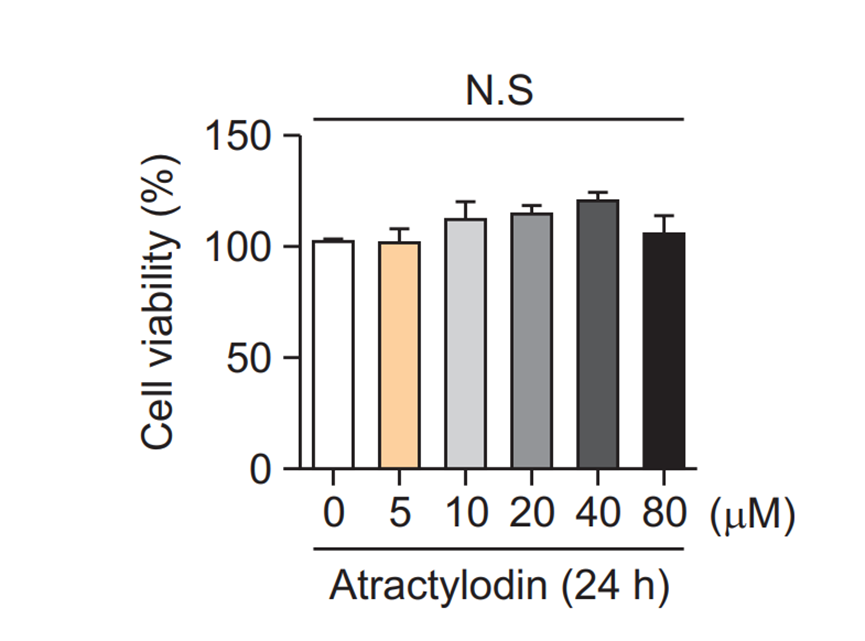
HepG2 cells were treated with Atractylodin (0, 5, 10, 20, 40, 80 μM) for 24 h at the indicated doses. The MTT assay was performed, and absorbance at 540 nm OD was measured.
Atractylodin purchased from MedChemExpress. Usage Cited in: Biomol Ther (Seoul). 2024 Nov 1;32(6):778-792. [Abstract]
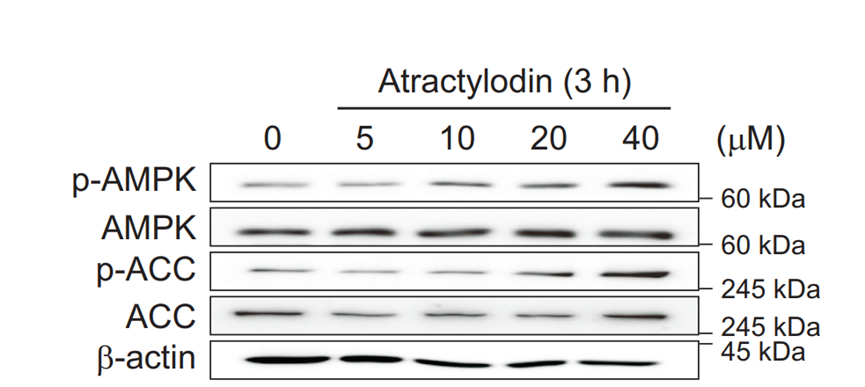
Protein levels of phospho-AMPK and phospho-ACC. HepG2 cell were treated with Atractylodin (0, 5, 10, 20, 40 μM).
Atractylodin purchased from MedChemExpress. Usage Cited in: Biomol Ther (Seoul). 2024 Nov 1;32(6):778-792. [Abstract]
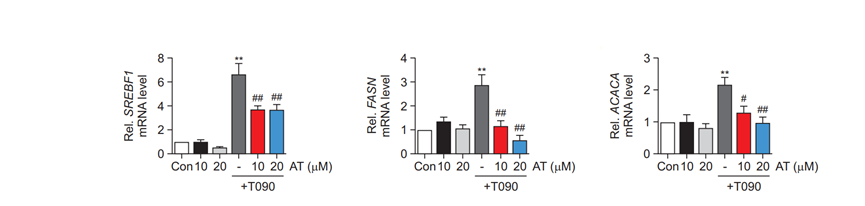
qRT-PCR analyses of mRNA levels for lipogenic genes (SREBF1, FASN, and ACACA). HepG2 cells were treated with Atractylodin (10, 20 μM) for 1 h followed by T090 treatment for 12 h.
Atractylodin purchased from MedChemExpress. Usage Cited in: Biomol Ther (Seoul). 2024 Nov 1;32(6):778-792. [Abstract]
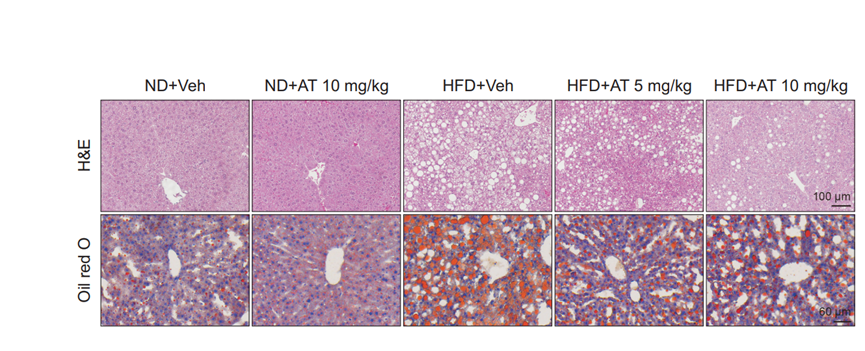
Representative H&E and Oil red O (ORO) staining images treated with Atractylodin (5, 10 mg/kg, p.o.)
Atractylodin purchased from MedChemExpress. Usage Cited in: Biomol Ther (Seoul). 2024 Nov 1;32(6):778-792. [Abstract]
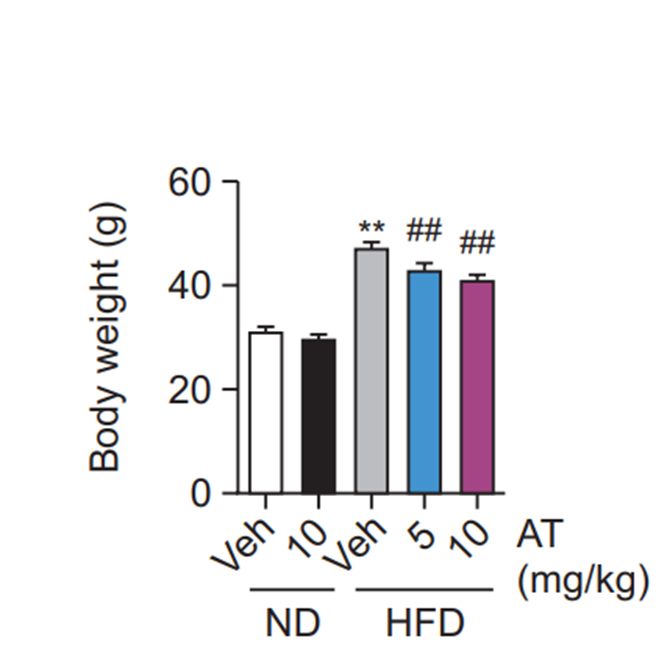
Mouse body weight treated with Atractylodin (5, 10 mg/kg, p.o.)
-
J Integr Neurosci
Atractylodin Suppresses Fibrotic Scar Formation and Enhances Functional Recovery Following Spinal Cord Injury. [Abstract]2026 Apr 22;25(4):47565. PMID: 42052760


Solvent & Solubility
In Vitro:
DMSO : 5.83 mg/mL (31.99 mM; Need ultrasonic; Hygroscopic DMSO has a significant impact on the solubility of product, please use newly opened DMSO)
Please refer to the solubility information to select the appropriate solvent. Once prepared, please aliquot and store the solution to prevent product inactivation from repeated freeze-thaw cycles.
Storage method and period of stock solution: -80°C, 6 months; -20°C, 1 month (protect from light). When stored at -80°C, please use it within 6 months. When stored at -20°C, please use it within 1 month.
Please refer to the solubility information to select the appropriate solvent. Once prepared, please aliquot and store the solution to prevent product inactivation from repeated freeze-thaw cycles.
Storage method and period of stock solution: -80°C, 6 months; -20°C, 1 month (protect from light). When stored at -80°C, please use it within 6 months. When stored at -20°C, please use it within 1 month.
Concentration (start) × Volume (start) = Concentration (final) × Volume (final)


Purity & Documentation
-
Data Sheet (273 KB)
-
SDS (394 KB)
- English - EN (394 KB)
- Français - FR (394 KB)
- Deutsch - DE (394 KB)
- Norwegian - NO (394 KB)
- Español - ES (394 KB)
- Swedish - SV (394 KB)
- Italian - IT (394 KB)
- Korean - KR (394 KB)
- Portuguese - PT (394 KB)
-
Handling Instructions (2659 KB)
References
[1]. Hai-Ping Chen, et al. Insecticidal and repellant activities of polyacetylenes and lactones derived from Atractylodes lancea rhizomes. Chem Biodivers. 2015 Apr;12(4):593-8. [Content Brief]
[2]. Heo G, et al. Atractylodin Ameliorates Colitis via PPARα Agonism. Int J Mol Sci. 2023 Jan 2;24(1):802. [Content Brief]
[3]. Hong YP, et al. Effects of Castanospermine on Inflammatory Response in a Rat Model of Experimental Severe Acute Pancreatitis. Arch Med Res. 2016 Aug;47(6):436-445. [Content Brief]


Complete Stock Solution Preparation Table
Please refer to the solubility information to select the appropriate solvent. Once prepared, please aliquot and store the solution to prevent product inactivation from repeated freeze-thaw cycles.
Storage method and period of stock solution: -80°C, 6 months; -20°C, 1 month (protect from light). When stored at -80°C, please use it within 6 months. When stored at -20°C, please use it within 1 month.
| Optional Solvent | Concentration Solvent Mass | 1 mg | 5 mg | 10 mg | 25 mg |
|---|---|---|---|---|---|
| DMSO | 1 mM | 5.4879 mL | 27.4394 mL | 54.8787 mL | 137.1968 mL |
| 5 mM | 1.0976 mL | 5.4879 mL | 10.9757 mL | 27.4394 mL | |
| 10 mM | 0.5488 mL | 2.7439 mL | 5.4879 mL | 13.7197 mL | |
| 15 mM | 0.3659 mL | 1.8293 mL | 3.6586 mL | 9.1465 mL | |
| 20 mM | 0.2744 mL | 1.3720 mL | 2.7439 mL | 6.8598 mL | |
| 25 mM | 0.2195 mL | 1.0976 mL | 2.1951 mL | 5.4879 mL | |
| 30 mM | 0.1829 mL | 0.9146 mL | 1.8293 mL | 4.5732 mL |


Atractylodin Related Classifications
HY-N0238 Related Classifications
 Powered by Bioz