



Carperitide
Based on 4 publication(s) in Google Scholar
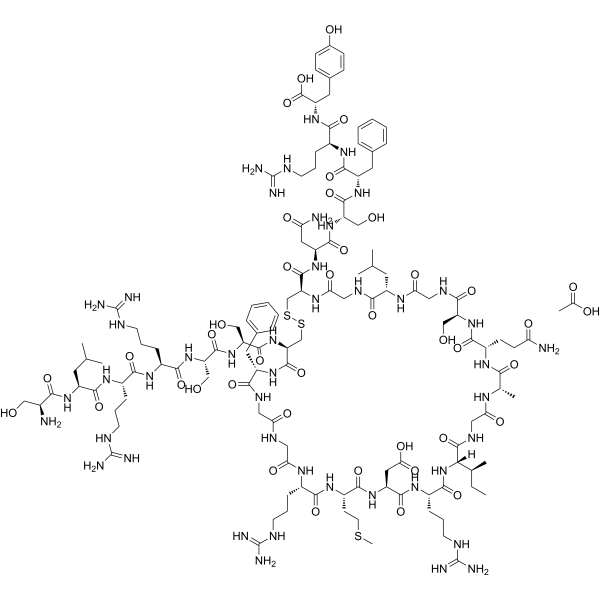
Carperitide (Atrial Natriuretic Peptide (ANP) (1-28), human, porcine) is a 28-amino acid hormone, that is normally produced and secreted by the human heart in response to cardiac injury and mechanical stretch. Carperitide (Atrial Natriuretic Peptide (ANP) (1-28), human, porcine) inhibits endothelin-1 secretion in a dose-dependent way.
For research use only. We do not sell to patients.
- CAS No.: 89213-87-6
- Formula: C127H203N45O39S3
- Molecular Weight:3080.44
-
Storage:
Please store the product under the recommended conditions in the Certificate of Analysis.

To place orders, for customer services and technical support, please contact: MedChemExpress USA
Tel: 609-228-6898 E-mail: [email protected] [email protected]


-
 Biological Activity
-
Chemical Information
- Protocols
- Purity & Documentation
- References
-
 Help & FAQs



Publications Citing Use of MedChemExpress (MCE) Carperitide
More

Biological Activity
Description
IC50 & Target
Endothelin-1[1]
In Vitro
Carperitide (Atrial Natriuretic Peptide (ANP) (1-28), human, porcine) is a diuretic, natriuretic, and vasodilatory peptide hormone originally isolated from mammalian hearts. In cultured porcine endothelial cells the inhibition by porcine ANP (1-28) of immunoreactive endothelin-1 secretion after stimulation with Angiotensin II (Ang II) is paralleled by an increase in the cellular cGMP level. Porcine ANP (1-28) strongly inhibits immunoreactive endothelin-1 secretion in porcine aorta after stimulation with Ang II[1]. ANP is a cardiac hormone involved in electrolyte and fluid homeostasis. The inhibition by ANP of endothelin-1 secretion stimulated by angiotensin II (ANGII) and thrombin using cultured human umbilical-vein endothelial cells. Human ANP (1-28) inhibits immunoreactive (ir)-endothelin-1 secretion and increases cyclic GMP in the human umbilical-vein endothelial cells[2]. In glomeruli from normal rats, Human 125I-ANP (1-28) binds to a single population of high affinity receptors with a mean equilibrium dissociation constant of 0.46 nM. Human ANP (1-28) binds to the glomerular ANP receptor with high affinity stimulated cGMP accumulation. Human ANP (1-28) markedly stimulates cGMP generation, but not cAMP generation in normal rat glomeruli[3].
MedChemExpress (MCE) has not independently confirmed the accuracy of these methods. They are for reference only. Further protocols information, click here.
Clinical Trial
| NCT Number | Sponsor | Condition | Start Date |
Phase

|
|---|---|---|---|---|
| NCT01329991 | Plexxikon| | 2011-05 | PHASE1 |


Chemical Information
-
CAS No. 89213-87-6
-
Molecular Weight 3080.44
-
Formula C127H203N45O39S3
-
Synonyms
Atrial Natriuretic Peptide (ANP) (1-28), human, porcine
-
Sequence
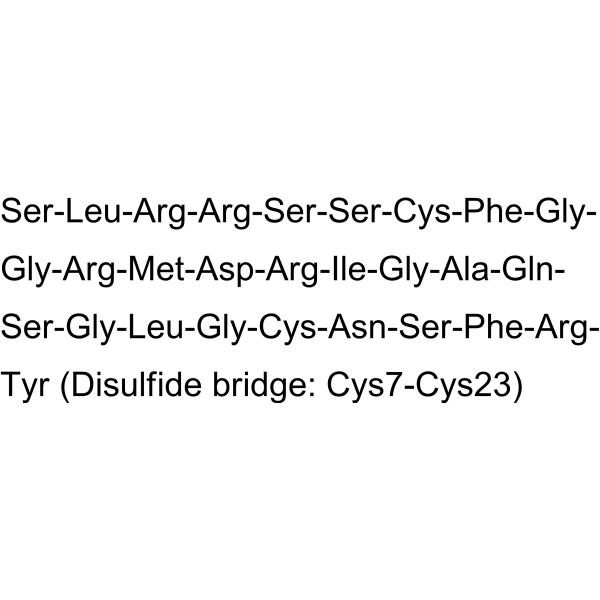
Ser-Leu-Arg-Arg-Ser-Ser-Cys-Phe-Gly-Gly-Arg-Met-Asp-Arg-Ile-Gly-Ala-Gln-Ser-Gly-Leu-Gly-Cys-Asn-Ser-Phe-Arg-Tyr (Disulfide bridge: Cys7-Cys23)
-
Sequence Shortening
SLRRSSCFGGRMDRIGAQSGLGCNSFRY (Disulfide bridge: Cys7-Cys23)
-
Shipping
Room temperature in continental US; may vary elsewhere.
-
Storage
Please store the product under the recommended conditions in the Certificate of Analysis.


Publications (4)
-
Journal Impact Factor
-
Most Recent
-
-
Biofabrication
A glomerulus chip with spherically twisted cell-laden hollow fibers as glomerular capillary tufts. [Abstract]2023 Apr 12;15(3). PMID: 36898152 -
J Cell Mol Med
Single-cell RNA sequencing analysis to characterize cells and gene expression landscapes in atrial septal defect. [Abstract]2021 Oct;25(20):9660-9673. PMID: 34514716 -
Mol Biol Rep
Targeting myocardial inflammation: investigating the therapeutic potential of atrial natriuretic peptide in atrial fibrosis. [Abstract]2024 Apr 15;51(1):506. PMID: 38622341

Protocols
-
Research Protocol for Endocrine Diseases
Endocrine diseases often arise from disrupted hormone production, hormone signaling, or target-tissue responsiveness; for diabetes-focused endocrine disease models, insulin signaling regulates glucose uptake, hepatic glucose output, lipid metabolism, and β-cell compensation. Type 2 diabetes develops through interacting defects in insulin resistance, β-cell dysfunction, adipose inflammation, hepatic glucose overproduction, altered incretin signaling, and ectopic lipid metabolism. A major unresolved question is whether endocrine dysfunction is driven primarily by target-tissue insulin resistance, intrinsic β-cell failure, immune/inflammatory stress, or combined multi-organ failure that differs by disease stage.


Purity & Documentation
References
[1]. Kohno M, et al. Atrial and brain natriuretic peptides inhibit the endothelin-1 secretory response to angiotensin II in porcine aorta. Circ Res. 1992 Feb;70(2):241-7. [Content Brief]
[2]. Kohno M, et al. Inhibition by atrial and brain natriuretic peptides of endothelin-1 secretion after stimulation with angiotensin II and thrombin of cultured human endothelial cells. J Clin Invest. 1991 Jun;87(6):1999-2004. [Content Brief]
[3]. Ballermann BJ, et al. Physiologic regulation of atrial natriuretic peptide receptors in rat renal glomeruli. J Clin Invest. 1985 Dec;76(6):2049-56. [Content Brief]

Calculators
Concentration (start) × Volume (start) = Concentration (final) × Volume (final)


Carperitide Related Classifications
HY-P1235 Related Classifications
 Powered by Bioz