



GW274150
Based on 2 publication(s) in Google Scholar
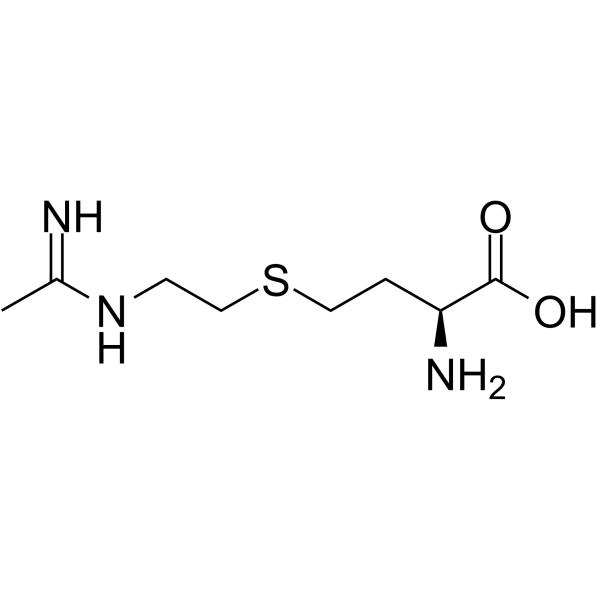
GW274150 is a potent, selective, orally active and NADPH-dependent inhibitor of human inducible nitric oxide synthase (iNOS) (IC50=2.19 μM; Kd=40 nM) and rat iNOS (ED50=1.15 μM). GW274150 also displays less potency for both humans or rats endothelial NOS (eNOS) and neuronal NOS (nNOS). GW274150 exerts a protective role in an acute model of lung injury inflammation.
For research use only. We do not sell to patients.
- Purity : 98.42%
- CAS No.: 210354-22-6
- Formula: C8H17N3O2S
- Molecular Weight:219.30
-
Storage:
4°C, stored under nitrogen
* In solvent : -80°C, 6 months; -20°C, 1 month (stored under nitrogen)

To place orders, for customer services and technical support, please contact: MedChemExpress USA
Tel: 609-228-6898 E-mail: [email protected] [email protected]


-
 Biological Activity
-
Chemical Information
-
Solvent & Solubility
- Protocols
- Purity & Documentation
- References
-
 Help & FAQs


-
HY-12116
L-NILNO Synthase Inhibitor -
HY-18731
1400W DihydrochlorideNO Synthase Inhibitor -
HY-18732A
L-NMMA acetateEndogenous Metabolite -
HY-12122A
AR-C102222 hydrochlorideiNOS Inhibitor -
HY-13912
IWP-2Wnt Production Inhibitor -
HY-10224
PanobinostatHDAC Inhibitor -
HY-Y0873
PEG300Neutral Polymer -

HY-Y1891
Tween 80 -
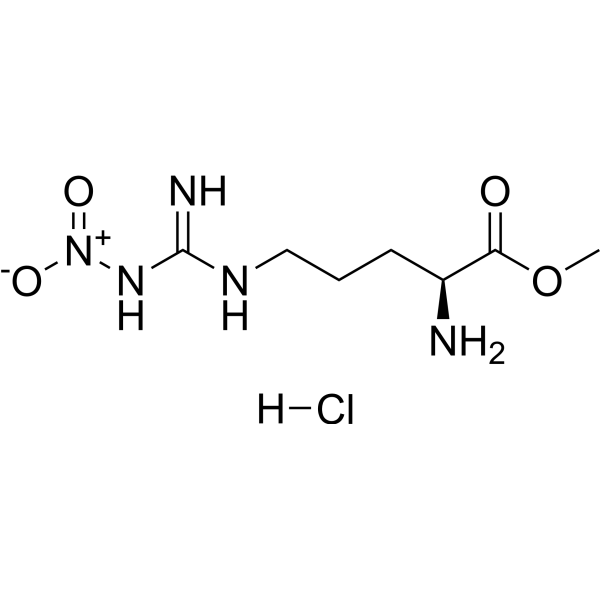
HY-18729A
L-NAME hydrochlorideNO Synthase Inhibitor -
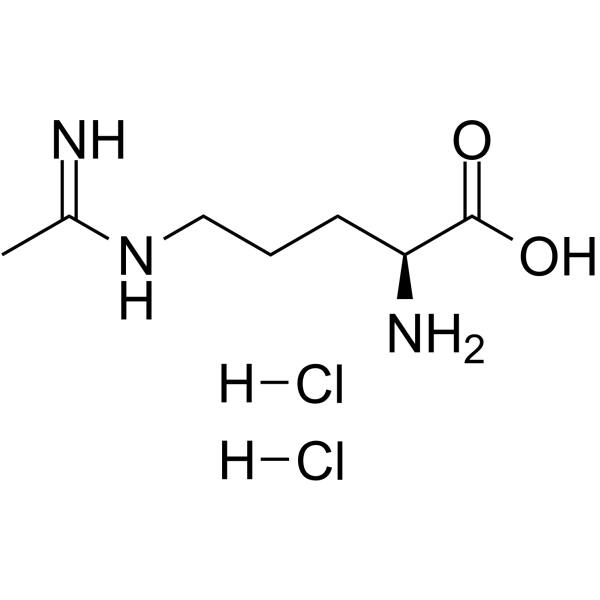
HY-100986
L-NIO dihydrochlorideNOS Inhibitor -
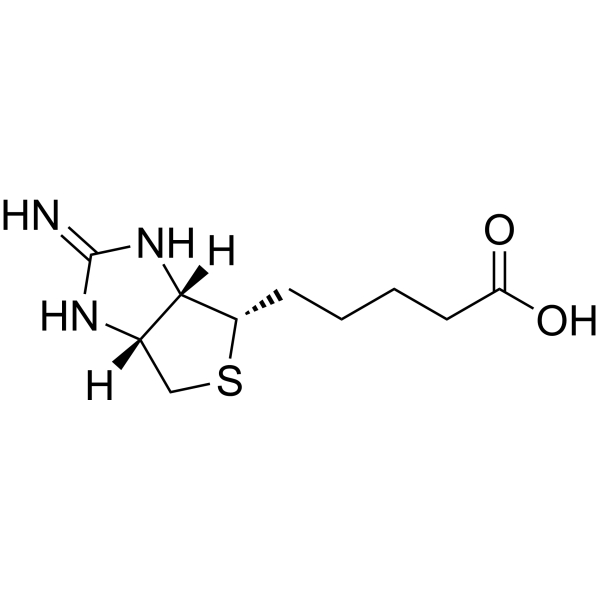
HY-118700
2-IminobiotinNitric Oxide Synthases Inhibitor -
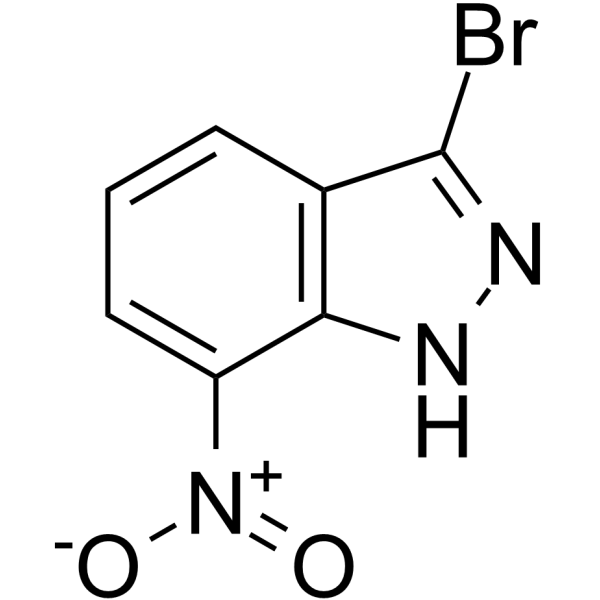
HY-101175
3-Bromo-7-nitroindazolenNOS Inhibitor
Publications Citing Use of MedChemExpress (MCE) GW274150
More

Biological Activity
Description
IC50 & Target
|
iNOS |
Cellular Effect
|
Cell Line

|
Type | Value | Description | References |
|---|---|---|---|---|
| DLD-1 | IC50 |
220 nM
Compound: 2, GW-274150
|
Inhibition of human iNOS expressed in human DLD1 cells after 1 hr
Inhibition of human iNOS expressed in human DLD1 cells after 1 hr
|
[PMID: 18024030] |
| Sf9 | IC50 |
8400 nM
Compound: 2, GW-274150
|
Inhibition of human nNOS expressed in insect SF9 cells after 1 hr
Inhibition of human nNOS expressed in insect SF9 cells after 1 hr
|
[PMID: 18024030] |
In Vitro
GW274150 inhibits intracellular iNOS in J774 cells in a time-dependent manner, reaching IC50 values of 0.2 μM[1].GW274150 is >260-fold and 219-fold selective for iNOS against eNOS and nNOS in rat tissues, respectively. And it displays >100-fold and >80-fold for human iNOS against human eNOS and nNOS, respectively[1].
MedChemExpress (MCE) has not independently confirmed the accuracy of these methods. They are for reference only. Further protocols information, click here.
In Vivo
MedChemExpress (MCE) has not independently confirmed the accuracy of these methods. They are for reference only.
-
Animal Model:SD-rat[2]
-
Dosage:2.5, 5 and 10 mg/kg; single dose
-
Administration:Intraperitoneal injection 5 min before carrageenan injection
-
Result:Exerted a protective role in an acute model of inflammation, carrageenan-induced lung injury.


Chemical Information
-
CAS No. 210354-22-6
-
Appearance Solid
-
Molecular Weight 219.30
-
Formula C8H17N3O2S
-
Color White to off-white
-
SMILES
N[C@@H](CCSCCNC(C)=N)C(O)=O
-
Shipping
Room temperature in continental US; may vary elsewhere.
-
Storage
4°C, stored under nitrogen
* In solvent : -80°C, 6 months; -20°C, 1 month (stored under nitrogen)


Publications (2)
-
Journal Impact Factor
-
Most Recent
-
EMBO Mol Med
Pharmacological or genetic inhibition of iNOS prevents cachexia-mediated muscle wasting and its associated metabolism defects. [Abstract]2021 Jul 7;13(7):e13591. PMID: 34096686 -


Solvent & Solubility
In Vitro:
H2O : ≥ 62 mg/mL (282.72 mM)
* "≥" means soluble, but saturation unknown.
Please refer to the solubility information to select the appropriate solvent. Once prepared, please aliquot and store the solution to prevent product inactivation from repeated freeze-thaw cycles.
Storage method and period of stock solution: -80°C, 6 months; -20°C, 1 month (stored under nitrogen). When stored at -80°C, please use it within 6 months. When stored at -20°C, please use it within 1 month.
* Note: If you choose water as the stock solution, please dilute it to the working solution, then filter and sterilize it with a 0.22 μm filter before use.
Please refer to the solubility information to select the appropriate solvent. Once prepared, please aliquot and store the solution to prevent product inactivation from repeated freeze-thaw cycles.
Storage method and period of stock solution: -80°C, 6 months; -20°C, 1 month (stored under nitrogen). When stored at -80°C, please use it within 6 months. When stored at -20°C, please use it within 1 month.
* Note: If you choose water as the stock solution, please dilute it to the working solution, then filter and sterilize it with a 0.22 μm filter before use.
Concentration (start) × Volume (start) = Concentration (final) × Volume (final)

Protocols
-
Cell Cytotoxicity Assay
Cytotoxicity assays are usually based on the assessment of cell membrane damage, which can also be indirectly detected by measuring cell viability. Detection methods include MTT assay, CKK-8 assay, LDH assay and ATP assay, etc.
-
Research Protocol for Inflammation-related Diseases
The NLRP3 inflammasome is a cytosolic innate immune signaling platform that integrates priming signals and danger-signal activation to promote caspase-1 activation, maturation of IL-1β and IL-18, and gasdermin D-mediated pyroptotic cell death. The core experimental logic is to determine whether inflammatory disease phenotypes are driven by increased NLRP3 expression, ASC-containing inflammasome assembly, caspase-1 cleavage, GSDMD cleavage, and extracellular release of IL-1β/IL-18 rather than by nonspecific cell injury alone. The pathway is strongly linked to inflammation-related disease phenotypes because monosodium urate crystals activate NALP3/NLRP3 inflammasome signaling in gout-like crystal inflammation, cholesterol crystals activate NLRP3 inflammasomes in atherogenesis models, and DSS-induced intestinal inflammation has been reported to involve NLRP3 inflammasome activity. However, experimental colitis studies also show context-dependent protective effects of NLRP3 inflammasome co
-
Inhalation Toxicity Study
Inhalation toxicity studies expose rodents to a controlled aerosol, vapor, gas, or smoke atmosphere and assess respiratory and systemic toxicity using exposure-atmosphere characterization, clinical observations, body and organ weights, bronchoalveolar lavage fluid, histopathology, blood chemistry, hematology, and, when included, molecular endpoints such as transcriptomics, proteomics, lipidomics, or tissue burden analysis. The primary biological readouts are airway irritation, pulmonary inflammation, cytotoxicity, altered surfactant or lipid homeostasis, impaired particle clearance, and tissue remodeling, reflected by BALF cell differentials, BALF protein, LDH, phosphatase activities, cytokines, lung weight, microscopic respiratory-tract lesions, and retained lung burden.


Purity & Documentation
-
Data Sheet (272 KB)
-
SDS (252 KB)
- English - EN (252 KB)
- Français - FR (252 KB)
- Deutsch - DE (252 KB)
- Norwegian - NO (252 KB)
- Español - ES (252 KB)
- Swedish - SV (252 KB)
- Italian - IT (252 KB)
- Korean - KR (252 KB)
- Portuguese - PT (252 KB)
-
Handling Instructions (2659 KB)
References
[1]. Alderton WK, et al. GW274150 and GW273629 are potent and highly selective inhibitors of inducible nitric oxide synthase in vitro and in vivo.Br J Pharmacol. 2005 Jun;145(3):301-12. [Content Brief]
[2]. Dugo L, et al. Effects of GW274150, a novel and selective inhibitor of iNOS activity, in acute lung inflammation. Br J Pharmacol. 2004 Mar;141(6):979-87. Epub 2004 Feb [Content Brief]
[3]. Broom L, et al. Neuroprotection by the selective iNOS inhibitor GW274150 in a model of Parkinson disease.Free Radic Biol Med. 2011 Mar 1;50(5):633-40. [Content Brief]


Complete Stock Solution Preparation Table
Please refer to the solubility information to select the appropriate solvent. Once prepared, please aliquot and store the solution to prevent product inactivation from repeated freeze-thaw cycles.
Storage method and period of stock solution: -80°C, 6 months; -20°C, 1 month (stored under nitrogen). When stored at -80°C, please use it within 6 months. When stored at -20°C, please use it within 1 month.
| Optional Solvent | Concentration Solvent Mass | 1 mg | 5 mg | 10 mg | 25 mg |
|---|---|---|---|---|---|
| H2O | 1 mM | 4.5600 mL | 22.7998 mL | 45.5996 mL | 113.9991 mL |
| 5 mM | 0.9120 mL | 4.5600 mL | 9.1199 mL | 22.7998 mL | |
| 10 mM | 0.4560 mL | 2.2800 mL | 4.5600 mL | 11.3999 mL | |
| 15 mM | 0.3040 mL | 1.5200 mL | 3.0400 mL | 7.5999 mL | |
| 20 mM | 0.2280 mL | 1.1400 mL | 2.2800 mL | 5.7000 mL | |
| 25 mM | 0.1824 mL | 0.9120 mL | 1.8240 mL | 4.5600 mL | |
| 30 mM | 0.1520 mL | 0.7600 mL | 1.5200 mL | 3.8000 mL | |
| 40 mM | 0.1140 mL | 0.5700 mL | 1.1400 mL | 2.8500 mL | |
| 50 mM | 0.0912 mL | 0.4560 mL | 0.9120 mL | 2.2800 mL | |
| 60 mM | 0.0760 mL | 0.3800 mL | 0.7600 mL | 1.9000 mL | |
| 80 mM | 0.0570 mL | 0.2850 mL | 0.5700 mL | 1.4250 mL | |
| 100 mM | 0.0456 mL | 0.2280 mL | 0.4560 mL | 1.1400 mL |
* Note: If you choose water as the stock solution, please dilute it to the working solution, then filter and sterilize it with a 0.22 μm filter before use.


GW274150 Related Classifications
HY-12119 Related Classifications
 Powered by Bioz