



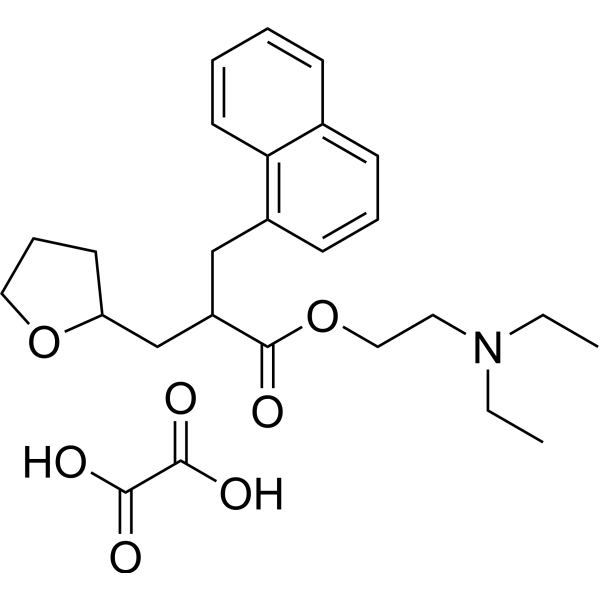
Naftidrofuryl oxalate

Based on 1 Customer Validation
Naftidrofuryl oxalate (Nafronyl oxalate salt) is an orally active 5-HT2 receptor antagonist. Naftidrofuryl oxalate selectively blocks vascular and platelet 5-HT2 receptors, inhibiting Serotonin (HY-B1473A)-induced vasoconstriction, platelet aggregation, and vascular smooth muscle cell proliferation. Naftidrofuryl oxalate can be used for the research of intermittent claudication, peripheral occlusive arterial disease, and critical limb ischaemia.
For research use only. We do not sell to patients.
- Purity : 99.94%
- CAS No.: 3200-06-4
- Formula: C26H35NO7
- Molecular Weight:473.56
-
Storage:
4°C, sealed storage, away from moisture
* In solvent : -80°C, 6 months; -20°C, 1 month (sealed storage, away from moisture)

To place orders, for customer services and technical support, please contact: MedChemExpress USA
Tel: 609-228-6898 E-mail: [email protected] [email protected]


-
 Biological Activity
-
Chemical Information
-
Solvent & Solubility
- Purity & Documentation
- References
-
 Help & FAQs




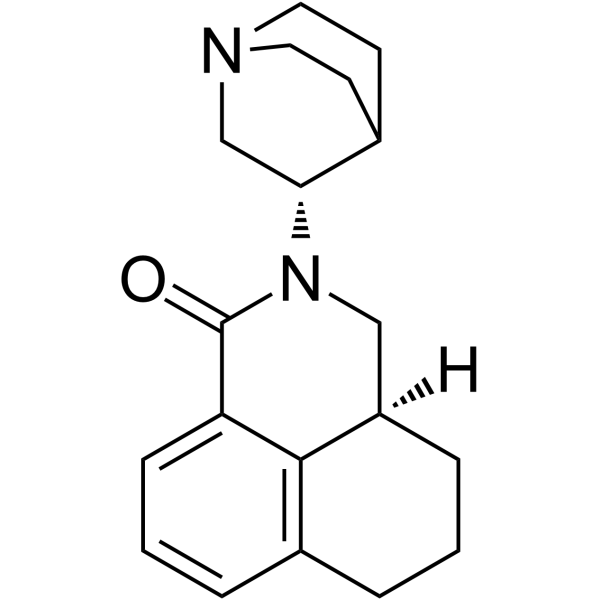
All 5-HT Receptor Isoforms
More

Biological Activity
Description
IC50 & Target
[1]|
5-HT2 Receptor |
In Vitro
Naftidrofuryl (1 nM-10 μM) oxalate concentration-dependently protects human fibroblast and endothelial cells from hypoxic stress by increasing protein production and preserving ATP levels[2].
Naftidrofuryl (10 nM-1 mM) oxalate dose-dependently inhibits Serotonin-induced vasoconstriction in human saphenous vein and animal blood vessels[2].
Naftidrofuryl (1 μM) oxalate completely inhibits Serotonin-induced proliferation of vascular smooth muscle cells[2].
Naftidrofuryl (1-100 μM) oxalate inhibits Serotonin-stimulated inositol triphosphate synthesis[2].
MedChemExpress (MCE) has not independently confirmed the accuracy of these methods. They are for reference only.
In Vivo
Naftidrofuryl (30 mg/kg/day; i.p.; daily; 1 to 3 months) oxalate attenuates age-related increases in vascular reactivity to serotonin in spontaneously hypertensive rats without altering heart rate or hypertension progression[2].
Naftidrofuryl (50 mg/kg/day; p.o.; daily; 12 weeks) oxalate attenuates PMN-related atherosclerotic lesion formation and preserves endothelial function in high cholesterol diet-fed rats[2].
Naftidrofuryl (1 mg/kg; i.v.; single dose) oxalate inhibits thrombus growth and reduces thrombus stability in hamster cheek pouch arterioles[2].
Naftidrofuryl (7 mg/kg; i.p.; twice daily; 8 weeks) oxalate mimics exercise training effects on skeletal muscle oxidative metabolism in old rats, with additive benefits when combined with training[2].
Naftidrofuryl (0.025-8 mg/kg; i.a. or i.m.; single dose) oxalate produces immediate, dose-dependent femoral artery vasodilation in dogs without altering arterial blood pressure[2].
Naftidrofuryl (50 mg/kg/day; p.o.; daily) oxalate prevents high cholesterol diet-induced platelet hyper-reactivity in rabbits without affecting normal platelet function[2].
MedChemExpress (MCE) has not independently confirmed the accuracy of these methods. They are for reference only.
-
Animal Model:Spontaneously Hypertensive Rats (SHR)[2]
-
Dosage:30 mg/kg/day
-
Administration:i.p.; daily; 1 to 3 months
-
Result:Attenuated the age-related increase in vascular reactivity to serotonin.
Did not modify heart rate or the development of hypertension.
-
Animal Model:Rats (unstated specific strain)[2]
-
Dosage:50 mg/kg/day
-
Administration:p.o.; daily; 12 weeks
-
Result:Caused focal rather than circumferential intimal proliferation.
Prevented hypercholesterolaemia-induced impairment of endothelial relaxation to acetylcholine in thoracic and abdominal aorta.
Normalised PMN-dependent generation of oxygen-centred free radicals.
-
Animal Model:Hamsters (unstated specific strain)[2]
-
Dosage:1 mg/kg
-
Administration:i.v.; single dose
-
Result:Caused significant dose-related inhibition of thrombus growth that lasted for at least 2 hours.
Decreased thrombus stability as demonstrated by increased thrombus fragmentation.
-
Animal Model:Old rats (21 months old, unstated specific strain)[2]
-
Dosage:7 mg/kg
-
Administration:i.p.; twice daily; 8 weeks
-
Result:Mimicked the effects of training on the oxidative metabolism of skeletal muscle.
Combining Naftidrofuryl treatment with exercise training resulted in additive beneficial effects.
-
Animal Model:Rabbits (unstated specific strain)[2]
-
Dosage:50 mg/kg/day
-
Administration:p.o.; daily
-
Result:Prevented platelet hyper-reactivity in rabbits receiving a high cholesterol diet.
Had no effect on platelet functions in rabbits receiving a standard diet.


Chemical Information
-
CAS No. 3200-06-4
-
Appearance Solid
-
Molecular Weight 473.56
-
Formula C26H35NO7
-
Color White to off-white
-
SMILES
O=C(OCCN(CC)CC)C(CC1=C2C=CC=CC2=CC=C1)CC3OCCC3.O=C(O)C(O)=O
-
Synonyms
Nafronyl oxalate salt
-
Shipping
Room temperature in continental US; may vary elsewhere.
-
Storage
4°C, sealed storage, away from moisture
* In solvent : -80°C, 6 months; -20°C, 1 month (sealed storage, away from moisture)


Solvent & Solubility
In Vitro:
DMSO : ≥ 100 mg/mL (211.17 mM; Hygroscopic DMSO has a significant impact on the solubility of product, please use newly opened DMSO)
H2O : 100 mg/mL (211.17 mM; Need ultrasonic)
* "≥" means soluble, but saturation unknown.
Please refer to the solubility information to select the appropriate solvent. Once prepared, please aliquot and store the solution to prevent product inactivation from repeated freeze-thaw cycles.
Storage method and period of stock solution: -80°C, 6 months; -20°C, 1 month (sealed storage, away from moisture). When stored at -80°C, please use it within 6 months. When stored at -20°C, please use it within 1 month.
* Note: If you choose water as the stock solution, please dilute it to the working solution, then filter and sterilize it with a 0.22 μm filter before use.
Please refer to the solubility information to select the appropriate solvent. Once prepared, please aliquot and store the solution to prevent product inactivation from repeated freeze-thaw cycles.
Storage method and period of stock solution: -80°C, 6 months; -20°C, 1 month (sealed storage, away from moisture). When stored at -80°C, please use it within 6 months. When stored at -20°C, please use it within 1 month.
* Note: If you choose water as the stock solution, please dilute it to the working solution, then filter and sterilize it with a 0.22 μm filter before use.
Concentration (start) × Volume (start) = Concentration (final) × Volume (final)
In Vivo:
Select the appropriate dissolution method based on your experimental animal and administration route.
- For the following dissolution methods, please ensure to first prepare a clear stock solution using an In Vitro approach and then sequentially add co-solvents:
- To ensure reliable experimental results, the clarified stock solution can be appropriately stored based on storage conditions. As for the working solution for In Vivo experiments, it is recommended to prepare freshly and use it on the same day.
- The percentages shown for the solvents indicate their volumetric ratio in the final prepared solution. If precipitation or phase separation occurs during preparation, heat and/or sonication can be used to aid dissolution.
Add each solvent one by one: 10% DMSO 40% PEG300 5% Tween-80 45% Saline
Solubility: ≥ 2.5 mg/mL (5.28 mM); Clear solution
This protocol yields a clear solution of ≥ 2.5 mg/mL (saturation unknown).
Taking 1 mL working solution as an example, add 100 μL DMSO stock solution (25.0 mg/mL) to 400 μL PEG300, and mix evenly; then add 50 μL Tween-80 and mix evenly; then add 450 μL Saline to adjust the volume to 1 mL.
Preparation of Saline: Dissolve 0.9 g sodium chloride in ddH₂O and dilute to 100 mL to obtain a clear Saline solution.
Add each solvent one by one: 10% DMSO 90% (20% SBE-β-CD in Saline)
Solubility: ≥ 2.5 mg/mL (5.28 mM); Clear solution
This protocol yields a clear solution of ≥ 2.5 mg/mL (saturation unknown).
Taking 1 mL working solution as an example, add 100 μL DMSO stock solution (25.0 mg/mL) to 900 μL 20% SBE-β-CD in Saline, and mix evenly.
Preparation of 20% SBE-β-CD in Saline (4°C, storage for one week): 2 g SBE-β-CD powder is dissolved in 10 mL Saline, completely dissolve until clear.
For the following dissolution methods, please prepare the working solution directly:
It is recommended to prepare fresh solutions and use them promptly within a short period of time.
The percentages shown for the solvents indicate their volumetric ratio in the final prepared solution. If precipitation or phase separation occurs during preparation, heat and/or sonication can be used to aid dissolution.
Add each solvent one by one: PBS
Solubility: 50 mg/mL (105.58 mM); Clear solution; Need ultrasonic
In Vivo Dissolution Calculator
Please enter the basic information of animal experiments:
-
-
-
-
Recommended: Prepare an additional quantity of animals to account for potential losses during experiments.
Working solution concentration: 0.22 mg/mL
This product has good water solubility, please refer to the measured solubility data in water/PBS/Saline for details.


Purity & Documentation
-
Data Sheet (283 KB)
-
SDS (394 KB)
- English - EN (394 KB)
- Français - FR (394 KB)
- Deutsch - DE (394 KB)
- Norwegian - NO (394 KB)
- Español - ES (394 KB)
- Swedish - SV (394 KB)
- Italian - IT (394 KB)
- Korean - KR (394 KB)
- Portuguese - PT (394 KB)
-
Handling Instructions (2659 KB)
References
[1]. de Backer TL, et al. Naftidrofuryl for intermittent claudication. Cochrane Database Syst Rev. 2012 Dec 12;12(12):CD001368. [Content Brief]
[2]. Barradell LB, et al. A review of its pharmacology and therapeutic use in the management of peripheral occlusive arterial disease. Drugs Aging. 1996 Apr;8(4):299-322. [Content Brief]
[3]. Smith FB, et al. Intravenous naftidrofuryl for critical limb ischaemia. Cochrane Database Syst Rev. 2012 Jul 11;2012(7):CD002070. [Content Brief]


Complete Stock Solution Preparation Table
Please refer to the solubility information to select the appropriate solvent. Once prepared, please aliquot and store the solution to prevent product inactivation from repeated freeze-thaw cycles.
Storage method and period of stock solution: -80°C, 6 months; -20°C, 1 month (sealed storage, away from moisture). When stored at -80°C, please use it within 6 months. When stored at -20°C, please use it within 1 month.
| Optional Solvent | Concentration Solvent Mass | 1 mg | 5 mg | 10 mg | 25 mg |
|---|---|---|---|---|---|
| DMSO / H2O | 1 mM | 2.1117 mL | 10.5583 mL | 21.1166 mL | 52.7916 mL |
| 5 mM | 0.4223 mL | 2.1117 mL | 4.2233 mL | 10.5583 mL | |
| 10 mM | 0.2112 mL | 1.0558 mL | 2.1117 mL | 5.2792 mL | |
| 15 mM | 0.1408 mL | 0.7039 mL | 1.4078 mL | 3.5194 mL | |
| 20 mM | 0.1056 mL | 0.5279 mL | 1.0558 mL | 2.6396 mL | |
| 25 mM | 0.0845 mL | 0.4223 mL | 0.8447 mL | 2.1117 mL | |
| 30 mM | 0.0704 mL | 0.3519 mL | 0.7039 mL | 1.7597 mL | |
| 40 mM | 0.0528 mL | 0.2640 mL | 0.5279 mL | 1.3198 mL | |
| 50 mM | 0.0422 mL | 0.2112 mL | 0.4223 mL | 1.0558 mL | |
| 60 mM | 0.0352 mL | 0.1760 mL | 0.3519 mL | 0.8799 mL | |
| 80 mM | 0.0264 mL | 0.1320 mL | 0.2640 mL | 0.6599 mL | |
| 100 mM | 0.0211 mL | 0.1056 mL | 0.2112 mL | 0.5279 mL |
* Note: If you choose water as the stock solution, please dilute it to the working solution, then filter and sterilize it with a 0.22 μm filter before use.


Naftidrofuryl oxalate Related Classifications
HY-B1107 Related Classifications
 Powered by Bioz
Keywords