



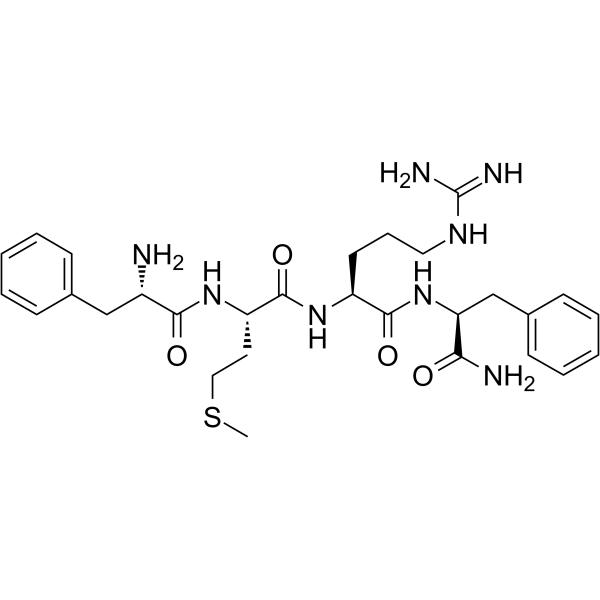
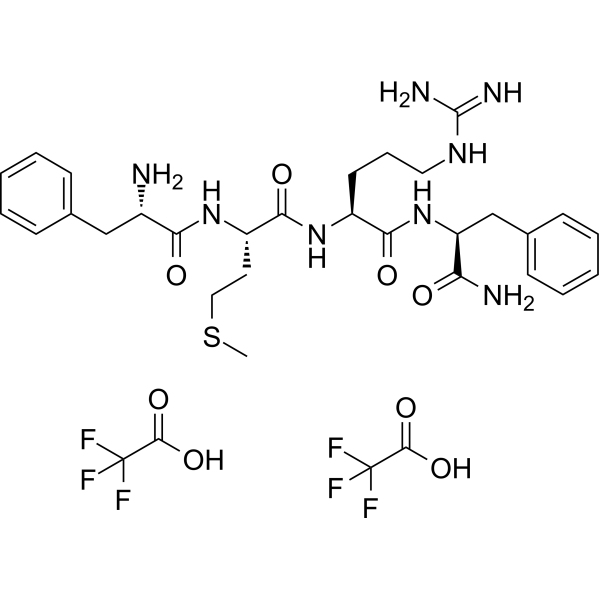
Phe-Met-Arg-Phe, amide
Phe-Met-Arg-Phe, amide dose dependently (ED50=23 nM) activates a K+ current in the peptidergic caudodorsal neurons.
For research use only. We do not sell to patients.
- CAS No.: 64190-70-1
- Formula: C29H42N8O4S
- Molecular Weight:598.76
-
Storage:
Please store the product under the recommended conditions in the Certificate of Analysis.

To place orders, for customer services and technical support, please contact: MedChemExpress USA
Tel: 609-228-6898 E-mail: [email protected] [email protected]


-
 Biological Activity
-
Chemical Information
- Purity & Documentation
- References
-
 Help & FAQs




Biological Activity
Description
IC50 & Target
ED50: 23 nM (K+ current)[1]
In Vitro
In the molluscan central nervous system, Phe-Met-Arg-Phe, amide (FMRFa) acts on K+ channels in sensory, motor-, and neuroendocrine neurones. Phe-Met-Arg-Phe, amide activates a novel K+ current that is characterized by a combined voltage- and receptor-dependent gating mechanism, with both factors being necessary for opening of the channels[1]. Phe-Met-Arg-Phe, amide (1 μM) significantly inhibits glucose stimulated (300 mg/dL) insulin release (p<0.005) and somatostatin release (p<0.01) from the isolated perfused pancreas. Phe-Met-Arg-Phe, amide (FMRF-NH2) (1 and 10 μM) is without effect on glucagon secretion, either in low glucose (50 mg/dL), high glucose (300 mg/dL), or during arginine stimulation (5 mM)[2].
MedChemExpress (MCE) has not independently confirmed the accuracy of these methods. They are for reference only. .
In Vivo
MedChemExpress (MCE) has not independently confirmed the accuracy of these methods. They are for reference only.


Chemical Information
-
CAS No. 64190-70-1
-
Molecular Weight 598.76
-
Formula C29H42N8O4S
-
Sequence
Phe-Met-Arg-Phe-NH2
-
Sequence Shortening
FMRF-NH2
-
Shipping
Room temperature in continental US; may vary elsewhere.
-
Storage
Please store the product under the recommended conditions in the Certificate of Analysis.


Purity & Documentation
References
[1]. Kits KS, et al. Phe-Met-Arg-Phe-amide activates a novel voltage-dependent K+ current through a lipoxygenasepathway in molluscan neurones. J Gen Physiol. 1997 Nov;110(5):611-28. [Content Brief]
[2]. Sorenson RL, et al. Phe-met-arg-phe-amide (FMRF-NH2) inhibits insulin and somatostatin secretion and anti-FMRF-NH2 sera detects pancreatic polypeptide cells in the rat islet. Peptides. 1984 Jul-Aug;5(4):777-82. [Content Brief]
[3]. Ottlecz A, et al. Phe-Met-Arg-Phe-amide (FMRFamide) stimulated growth hormone secretion in conscious OVX rats. Neuropeptides. 1987 Feb-Mar;9(2):161-7. [Content Brief]

Calculators
Concentration (start) × Volume (start) = Concentration (final) × Volume (final)


Phe-Met-Arg-Phe, amide Related Classifications
HY-P0249 Related Classifications
 Powered by Bioz