



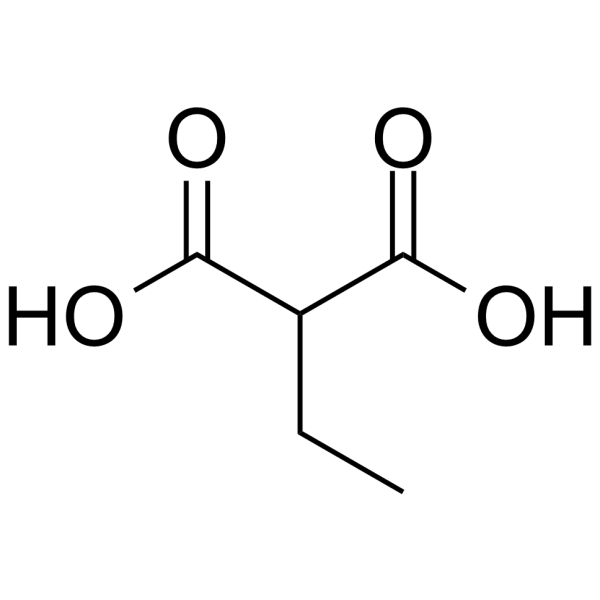
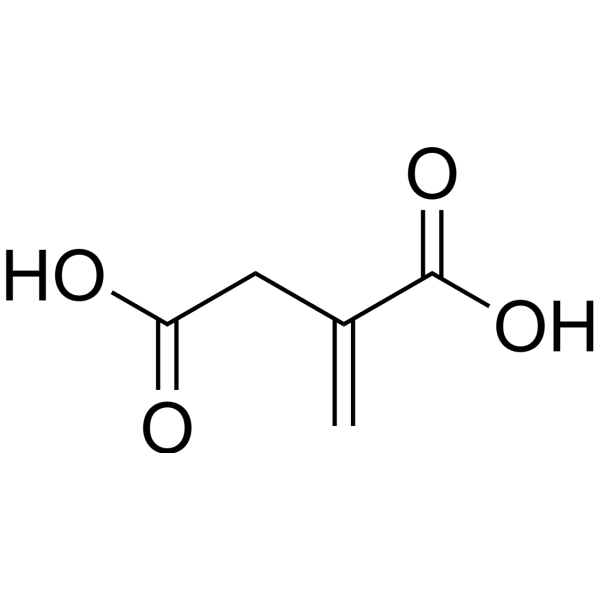
Ethylmalonic acid

Based on 1 Customer Validation
Ethylmalonic acid is a short-chain organic dicarboxylic acid. Ethylmalonic acid synergistically induces mitochondrial permeability transition (MP) with Ca2+, inhibits Mi-CK, and disrupts mitochondrial energy metabolism. Ethylmalonic acid can be used in the research of SCADD, EE and other genetic metabolic diseases characterized by EMA accumulation.
For research use only. We do not sell to patients.
- Purity : 98.0%
- CAS No.: 601-75-2
- Formula: C5H8O4
- Molecular Weight:132.11
-
Storage:Powder -20°C, 3 years , 4°C, 2 years ; In solvent -80°C, 6 months , -20°C, 1 month

To place orders, for customer services and technical support, please contact: MedChemExpress USA
Tel: 609-228-6898 E-mail: [email protected] [email protected]


-
 Biological Activity
-
Chemical Information
-
Solvent & Solubility
- Purity & Documentation
- References
-
 Help & FAQs





Biological Activity
Description
IC50 & Target
|
Human Endogenous Metabolite |
In Vitro
Ethylmalonic acid (0.5-5 mM) dissipates the mitochondrial membrane potential, provokes mitochondrial swelling, impairs mitochondrial Ca2+ retention capacity, decreases NAD(P)H matrix content, and does not stimulate hydrogen peroxide generation in isolated brain mitochondria from young rats[1].
Ethylmalonic acid (0.5-2.5 mM) significantly inhibits mitochondrial creatine kinase (Mi-CK) activity in rat cerebral cortex in a dose-dependent manner, while having no effect on cytosolic creatine kinase (Cy-CK) activity in brain, skeletal muscle, and cardiac muscle[2].
Ethylmalonic acid (0.5-2.5 mM) increases lipid peroxidation (TBA-RS and chemiluminescence), protein oxidative damage (carbonyl content and sulfhydryl oxidation), DCFH oxidation, and superoxide production, and decreases reduced glutathione (GSH) levels in rat cerebral cortex homogenates[3].
MedChemExpress (MCE) has not independently confirmed the accuracy of these methods. They are for reference only.
In Vivo
MedChemExpress (MCE) has not independently confirmed the accuracy of these methods. They are for reference only.


Chemical Information
-
CAS No. 601-75-2
-
Appearance Solid
-
Molecular Weight 132.11
-
Formula C5H8O4
-
Color White to off-white
-
SMILES
O=C(O)C(CC)C(O)=O
-
Structure Classification
-
Shipping
Room temperature in continental US; may vary elsewhere.
-
Storage
Powder -20°C 3 years 4°C 2 years In solvent -80°C 6 months -20°C 1 month


Solvent & Solubility
In Vitro:
DMSO : 200 mg/mL (1513.89 mM; Need ultrasonic; Hygroscopic DMSO has a significant impact on the solubility of product, please use newly opened DMSO)
Please refer to the solubility information to select the appropriate solvent. Once prepared, please aliquot and store the solution to prevent product inactivation from repeated freeze-thaw cycles.
Storage method and period of stock solution: -80°C, 6 months; -20°C, 1 month. When stored at -80°C, please use it within 6 months. When stored at -20°C, please use it within 1 month.
Please refer to the solubility information to select the appropriate solvent. Once prepared, please aliquot and store the solution to prevent product inactivation from repeated freeze-thaw cycles.
Storage method and period of stock solution: -80°C, 6 months; -20°C, 1 month. When stored at -80°C, please use it within 6 months. When stored at -20°C, please use it within 1 month.
Concentration (start) × Volume (start) = Concentration (final) × Volume (final)
In Vivo:
Select the appropriate dissolution method based on your experimental animal and administration route.
- For the following dissolution methods, please ensure to first prepare a clear stock solution using an In Vitro approach and then sequentially add co-solvents:
- To ensure reliable experimental results, the clarified stock solution can be appropriately stored based on storage conditions. As for the working solution for In Vivo experiments, it is recommended to prepare freshly and use it on the same day.
- The percentages shown for the solvents indicate their volumetric ratio in the final prepared solution. If precipitation or phase separation occurs during preparation, heat and/or sonication can be used to aid dissolution.
Add each solvent one by one: 10% DMSO 40% PEG300 5% Tween-80 45% Saline
Solubility: ≥ 2.08 mg/mL (15.74 mM); Clear solution
This protocol yields a clear solution of ≥ 2.08 mg/mL (saturation unknown).
Taking 1 mL working solution as an example, add 100 μL DMSO stock solution (20.8 mg/mL) to 400 μL PEG300, and mix evenly; then add 50 μL Tween-80 and mix evenly; then add 450 μL Saline to adjust the volume to 1 mL.
Preparation of Saline: Dissolve 0.9 g sodium chloride in ddH₂O and dilute to 100 mL to obtain a clear Saline solution.
Add each solvent one by one: 10% DMSO 90% (20% SBE-β-CD in Saline)
Solubility: ≥ 2.08 mg/mL (15.74 mM); Clear solution
This protocol yields a clear solution of ≥ 2.08 mg/mL (saturation unknown).
Taking 1 mL working solution as an example, add 100 μL DMSO stock solution (20.8 mg/mL) to 900 μL 20% SBE-β-CD in Saline, and mix evenly.
Preparation of 20% SBE-β-CD in Saline (4°C, storage for one week): 2 g SBE-β-CD powder is dissolved in 10 mL Saline, completely dissolve until clear.
In Vivo Dissolution Calculator
Please enter the basic information of animal experiments:
-
-
-
-
Recommended: Prepare an additional quantity of animals to account for potential losses during experiments.
Please enter your animal formula composition:
-
%DMSO +
Recommended: Keep the proportion of DMSO in working solution below 2% if your animal is weak.
-
%+
-
+%Tween-80 + +
-
%Saline +
The co-solvents required include: DMSO, . All of co-solvents are available by MedChemExpress (MCE). , Tween 80. All of co-solvents are available by MedChemExpress (MCE).
Working solution concentration: 0.22 mg/mL
Method for preparing stock solution: mg drug dissolved in μL DMSO. Stock solution concentration: mg/mL.
1. Take μL DMSO stock solution;
2. Add μL .
μL , mix evenly;
3. Then add μL Tween 80, mix evenly;
4. Then add μL
Please ensure that the stock solution in the first step is dissolved to a clear state, and add co-solvents in sequence. You can use ultrasonic heating (ultrasonic cleaner, recommended frequency 20-40 kHz), vortexing, etc. to assist dissolution.


Purity & Documentation
-
Data Sheet (281 KB)
-
SDS (394 KB)
- English - EN (394 KB)
- Français - FR (394 KB)
- Deutsch - DE (394 KB)
- Norwegian - NO (394 KB)
- Español - ES (394 KB)
- Swedish - SV (394 KB)
- Italian - IT (394 KB)
- Korean - KR (394 KB)
- Portuguese - PT (394 KB)
-
Handling Instructions (2659 KB)
References
[1]. Cecatto C, et al. Ethylmalonic acid induces permeability transition in isolated brain mitochondria. Neurotox Res. 2014 Aug;26(2):168-78. [Content Brief]
[2]. Leipnitz G, et al. Ethylmalonic acid inhibits mitochondrial creatine kinase activity from cerebral cortex of young rats in vitro. Neurochem Res. 2003 May;28(5):771-7. [Content Brief]
[3]. Schuck PF, et al. Promotion of lipid and protein oxidative damage in rat brain by ethylmalonic acid. Neurochem Res. 2010 Feb;35(2):298-305. [Content Brief]
[4]. Schuck PF, et al. Brain and muscle redox imbalance elicited by acute ethylmalonic acid administration. PLoS One. 2015 May 26;10(5):e0126606. [Content Brief]


Complete Stock Solution Preparation Table
Please refer to the solubility information to select the appropriate solvent. Once prepared, please aliquot and store the solution to prevent product inactivation from repeated freeze-thaw cycles.
Storage method and period of stock solution: -80°C, 6 months; -20°C, 1 month. When stored at -80°C, please use it within 6 months. When stored at -20°C, please use it within 1 month.
| Optional Solvent | Concentration Solvent Mass | 1 mg | 5 mg | 10 mg | 25 mg |
|---|---|---|---|---|---|
| DMSO | 1 mM | 7.5694 mL | 37.8472 mL | 75.6945 mL | 189.2362 mL |
| 5 mM | 1.5139 mL | 7.5694 mL | 15.1389 mL | 37.8472 mL | |
| 10 mM | 0.7569 mL | 3.7847 mL | 7.5694 mL | 18.9236 mL | |
| 15 mM | 0.5046 mL | 2.5231 mL | 5.0463 mL | 12.6157 mL | |
| 20 mM | 0.3785 mL | 1.8924 mL | 3.7847 mL | 9.4618 mL | |
| 25 mM | 0.3028 mL | 1.5139 mL | 3.0278 mL | 7.5694 mL | |
| 30 mM | 0.2523 mL | 1.2616 mL | 2.5231 mL | 6.3079 mL | |
| 40 mM | 0.1892 mL | 0.9462 mL | 1.8924 mL | 4.7309 mL | |
| 50 mM | 0.1514 mL | 0.7569 mL | 1.5139 mL | 3.7847 mL | |
| 60 mM | 0.1262 mL | 0.6308 mL | 1.2616 mL | 3.1539 mL | |
| 80 mM | 0.0946 mL | 0.4731 mL | 0.9462 mL | 2.3655 mL | |
| 100 mM | 0.0757 mL | 0.3785 mL | 0.7569 mL | 1.8924 mL |


Ethylmalonic acid Related Classifications
HY-34740 Related Classifications
 Powered by Bioz