



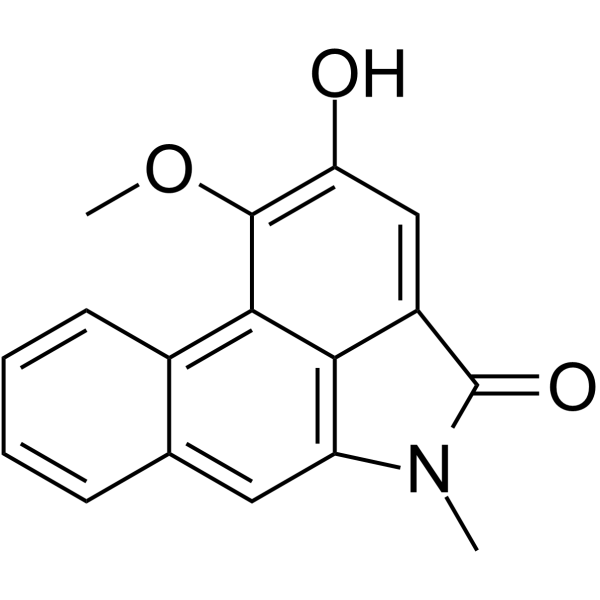
Sauristolactam
Sauristolactam, a natural aristolactam isolated from aerial portions of Saururus chinensis, has significant neuroprotective activity against glutamate-induced toxicity in primary cultured rat cortical cells. Sauristolactam also inhibits the receptor activator of nuclear factor-κB ligand (RANKL)-induced osteoclastogenesis and has the potential to inhibit osteoclast differentiation.
商品は「研究用試薬」です。人や動物の医療用・臨床診断用・食品用の製品ではありません。
研究用途以外に使用した場合、当社は一切の責任を負いかねます。
- CAS 番号: 128533-02-8
- 分子式: C17H13NO3
- 分子量:279.29
-
保管条件:
Please store the product under the recommended conditions in the Certificate of Analysis.

To place orders, for customer services and technical support, please contact: MedChemExpress USA
Tel: 609-228-6898 E-mail: [email protected] [email protected]


-
 生物活性
生物活性
-
化学情報
- プロトコル
- 純度とドキュメンテーション
- 参考文献
-
 Help & FAQs




生物活性
製品説明
Cellular Effect
|
Cell Line

|
Type | Value | Description | References |
|---|---|---|---|---|
| HCT-15 | GI50 |
4.1 μM
Compound: 10
|
Antiproliferative activity against human HCT15 cells by SRB assay
Antiproliferative activity against human HCT15 cells by SRB assay
|
[PMID: 19394218] |
| HCT-15 | GI50 |
4.38 μM
Compound: 10
|
Antiproliferative activity against multidrug resistant human HCT15/CLO2 cells by SRB assay
Antiproliferative activity against multidrug resistant human HCT15/CLO2 cells by SRB assay
|
[PMID: 19394218] |
| MES-SA | GI50 |
23.75 μM
Compound: 10
|
Antiproliferative activity against human MESSA cells by SRB assay
Antiproliferative activity against human MESSA cells by SRB assay
|
[PMID: 19394218] |
| MES-SA/Dx5 | GI50 |
23.11 μM
Compound: 10
|
Antiproliferative activity against multidrug resistant human MES-SA/Dx5 cells by SRB assay
Antiproliferative activity against multidrug resistant human MES-SA/Dx5 cells by SRB assay
|
[PMID: 19394218] |


化学情報
-
CAS 番号 128533-02-8
-
分子量 279.29
-
分子式 C17H13NO3
-
SMILES
O=C1N(C2=C3C1=CC(O)=C(C3=C4C(C=CC=C4)=C2)OC)C
-
別名
Saurolactam
-
Structure Classification
-
輸送条件
Room temperature in continental US; may vary elsewhere.
-
保管条件
Please store the product under the recommended conditions in the Certificate of Analysis.


純度とドキュメンテーション
参考文献
[1]. Kim SR, et al. Aristolactam BII of Saururus chinensis attenuates glutamate-induced neurotoxicity in rat cortical cultures probably by inhibiting nitric oxide production. Planta Med. 2004 May;70(5):391-6. [Content Brief]
[2]. Li Z, et al. Saurolactam Inhibits Proliferation, Migration, and Invasion of Human Osteosarcoma Cells. Cell Biochem Biophys. 2015 Jul;72(3):719-26. [Content Brief]

Calculators
濃度 (開始) × 体積 (開始) = 濃度 (終了) × 体積 (終了)


Sauristolactam 関連分類
HY-118482 関連分類
 Powered by Bioz